Steel cord conveyor belt specifications should define the belt construction, operating conditions, delivery lengths and matching splice requirements—not just an ST number. A useful request for quotation (RFQ) also tells suppliers which document controls, what evidence is required and whether technical alternatives are acceptable.
For cold-climate projects, add a further distinction: the buyer's required temperature is not a supplier's demonstrated capability. Keep those two fields separate until the proposed belt and splice system have supporting documentation.
Use the seven steps below to turn a short designation or tender attachment into a quotation package that can be checked line by line. This is a procurement guide, not a conveyor design calculation or an installation procedure. All numerical examples are illustrative; they are not customer specifications or confirmed BisonConvey supply limits.
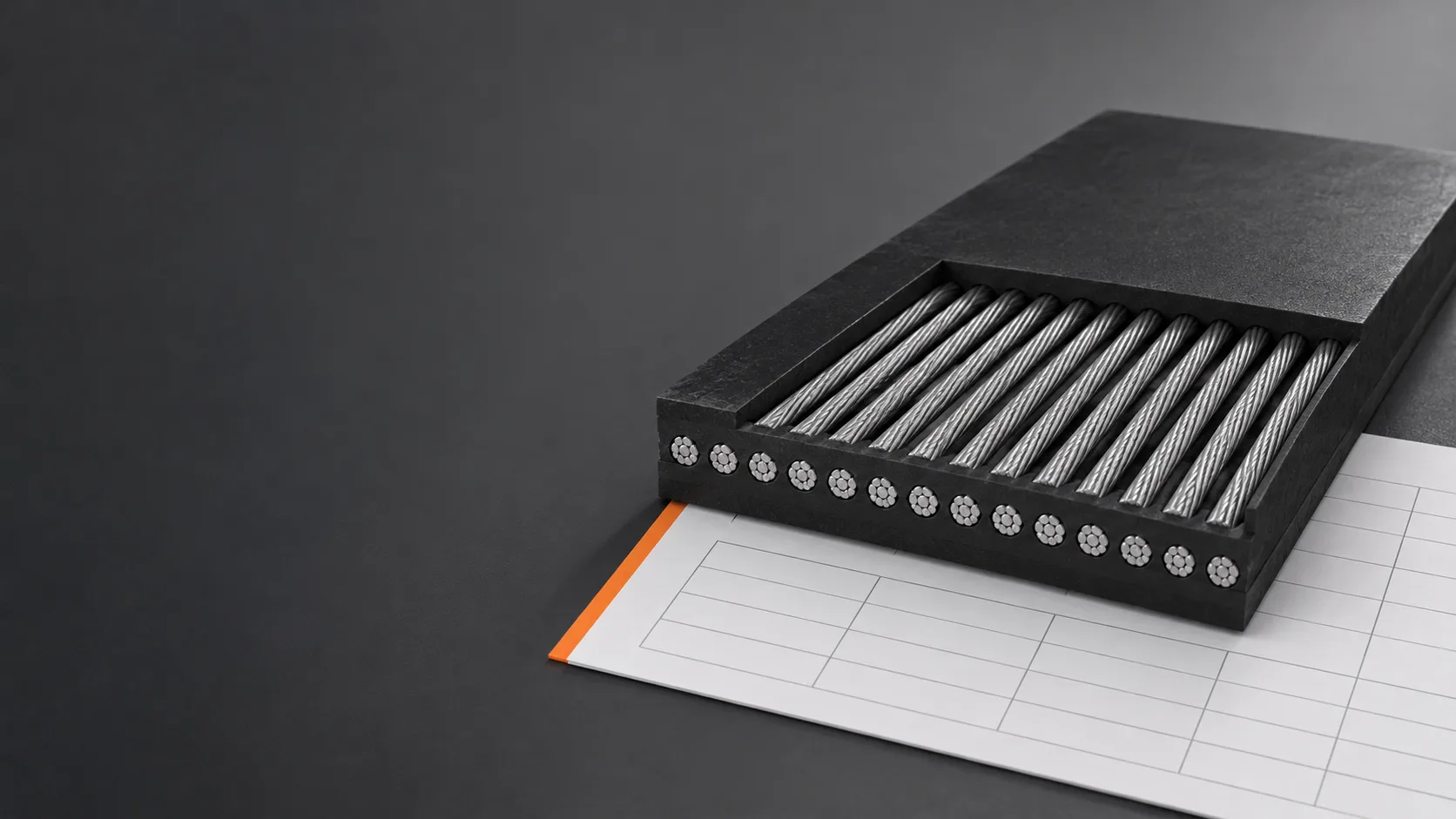
Conceptual illustration; not a manufacturing drawing or performance test.
1. Expand the steel cord conveyor belt specifications
A short designation can hide several independent requirements. Consider the illustrative notation 1600 ST2000 8+5 X:
| Field | Intended meaning in this example | What the RFQ should clarify |
|---|---|---|
| 1600 | Belt width: 1600 mm | Width tolerance and drawing reference |
| ST | Steel cord carcass | Cord construction and any additional reinforcement |
| 2000 | Nominal breaking strength: 2000 N/mm | Applicable specification and acceptance evidence |
| 8+5 | Top cover: 8 mm; bottom cover: 5 mm | Each cover tolerance and overall belt thickness |
| X | Requested cover grade | Governing standard, edition and required properties |
Notation varies, so include the expanded fields even when the original designation appears clear. Confirm that the first dimension is width rather than roll length, and identify the carrying face and pulley-side cover.
ST2000 is not an operating-tension approval. Its nominal strength is 2000 newtons per millimetre of belt width, numerically equal to 2000 kilonewtons per metre. The conveyor designer must separately assess working loads and splice performance under the applicable design method.
Cover thickness is not finished belt thickness. An 8 mm top cover and 5 mm bottom cover do not establish a 13 mm finished belt. The Metso Flexocord construction brochure distinguishes the top cover, cord diameter, bottom cover and overall thickness. Request the proposed belt's cross-section and tolerance rather than adding covers alone or treating a generic diagram as your final drawing.
Also record cord diameter, centre-to-centre pitch, cord count and edge construction. Yokohama's steel cord belt specifications explicitly identify their table as a Yokohama construction standard. A table from another manufacturer therefore cannot confirm the cord layout of the belt you are buying.
For the product-level overview and quotation route, see our steel cord belt construction options. Keep the detailed requirements in the RFQ attachment so they remain available when the quotation is reviewed.
2. Separate cold-climate conditions from cover grade
“Cold-resistant” describes a requirement, but it does not supply the temperature, exposure or acceptance criteria needed to assess a proposed belt. Record three temperature inputs separately:
- Minimum ambient temperature where the conveyor operates.
- Minimum belt temperature at restart after an idle period.
- Conveyed-material temperature, including relevant seasonal changes.
Describe outdoor exposure, shutdown duration and whether the conveyor may restart loaded. If an input is unknown, say that it requires confirmation; do not replace it with a supplier catalogue's lowest advertised temperature.
An abrasion-grade designation is not a low-temperature test result. Likewise, a supplier compound name such as SAR needs a defined technical meaning and measurable requirements before it can be compared with another offer. Ask which properties the proposed compound addresses and what evidence supports each claim.
For cold-duty approval, request a written statement covering the proposed belt construction, the relevant test method, sample identification, test conditions and acceptance criteria. Confirm how the results relate to the required operating and starting conditions. A test on an unidentified rubber sample does not establish suitability of every belt carrying the same marketing label.
Ask about the matching splice materials too. A suitable belt compound does not automatically establish suitability of the joint system. Keep cold-service suitability separate from storage and application conditions for uncured materials; they are different questions.
3. Resolve conflicting specifications before quotation
A bilingual attachment, drawing and purchasing description may not agree. The supplier should not silently choose the easiest value to manufacture, and the buyer should not assume that a newer quotation supersedes an engineering requirement.
Create a short clarification register. For example:
| Illustrative conflict | Clarification needed |
|---|---|
| One drawing says maximum cord diameter 5.2 mm; another says 5.8 mm | Which revision controls, and is the limit nominal or maximum? |
| The description gives separate covers but calls their sum “total thickness” | What overall thickness and tolerance does the cross-section require? |
| A material list gives eight cans while the quotation gives kilograms | What product, net content per can and total quantity are required? |
These numbers are invented examples, not recommended tolerances. Do not average conflicting dimensions or resolve them by selecting a familiar ST-class table.
Assign each question to the appropriate approver. The buyer or designer confirms the requirement; the supplier states whether the proposed construction complies or deviates. Record the document reference, revision, clarified value and written response together.
For a tender, also ask whether alternatives are permitted and when clarification must be completed. Keep mandatory requirements separate from preferences. That helps avoid comparing a compliant offer with a cheaper but technically different proposal as though they were the same product.
4. Request compatibility inputs, not just an ST number
An RFQ can specify the requested tensile class without proving that the belt fits the conveyor. For a replacement, attach the existing belt identification and layout, then request review of the proposed construction against the installed equipment.
Useful inputs include:
- Conveyor length, lift, capacity, speed and drive arrangement.
- Available tension calculations and relevant starting conditions.
- Pulley diameters, positions, roles and wrap angles.
- Troughing and transition geometry at both ends.
- Take-up type, available travel and existing installation constraints.
Ask for elongation data with its test basis rather than a percentage without context. Identify what the supplier recommends and what the conveyor designer must approve. A low-elongation description alone does not establish sufficient take-up travel.
Similarly, do not request a universal minimum pulley diameter from ST2000 alone. Our conveyor pulley diameter selection guide explains the input questions. Final compatibility must be checked for the actual proposed belt and local duty; an indicative tool result is not a supplier acceptance document.
If drawings or calculations are unavailable, list that limitation explicitly. Ask which information is necessary before an offer can be treated as technically firm. A price issued with unresolved compatibility assumptions should remain identifiable as such during purchasing review.
For mining projects that still need those design inputs, follow the broader mining conveyor belt selection workflow before treating the RFQ as a final technical specification.
5. Specify delivery rolls and splice materials separately
Total purchased length, delivery roll lengths, conveyor centre distance and finished endless-belt length are different quantities. Your RFQ should show which one each figure represents.
An illustrative delivery schedule could be:
| Delivery roll length | Quantity | Supplied length |
|---|---|---|
| 250 m | 4 | 1000 m |
| 175 m | 2 | 350 m |
| Total | 6 rolls | 1350 m |
The arithmetic confirms supplied length only. It does not establish the number of installed belt loops, planned joints or splice kits. Identify which rolls serve each conveyor, any joint locations and the agreed spare-material allowance.
Ask whether roll lengths include splice preparation allowances or whether those must be added separately under the approved plan. Record maximum roll diameter, packing dimensions, gross weight and site-handling constraints for supplier confirmation. A roll schedule that fits the purchase total can still conflict with unloading or installation arrangements.
For splice materials, provide the belt construction and approved splice drawing. List cover panels, cord-fill or intermediate materials, the required solution, release materials and any accessories by their actual specification and unit. REMA TIP TOP's steel cord splice-kit page notes that kit contents may vary with splice designation; “one kit” is not a universal bill of materials.
Confirm material dimensions, quantities, batch identification, shelf life, storage conditions and applicable technical and safety data sheets (TDS/SDS). Distinguish kilograms from cans and net content from gross package weight. Ask whether the quotation includes installation, supervision or materials only.
Our steel cord splice planning background provides context for that discussion. The supplier-approved procedure—not a purchasing checklist—must govern the actual splice work.
6. Ask for evidence and an explicit deviation schedule
A quotation is easier to assess when the supplier answers each technical requirement rather than attaching a general brochure and writing “as requested.”
Use three columns: requested requirement, proposed value or deviation, and supporting document. Include belt dimensions and construction, temperature requirements, cover properties, delivery rolls, splice-material scope and required marking.
Request the proposed belt's datasheet and cross-section first. Then specify the relevant inspection or test records needed for acceptance. Tie documents to the offered product, supplier and applicable batch or sample where relevant. A quality-system certificate, a standard reference and a belt test report serve different purposes; none should be used as a substitute for the others.
If the RFQ cites DIN 22131 or ISO 15236, identify the required document and edition. Do not infer full compliance from the shared ST class or assume that every standard reference means certified production. Ask the supplier to state exceptions openly.
Specify marking content, method, position and traceability requirements if needed. Do not present one buyer's marking interval as a universal rule. For warranty, ask for the responsible seller, start point, agreed operating conditions and exclusions; a requested term is not an accepted warranty until confirmed.
Before release, reconcile the technical offer with the commercial scope. Confirm currency, delivery location, named trade term, included charges, quotation validity and lead time. Identify the actual contracting and exporting parties rather than relying on the brand shown on the website.
7. Send a complete RFQ handoff
Copy the following field list into your enquiry and fill in what is known. Mark unknown inputs as requiring review, and attach the controlling specification rather than rewriting it from memory.
Project / conveyor reference:
Controlling specification and drawing revision:
Replacement belt identification, if applicable:
Belt width and tolerance:
Requested ST class:
Top cover / bottom cover / overall thickness:
Cover grade, governing standard and edition:
Cord diameter / pitch / count / edge construction:
Material, lump size, abrasion and loading conditions:
Minimum ambient / cold-start / material temperatures:
Required test methods, acceptance criteria and documents:
Conveyor layout, pulley data, tensions and take-up constraints:
Total supply length and itemized roll schedule:
Splice drawing, planned joints and material BOM:
Required marking, packing and handling limits:
Destination and required delivery date:
Quotation deadline and permitted alternatives:
Requested seller, delivery scope and warranty terms:
BisonConvey can help organize these inputs for supplier quotation review. Submit your steel cord belt specification with your attachment and delivery requirements. The form supports belt enquiries and an attachment; put additional cord, temperature and roll details in the message. Product availability, performance, documents and commercial responsibilities remain subject to written confirmation.
Frequently asked questions
Does ST2000 describe the belt's operating tension?
No. It describes nominal breaking strength per unit belt width. Working tension and splice suitability require a separate construction- and application-specific engineering assessment.
Does 10+6 mean a finished belt thickness of 16 mm?
Not when those numbers specify the top and bottom covers. Request overall thickness and a cross-section; do not enter the cover sum as the finished belt thickness.
Is cold vulcanization the same as a cold-resistant belt?
No. Cold vulcanization describes a bonding process; cold resistance describes a service requirement. The term does not establish the belt's minimum operating temperature or an approved steel cord splice method.
Can splice-kit quantity be calculated from roll count alone?
No. Confirm installed belt loops, planned joints, the approved splice design and spare allowance. Delivery rolls and material kits are separate purchasing items.