How to select the right mining conveyor belt for industrial operations
If you’re responsible for specifying or buying belts in mining, cement, or bulk terminals, the wrong choice shows up fast: mistracking, rapid cover wear, splice failures, and costly downtime. This guide walks through a standards-aligned, engineer-ready process to choose the correct carcass, covers, and components—so your system runs safely, efficiently, and for longer. In short, it’s your practical roadmap for how to select the right mining conveyor belt for industrial operations.
Key takeaways
-
Start with the material and duty: lump size, abrasiveness, temperature, oil/chemicals, and fire/antistatic requirements drive the belt family and cover compound.
-
Match carcass to tension and elongation needs: textile (EP/NN) for shorter, impact-heavy duties; steel cord (ST) for long, high-tension, low-elongation applications per ISO frameworks.
-
Respect system constraints early: belt speed/width envelope, minimum pulley diameters, idler spacing, and troughability narrow your viable options using CEMA/DIN methods.
-
Splice choice isn’t an afterthought: hot-vulcanized generally yields higher efficiency; mechanical fasteners can be viable for certain textile belts and maintenance scenarios.
-
Document compliance: for underground or hazardous atmospheres, confirm flame-resistant (ISO 340 test method) and antistatic (ISO 284) requirements alongside local regulations (e.g., MSHA in the U.S.).
Core concepts you must get right
A clear understanding of belt anatomy and standards will speed up selection and reduce risk.
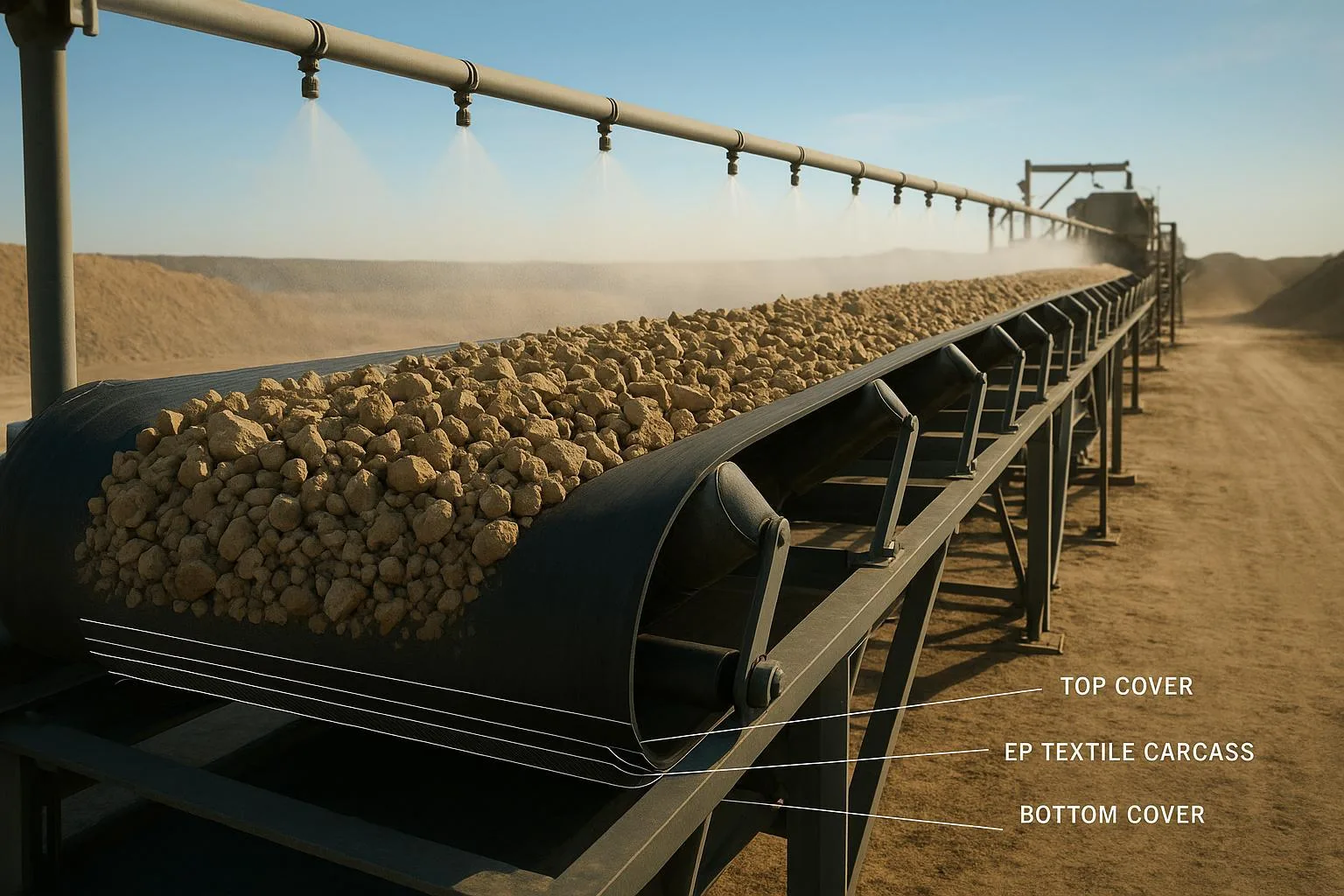
Belt anatomy at a glance
-
Carcass: the tensile member—either textile (EP/NN/PN) or steel cords (ST).
-
Covers: rubber or polymer top/bottom layers for abrasion, cut/gouge, heat, oil, or flame resistance.
-
Skim and adhesion layers: bond the carcass to covers and, in steel-cord belts, encapsulate cords.
-
Edge: cut or molded/sealed; affects moisture ingress and durability.
For definitions and specification frameworks, ISO 14890 addresses textile belts and their cover grades, while the steel-cord family is covered by the ISO 15236 series. See ISO’s official entries for the textile belts specification in ISO 14890 and the steel cord conveyor belts series in ISO 15236.
- According to the ISO catalogue pages for textile and steel-cord belts, these standards set out construction classes and test methods that manufacturers align with. Review ISO’s entries for ISO 14890 — textile-reinforced belts and ISO 15236 — steel-cord belts series before finalizing RFQs.
Textile (EP/NN) vs. steel cord (ST)
-
Textile belts (EP/NN/PN): generally higher elongation, good troughability, compatible with smaller pulleys depending on class, and easier/cheaper to splice or replace. Well-suited for short to medium runs, impact zones, and plant conveyors.
-
Steel-cord belts (ST): very low permanent elongation and high tensile capacity; typically require larger pulley diameters and hot-vulcanized splices; ideal for long overland conveyors and high lifts.
These behaviors are reflected in ISO 14890 (textile) and ISO 15236 (steel cord) scope descriptions and are treated in depth in the design practices of the CEMA Belt Book and the DIN 22101 calculation basis. You’ll use CEMA and DIN methods to evaluate tensions and power, then pick carcass types/ratings that satisfy the resulting loads. For design frameworks and typical ranges, see DIN 22101 — basis for calculation and dimensioning and the CEMA Belt Conveyors for Bulk Materials overview.
Speed, tension, and geometry constraints (the non-negotiables)
-
Capacity to speed/width: CEMA provides the capacity and geometry relationships engineers use to fit throughput within a speed/width envelope.
-
Tensions and power: DIN 22101 and the CEMA Belt Book outline how to calculate steady-state and starting tensions and drive power, factoring rolling resistances and profile.
-
Minimum pulley diameters: dictated by carcass construction and splice geometry—steel cords typically need larger diameters than many multi-ply textile belts; always verify with standard/manufacturer guidance.
-
Idler spacing and troughability: tighter spacing in impact/loading zones; trough angle affects cross-sectional area and tracking behavior.
For calculation frameworks and good-practice ranges, refer to the Beuth catalogue for DIN 22101 and to CEMA’s Belt Conveyors for Bulk Materials (7th+ edition) preview and the official product page.
Special geometries and sidewall belts
For steep-angle or vertical conveying where a standard troughed belt cannot maintain load, corrugated sidewall belts are often used with cleats to hold material on incline. If you’re evaluating this route, review sidewall belt options (see sidewall belts) for application fit and transition design notes.
Splicing overview (selection affects design)
-
Hot vulcanized splices: highest efficiency and durability; standard for steel-cord belts and many textiles.
-
Cold vulcanized splices: used on some textile belts; easier logistics but typically lower dynamic performance than hot cures.
-
Mechanical fasteners: fast installation and easy maintenance access; generally lower efficiency and not suited to small pulleys at high speeds; common for certain textile belts in quarry or temporary service.
CEMA and the ISO families above provide the context for choosing splices; specific splice geometry and verification should follow manufacturer procedures and QA.
Applications and real-world scenarios
Three concise scenarios illustrate how constraints steer the specification.
1) Overland coal conveyor (long distance, low elongation)
-
Context: 6–12 km overland route with modest lift and multiple horizontal/vertical curves.
-
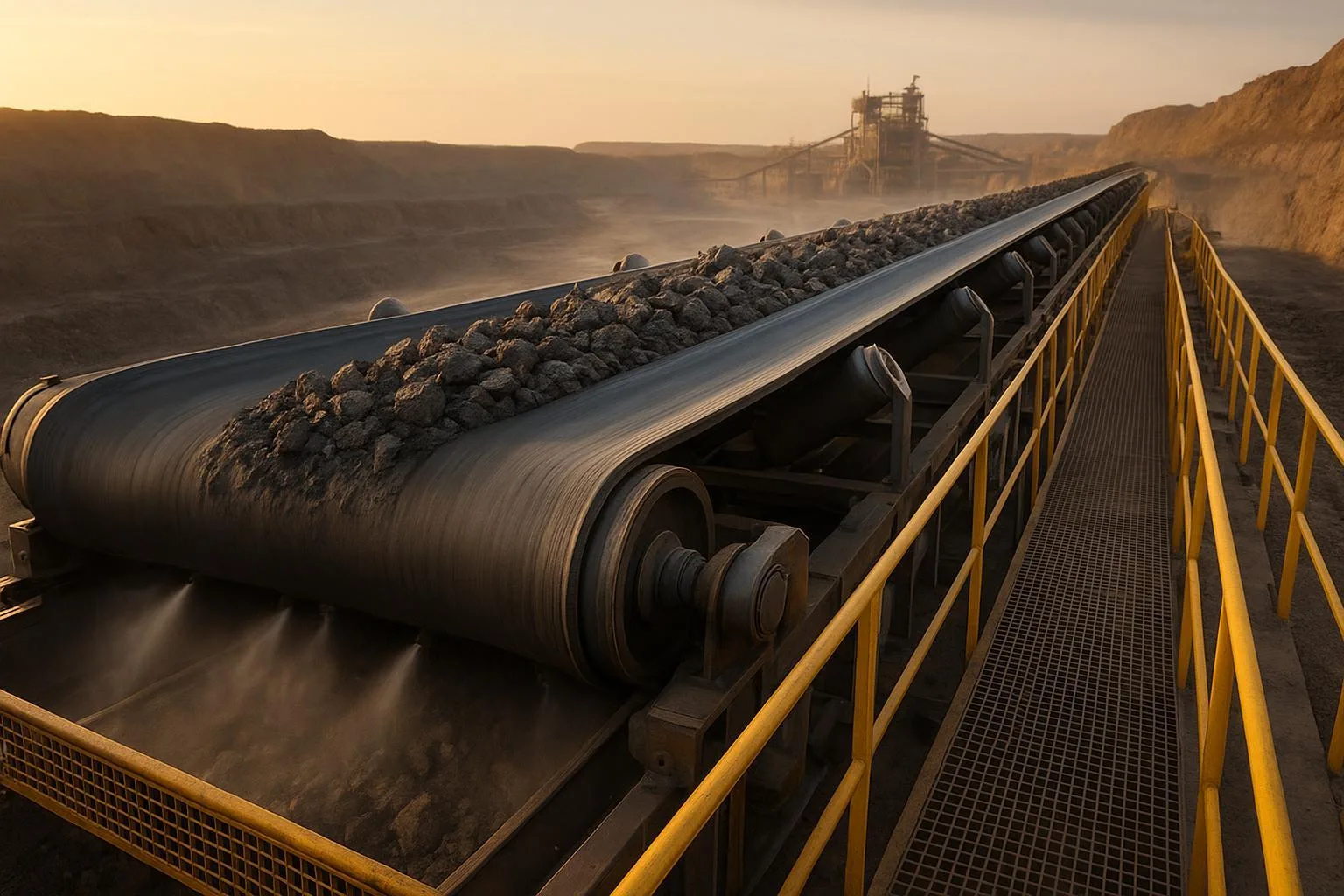
Likely choice: steel cord (ST) belt for high tensile rating and minimal permanent elongation to control take-up travel.
-
Notes: verify minimum pulley diameters and transition lengths; prioritize hot-vulcanized splices and rigorous NDT for cord integrity over life.
-
Why: long runs amplify the penalties of stretch and splice losses; ST belts reduce sag and drift over distance.
2) Quarry primary crusher to surge pile (short, high impact)
-
Context: 80–250 m conveyor with sharp, abrasive rock, frequent stops/starts, and heavy impact at loading.
-
Likely choice: textile EP multi-ply with cut & gouge-resistant top cover; dense impact idlers or beds in loading zone; mechanical splice acceptable if downtime sensitivity is high.
-
Notes: conservative speed to limit bounce; strong skirt sealing and chute design to control dust and edge wear.
3) Clinker transport in cement (elevated temperature)
-
Context: hot clinker conveying in-plant with dust control needs.
-
Likely choice: textile belt with heat-resistant cover compound classified per OEM guidance; speed moderated to limit thermal and abrasive wear; ensure cleaner materials compatible with heat and cement fines.
-
Notes: confirm compound rating against expected temperature envelope; check idler sealing to keep fines out.
For practical configuration and troubleshooting context across applications, see FEECO’s industrial conveyor selection and troubleshooting guide.
The step-by-step selection workflow (engineer checklist)
Follow this sequence to reduce iteration and avoid late rework. It’s the disciplined way for how to select the right mining conveyor belt for industrial operations.
- Define the material and environment
Capture bulk density, moisture, surcharge angle, lump size, abrasiveness, temperature range, oil/chemical exposure, and any fire/antistatic or regulatory constraints (e.g., MSHA approvals for U.S. underground mines).
- Lock the geometry and capacity envelope
Establish conveyor length, lift, curves, transfer conditions, and target throughput (tph). Use CEMA capacity relationships to bracket belt width and speed. Document any limits (e.g., max speed due to dusting or degradation). See the CEMA Belt Conveyors for Bulk Materials overview.
- Estimate tensions and power with standards-based methods
Apply DIN 22101 and the CEMA Belt Book methodologies to estimate steady and starting tensions and drive power. Record take-up travel constraints and required safety factors per your corporate or OEM practice.
- Choose carcass type and rating
-
Textile vs. steel cord: match to tension/elongation profile, pulley diameter limits, impact zones, and splicing strategy.
-
Rating: select per manufacturer class and your calculated tensions with margins; align textile classes with ISO 14890 and steel cord classes with the ISO 15236 series terminology.
- Select cover compounds for the duty
Map the environment to compound families (abrasion, cut/gouge, heat, oil, FR). OEM matrices, such as ASGCO’s heavy-duty belting overview, are handy cross-checks. See the 2024 ASGCO heavy-duty conveyor belting brochure. Where flame resistance or antistatic properties are required, note ISO 340 and ISO 284 as test methods referenced by many specs (local law may require additional approvals).
- Verify pulleys, idlers, and transitions
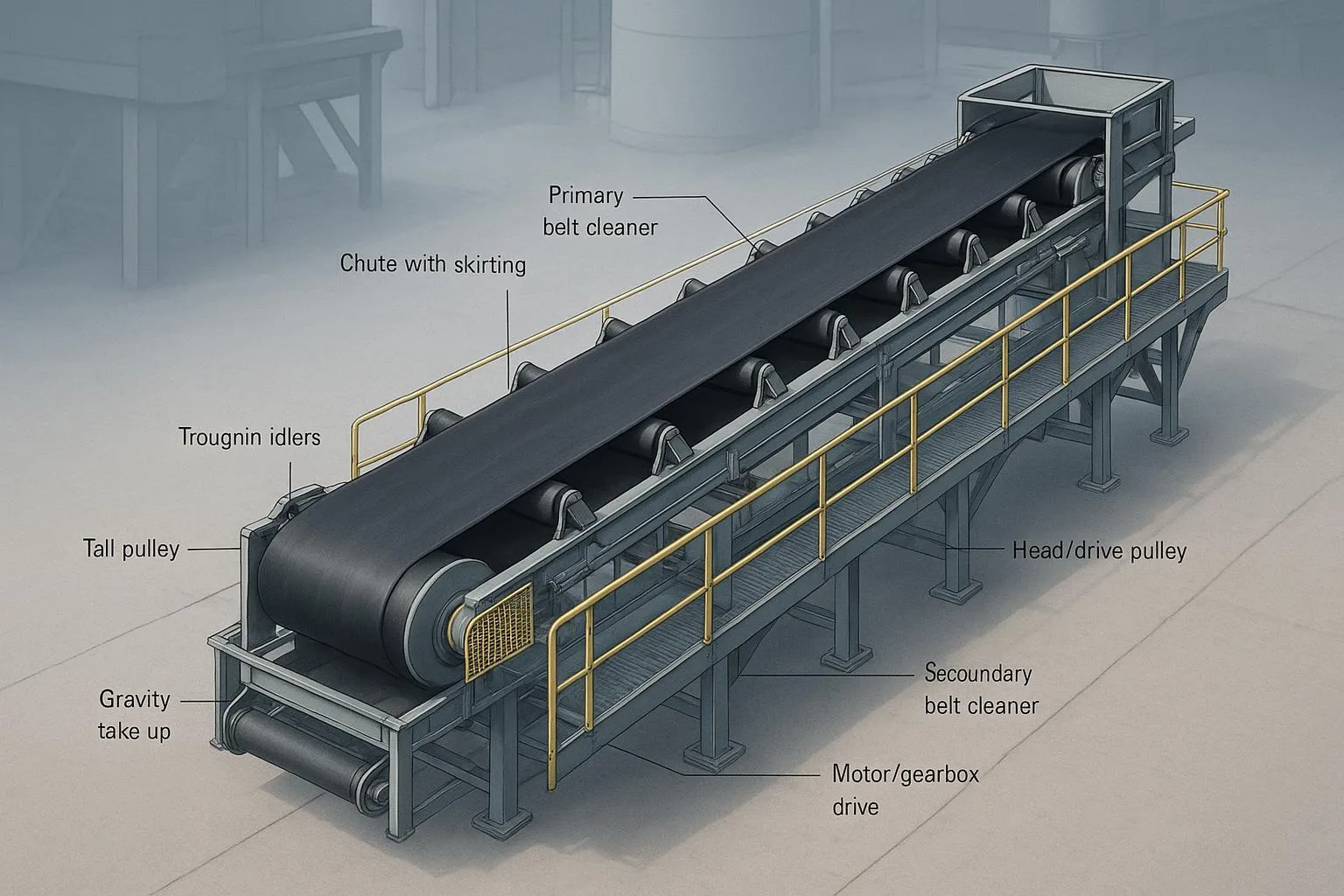
Check minimum pulley diameters for the chosen carcass and splice geometry; confirm idler spacing, impact protection in loading zones, transition lengths, and cleaners/skirts. Reference CEMA component selection practices and manufacturer limits; where needed, consult the CEMA product page.
- Decide splice method and QA protocol
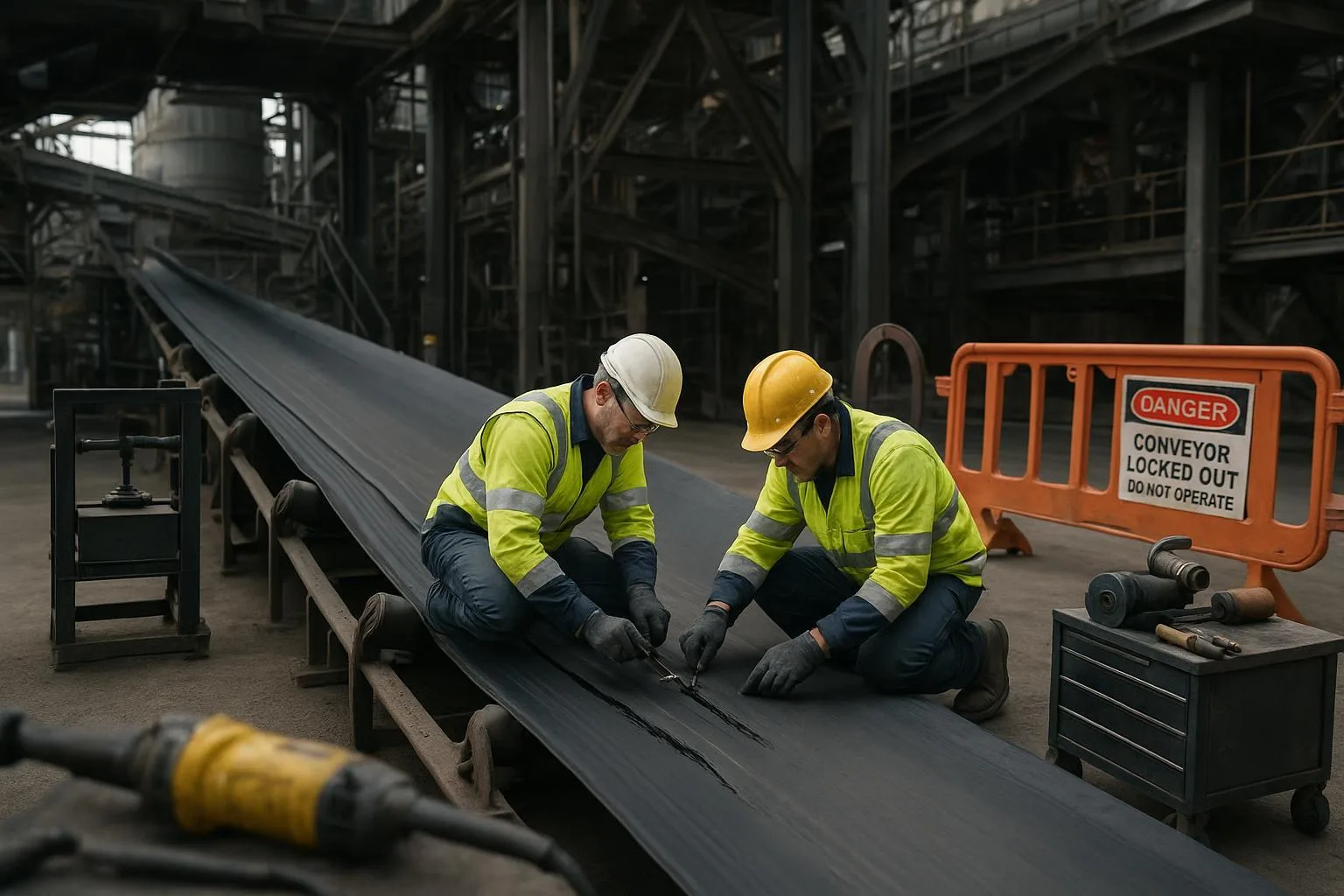
Choose hot vs. cold vulcanization vs. mechanical fasteners based on duty and downtime profile. Define inspection hold points, cure parameters, and efficiency verification (e.g., NDT for ST splices) per manufacturer procedures and QA frameworks. For QA language examples aligned to standards, review Semperit’s quality management overview.
- Confirm compliance and documentation
Record applicable standards and any regulatory approvals. For textile belts, reference ISO 14890; for steel cords, the ISO 15236 series; for FR and antistatic properties, ISO 340 and ISO 284; for calculation frameworks, DIN 22101 and CEMA’s Belt Book. In U.S. underground mines, MSHA approvals and 30 CFR parts govern; see the MSHA MINER Act overview and the conveyor systems regulations hub.
- Prepare the RFQ package
Include a data sheet with material and duty details, calculated tensions/power, carcass type/rating, cover compound, minimum pulley diameters, splice method, cleaner/skirt requirements, and compliance notes. Request manufacturer confirmation and any deviations.
Comparison: textile vs. steel-cord belts
Below is a compact matrix to ground your selection trade-offs.
| Attribute | Textile (EP/NN/PN) | Steel cord (ST) | Notes/standards context |
|---|---|---|---|
| Typical use | Short/medium runs, impact areas | Long-distance, high-tension | ISO 14890 vs. ISO 15236 terminology |
| Elongation | Higher | Very low | Affects take-up travel and start-up behavior |
| Pulley diameters | Smaller (class dependent) | Larger | Verify per OEM/CEMA/ISO |
| Splice method | Vulcanized or mechanical | Hot-vulcanized | Efficiency and fatigue life differ |
| Tension capacity | Moderate | Very high | Match to CEMA/DIN tension outcomes |
| Troughability | Generally good | Stiffer | Impacts idler spacing and loading |
| CAPEX/OPEX | Lower CAPEX; flexible maintenance | Higher CAPEX; stable long-run OPEX | Consider TCO and downtime profile |
For the calculation and standards context behind these trade-offs, consult the DIN 22101 calculation basis and CEMA’s Belt Book overview.
Cover compound selection matrix
Match duties to cover families, then verify test methods and supplier data.
| Duty/Condition | Recommended compound family | Common industries | Cautions/trade-offs | Standards/test references |
|---|---|---|---|---|
| Severe abrasion | High-abrasion rubber (AR) | Quarrying, iron ore | May trade tear strength for wear life | See ISO 14890 classes; OEM data such as the 2024 ASGCO heavy-duty belting brochure |
| Cut & gouge | Cut/gouge-resistant (CG) | Primary crushing | Often lower abrasion index than AR | Cross-check OEM matrices (e.g., ASGCO 2024) |
| Heat (elevated) | Heat-resistant (HR) | Cement/clinker | Higher temps can reduce adhesion fatigue life | Confirm rating vs. temp bands; ISO 14890 framework |
| Oil/chemicals | Oil-resistant (OR) | Fertilizer, recycling | Swelling/softening risk | Verify compatibility; check OEM test data |
| Flame-resistance | FR/FRAS | Underground, hazards | FR may trade wear resistance | ISO 340 flammability test method; local approvals may apply |
| Cold climate | Cold-resistant (CR) | Arctic/high altitude | Flex cracking risk | Verify low-temp flexibility per OEM tests |
For a practical overview of compound families and where they’re applied, many engineers reference the 2024 ASGCO heavy-duty conveyor belting brochure to supplement standards language when drafting specs.
Troubleshooting and maintenance
A targeted troubleshooting matrix helps isolate root causes quickly.
| Symptom | Likely root cause | Corrective action |
|---|---|---|
| Belt mistracking | Misaligned frames/idlers; poor loading; uneven buildup | Re-square frames; align idlers; optimize chute and loading; clean build-up; verify transition lengths |
| Premature top cover wear | Excessive speed; abrasive fines; poor chute design | Moderate speed; upgrade cover compound; install liners and impact control; fine-tune transfer angles |
| Edge damage | Skirt contact; misaligned loading; belt wander | Adjust skirts; improve sealing; correct tracking and loading alignment |
| Splice deterioration | Improper cure; contamination; incompatible geometry | Implement splice QA; recut/recure; follow manufacturer geometry and cure parameters |
| Slippage at drive | Worn lagging; inadequate tension | Re-lag pulley; adjust take-up; verify wrap angle and cleaner interference |
| Dust and spillage | Ineffective sealing/cleaners; off-center loading | Upgrade sealing and cleaners; center-load; add skirting/hoods |
Maintenance best practices (keep it simple and scheduled):
-
Keep lagging effective: select lagging appropriate to duty and plan re-lag intervals before gross wear sets in.
-
Protect the loading zone: use impact idlers/beds and maintain skirts and liners.
-
Cleaners and carryback: choose cleaner types compatible with your compound and temperature; adjust frequently until stable.
-
Idler health: specify sealed-for-life bearings where warranted and inspect for noise/heat; replace seized or wobbling rolls immediately.
-
Splice QA: document cure temps/pressures and perform regular visual and NDT checks (for ST) at scheduled shutdowns.
For broader troubleshooting and configuration context, see FEECO’s industrial conveyor selection and troubleshooting guide and the CEMA Belt Book preview.
Standards and compliance you should cite in your RFQ
-
Calculation and design basis: refer to the Beuth listing for DIN 22101 for resistance and tension methods and to the CEMA Belt Conveyors for Bulk Materials overview and the official product page for North American practice.
-
Textile belt specification: reference the ISO 14890 specification for textile-reinforced belts.
-
Steel-cord belt specification: reference the ISO 15236 series for steel-cord belt requirements and test methods.
-
Flame-resistance and antistatic tests: state ISO 340 for FR test method and ISO 284 for antistatic properties where your jurisdiction accepts them; in the U.S. underground context, emphasize MSHA approvals and 30 CFR parts, per the MSHA MINER Act overview and the conveyor systems regulations hub.
-
Quality management alignment: many reputable belt OEMs map their QA to ISO/DIN/EN families; see Semperit’s quality management page for an example of standards mapping language when crafting your QA clauses.
Worked example (conceptual) — from capacity to belt choice
Think of this as a sanity-check walkthrough rather than a full calculation. Suppose you’re moving 1,200 tph of iron ore over an 800 m run with moderate lift.
-
Capacity to width/speed: Use CEMA capacity relationships to evaluate width options (e.g., 1000–1200 mm) against a speed envelope that controls dust and wear. Document why you exclude too-high speeds.
-
Tensions and power: Apply DIN 22101/CEMA methods to estimate steady-state tension and required drive power. Confirm that take-up travel can accommodate expected elastic stretch under load.
-
Carcass selection: If tensions and take-up travel favor low elongation, shortlist an ST belt per the ISO 15236 series. Otherwise, evaluate a high-class EP textile per ISO 14890 with appropriate safety factors.
-
Covers and splicing: For sharp, abrasive ore, specify a high-abrasion or cut/gouge top cover; plan for hot-vulcanized splices to preserve efficiency. Verify minimum pulley diameters and transition lengths for the chosen carcass and splice geometry.
Validate every numeric output with your site parameters and the referenced standards or OEM design tools.
Conclusion and next steps
Selecting the right belt is a constraint-driven exercise: define the duty and environment, size the system with CEMA/DIN methods, pick the carcass and covers that meet tensions and conditions, then verify pulleys/idlers, splice geometry, and compliance. Treat splicing and QA as design decisions, not maintenance afterthoughts, and your uptime will show it. That’s the disciplined approach to how to select the right mining conveyor belt for industrial operations.
If your operation needs help translating calculations and constraints into a clean RFQ and matched components, BisonConvey can support custom solutions for complex conveyor requirements. Talk to an engineer about belts, idlers, pulleys, or integrated components that fit your duty and standards.
Author: Senior Mechanical Engineer, Bulk Material Handling