“Optimal belt speed” isn’t a single number. In mining and other heavy-duty bulk handling, it’s the speed range that hits your throughput target without creating chronic spillage, dust, carryback, or accelerated wear that turns into downtime.
This guide is written for engineering and maintenance leaders who have to live with the consequences: mistracking, torn covers, overloaded transfers, short idler life, and nonstop cleanup.
Start with the tradeoff: speed buys capacity, but it raises risk
For a given belt width and loaded cross-section, higher speed increases capacity roughly in proportion to belt speed. Engineering ToolBox summarizes the relationship as Q = ρ · A · v (bulk density × cross-section × belt speed) in its overview of bulk material conveyor capacity—the simplest way to think about belt speed vs capacity before you get into chute dynamics and losses.
But speed isn’t “free capacity.” As speed goes up, you typically see:
-
More wear at loading and transfer points (belt cover, skirt rubber, liners, impact beds)
-
Higher idler RPM (more bearing duty; more sensitivity to sealing quality and lubrication)
-
More dust and harder containment at transfers/discharge
-
More spillage sensitivity (small tracking or loading errors become big messes)
-
Higher power demand (and greater consequences when something goes wrong)
A practical rule in bulk handling is: if you’re chasing capacity, increase belt width first when the layout allows it, then use speed as the secondary lever.
⚠️ Warning: If your transfer points aren’t already stable and well-contained, increasing speed often turns “occasional cleanup” into a reliability problem.
A practical “normal range” for many bulk belt conveyors
A widely cited working band for belt conveyor speed is 2.5–3.5 m/s, with selection driven by material behavior, conveyor geometry, and horsepower. GlobalSpec’s guide to specifying belt conveyor systems notes this as a typical suitable range.
Treat that as the middle of the road—not as a default you apply everywhere. Earlier in this guide we referenced that same GlobalSpec article; here, we’ll use it only once as the canonical citation.
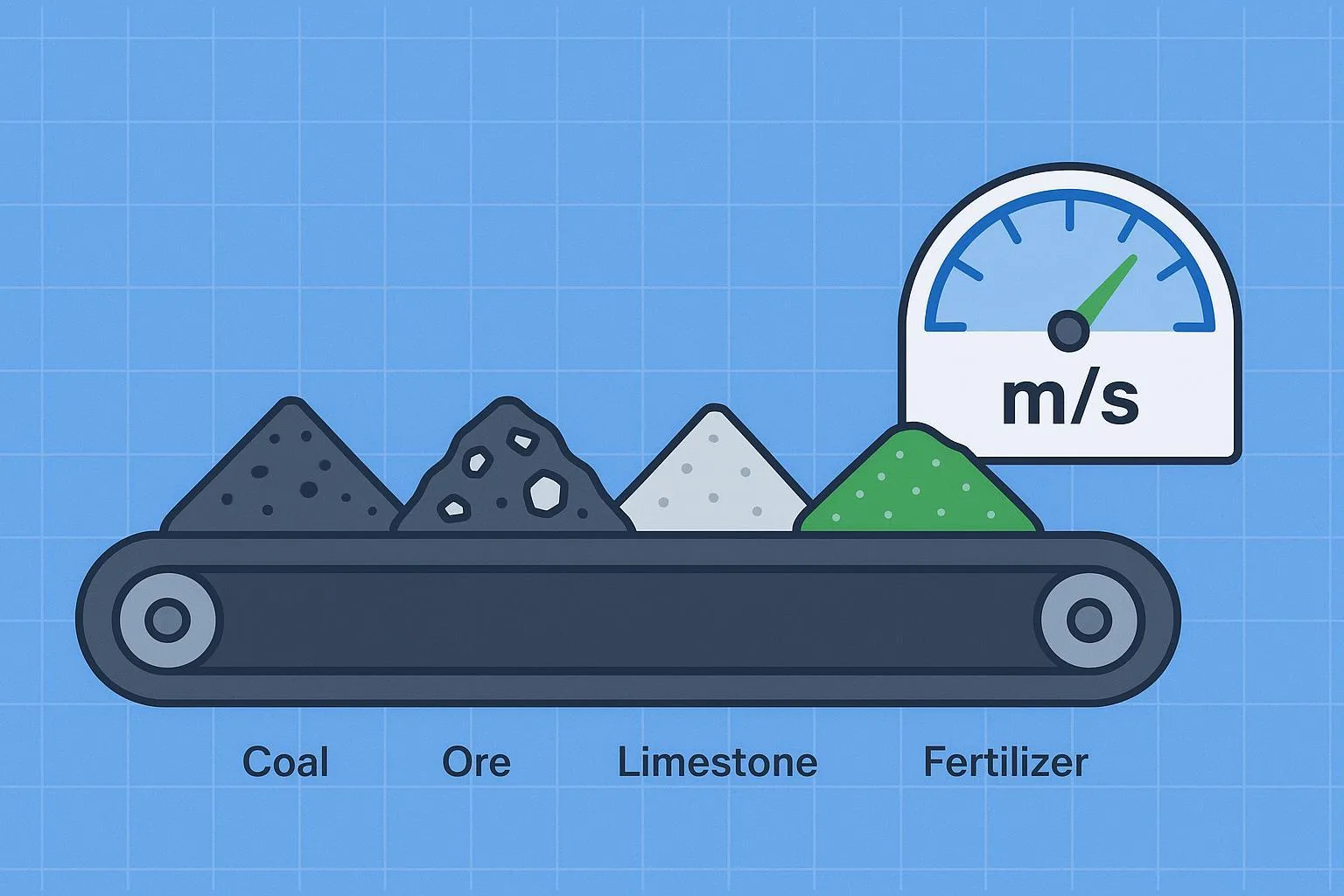
Belt conveyor speed range by material (rules of thumb)
When you choose speed by material, you’re really choosing it by material behavior: dusting, lump size, abrasiveness, and how well the stream can be controlled at transfers.
The Engineering ToolBox “typical maximum” table for conveyor belt speeds by material group is a useful sanity check for upper-end speeds:
How to map “your material” to the table
If you’re deciding between speed bands, use these material questions:
-
Lump size and shape: large/angular lumps push you slower.
-
Abrasiveness: abrasive ore pushes you slower unless transfers are engineered and liners are robust.
-
Dusting and friability: dusty or friable material pushes you slower to reduce dust and degradation.
-
Moisture/stickiness: sticky fines often favor lower speed plus better cleaning/containment.
Conveyor speed mining and other industries: what’s typical, and why
Industry norms reflect typical materials, transfer complexity, and environmental constraints.
These bands are intentionally conservative. If you operate above them, it can be perfectly valid—but only when transfer design, belt selection, and maintenance practices are upgraded to match.
Conveyor belt speed selection: a 7-step workflow to avoid downtime
This is the decision process that tends to hold up in real mines.
1) Lock the non-negotiables: throughput, safety, constraints
Write down:
-
Required capacity (tph)
-
Operating schedule and acceptable downtime
-
Site/regulatory constraints (dust, housekeeping, guarding, fire risk where applicable)
-
Whether this conveyor is a critical path (if it is, bias toward reliability over peak capacity)
2) Classify the material (don’t overcomplicate it)
Use “behavior classes” rather than ore names:
-
dusty/friable vs stable
-
abrasive vs mild
-
lumpy vs uniform
-
wet/sticky vs dry
If the material is dusty + abrasive + lumpy, start at the low end.
3) Check belt width first (before you push speed)
If you’re already fighting spillage and mistracking, a narrow belt running fast is usually the wrong direction.
A wider belt lets you:
-
reduce speed for the same tph
-
increase edge clearance margin
-
reduce sensitivity to off-center loading
4) Audit your transfers (they decide your real max speed)
A belt can run fast on paper but fail at the chute.
High-speed belts demand:
-
controlled material trajectory (velocity matching where possible)
-
sufficient skirt length and sealing
-
impact protection sized for the drop height and lump mass
-
wear liner strategy you can actually maintain
Martin Engineering’s overview of common conveyor specification mistakes points readers back to CEMA suggested maximum conveying speeds for exactly this reason: speed selection without transfer reality is a repeat offender.
5) Confirm idler/roller duty at the chosen speed
As speed increases, idler RPM increases. That shifts what matters:
-
bearing and seal quality
-
alignment and structural stiffness
-
maintenance interval realism (grease/condition monitoring)
If your idler reliability is already marginal, increasing speed can make it worse fast.
6) Choose a speed band, then validate power and tension
At this point, pick a speed band (e.g., 2.0–2.5 m/s) and run the real calculations:
-
absorbed power and motor margin
-
starting and transient loads
-
belt tensions and take-up travel
When you need a high-confidence baseline reference for the calculation framework, CEMA’s belt conveyor engineering text is the industry standard (see CEMA’s corrected pages: Belt Conveyors for Bulk Materials change pages).
7) Field-check the “mess factor” before you commit
Before you lock speed in, walk the conveyor (or model it) and ask:
-
Will the load stay stable on the trough at this speed?
-
Are skirts and seals maintainable at this speed?
-
Can your cleaners handle carryback at this speed?
-
If a belt wanders, how quickly does it become a safety or spillage event?
Red flags that your belt is running too fast
If you see these symptoms, speed is a likely contributor (even if it isn’t the only root cause):
-
chronic spillage at loading zones even after chute alignment work
-
excessive dust plume at discharge/transfer compared with similar lines
-
rapid skirt rubber wear or skirtboard heat buildup
-
accelerated idler failures (temperature, noise, seizure rate)
-
carryback that overwhelms your cleaning system
-
material “bounce” or unstable loading profile
What to change first (in order)
-
Fix loading and transfer control (trajectory, impact, skirting, seals)
-
Increase belt width (if the structure allows it)
-
Upgrade wear protection (liners/impact beds) and cleaning
-
Then consider whether higher speed is still necessary
Where BisonConvey fits (light mention)
If you’re reviewing a speed change as part of a belt upgrade (new carcass class, cover grade, or long overland), BisonConvey builds heavy-duty belt and conveying components for mines, ports, and heavy industry. You can start with the mining selection overview: BisonConvey’s mining conveyor belt selection guide.
FAQs
What’s a “safe default” belt speed for mining conveyors?
If you need a first-pass number before detailed transfer and power checks, 2.5–3.5 m/s is a common working band for many bulk belt conveyors. Then adjust down for dusty/lumpy/abrasive streams, or up only when transfers and wear strategy are designed for it.
Is increasing belt speed better than increasing belt width?
Often, no—especially when spillage, dust, and wear are already issues. Increasing speed tends to raise transfer severity and idler duty, while a wider belt can deliver the same tph at a lower, more forgiving speed.
Does higher speed always mean more wear?
In practice, it often does—because speed increases the energy and frequency of interactions at loading and transfers, and it increases idler RPM. You can run high speed reliably, but it usually requires better transfer design, wear liners, and a maintenance strategy that matches the duty.
How do I tie belt speed back to capacity quickly?
Use the proportional relationship: capacity scales with belt speed for the same cross-sectional loading. If you need the simplest baseline model, Engineering ToolBox provides the basic expression Q = ρ · A · v.
Next step: get a speed range sanity check (with your real constraints)
If you want a fast, engineering-friendly sanity check, pull these inputs together:
-
material type + fines percentage + max lump size
-
target tph
-
belt width and trough angle
-
incline/decline and conveyor length
-
transfer count and worst drop height
-
dust/spillage constraints
Then compare your current speed to the bands above. If you’d like, you can also reference BisonConvey’s engineering resources on belt construction and selection (e.g., EP vs steel cord belt comparison and belt mistracking troubleshooting).