If you’re specifying belts for a mine, “EP vs steel cord” isn’t a materials debate—it’s a system constraints debate. Your conveyor’s center distance + lift, take-up travel, pulley diameters, loading zone impact, and splice strategy usually determine whether an EP (polyester/nylon fabric) belt is a smart choice—or an expensive mismatch.
Below is a criteria-led comparison you can use to align belt construction with duty, downtime risk, and total cost of ownership.
| Decision factor | EP (fabric) belt tends to win when… | Steel cord belt tends to win when… |
|---|---|---|
| Center distance & lift | Short-to-medium runs; moderate tensions | Long overland runs; high tensions driven by lift/length |
| Elongation & take-up travel | You have room for take-up travel and tension adjustments | You need stable tension and limited take-up travel |
| Pulley diameter constraints | Smaller pulleys / tighter geometry are unavoidable | Larger pulleys are feasible and designed into the system |
| Loading-zone impact | Impact absorption and “give” matter at transfer points | You need high-strength carcass for long-haul tension (often with impact protection engineered into the top cover/package) |
| Splicing & repair | Faster, simpler field splicing and repairs | You can control splice quality and want long-run joint reliability |
| Downtime/TCO | Lower initial cost and easier replacement matters most | Downtime and changeouts dominate your cost model |
| Safety/compliance | You need specific cover properties (e.g., flame-retardant, oil/chemical/heat resistance) matched to the mine environment | Same—plus you may need higher tensile classes for long-distance duty; compliance must still be verified by belt type and market |
Start with the variables that actually drive belt selection
Before you compare belt constructions, lock down these four inputs:
-
Required belt tension (driven by length, lift, throughput, friction, and starting/stopping dynamics)
-
Available take-up travel and how you plan to maintain tension over belt life
-
Minimum pulley diameters available at the head, tail, and take-up
-
Loading zone severity (lump size, drop height, impact idlers, chute design, skirtboard setup)
Once those are known, EP vs steel cord becomes much clearer.
EP vs steel cord conveyor belt (fabric conveyor belt vs steel cord)
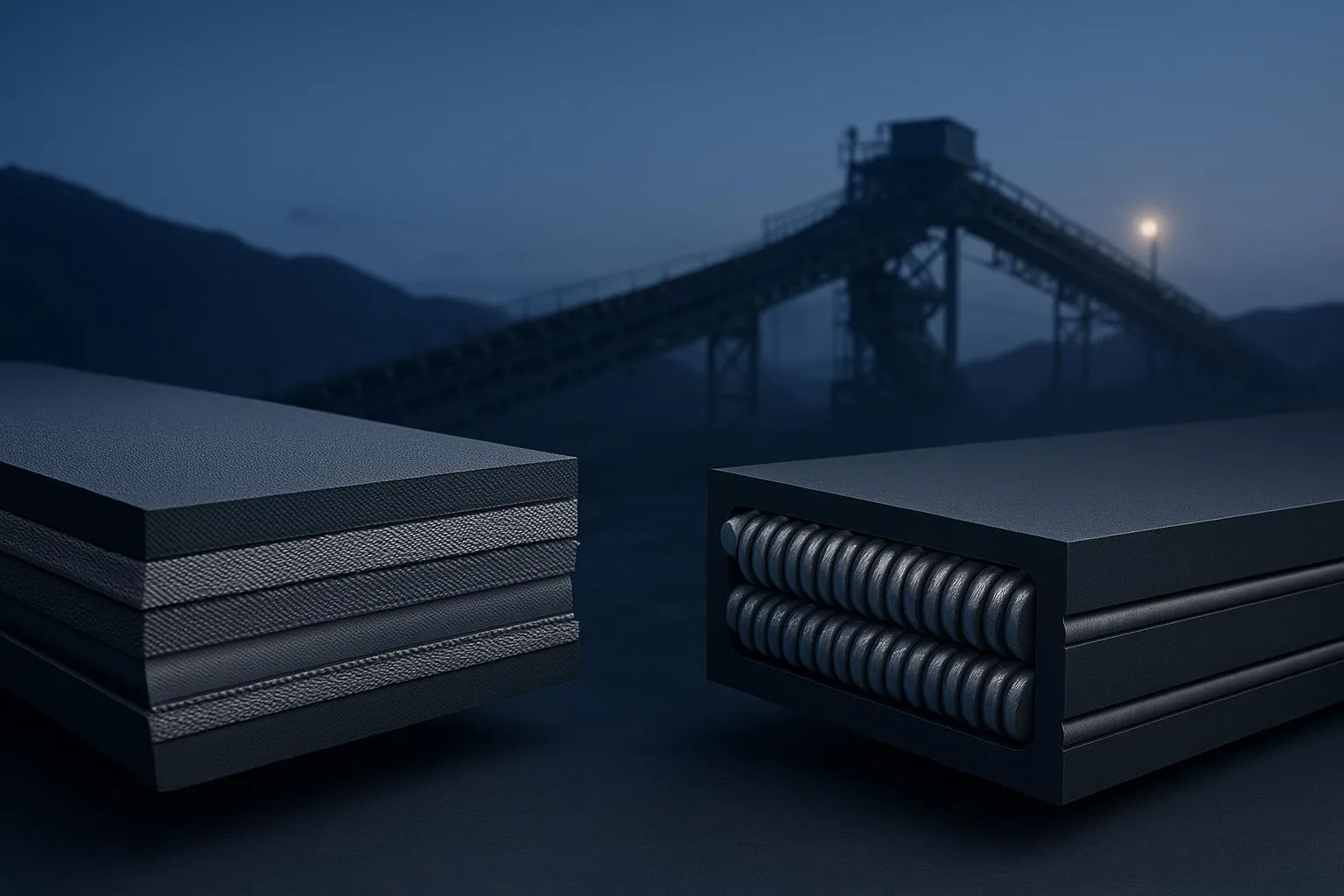
EP conveyor belt (polyester/nylon fabric): flexible, forgiving, easier to handle
An EP belt uses a multi-ply textile carcass (polyester in one direction and nylon in the other, depending on construction). In mining, EP belts are often selected when:
-
conveyor geometry demands flexibility (smaller pulleys, more transitions)
-
the operation values ease of field handling and repair
-
tension requirements sit within the feasible range of fabric ratings
Steel cord conveyor belt: high-modulus, low-elongation, long-haul strength
A steel cord belt embeds parallel steel cords inside the rubber carcass. It’s commonly chosen for mines when:
-
center distance and lift drive high working tensions
-
you need low operational elongation to reduce take-up demands and tension drift
-
the cost of downtime makes longer-life, long-haul designs economical
For product context: BisonConvey manufactures both EP/NN Fabric Conveyor Belts and Steel Cord Conveyor Belts for heavy-duty bulk material conveying.
1) Center distance & lift: when EP becomes a risk
For mining conveyors, the most common EP failure mode isn’t “the belt broke.” It’s that the belt choice creates a chain of system penalties:
-
more take-up travel needed than the structure can accommodate
-
more frequent tension adjustments
-
higher risk of slip events during starts/stops if tension control is marginal
-
more splice stress if the belt is running in a regime it wasn’t designed for
Steel cord belts are typically selected when length/lift push you toward high tensile classes and you want to keep elongation and tension drift under control.
Pro Tip: If your design is already tight on take-up travel, treat elongation as a first-order constraint—don’t leave it as a “we’ll adjust it later” commissioning issue.
2) Elongation, modulus, and take-up travel (why long overlands tilt toward steel cord)
Even if two belts can meet your ultimate tensile requirement, they don’t behave the same in service.
-
Higher modulus belts resist stretch more under a given tension.
-
Belt stretch behavior drives how much take-up travel you need and how stable your system stays across temperature swings, load changes, and belt aging.
NIBA’s belting technical notes discuss belt modulus/elasticity as a key concept for diagnosing stretch and elongation behavior in conveyor belting (and they explicitly call out differences between fabric-plied and steel cable belts in splicing practices): see NIBA Tech Notes on splicing and belt modulus.
If your mine runs long, high-tension conveyors, low-elongation behavior isn’t a nice-to-have—it’s often the difference between steady operation and chronic tension-related incidents.
3) Pulley diameter constraints: a hard mechanical limit you can’t “procure” your way out of
Pulley sizing is where many belt retrofits fail. You can’t buy your way around bending fatigue.
Fenner Conveyors notes that stronger belts such as steel cord belts generally require larger pulleys than PN (polyester-nylon) belts—often up to ~50% larger—while emphasizing that pulley sizing depends on operating tension and should follow ISO-based methods: see Fenner Conveyors’ “Why are pulley diameters important in conveyor belt design?”.
For a standard reference on the method itself, ISO’s catalog entry for ISO 3684:1990 “Determination of minimum pulley diameters” describes a calculation approach for minimum pulley diameters for belts with textile or metal carcasses.
Practical takeaway:
-
If your conveyor is constrained to smaller pulleys, EP may be the only feasible carcass type without redesign.
-
If you’re designing a new long overland, steel cord often makes sense—but only if pulley diameters, lagging, wrap, and tension analysis support it.
4) Loading zone and impact: don’t confuse “impact resistance” with “long-haul suitability”
Mining loading zones can be brutal: large lumps, high drop heights, fines + dust, and imperfect chute conditions.
EP belts often perform well in impact-heavy zones because the fabric carcass is more forgiving. But that doesn’t automatically make EP the best choice for the entire conveyor.
Two common patterns that work better than “pick one belt and hope”:
-
Engineer the loading zone (chute design, impact idlers, belt support, skirt sealing) so the belt isn’t forced to absorb energy it shouldn’t.
-
Use the carcass that matches tension/length, then specify cover and protective plies appropriate to the loading severity.
5) Splicing and repair strategy: downtime is usually a splice problem
In mines, belts don’t “fail” so much as splices fail, repairs accumulate, and availability drops.
Fabric (EP) belts tend to be easier to handle in the field, and repair/splice workflows are generally simpler. Steel cord belts can deliver excellent long-run performance, but you’re buying into a higher requirement for splice quality control (people, tools, environment, and process discipline).
If your mine is remote, weather-exposed, or routinely forced into emergency repairs, splice realism should weigh heavily in the decision.
⚠️ Warning: If you choose steel cord but can’t reliably execute high-quality splices on site (or through a service partner), you can lose the very downtime advantage you were paying for.
6) Total cost of ownership: the cheapest belt is the one you don’t replace during peak production
For EP vs steel cord, the strongest TCO comparison is usually not “belt price.” It’s:
-
planned vs unplanned downtime
-
splice labor and repair frequency
-
carryback/spillage cleanup burden (often a systems issue, not just belt type)
-
inventory strategy and lead time risk
A simplified way to decide:
-
If your belt is a production bottleneck and changeouts are painful, steel cord often pencils out.
-
If your belt is modular, short-to-medium, and you optimize for serviceability, EP can be the rational choice.
7) Safety and compliance: treat this as verification, not a checkbox
For U.S. underground coal mines, flame-resistance approval and related requirements are often governed by MSHA rules and listings. MSHA publishes an official list of flame-resistant conveyor belts approved under 30 CFR Part 14: see MSHA’s flame-resistant conveyor belt approval list (30 CFR Part 14).
Use this as a verification reference—not as a blanket assumption. Your exact requirements vary by mine type (surface vs underground), commodity, and local regulations.
Who should choose which (mining scenarios)
Choose an EP fabric belt when:
-
your conveyor has smaller pulley diameters or tight geometry
-
center distance/lift is moderate and take-up travel is available
-
your operation prioritizes field serviceability and rapid repair
-
impact loading is severe and you’ve validated the carcass + cover package for it
Choose a steel cord belt when:
-
you’re running long-distance, high-tension conveyors where elongation control matters
-
take-up travel is limited and tension stability is critical
-
downtime cost dominates your economics and you can control splice quality
-
you’re engineering a new overland or major upgrade where pulley sizing can be designed correctly
Next steps (a practical way to avoid mis-spec)
If you’re doing mining conveyor belt selection, use the steps below to turn “EP vs steel cord” into a defensible spec.
-
Pull your current constraints: center distance, lift, belt speed, max lump size, drop height, pulley diameters, and take-up travel.
-
Decide which constraint is non-negotiable (pulley diameter is often the one).
-
Build a short comparison spec sheet that forces the decision:
-
required tensile class
-
take-up travel requirement
-
minimum pulley diameter requirement (reference ISO-based method as needed)
-
splice type and repair plan
-
cover grade requirements (abrasion, heat, oil/chemical, flame-retardant, etc.)
If you want a second set of eyes on that spec before you issue an RFQ, BisonConvey can review the duty inputs and point out where EP vs steel cord choices commonly create hidden downtime risk.