
FABRIC CONVEYOR BELTS

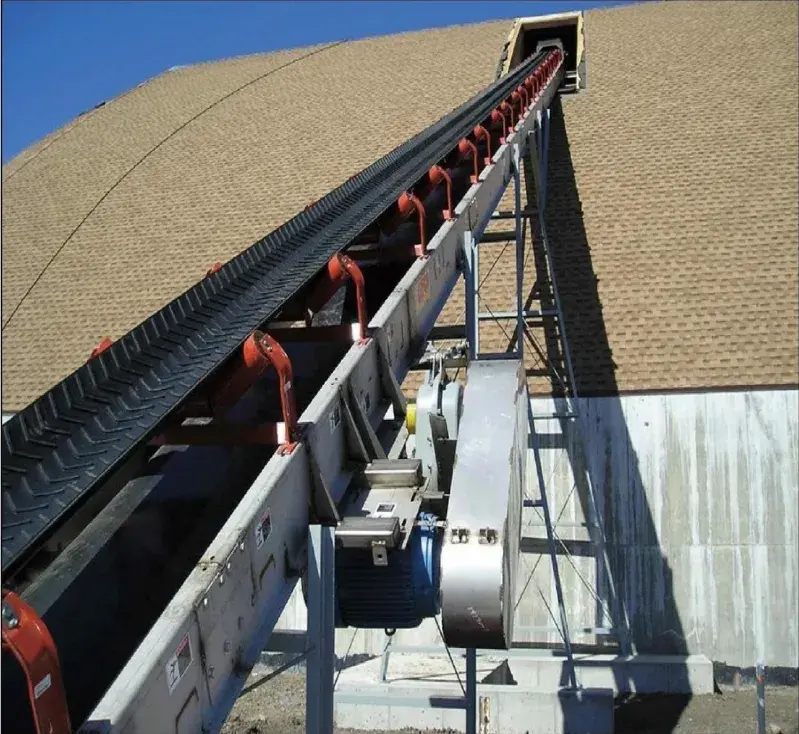
EP/NN MULTI-PLY FABRIC CONVEYOR BELTS
BisonConvey's fabric conveyor belts are engineered using high-tenacity EP (polyester-nylon) and NN (nylon-nylon) woven fabrics as the carcass reinforcement. These multi-ply constructions deliver an excellent balance of tensile strength, impact resistance, and flexibility for a wide range of standard to heavy-duty conveying applications.
Available in widths from 500mm to 2400mm with tensile strengths ranging from EP100 to EP500. We offer multiple cover grades including abrasion-resistant (Grade M, H, D), heat-resistant (T1, T2, T3), oil-resistant (MOR, HOR), and fire-resistant (K, S) compounds to match your specific operating environment.
- ISO 9001:2015
- SGS Certified
- CE
- OHSAS 18001
- ISO 14001
- · 30+ Countries
- · Since 2005
TECHNICAL DATA
WHY CHOOSE THIS PRODUCT
- High tensile strength with low elongation for consistent tracking
- Multi-ply construction absorbs heavy impact at loading points
- Excellent troughability for efficient material containment
- Available in abrasion, heat, oil, and fire-resistant grades
- Wide range of widths and strengths for versatile application
- Compliant with ISO 14890 and DIN 22102 standards
APPLICATIONS
How to Read a Fabric Belt Designation
Fabric belt designations follow ISO 14890 and DIN 22102, and they encode everything a manufacturer needs to build the belt: carcass material, strength, ply count, cover thickness and cover grade. Reading the designation correctly is the difference between ordering the right belt once and paying freight twice on a re-order. The worked example below decodes EP 500/4 6+2 Y, a typical heavy-duty bulk handling specification.
- EP
- Carcass fabric typeEP means a polyester (E) warp running lengthwise and a polyamide/nylon (P) weft running crosswise. The polyester warp gives low lengthwise stretch — typically under 2% elongation at working tension — while the nylon weft keeps the belt flexible across its width for good troughability. NN uses nylon in both directions: more elastic, better impact absorption at severe loading points, but it needs substantially more take-up travel to accommodate the stretch.
- 500
- Full-belt tensile strength (N/mm)The rated breaking strength per millimetre of belt width, measured across all plies together — not per ply. An EP 500 belt at 800 mm width therefore has a total rated breaking strength of 400 kN. Allowable working tension is that figure divided by the safety factor, normally 8 to 10 for a vulcanised splice, so the same belt carries roughly 40–50 kN in service.
- /4
- Number of fabric pliesFour fabric layers bonded together with rubber skim coats. More plies raise strength but also raise bending stiffness, which drives larger minimum pulley diameters and longer transition distances at the terminals. At an equal tensile class, fewer plies of stronger fabric is usually the better engineering choice: the belt troughs more readily, tracks better and runs on smaller drums.
- 6+2
- Cover thickness, top + bottom (mm)A 6 mm top cover and a 2 mm bottom cover. The top cover carries the material and absorbs impact and abrasion; the bottom cover only rides the idlers and drive pulley, so it wears far more slowly. Heavy impact from crushed rock or run-of-mine ore justifies an 8–10 mm top cover, while 2–3 mm on the bottom is adequate for the large majority of bulk duty.
- Y
- Cover grade (DIN 22102)Y is the general-purpose compound, permitting a maximum abrasion volume loss of 150 mm³ tested to ISO 4649. W is a high-abrasion compound at 90 mm³. X combines high abrasion resistance with cut and gouge resistance for sharp, blocky material. G denotes an oil-resistant compound for greasy or oil-contaminated duty.
Under ISO 14890 the cover class may be written in ISO notation (H, D or L) rather than the DIN X/W/Y letters. For practical selection, H is equivalent to X, D to W, and L to Y.
Fabric Belt Selection Guide
Five parameters define a fabric belt, and they are best resolved in order — each one constrains the next. Work through them in sequence and the specification falls out with no guesswork.
Required tensile class
Start from the effective tension Te, calculated from conveyor length, lift, capacity and belt speed. Resolve the peak tension T1 at the drive pulley, divide by belt width to get tension per millimetre, then multiply by the safety factor for your splice method. The result is the minimum breaking strength in N/mm — round up to the next standard class: EP 250, 315, 400, 500, 630 or 800.
Use the Belt Tension Calculator to size Te and T1 in under a minute.Belt width from capacity
Width follows from required throughput, belt speed, material bulk density, surcharge angle and trough angle. Standard widths run from 500 mm to 2400 mm. Where throughput sits between two widths, round the width up rather than raising belt speed — higher speed accelerates cover wear, increases spillage and raises the impact energy at every transfer point.
The Belt Width Calculator solves width from your target t/h.Cover grade for the material
Match the cover compound to what the belt actually carries. General bulk materials such as coal, grain and sand are well served by grade Y. Sharp crushed rock, hard ore and slag need W or X. Oily, greasy or chemically contaminated material requires grade G. Mismatched cover grade is the single most common cause of premature cover failure we see in the field.
Ply count vs pulley geometry
A higher ply count means a stiffer belt, which means a larger minimum pulley diameter and a longer transition distance. If the terminal pulleys are already fixed — a retrofit or a replacement belt on an existing frame — ply count is constrained by that geometry. In those cases a higher-grade 3-ply belt frequently outperforms a lower-grade 4-ply belt at exactly the same tensile class.
Check minimum drum sizes with the Pulley Diameter Calculator (DIN 22101).Splice method
Hot-vulcanised finger splices retain most of the carcass strength and allow the lowest safety factor, typically 8 to 10. Mechanical fasteners install faster and need no press, but they force a safety factor of 12 to 15 — which means a stronger and more expensive belt for the same duty. Decide the splice method before finalising the tensile class, not after the belt is on order.
Common Specification Mistakes
Four errors appear repeatedly in fabric belt enquiries; each one either shortens belt life or inflates cost with no operational benefit in return.
Specifying tensile class without declaring the splice method
The safety factor — and therefore the tensile class — depends directly on how the belt will be joined. Sizing an EP 500 around a vulcanised splice and then installing mechanical fasteners on site roughly halves the real margin against breaking strength. Declare the splice method first, then select the belt around it.
Over-specifying ply count instead of upgrading tensile class
A 6-ply EP 400 and a 4-ply EP 630 reach comparable strength, but the 6-ply belt is stiffer, demands larger pulleys and a longer transition, weighs more per metre and troughs less readily. Fewer plies at a higher tensile class is almost always the better specification.
Choosing cover grade on price rather than material abrasiveness
Grade Y costs less per metre, but on crushed ore it wears through in 12 to 18 months where a grade W cover lasts four to five years. Cover grade is dictated by the abrasiveness of the conveyed material, not by the unit price line on the quotation.
Ignoring transition distance at the terminal pulleys
As the troughed profile flattens approaching a pulley, the belt edges travel a longer path than the centre and pick up additional tension. Too short a transition overloads those edges and produces edge cracking and splice fatigue within a year. Apply the DIN 22101 transition rule at both the drive and the tail pulley — not just the drive.
FREQUENTLY ASKED QUESTIONS
What is the difference between EP and NN conveyor belts?
EP belts use a polyester warp and a nylon weft; NN belts use nylon in both directions. The polyester warp gives EP very low lengthwise elongation, typically under 2% at working tension, so EP needs less take-up travel and holds tracking better on long centres. NN stretches more but absorbs impact better, which suits short conveyors with severe loading. For most bulk handling, EP is the default choice.
What does EP500/4 mean?
EP identifies a polyester-warp, nylon-weft carcass. 500 is the full-belt rated breaking strength in newtons per millimetre of width, measured across all plies together rather than per ply. The 4 is the number of fabric plies. So an EP 500/4 belt at 1000 mm width has a total rated breaking strength of 500 kN, carried by four bonded fabric layers. Working tension is that figure divided by the safety factor.
How do I choose the right cover thickness?
Top cover thickness follows impact energy and abrasion; bottom cover only rides the idlers. For general bulk on a well-designed loading point, 4 to 6 mm on top is sufficient. Run-of-mine ore, large lump size or a high drop height justifies 8 to 10 mm. Bottom covers of 2 to 3 mm suit almost all duty; going thicker adds weight and cost without extending life. A common ratio is roughly 3:1 top to bottom.
What safety factor should I use for fabric belts?
The safety factor depends on the splice, not the belt. Hot-vulcanised splices retain most of the carcass strength and allow a factor of 8 to 10 against rated breaking strength. Mechanical fasteners transfer load through a much smaller area and require 12 to 15. Because the factor multiplies straight into the required tensile class, choosing fasteners on a marginal design can push you up a full strength class.
What is the maximum incline for a fabric conveyor belt?
A smooth fabric belt handles roughly 18 to 20 degrees before material starts rolling back, and the practical limit depends on lump size, moisture and loading. A chevron or patterned cover extends this to 35 to 40 degrees. Sidewall belts with cleats convey up to 90 degrees. As a design rule, keep the incline 5 to 15 degrees below the material's dynamic angle of repose.
How long does a fabric conveyor belt last?
Service life typically runs 3 to 10 years. The drivers are cover grade against material abrasiveness, loading-point design, tracking quality and belt cleaning. A correctly graded belt on a well-designed loading zone reaches the upper end of that range. Most premature failures trace back to loading-zone design or persistent mistracking rather than to the belt specification itself — the belt is usually the symptom, not the cause.
Free tools for sizing this product
Run the numbers before you send an RFQ — no signup, no email.
Download the EP/NN MULTI-PLY FABRIC CONVEYOR BELTS spec sheet
Full specifications, cover grades, tensile classes, and application recommendations — one PDF to share with your engineering team or procurement.
PDF · A4 · English


