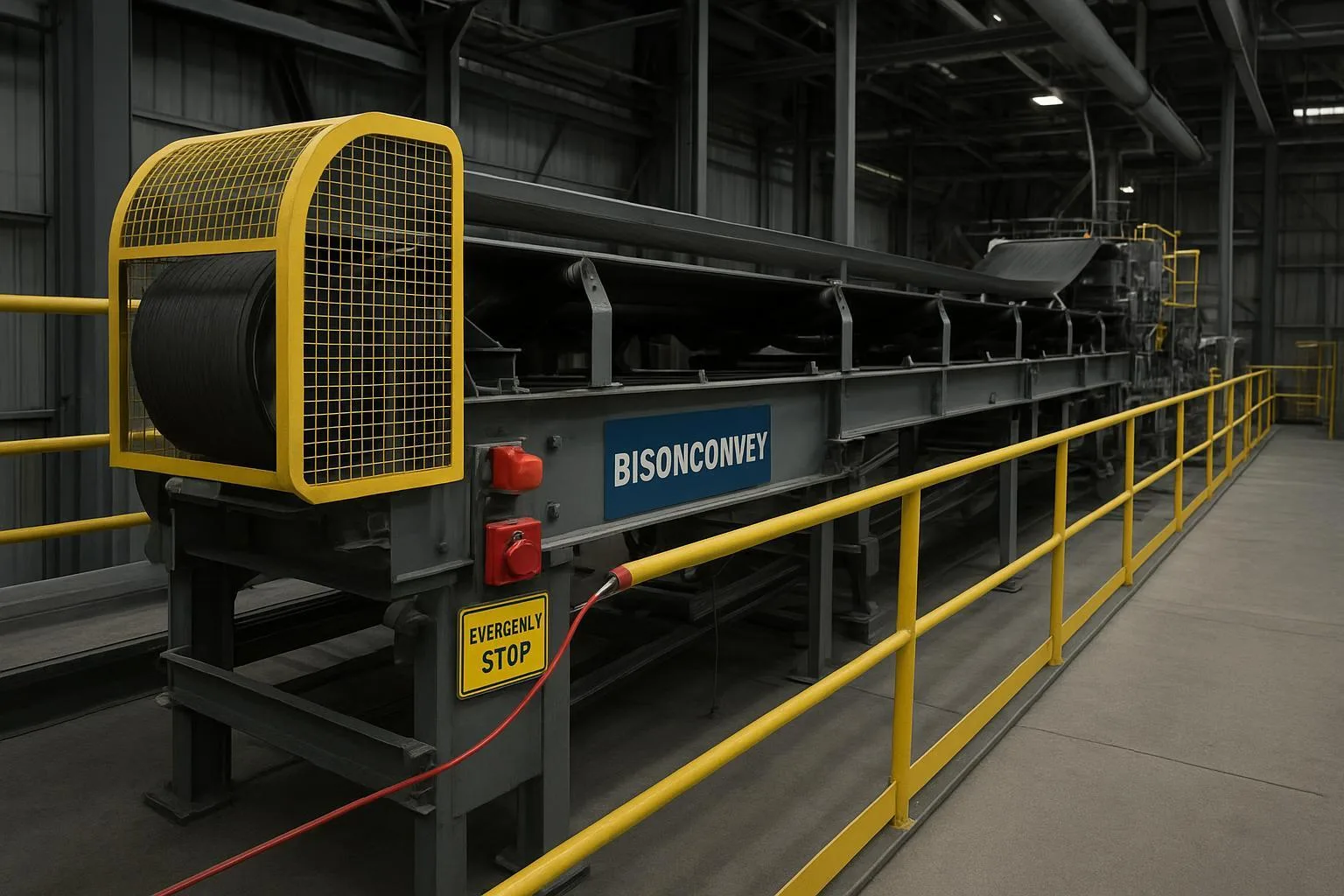
If you’re responsible for a belt conveyor—whether in mining, cement, ports, or manufacturing—compliance isn’t optional. It’s the foundation for safe uptime. This guide turns Conveyor Belt Safety Regulations and OSHA Standards into practical engineering actions you can apply on real systems, with direct links to the code and field-proven tips from commissioning and audits. If you’re also evaluating equipment upgrades, BisonConvey’s conveyor belts and components catalog is a useful reference point for what’s typically specified on heavy-duty lines.
Key takeaways
-
OSHA’s core rules that touch conveyors are 29 CFR 1910.212 (machine guarding), 1910.219 (power-transmission apparatus), 1910.147 (LOTO), 1910.22/28/30 (walking‑working surfaces and training), and 1910.176 (materials handling). Each is mandatory and enforceable in U.S. general industry.
-
Guard all in-running nip points and rotating parts; design guards that prevent reach-through while still allowing inspection and cleaning. See OSHA’s machine guarding rule in General requirements for all machines, 29 CFR 1910.212.
-
Emergency stops must be accessible and reliable; full-length pull-cords are not universally required in general industry. A pull-cord mandate appears in pulp and paper only—see 1910.261 pulp, paper, and paperboard mills.
-
LOTO is non-negotiable for servicing: implement equipment-specific procedures covering electrical, mechanical (gravity/counterweights), and fluid power. Start with Control of hazardous energy, 29 CFR 1910.147.
-
Treat ANSI/ASME B20.1, ASSP Z244.1, ISO 12100, and ISO 13849 as best-practice frameworks to strengthen your program; they complement, but don’t replace, OSHA.
What falls under “Conveyor Belt Safety Regulations and OSHA Standards”
OSHA provides the mandatory baseline. The main sections a plant engineer will apply on conveyors are:
2025 update: what actually changed
If you searched for “2025 OSHA conveyor regulations,” here’s the practical reality: OSHA did not publish a conveyor-specific final rule in 2025 that rewrote the core general-industry standards discussed in this guide. What did change in 2025 was the compliance environment—especially enforcement focus and inspection targeting.
-
Amputation hazards remained a major enforcement priority, and belt conveyors are a common exposure because of in-running nip points and rotating parts. OSHA updated its enforcement guidance via CPL 03-00-027, National Emphasis Program on Amputations in Manufacturing Industries (2025).
-
OSHA also publicized inspection-program updates that concentrate attention on higher injury/illness-rate workplaces, which can increase the probability that guarding and LOTO issues on conveyors are reviewed during an inspection. See OSHA’s May 20, 2025 inspection program update.
Engineering takeaway: don’t wait for a new rulebook—treat 2025 as a reminder to tighten guarding surveys, LOTO verification drills, and documentation so you’re ready for a more focused inspection environment.
-
Machine guarding for nip points and rotating parts in 1910.212 and power‑transmission specifics in 1910.219. These two rules work together; an OSHA interpretation confirms dual applicability for belt/shaft drives.
-
Energy control for servicing in 1910.147: procedures, training, and periodic inspections.
-
Housekeeping and walking‑working surfaces in 1910.22, with fall protection/training in 1910.28/1910.30.
-
Materials handling expectations in 1910.176 for clear aisles and safe storage near transfer points.
Consensus standards strengthen designs and programs:
- ANSI/ASME B20.1 (conveyor safety practices), ASSP Z244.1 (energy control, incl. alternative methods), ISO 12100 (risk assessment), ISO 13849 (safety-related control systems). Treat these as best practices; they are not OSHA mandates.
Long-tail search variants addressed here include OSHA conveyor guarding requirements, conveyor nip point guarding, 29 CFR 1910.212 conveyor, and conveyor LOTO procedures.
Machine guarding: controlling nip points and rotating parts (1910.212/1910.219)
The most serious conveyor injuries happen at in‑running nip points and exposed rotating parts. Under 1910.212, employers must guard hazards created by ingoing nip points and rotating parts. 1910.219 adds detailed provisions for belts, pulleys, and shafts.
Practical design guidance:
-
Identify all exposures: head and tail pulleys, snub/bend pulleys, return idlers above walkways, take-up sheaves, belt-to-skirting contact, and drive couplings. Guard each exposure with fixed, secured guards. For a quick parts taxonomy when you’re documenting hazards, see pulleys and idlers.
-
Guard opening vs. distance concept: OSHA’s amputations guide explains that the larger the guard opening, the farther it must be from the hazard to prevent reach-through. See the principle in the OSHA publication on amputations, summarized in the OSHA machine guarding resources.
-
Local guards vs. perimeter fencing: Use localized fixed guards where frequent inspection is required; use barrier fencing with interlocked access where comprehensive exclusion makes more sense (e.g., large transfer houses). Do not introduce new pinch/shear points with guard edges or hinges.
-
Overhead conveyors and crossings: Where belts run above work areas or aisles, provide protection from falling materials; this is explicit in construction standard 1926.555 and is commonly adopted as a best practice in general industry designs.
-
Inspection and maintenance access: Design guards with captive fasteners or hinged/interlocked panels so routine inspections and cleaning are practical without removing entire assemblies. Keep openings compliant with the opening–distance principle.
Field scenario: A return idler over a walkway accumulates buildup, then binds. Without a guard, a gloved hand used to spin the idler can be pulled into the belt. A simple mesh guard with the correct stand‑off distance eliminates the grab point and allows visual inspection.
Emergency stops and safety circuits: what OSHA requires vs. best practice
OSHA requires machines to be stopped quickly in emergencies, and e-stops must be accessible where provided. However, a common misconception is that pull‑cords are mandated for all conveyors. The explicit full‑length emergency stop cable requirement appears in the pulp and paper rule 1910.261(c)(15)(iv) and does not apply across general industry.
Best-practice engineering measures:
-
Provide accessible e-stop devices at loading/unloading points and along accessible runs as risk dictates. Use latching e-stop devices that require a manual reset and inhibit restart until the cause is investigated.
-
Function-test e-stops on a set cadence (weekly to monthly depending on duty and environment) and after any maintenance that could affect controls. Document results.
-
Where risk justifies, design the emergency-stop and interlock circuits to safety-related architectures aligned with ISO 13849 (e.g., target Category 3/PL d) using safety relays or safety PLCs. This is a consensus best practice, not an OSHA mandate; it improves diagnostic coverage and fault tolerance.
Field scenario: A belt mistracks and begins to rub a stringer. Operators can’t reach a push-button at the tail. A pull‑cord run the full length, within easy reach, stops the belt immediately. After inspection, the system requires a supervised reset.
LOTO for conveyors (1910.147): procedures that actually prevent movement
The control of hazardous energy, 29 CFR 1910.147 requires an energy control program for servicing and maintenance where unexpected energization or stored energy release could cause injury.
Build robust, equipment-specific procedures:
-
Identify all energy sources: electrical (main disconnects, VFDs), mechanical (gravity in counterweights/take‑ups), hydraulic/pneumatic circuits, and potential energy in loaded belts.
-
Isolate and dissipate: de‑energize electrical sources; block or secure counterweights; bleed hydraulic/pneumatic lines; lower suspended loads; and clear belt loads where necessary.
-
Verify zero energy: try‑start tests and instrument checks before starting work.
-
Group LOTO: each authorized employee applies a personal lock; a primary authorized employee coordinates the job and verification. Maintain robust shift‑change controls so incoming personnel verify isolation.
-
Minor servicing exception: applies only to routine, repetitive tasks integral to production when effective alternative protection is used. It’s narrow; evaluate against OSHA’s directive guidance and document the rationale.
Helpful OSHA resources include the OSHA OTM Lockout/Tagout chapter and enforcement directive CPL 02‑00‑147 for interpretations.
Walking‑working surfaces around conveyors (1910.22/28/30)
Housekeeping failures are a leading contributor to slips, trips, and falls near conveyors. Walking‑working surfaces, 29 CFR 1910.22 requires that floors and walkways be kept clean and orderly.
Practical controls:
-
Maintain clear, dry walkways; promptly remove fugitive material at transfer points; repair floor defects.
-
Provide guardrails or edge protection where walkways run adjacent to elevated conveyors; ensure safe crossovers/bridges at belt lines.
-
Ensure lighting and signage are sufficient; separate pedestrian and forklift routes with barricades or markings.
-
Train employees per 1910.30 requirements when fall protection systems are used.
Materials handling near conveyors (1910.176)
Handling materials—general, 29 CFR 1910.176 calls for safe storage and maintaining clear aisles and passageways.
Engineering and procedural expectations:
-
Keep storage and staging away from moving belts and under transfer points where falling material could create struck-by hazards.
-
Fit guards, pans, or covers below overhead conveyors to protect employees from falling debris (also reflected in construction standard 1926.555).
-
For blockages: shut down, apply LOTO, and use tools—not hands—to clear chutes and skirtings.
Training, documentation, and inspections: making compliance durable
A compliant program is documented, trained, and verified.
-
Role-based training: operators on normal operations and emergency stops; maintenance on guarding and LOTO; contractors briefed on site procedures.
-
LOTO program maintenance: annual training and periodic inspections of procedures as required by 1910.147(c)(6). Keep records.
-
Document guard designs and modifications, e-stop test results, and incident/corrective actions. Retain supplier manuals and safety device schematics.
Troubleshooting and real-world scenarios
-
Nip-point entanglement near the head pulley: A technician attempts to brush off carryback during operation; a loose sleeve is caught. Root cause: no fixed guard on the pulley–belt interface and poor housekeeping. Corrective actions: install a compliant mesh guard with proper stand‑off; add scraper/cleaner upgrades; reinforce lockout-before-cleaning.
-
Improper LOTO during belt splicing: Crew isolates the MCC but misses a local control circuit supplying a take‑up. Movement occurs. Root cause: incomplete energy survey. Corrective actions: update the equipment-specific LOTO procedure to include local disconnects and stored energy in counterweights; require verification tests and group LOTO with a primary authorized employee.
-
Failed emergency stop: Pull‑cord switch trips but the belt coasts far due to control logic and no mechanical braking. Root cause: control circuit not safety‑rated; no stop category analysis. Corrective actions: review stop performance; where risk justifies, upgrade to a monitored safety relay/PLC architecture and evaluate braking to meet a safe stop distance consistent with ISO 13849 engineering practices (best practice, not an OSHA mandate).
Selection and procurement guidance that supports compliance
When specifying or purchasing conveyors and components, require documentation and features that make compliance straightforward:
-
Guarding: confirmation that all exposed rotating parts and nip points are guarded to meet 1910.212/1910.219 principles; guard drawings and materials included.
-
Emergency stops: clearly identified devices with manual reset and restart interlock; testing procedures provided. Where appropriate, designs that can achieve ISO 13849 Category 3/PL d for safety functions.
-
Energy control: equipment-specific LOTO placards listing all isolating devices per 1910.147; identification tags at disconnects, valves, and bleed points.
-
Documentation package: O&M manuals, wiring schematics for safety devices, inspection checklists, and recommended maintenance intervals.
-
Critical rotating components: specify traceable documentation for major rotating parts (e.g., drive pulley head pulley) so guarding layouts, maintenance access, and replacement planning stay consistent over the equipment life.
Best practices and maintenance tips
-
Schedule routine visual guard checks (daily/weekly) and monthly fastener integrity checks. Investigate any ad‑hoc guard removals by maintenance and correct at once.
-
Control spillage with proper skirting, sealing, and belt cleaners to reduce manual intervention near nip points.
-
Track the belt correctly: misalignment drives emergency interventions. Use training idlers and regular alignment checks.
-
Test e-stops routinely and after any controls work; record results and time-to-stop. Investigate degradations.
-
Keep walkways and platforms clear and dry; verify lighting levels where operators read gauges or inspect belt edges.
Standards crosswalk: OSHA vs. consensus guidance
If you sell or install conveyors in the EU: CE and the Machinery Regulation
If your conveyor (or an integrated conveying line) is placed on the EU market, your compliance obligations are governed by the EU’s machinery framework—not OSHA.
-
The EU has adopted Regulation (EU) 2023/1230 on machinery, which replaces the Machinery Directive (2006/42/EC) on its applicability date.
-
Important: I couldn’t reliably extract the exact “date of application” clause from EUR-Lex in this session due to access limits, and different summaries cite January 2027. Before you finalize compliance messaging, confirm the applicability date directly on the official EUR-Lex text.
Practical implications for conveyor manufacturers/exporters (high level):
-
Perform and document a risk assessment (typically aligned with ISO 12100).
-
Demonstrate adequate guarding and safe access for cleaning/jam clearing.
-
Ensure safe control system behavior (safe start/restart, prevention of unexpected start-up; safety functions validated where needed).
-
Prepare a complete technical file and EU Declaration of Conformity, and apply CE marking.
If you tell me whether the target reader is mainly U.S. plant engineers or global OEM/export teams, I can tighten this section to match their decision-making context.
| Framework | Conveyor scope | Enforceability |
|---|---|---|
| OSHA 29 CFR 1910.212/219 | Machine guarding and power-transmission apparatus | Mandatory (U.S. general industry) |
| OSHA 29 CFR 1910.147 | Energy control (LOTO) for servicing/maintenance | Mandatory |
| OSHA 29 CFR 1910.22/28/30 | Walking‑working surfaces; fall protection; training | Mandatory |
| OSHA 29 CFR 1910.176 | Materials handling—general | Mandatory |
| ANSI/ASME B20.1 | Conveyor safety practices (design/operation/maintenance) | Consensus best practice |
| ASSP/ANSI Z244.1 | Energy control incl. alternative methods | Consensus best practice |
| ISO 12100 | Risk assessment and risk reduction | Consensus best practice |
| ISO 13849 | Safety-related control system design/validation | Consensus best practice |
Bringing it all together: a practical roadmap
Here’s the deal: if you align designs and procedures to OSHA’s mandatory rules, then layer in consensus best practices where risk and budget justify them, you’ll get a safer system and smoother audits.
-
Start with a machine guarding survey against 1910.212/219. Fix obvious nip points and verify guard opening–distance geometry.
-
Validate LOTO procedures under 1910.147 with a hands-on isolation/verification drill. Close gaps for counterweights, local feeds, and VFDs.
-
Review walking‑working surfaces near conveyors per 1910.22. Improve housekeeping, lighting, and crossings.
-
Evaluate emergency stops: placement, function tests, and, where appropriate, safety-rated circuits per ISO 13849 engineering practices.
-
Set inspection cadences and keep records. Use incident data to drive corrective actions.
If you need component support or documentation packages for belts, idlers, and pulleys that integrate cleanly with compliant guarding and maintenance practices, a supplier like BisonConvey can support custom configurations without the marketing fluff—just the drawings, materials, and lead times your team needs.
FAQ
1) Did OSHA issue a new conveyor safety standard in 2025
Not for U.S. general industry belt conveyors. The most important 2025 shift was enforcement focus, not a rewrite of 29 CFR 1910.212/219/147. A good example is OSHA’s 2025 NEP on amputations (CPL 03-00-027), which reinforces attention on in-running nip points and guarding/energy control.
2) Are full-length pull-cord emergency stops required on every conveyor
Not universally in general industry. OSHA expects emergency stopping capability and safe design, but a clear full-length pull-cord mandate appears in specific industry rules (like pulp and paper). Use a risk-based approach: if operators can’t reach a stop quickly, a pull-cord is often the simplest practical solution.
3) What conveyor points must be guarded first
Start with in-running nip points and rotating parts: head/tail pulleys, snub pulleys, return runs near walkways, take-ups, and belt-to-skirting pinch areas. If your team is improvising “quick” cleaning or tracking adjustments near moving parts, treat that as a red flag.
4) What is the most common LOTO failure on conveyors
An incomplete energy survey. Teams may isolate the MCC but miss local control power, stored energy (counterweights/take-ups), or secondary feeds. Build equipment-specific procedures under 29 CFR 1910.147 and require a verification step every time.
5) How often should we inspect guards and emergency stops
OSHA doesn’t prescribe one universal interval for every conveyor. A workable program is:
-
Frequent operator visual checks (daily/weekly) for missing/damaged guards
-
Scheduled maintenance checks (monthly/quarterly) for fasteners, clearances, and function tests
-
Documented periodic reviews and corrective actions
6) If we comply with OSHA, are we automatically compliant in the EU
No. OSHA compliance supports good practice, but EU compliance requires a CE conformity assessment, technical documentation, and meeting the EU machinery framework. If EU sales matter, align your design file with ISO 12100 risk assessment principles and validate safety functions where applicable.
References and further reading
-
Machine guarding: see OSHA’s General requirements for all machines, 29 CFR 1910.212 and Mechanical power-transmission apparatus, 29 CFR 1910.219.
-
Energy control: The control of hazardous energy (Lockout/Tagout), 29 CFR 1910.147 and OSHA’s OTM LOTO chapter.
-
Walking‑working surfaces: 29 CFR 1910.22. Materials handling: 29 CFR 1910.176.
-
Special case and design references: 1910.261 — pulp, paper, and paperboard mills and 1926.555 — construction conveyors.