Introduction
This article provides a data-backed comparison of EP (polyester/nylon), NN (nylon/nylon), and steel cord (ST) conveyor belt carcasses for corrugated sidewall duty in abrasive Australian mining conditions. For maintenance engineers, the practical questions are clear: which base belt delivers stable tension and tracking, controls elongation and creep, resists rip/tear, maintains transverse rigidity for sidewalls and cleats, bonds reliably, and offers workable splice options?
We frame the analysis in the context of widely used abrasion cover grade standards—ISO 14890 (H/D/L) and DIN 22102 (X/W/Y)—and the underlying test method mapping. In brief, both systems classify abrasion resistance using volume loss measurements per ISO 4649 or DIN 53516; lower mm³ loss indicates better wear performance. This equivalence is emphasized by OEM technical resources, for example, Dunlop’s explanation of abrasion standards and test methods and related OEM notes that align ISO and DIN grade families.
How to use this guide: apply the selection matrix to match duty (short steep transfers vs long fixed inclines) and material severity. Priorities are weighted to elongation/creep and tension stability (A), transverse rigidity/cross-stability (B), bonding performance (C), and lifecycle cost/TCO in Australian conditions (F).
Mechanics by carcass
EP: tensile, creep
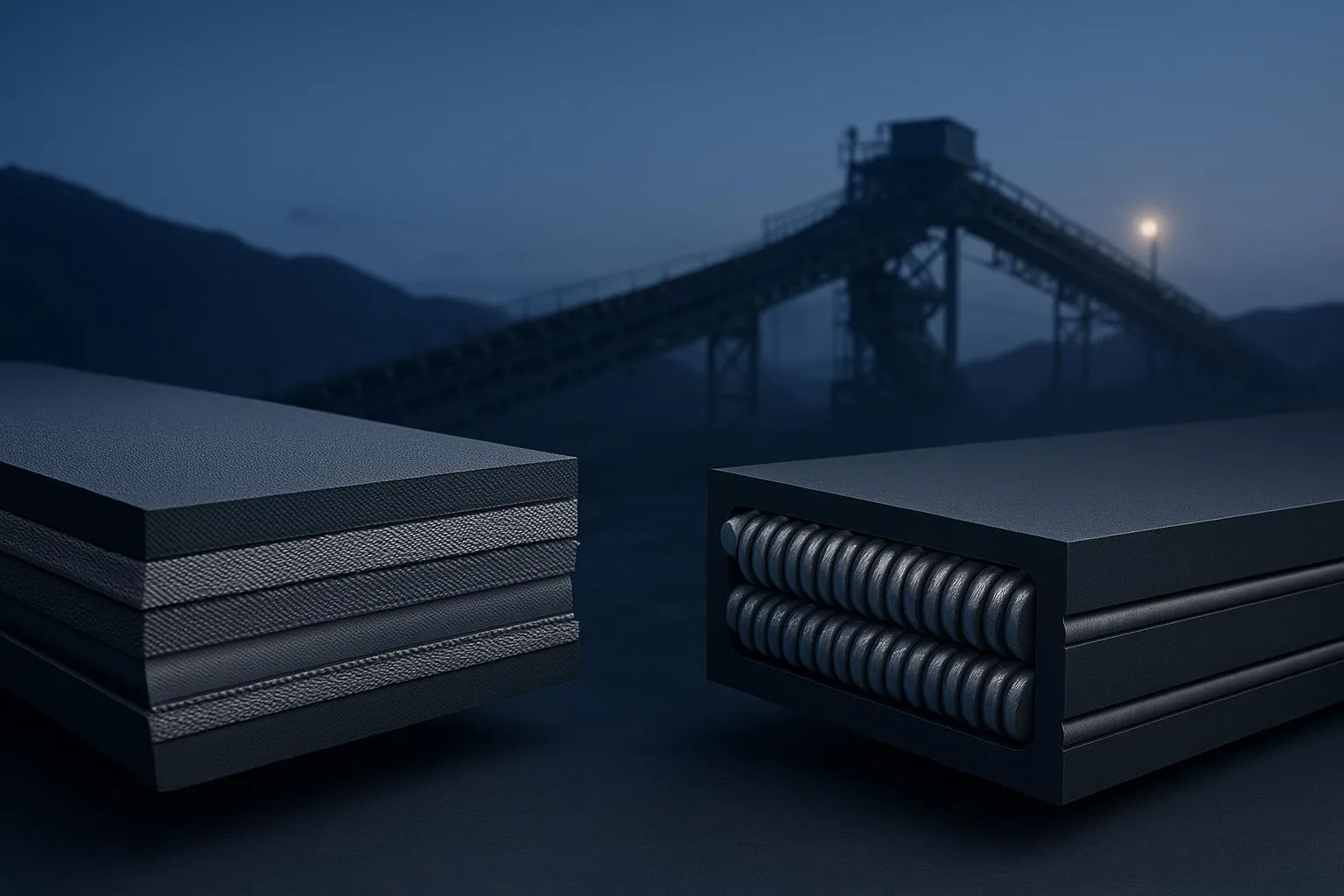
EP (polyester warp/nylon weft) multiply belts are favored in heavy-duty mining because polyester in the warp provides low elastic elongation and good tension stability, while nylon in the weft supports flexibility and shock distribution. OEM literature consistently positions EP as a “balanced” choice for demanding duty, citing its lower elongation compared with all-nylon constructions; see Dunlop’s technical overview “Why the difference?” (2022). In maintenance terms, lower creep helps keep take-up travel within range and stabilizes tracking on steep sidewall runs. That stability also helps preserve finger or step splice geometry under cyclic loading, aligning with the intent of ISO 9856 to characterize elastic versus permanent elongation.
NN: impact, flex
NN (nylon warp/weft) multiply belts typically exhibit higher elastic elongation than EP and superior impact absorption and flex-fatigue behavior. This can be advantageous for short, high-impact runs where shock loading dominates. The trade-off is more take-up movement and potential tracking attention on steep sidewall sections. Where impact is extreme—large ore lumps or drop heights—NN’s flex resilience can reduce carcass damage, provided cross-stability is carefully managed and pulley diameters are confirmed with the sidewall OEM.
Steel cord: rigidity
Steel cord belts deliver extremely low stretch and high longitudinal rigidity, which suits long overland conveyors at high tensions. Sidewall duty introduces two hurdles: transverse flexibility and reliable bonding for sidewalls/cleats. Steel cord’s lateral stiffness and cord construction complicate corrugated sidewall integration and often demand larger pulley diameters and engineered splicing. Continental’s steep-incline portfolio (e.g., Flexowell) is supported through engineered solutions rather than general-purpose charts, highlighting the bespoke nature of these builds; see Continental’s Steep Incline and Vertical Conveyor Belts and Flexowell overview.
Sidewall design
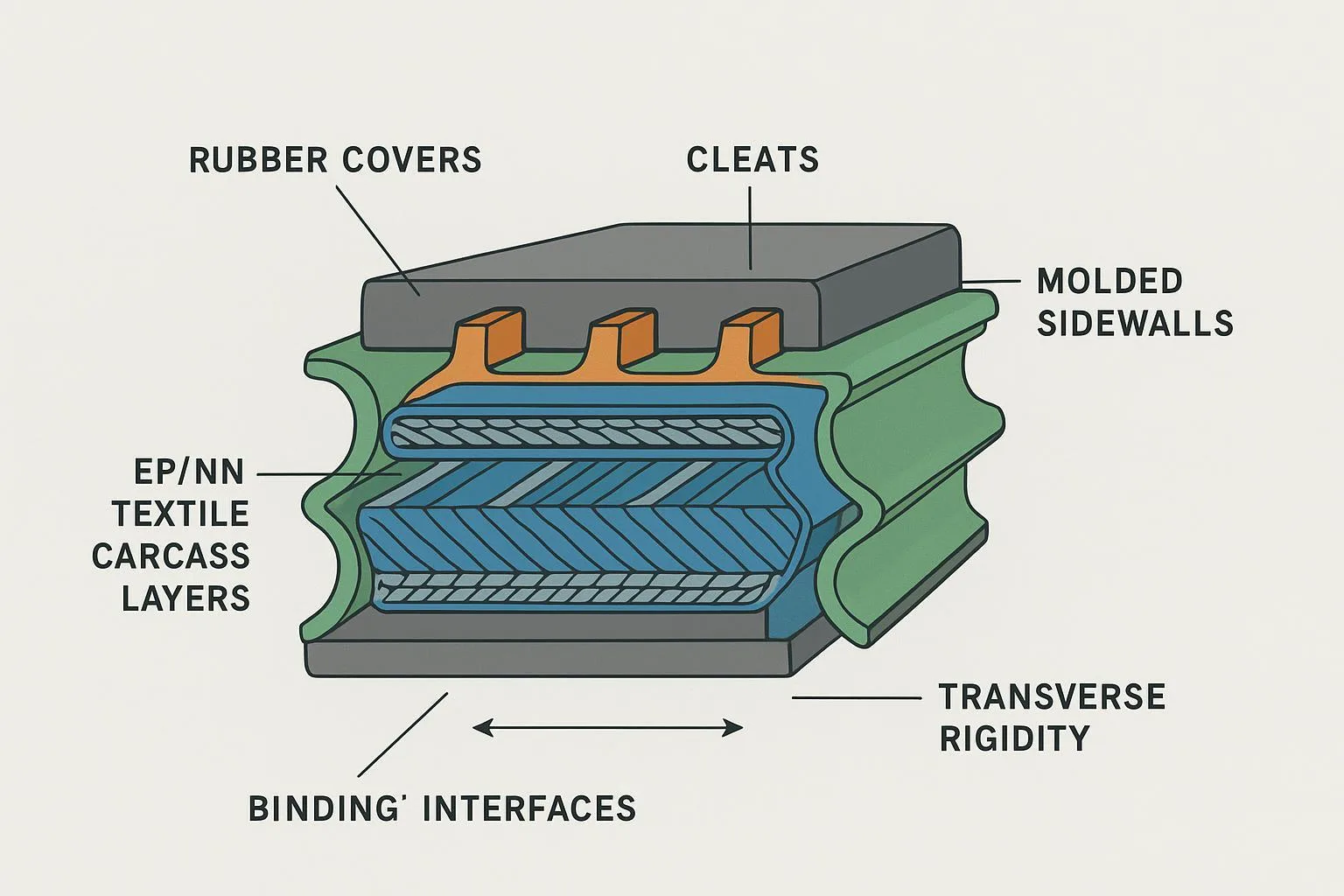
Transverse rigidity
Corrugated sidewall belts depend on cross-stability to keep sidewalls upright and cleats properly engaged. Think of transverse rigidity like a book’s spine—too floppy and pages (sidewalls) buckle; too stiff and the book won’t open smoothly. Textile EP carcasses often offer better lateral stiffness than NN, aiding sidewall geometry while still flexing over pulleys. Although public manuals rarely publish “transverse rigidity” numbers, OEMs confirm lateral stiffness is a design parameter in specialty belts—see Dunlop EMEA’s range notes on achieving transverse rigidity in slider applications (EMEA product range).
Bonding and cleats
Sidewalls and cleats rely on robust adhesion to the base belt and covers. Hot-vulcanized attachments typically provide the highest reliability. For splicing, multiply belts commonly use hot vulcanized step or finger splices; procedures are documented by OEMs such as Dunlop’s Multiply Belting – Step Splicing. Peel adhesion testing is governed by EN ISO 252; while open numeric targets are scarce on public pages, maintenance practice centers on correct surface preparation, compatible rubber systems, calibrated pressure/temperature cycles, and contamination control.
Pulleys and flex
Minimum pulley diameters depend on carcass type, ply count, belt thickness, and sidewall/cleat geometry. Sidewalls add stiffness and thickness, often increasing bend radius requirements. Without public charts, use OEM tables for both the base belt and the sidewall system. As a rule of thumb, confirm bend pulley diameters with the sidewall OEM and the belt manufacturer together—especially for NN belts (to avoid excessive elastic elongation on steep runs) and for steel cord (to verify feasibility at all).
Standards and grades
ISO 14890 (H/D/L)
ISO 14890 classifies abrasion-resistant covers broadly as H (high), D (moderate), and L (low). The practical takeaway for maintenance is that abrasion testing uses volume loss (mm³) per ISO 4649; lower volume loss correlates with longer cover wear life in abrasive ores.
DIN 22102 (X/W/Y)
DIN 22102 classifies abrasion-resistant covers as X, W, Y. OEM guidance commonly treats X/W/Y as equivalent categories to H/D/L from ISO 14890 in everyday selection.
Mapping and tests
Both systems rely on the same principle: standardized abrasion tests. OEM technical materials align the categories (e.g., DIN X ≈ ISO H, DIN W ≈ ISO D, DIN Y ≈ ISO L) and emphasize that mm³ volume loss is the metric of interest; see Dunlop’s cross-system explanations in “Abrasion standards and test methods” and “Quality matters”.
| Cover system | Abrasion classes | Test method reference | Practical selector note |
|---|---|---|---|
| ISO 14890 | H / D / L | ISO 4649 (mm³ volume loss) | Lower mm³ = higher abrasion resistance |
| DIN 22102 | X / W / Y | DIN 53516 (comparable to ISO 4649) | X ≈ H; W ≈ D; Y ≈ L (category alignment) |
If numeric thresholds are needed for specifications, consult the standards texts or OEM technical manuals.
Lifecycle and costs
Service life factors
Service life in Australian ore duty is dominated by cover abrasion rate (ISO 4649/DIN 53516 outcome), carcass protection against rip/tear, transverse rigidity for sidewall geometry, and tension stability that preserves splices. Materials like iron ore and nickel laterite demand higher abrasion grades (DIN X/ISO H) to control wear.
Splicing and repairs
Multiply textile belts (EP/NN) are generally more repairable on site than steel cord: cleat or sidewall re-attachments and patch repairs can be performed with established hot or cold bonding systems, provided adhesion procedures are followed. Refer to OEM splice instructions for step or finger splices, e.g., Dunlop’s multiply splice guide.
TCO in AU mines
Public, quantified Australian TCO comparisons between fabric and steel cord sidewall belts are limited. Practical cost drivers include downtime from splice or adhesion failures, frequency of re-bonding sidewalls/cleats, take-up adjustments due to creep, and cover replacement cycles governed by abrasion grade performance. Where possible, validate on site using failure logs, splice pull tests, and abrasion loss measurements tied to ISO/DIN methods; this aligns with reliability best practice and OEM guidance.
Selection matrix
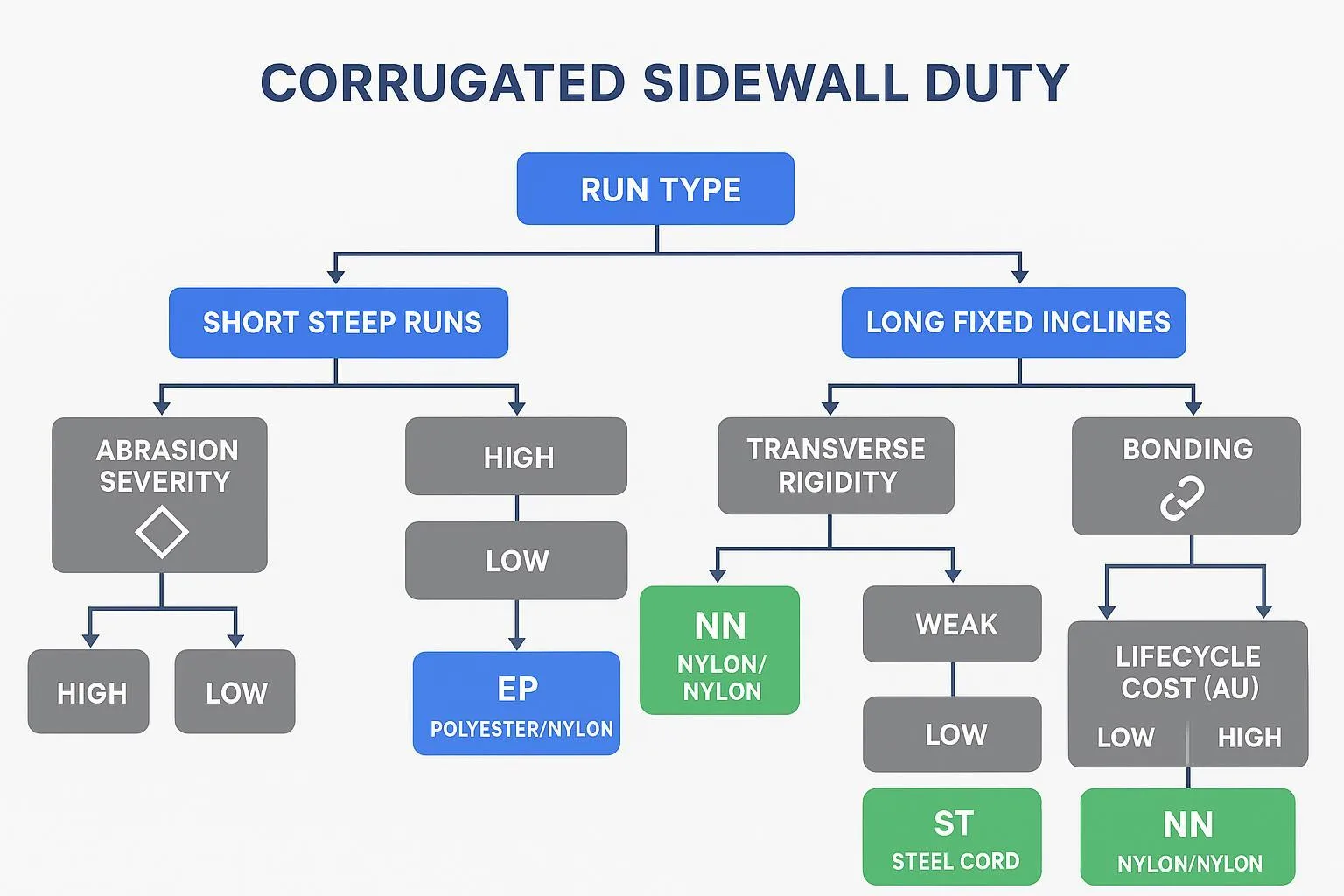
Short steep runs
Priority should go to transverse rigidity (B) and bonding (C), then elongation control (A) and TCO (F). In practice, an EP base belt with high-abrasion cover (DIN X/ISO H) is often the workable choice for maintaining sidewall geometry and stable tracking. NN can be considered where impact is extreme and runs are short, but cross-stability must be verified and pulley diameters confirmed with the sidewall OEM.
Long fixed inclines
Elongation/creep (A) and pulley/splice feasibility dominate. EP remains the default textile base for engineered sidewall inclines when feasible. Steel cord provides excellent tension stability, but corrugated sidewall builds on steel cord usually require bespoke engineering (bonding interfaces, larger pulleys, splice complexity); consult OEM design services before selection.
Abrasion severity
Cover grade selection via ISO/DIN mapping is central. Specify covers to ISO 14890 H or DIN 22102 X for severe abrasion; use ISO 4649/DIN 53516 mm³ loss as the comparative metric. For moderate to lower abrasion, ISO D/DIN W or ISO L/DIN Y may suffice depending on ore and throughput.
Conclusion
-
EP often balances stability, bonding, and flex-life for corrugated sidewalls in abrasive ores. OEM literature frames EP’s low elongation and balanced mechanics as suitable for heavy-duty mining (as of 2022), supporting stable tension and reliable splices.
-
NN may suit high-impact, shorter runs but needs careful control of cross-stability and tracking on steep inclines. Verify pulley diameters and adhesion procedures.
-
Steel cord offers very low stretch but is generally unsuited to sidewalls without bespoke engineering. When considered, involve the sidewall system OEM for bonding, pulley, and splice validation.
-
Specify cover grades to ISO/DIN, verify pulleys/splices with OEM tables, and validate lifecycle costs on site using failure logs, abrasion loss tests (ISO 4649/DIN 53516), and splice pull checks.
Also consider: suppliers that manufacture EP/NN/steel cord belts and sidewall components. Disclosure: BisonConvey is our product. For vendor-neutral product information, visit BisonConvey’s official site. External standards and OEM resources used in this article include Dunlop’s abrasion standards overview and Continental’s steep incline belts pages.