Heavy Construction Conveyor Engineering Guide
If you build, buy, or maintain bulk-material conveyors in mining, cement, ports, or steel, the difference between a reliable line and a chronic headache usually comes down to fundamentals: sizing, component selection, guarding, and disciplined upkeep. This Heavy Construction Conveyor Engineering Guide distills field experience and recognized standards into practical steps you can apply on your next project or shutdown.
Key takeaways
-
Use standards and calculations together. Size by duty and loads first, then select components whose ratings exceed the computed demands; don’t choose parts by belt width alone.
-
Prioritize safety in the design. Design guards to ISO 14120, respect reach distances per ISO 13857, and align with ASME B20.1; operate under OSHA/MSHA controls as applicable.
-
Match belt construction, idler class, and lagging to the environment. Abrasion, moisture, impact, and speed drive different choices—avoid one-size-fits-all.
-
Fix root causes before add-ons. Correct structure, loading geometry, and tensioning first; use cleaners, trainers, and skirting to stabilize a sound system, not to mask flaws.
-
Maintain with intent. Routine inspections, condition monitoring, and clean transfer points prevent most failures and extend component life.
Core concepts in the Heavy Construction Conveyor Engineering Guide
Conveyor anatomy and loads
A heavy-duty belt conveyor is a system, not a single component. Core elements are the belt (the tensioned traction and carrying element), idlers (troughed and return rollers that support and shape the belt), pulleys (drive, tail, bend/snub, with or without lagging), the drive (motor, gearbox, coupling), take-up (gravity or screw), structure, and guarding. Loads include the dead weight of belt and rotating parts, the live load of material, frictional resistances at idlers and pulleys, and any lift due to elevation change.
Capacity, speed, and tension basics
For quick scoping, mass flow Q ≈ ρ × A × v, where ρ is bulk density (t/m³), A is cross-sectional area of load on the belt (m²), and v is belt speed (m/s). Cross-sectional area depends on belt width, trough angle, and surcharge angle. Many heavy-duty designs run between roughly 2.0–3.5 m/s; pushing speed higher increases capacity but typically raises wear and dust generation. Practical ranges for aggregates and ores cluster near 1.8–3.5 m/s, as discussed in accessible explainers such as the engineering notes by MEKA on belt capacity and speed selection, which outline the Q = ρ·A·v relationship and typical ranges in practice (see the concise discussion in the belt capacity article by MEKA Global).
Worked scoping example: Suppose crushed limestone at ρ = 1.6 t/m³, belt width 1000 mm with 35° trough, estimated A ≈ 0.07 m² (typical for this geometry), and v = 2.5 m/s. Then Q ≈ 1.6 × 0.07 × 2.5 ≈ 0.28 t/s ≈ 1000 t/h. For formal design and verification, consult established methods from CEMA/DIN and commissioning data.
Power relates to total effective tension T and belt speed v: HP ≈ (T × v)/33,000 in imperial units, or P ≈ T × v in SI (watts when T in newtons and v in m/s). T aggregates resistances from idlers, pulleys, material lift, and acceleration. Use conservative service factors and verify take-up travel for seasonal stretch and splice behavior.
For further reading on belt speed trade-offs, see this overview on practical ranges in bulk handling contexts by independent references; and for a refresher on belt fundamentals, see the educational primer on belt basics from BisonConvey’s resource on conveyor belt definition and basics.
Safety by design
Safety is engineered in from day one. In the U.S., ASME’s consensus code anchors conveyor safety. According to the explanatory overview of ASME B20.1 — Safety Standard for Conveyors and Related Equipment, designers and operators should address guarding of nip points and moving parts, emergency stop and control provisions, inspection, and maintenance practices. For general industry, OSHA’s machine-guarding and lockout/tagout rules apply—see the OSHA pages for 1910.212/219 machine guarding and 1910.147 energy control. For mining operations, MSHA’s guarding and operation rules govern.
For physical guard design and placement, ISO standards provide the geometry and principles. ISO 14120 on guard design requirements sets how fixed and movable guards should prevent access and withstand foreseeable impacts, while ISO 13857 on safety distances provides reach-distance tables for openings and clearances. Use these together: design guards that meet ISO 14120 and position them per ISO 13857 distances. Always verify against your jurisdiction’s applicable codes and your organization’s safety management system.
Practical applications and use cases
Mining overland and plant conveyors
Long runs and high tensions push toward steel cord belts for low elongation and stable tracking, with robust idlers and large-diameter pulleys. Dust, abrasion, and weather demand ceramic or diamond-grooved lagging on drives and conservative speeds to balance wear and throughput.
Cement and raw material handling
High-impact loading from crushers and raw mills plus pervasive dust favor EP/NN belts with impact-rated loading zones (impact idlers or beds) and close idler spacing near the chute. Heat-resistant covers may be required near clinker or hot materials. Housekeeping and sealing make or break uptime.
Ports and logistics terminals
Salt air and moisture challenge bearings and lagging. Galvanized or coated structures, stainless fasteners, and grooved or ceramic lagging on drive pulleys help maintain traction in wet conditions. Consider low-maintenance sealing and skirting to contain fines during windy operations.
Selection and implementation guidelines
Belt construction selection
Choosing the belt carcass is a balance of tensile rating, elongation, splicing method, troughability, impact resistance, and minimum pulley diameters. For a deeper primer, see BisonConvey’s comparison of EP vs NN vs steel cord belts.
| Belt type | Strength and elongation | Splicing | Troughability | Typical pulley diameters | Typical use cases |
|---|---|---|---|---|---|
| EP (polyester/nylon) | Moderate strength; moderate elongation | Mechanical or hot-vulcanized; straightforward | Good | Scales with rating; EP 400/4 often ~630 mm drive at higher tensions | General duty in cement, aggregates; moderate lengths |
| NN (nylon/nylon) | Similar to EP; differences in modulus/impact response | Similar methods | Good | Often smaller diameters at lighter ratings | Light to medium duty; short to moderate runs |
| ST (steel cord) | Very high strength; very low elongation | Vulcanized only; specialized | Excellent for long runs | Scales with class; e.g., ST1000 ~630 mm; ST5400 ~1,800 mm | Long overland, high-tension mining |
Sources summarizing pulley-diameter tendencies and carcass behaviors include accessible catalogs such as the Krishnabelts carcass chart and ISO 15236 summaries for steel cord families.
CEMA idler classes and typical duty
Select idlers by computed load and duty—not belt width alone. Service conditions (abrasion, speed, lump size), spacing, and environment influence both class and roll diameter.
| CEMA class | Typical roll diameters | Typical duty/environments | Notes |
|---|---|---|---|
| B | ~89–102 mm | Light to medium duty; low to moderate speeds | Short runs; clean environments |
| C | ~102–108 mm | Medium duty; aggregates, packaging | Common plant conveyors |
| D | ~108–133 mm | Medium-heavy; higher speeds/loads | Frequent in mining/cement |
| E | ~133–159 mm | Heavy; abrasive, impact-prone | Loading zones, harsh duty |
| F | ~159–194 mm | Very heavy; extreme loads/speeds | Overland, high-impact areas |
For a practical explainer of selection logic, see the discussion by Martin Engineering on CEMA idler classes and selection. Also see an engineering standard used in heavy industry projects (e.g., SAIL IPSS) that outlines load- and spacing-based selection similar to CEMA.
For fundamentals on idlers, see BisonConvey’s educational overview of belt conveyor idlers and why they matter.
Pulley and lagging selection
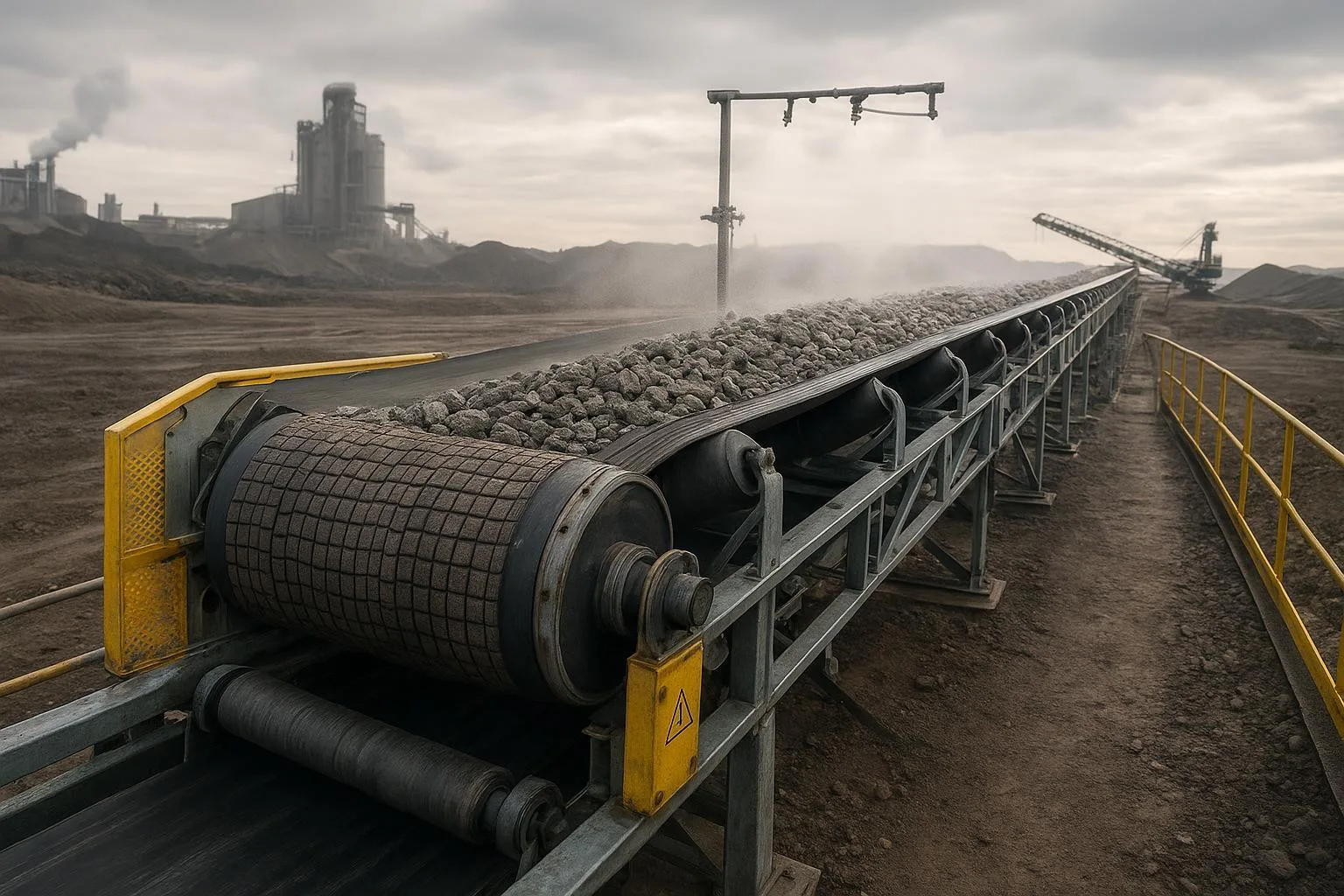
Pulley sizing is tension- and fatigue-driven. Verify shaft diameter and bearing life to combined radial loads; set wrap angle and take-up to maintain traction. Lagging is matched to environment and torque demand:
-
Plain rubber: non-drive or light/medium duty in dry, clean conditions.
-
Diamond-grooved rubber: drive pulleys in wet/dusty conditions; sheds water/debris and raises traction.
-
Ceramic: severe abrasion, wet/dirty, high-tension/high-torque applications.
For concise references, see industry explainers on lagging options from Luff Industries and DYNA Engineering, and a technical guide from Flexco on lagging selection.
Commissioning workflow example (neutral)
On a retrofit of a quarry transfer conveyor, the team scoped capacity at 900–1100 t/h and selected a 1200‑mm belt at ~2.6 m/s using the quick Q = ρ·A·v check, then finalized with a CEMA-based tension calc. Idlers were upgraded from CEMA C to D in the loading zone, and the drive pulley received diamond-grooved lagging for wet months. A supplier such as BisonConvey can provide belts, idlers, and pulleys to match these computed ratings and environmental conditions while you retain control of the specifications and compliance process.
Common problems and troubleshooting
Belt mistracking
Most mistracking issues trace back to load geometry, buildup, and structure rather than the belt itself. Prioritize corrections in this order: center and stabilize loading; remove buildup; free or replace seized rollers; verify pulley and frame squareness; check splices for squareness/cupping; set correct tension; then apply trainers as fine control on the return before the tail. For a deeper field checklist, see the practical write-up on how to fix conveyor belt misalignment and the diagnostic overview by Martin Engineering on root causes of mistracking.
Carryback and spillage
Carryback stems from sticky fines, moisture, or inadequate cleaning. Use a primary scraper at the head pulley and a secondary cleaner on the flat; add wash boxes or spray bars for clays; install a return plow ahead of the tail. Spillage often indicates poor chute geometry, low tension/sag, or misalignment. Stabilize loading with impact beds and close idler spacing, and seal the skirtline properly. For prevention strategies, see industry primers like FEECO’s summary of common conveyor issues and prevention and BisonConvey’s primer on belt skirting.
Best practices and maintenance tips
Inspection cadence and condition monitoring
Adopt a layered inspection program: frequent operator walkdowns for noise, heat, and visible dust clouds; weekly checks for idler rotation and buildup; monthly alignment and tension checks; quarterly lagging and splice audits. Add condition monitoring on critical conveyors—thermography on bearings, vibration on idlers in harsh zones, and motor current trending for drive health. Keep a running defect/backlog list and address sources, not just symptoms.
Training and documentation
Standardize lockout/tagout procedures and verify them via periodic drills. OSHA’s 1910.147 energy control provides the framework for isolating energy before service. Maintain up-to-date drawings, tension settings, splice records, and cleaner/skirt adjustments. Train new technicians on tracking hierarchy and cleaning discipline.
Tip: Need a quick sanity check on capacity during scoping? Use the belt capacity calculator to estimate throughput from belt width, speed, and material density before detailed design.
Conclusion and actionable takeaways
-
Begin with duty and loads, not catalogs. Compute capacity, tension, and idler loads; then select belt carcass, idler class, pulley size, and lagging to exceed those demands.
-
Engineer safety into the layout. Apply ISO 14120/13857 for guards and distances; align with ASME B20.1; enforce OSHA/MSHA practices on the floor.
-
Control the transfer points. Clean chutes, correct loading geometry, seal skirts, and use cleaners appropriate to the material and climate.
-
Inspect with intent. Pair frequent walkdowns with targeted condition monitoring to catch bearing, lagging, and splice issues before failure.
If you’d like an engineering review of a specification or help matching belts, idlers, and pulleys to your computed loads and environment, a supplier like BisonConvey can collaborate with your team on a standards-aligned solution.
Glossary
-
Belt carcass: The internal tensile structure of a belt (fabric plies or steel cords) that carries tension.
-
CEMA: Conveyor Equipment Manufacturers Association; publishes widely used conveyor design references.
-
Idler: A roller assembly that supports the belt and helps form the trough.
-
Lagging: Material bonded to a pulley face to improve traction and wear life.
-
Take-up: Device that maintains belt tension via gravity or screw mechanisms.
-
Trough angle: Angle between wing idlers and horizontal; shapes the cross-section of material on the belt.
References
-
Standards: ASME B20.1 — Safety Standard for Conveyors; OSHA machine guarding and LOTO pages; ISO 14120 guard design; ISO 13857 safety distances; ISO 15236 summaries for steel-cord belt families.
-
Engineering explainers: CEMA idler classes explained by Martin Engineering; FEECO: common conveyor issues and prevention; MEKA overview on belt capacity and speed selection (public explainer).