Types of Conveyor Systems — Ultimate Guide for Engineers
Conveyor systems are the backbone of bulk material handling and unit transport across mining, cement, ports, and manufacturing. Understanding the different types of conveyor systems helps engineers and buyers match mechanism to material, environment, throughput, and lifecycle cost. This guide takes an engineering-first look at the major conveyor types, grounded in standards such as ANSI/CEMA and ISO, and safety programs aligned with OSHA/MSHA. You’ll find practical selection heuristics, troubleshooting insights, and maintenance routines that reflect real plant conditions.
Key Takeaways
-
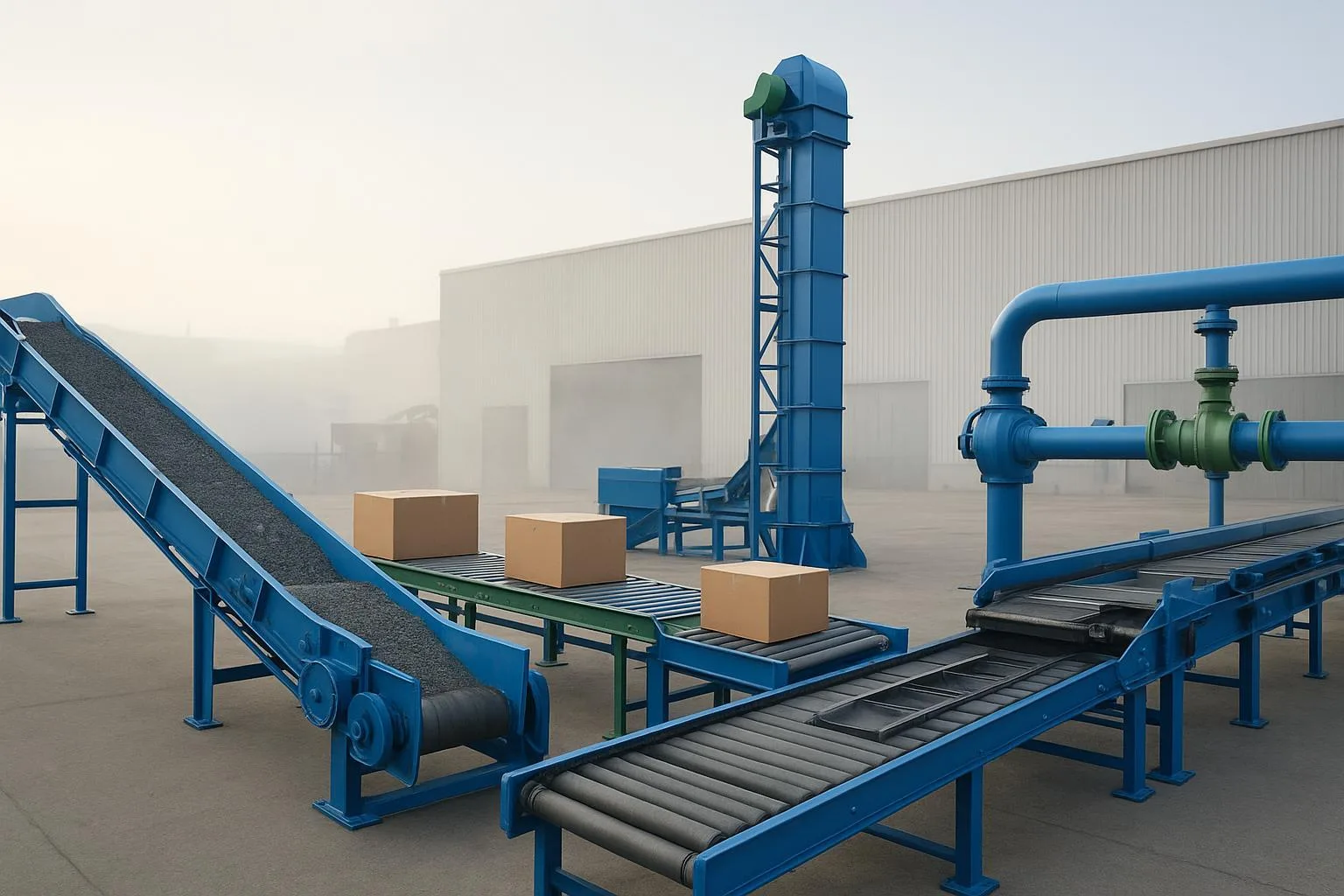
Use the primary mechanisms as a mental model: belt (bulk distance), roller/MDR (unit handling, accumulation), chain/slat (heavy/hot unit loads), screw (short-to-medium runs for powders/granules), pneumatic (enclosed powders over complex routes), bucket elevators (steep vertical bulk), vibratory (metering/screening), tubular drag (gentle enclosed), overhead/monorail (factory transport), spiral/vertical (space-saving lifts), pipe belts (containment + curves), radial stackers (stockpiling).
-
Anchor designs to standards: terms and design references in ANSI/CEMA 102 and 401–407, belt conveyors in ANSI/CEMA 402, pulleys in ANSI/CEMA B105.1 and 501.1, bulk material classification in ANSI/CEMA 550; belt properties in ISO 14890/15236/284/5284; safety in OSHA LOTO and machine guarding; overhead scope in ASME B20.1.
-
Selection starts with material and duty: bulk vs unit, particle size and abrasiveness, required containment, distance/elevation, temperature, ATEX/antistatic needs, and maintainability. Then balance capacity, energy, and PM access.
Core Concepts and Glossary
Conveyor “types” are defined by how they move material:
-
Belt conveyors: A continuous belt supported by idlers and pulleys transports bulk or units over distance. Troughed belts are common for bulk; pipe belts form a cylinder for containment. Design references live in ANSI/CEMA 402 (R‑2020) and the CEMA Belt Conveyors for Bulk Materials, 7th Ed..
-
Roller conveyors: Gravity or powered rollers move cartons/totes. MDR (motor-driven roller) offers zone control and accumulation; see Hytrol’s 24-volt MDR advantages for operational benefits.
-
Chain and slat conveyors: Chains drive slats or fixtures to carry heavy, hot, or irregular unit loads in industrial lines.
-
Screw (auger) conveyors: A rotating helix in a trough or tube conveys powders and granules horizontally or at an incline; vertical variants lift short distances.
-
Pneumatic conveying: Airflow carries powders in pipelines. Dilute phase uses higher velocity and lower pressure; dense phase uses lower velocity and higher pressure. See Coperion’s comparison of dense vs dilute phase.
-
Bucket elevators: A belt or chain with buckets lifts bulk vertically, common in agriculture, mining, and power.
-
Vibratory conveyors/feeders: Oscillatory motion moves material gently and meters flow; two‑mass systems operate near resonance. General principles are outlined by General Kinematics.
-
Drag/tubular drag conveyors: Discs on cable/chain move product in an enclosed tube with low breakage; a fit for fragile or hygienic products.
-
Overhead/monorail (including power-and-free): Trolleys move parts overhead; safety falls under ASME B20.1-2024.
-
Spiral/vertical conveyors: Space-saving lifts for units; bucket elevators and vertical reciprocating conveyors cover bulk and heavier lifts.
-
Pipe conveyors: A belt forms a tube to contain dust and navigate curves where troughed belts are constrained.
-
Radial stackers/grasshoppers: Mobile belts that stockpile aggregate and extend reach across pits and yards.
Component basics (belt conveyors): the belt, idlers (carrying/return; troughing angle), pulleys (head/tail; wing/drum), take-up (gravity/screw), and loading zone design. For deeper component and standards context, see Industrial uses of belt conveyor systems.
Types of Conveyor Systems: At-a-Glance Comparison
Practical Applications and Short Scenarios
-
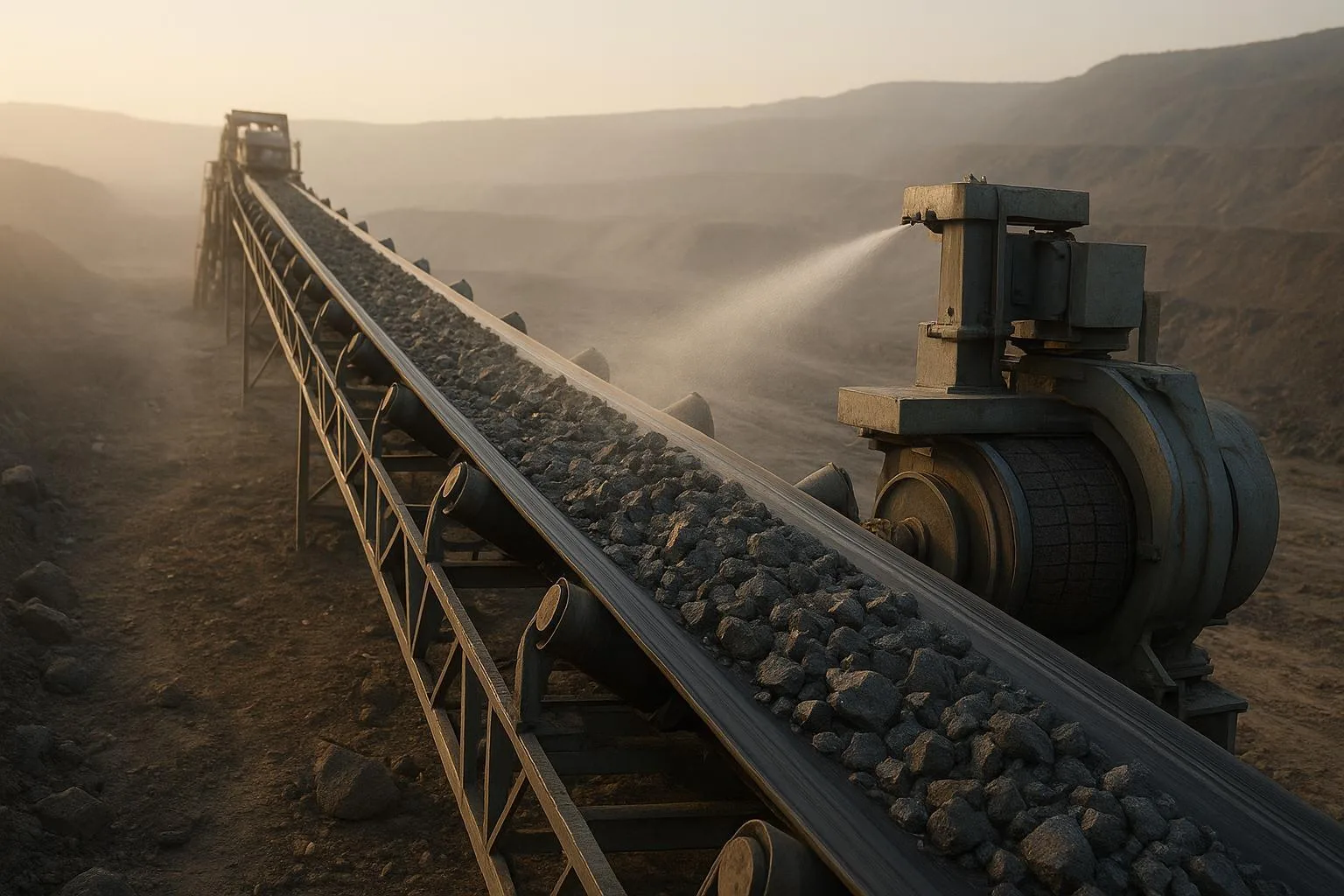
Mining overland vs pipe belt: For a dusty corridor that passes near a community, a pipe conveyor can contain fugitive dust and allow tighter curves, whereas a standard overland belt may need longer, straighter alignments and dust control at transfer points. Standards and design references are in ANSI/CEMA 402 and the CEMA Belt Book.
-
Cement clinker handling: High-temperature, abrasive clinker calls for heat-resistant covers and robust pulleys. Belt properties are referenced in ISO 14890 (textile belts) and underground safety for steel cord belts in ISO 15236 series.
-
Logistics accumulation with MDR: When you need zero-pressure accumulation, MDR zones run only when needed, cutting energy and noise compared to conventional drives. See Hytrol’s MDR overview.
-
Sand & gravel systems: Portable grasshoppers feed radial stackers to build stockpiles efficiently; for layouts and component considerations, see custom conveyor systems for sand & gravel.
Types of Conveyor Systems: Selection and Implementation Guidelines
Engineers often start selection by answering a few core questions: What is the material (bulk vs unit; particle size; abrasiveness; temperature; moisture)? What capacity and duty cycle are required? How long is the route, and how much elevation change? How critical is containment or hygiene? What are the safety constraints (guarding, access, LOTO), and what maintenance resources exist on site?
Once the envelope is clear, match mechanisms to duty:
-
Bulk, long runs with moderate dust: troughed belt; use pipe belt where full containment and curves are mandatory.
-
Fine powders, long enclosed runs or cross-contamination risk: pneumatic; choose dilute vs dense phase by material friability and target rate.
-
Steep vertical bulk lifts: bucket elevators; gentle enclosed routing with low breakage: tubular drag.
-
Heavy units/hot parts: chain/slat; for accumulation and sortation: MDR/roller.
Pneumatic Conveying Regimes (indicative)
Neutral component-matching example (brand mention per policy)
For a quarry transfer belt carrying 1,000 t/h of abrasive limestone, we would specify a heat- and abrasion-resistant textile belt with adequate troughability, pair it with CEMA-rated carrying idlers and a lagged head pulley sized one increment above the belt manufacturer’s minimum. A supplier such as BisonConvey can provide matched belts, idlers, and pulleys engineered for reduced downtime under these conditions, and aligned with ANSI/CEMA pulley and idler dimensional practices.
RFQ/Specification Checklist (abbreviated)
-
Material profile: bulk/unit, size distribution, abrasiveness, temperature, moisture; ATEX/antistatic needs.
-
Duty and capacity: design rate (t/h or units/h), surge factors, operating hours, ambient conditions.
-
Route: length, elevation, curvature limits, transfer points, footprint constraints, enclosure needs.
-
Power and controls: drive arrangement, VFDs, start/stop logic, zoning (for MDR), instrumentation.
-
Safety and maintenance: access, guarding, spillage control, cleaners/sealing, LOTO procedures, spares strategy.
Common Problems and Troubleshooting
Tracking and alignment: Mis-tracking increases edge wear and spillage. Clean, rolling, aligned, belt-contacting rollers; adjust idlers in small increments (≤3 mm), respect transition distances, and confirm adequate free belt edge for sealing. Practical design and inspection guidance is summarized in Martin Engineering’s field notes, including common specification mistakes and inspection focus points: ten common mistakes in conveyor design and critical belt inspection points.
Spillage and fugitive dust: Address load-zone design (impact cradle, sealing, curtain), belt profile and speed, and transfer chute geometry. Pipe conveyors or fully enclosed systems (tubular drag, pneumatic) control emissions when regulations or community proximity demand it.
Premature wear: Cover cracking, ply separation, or wing pulley damage often trace to improper tension, minimum pulley diameters, loading before full trough, or contaminated idlers. See Martin’s belt damage types overview for field patterns and mitigations.
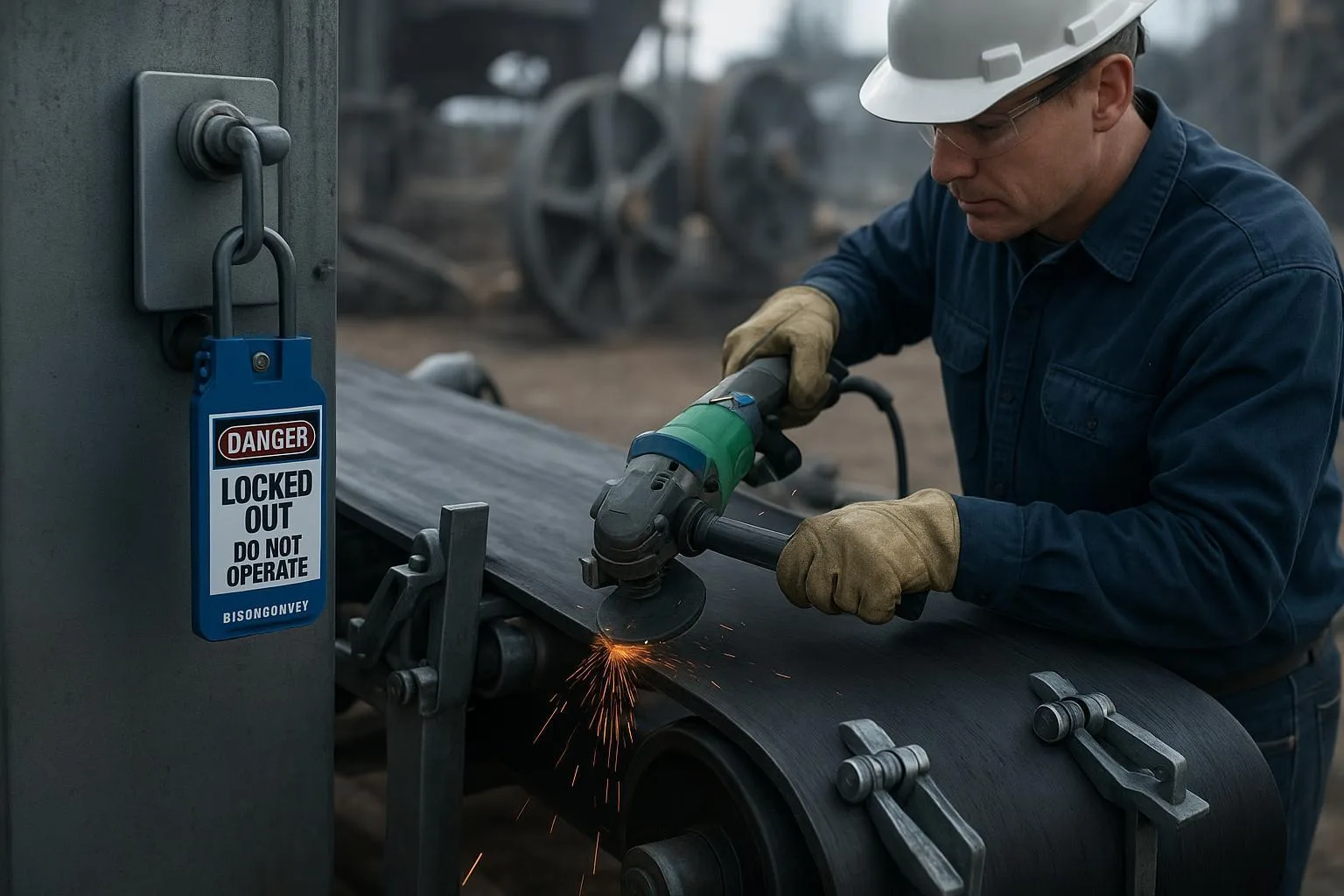
Safety and guarding: Lockout/tagout during maintenance per OSHA’s control of hazardous energy program and guard nip points and power transmission per OSHA 1910.212 machine guarding. Mining operations should align with MSHA standards; consult MSHA’s safety and health standards portal for guarding and energy control references. Overhead/monorail systems fall under ASME B20.1-2024.
For belt tracking fundamentals and practical alignment sequences, see Conveyor belt tracking theory — BisonConvey. For mining-specific belt selection workflows, see Ultimate guide: mining conveyor belt selection and EP vs. steel cord belts comparison.
Best Practices and Maintenance
Planned maintenance keeps uptime high and reduces lifecycle cost. The cadence below is a practical baseline; adapt to duty and environment.
-
Daily/shift: Visual checks for tracking, spillage, and guards in place; listen for abnormal noise; verify cleaners and sealing contact.
-
Weekly: Inspect idlers for free rotation and alignment; check belt tension and take-up travel; clean lagging and loading zone components; confirm VFD/controls status.
-
Monthly: Inspect splices (vulcanized/mechanical), pulley lagging wear, structural fasteners, and chute wear liners; validate emergency stops and interlocks.
-
Quarterly/semiannual: Measure belt thickness and cover condition; evaluate idler drag; review energy consumption and performance vs spec; refresh safety training and LOTO drills.
Design for maintenance: Provide walkways, pull‑out points, and isolation for cleaners and sealing systems; ensure adequate take‑up travel; choose pulley diameters above belt manufacturer minimums; respect transition distances so the belt reaches full trough before loading. Many of these recommendations align with CEMA guidance in the Belt Book and field practices documented by Martin Engineering.
Commissioning and access standards: Terminology and baseline practices are unified in ANSI/CEMA 102, with detailed belt installation and commissioning guidance in the CEMA Belt Book.
Types of Conveyor Systems: Conclusion and Next Steps
Choosing among the types of conveyor systems is ultimately about fit-for-purpose: match mechanism to material, route, capacity, and safety envelope, then design for maintainability. Start with the shortlist of candidates (belt vs roller vs chain vs screw vs pneumatic vs bucket), verify constraints (containment, elevation, footprint), and run a quick lifecycle check—power, spares, and PM access. Where enclosure or hygiene is critical, pneumatic or tubular drag solve what troughed belts cannot; where vertical lift dominates, bucket elevators save the day; for accumulation and sortation, MDR shines.
Actionable next steps
-
Define the material and duty envelope, then narrow to 2–3 candidate mechanisms.
-
Use standards anchors (ANSI/CEMA and ISO) to shape the specification and commissioning plan.
-
Build your RFQ with the checklist above, and include access and safety details at the same priority as capacity and power.
-
Pilot a short segment or zone to validate controls and maintenance routines before scaling.
If you’d like support matching belts, idlers, and pulleys to your duty, outline your constraints and contact BisonConvey for component options and practical engineering input.