Belt conveyors are the backbone of bulk material handling. When they are correctly specified, installed, and maintained, they deliver steady throughput at a lower total cost than trucks or loaders for many duties. This guide explains the industrial uses of belt conveyor systems across sectors, the core components and standards you should know, and a practical path from selection and commissioning to troubleshooting and reliability.
Key takeaways
-
Belt conveyors serve mining, cement, ports, power, manufacturing, and agriculture with continuous, efficient transfer of bulk materials.
-
Sound selection depends on duty, geometry, belt construction, idler class, pulley design, drive power, and safety provisions referenced to recognized standards.
-
Most chronic issues trace back to fundamentals such as loading, alignment, tension, sealing, and housekeeping—address root causes, not symptoms.
-
A tiered maintenance plan plus condition monitoring and verified guarding keeps availability high and risk low.
Core concepts and technical foundations
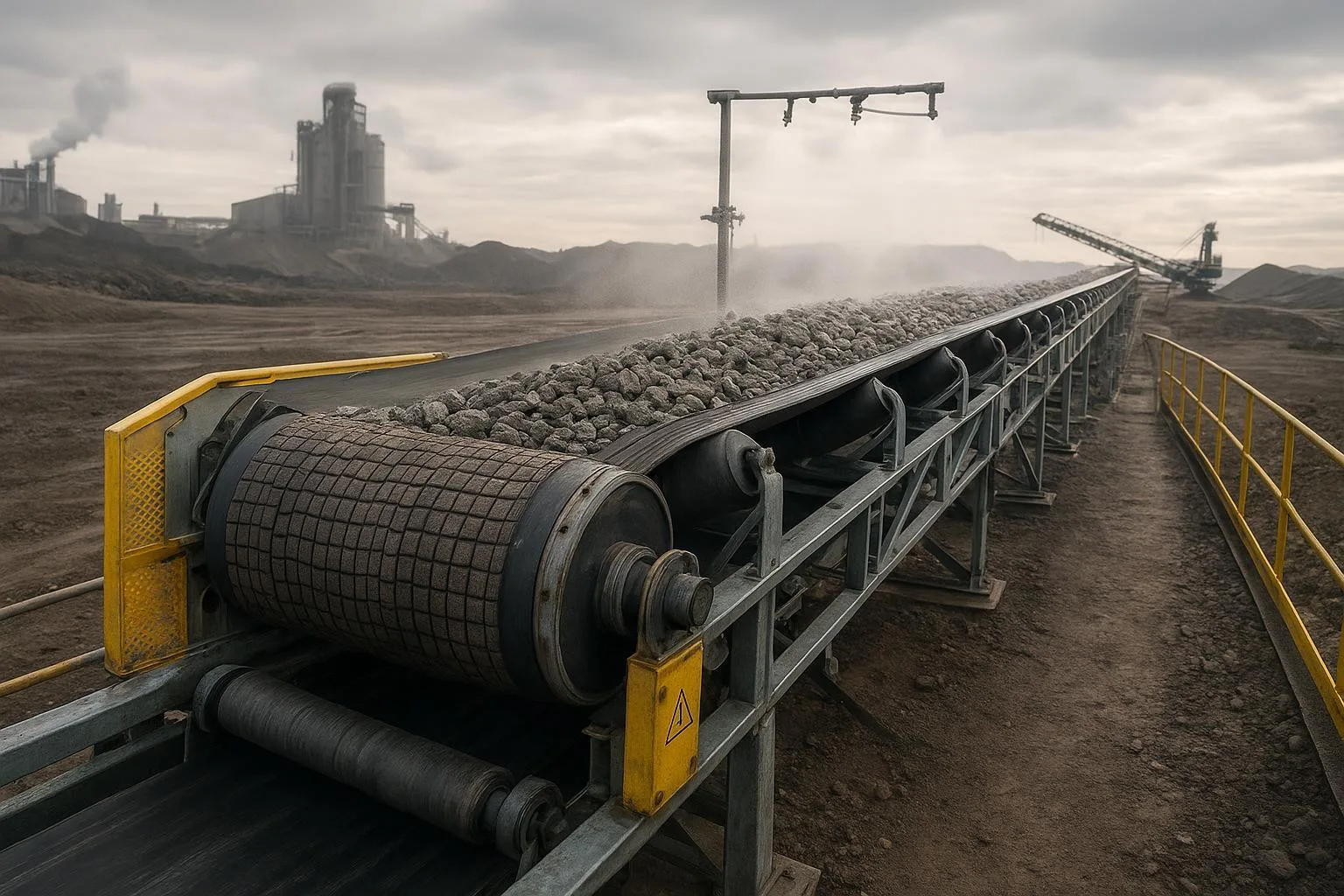
A belt conveyor moves bulk material on a continuous looped belt supported by idlers and driven by a motorized pulley arrangement. On the carry side the belt forms a trough to contain material, then returns flat beneath the structure. Reliable operation comes from getting the details right—belt construction, idler quality, pulley selection, tension control, and transfer design. Material should enter near the belt centerline through a well-shaped chute; troughing idlers limit sag and stabilize the load; the drive pulley applies tractive force while a take-up keeps tension as the belt elongates; at discharge, belt cleaners remove residual carryback before the return run.
Main components with plain language glossary
-
Belts: The moving element. Textile carcass belts for general service; steel cord belts for long, high-tension routes. Cover rubber is chosen for abrasion, heat, oil, or flame resistance.
-
Idlers: Roll assemblies that carry and return the belt. Class and sealing quality govern load capacity and life.
-
Pulleys: Head, tail, bend, and take-up pulleys redirect and drive the belt. Lagging on the drive improves traction and wear life.
-
Drives and controls: Motors, gearboxes, and VFDs provide power and speed control. Controls include interlocks and emergency devices.
-
Frames and stringers: The steelwork that holds alignment. Small squareness errors can create big tracking problems.
-
Chutes and sealing: Good transfer and skirting minimize spillage and dust, protecting components and housekeeping.
Standards at a glance
-
Power and tension checks follow the method scope of ISO 5048; accessible DIN/ISO-style derivations are summarized in public academic sources that align with industry practice.
-
Minimum pulley diameters are set using ISO 3684 to protect carcass and splices under stated applicability limits.
-
Textile carcass belts are covered by ISO 14890; steel cord belts by the ISO 15236 series.
-
Static control relies on electrical resistance properties in ISO 284 for conveyor belts and ISO 21178 for light belts.
-
Idler classes and dimensions are standardized in CEMA Standard 502, supporting interchangeability and class selection.
-
Drum and wing pulley specifications are defined in ANSI CEMA B105.1 and CEMA 501.1 respectively.
-
Safety frameworks call for guarding nip points, emergency stop devices, and lockout practices under OSHA for general industry and MSHA for mines, with UK HSE guidance widely referenced for guarding hierarchy.
For formal scope and definitions, consult ISO’s catalogue pages for ISO 5048 and ISO 3684. CEMA’s publications resource explains access to CEMA 502 and pulley specifications. When stating conformance in specs or audits, cite the exact document and edition.
Industrial Uses of Belt Conveyor Systems by sector
The industrial uses of belt conveyor systems span heavy, abrasive services outdoors to clean, controlled transfers inside plants. Typical patterns by sector are summarized below.
Sector overview table
| Sector | Typical materials | Duty constraints | Common belt types and layouts |
|---|---|---|---|
| Mining and quarrying | Ore, coal, aggregates; wet fines and large lumps | Abrasion, impact, weather, long distances | Steel cord for overland; EP textile for plant; long troughed belts with take-ups |
| Cement and building materials | Limestone, raw meal, clinker, cement | High abrasion, heat at clinker, dust containment | Heat resistant covers; EP or steel cord; enclosed transfers to control dust |
| Ports and bulk logistics | Grains, fertilizers, ores, coal | Weather exposure, high throughput, mobility at berth | Fixed and mobile conveyors, shiploaders, stackers and reclaimers |
| Power generation | Coal, biomass, gypsum, ash byproducts | Dust and fire risk management, long operating hours | Enclosed or covered belts, robust cleaners, reliable scales |
| Manufacturing and packaging | Components, boxes, light bulk | Clean environment, static control, hygiene for some goods | Light conveyor belts; flat runs; variable speeds |
| Agriculture and bulk commodities | Grain, seed, fertilizer | Dust explosions risk, outdoor exposure | Covered belts, gentle handling features, mobile stockpilers |
-
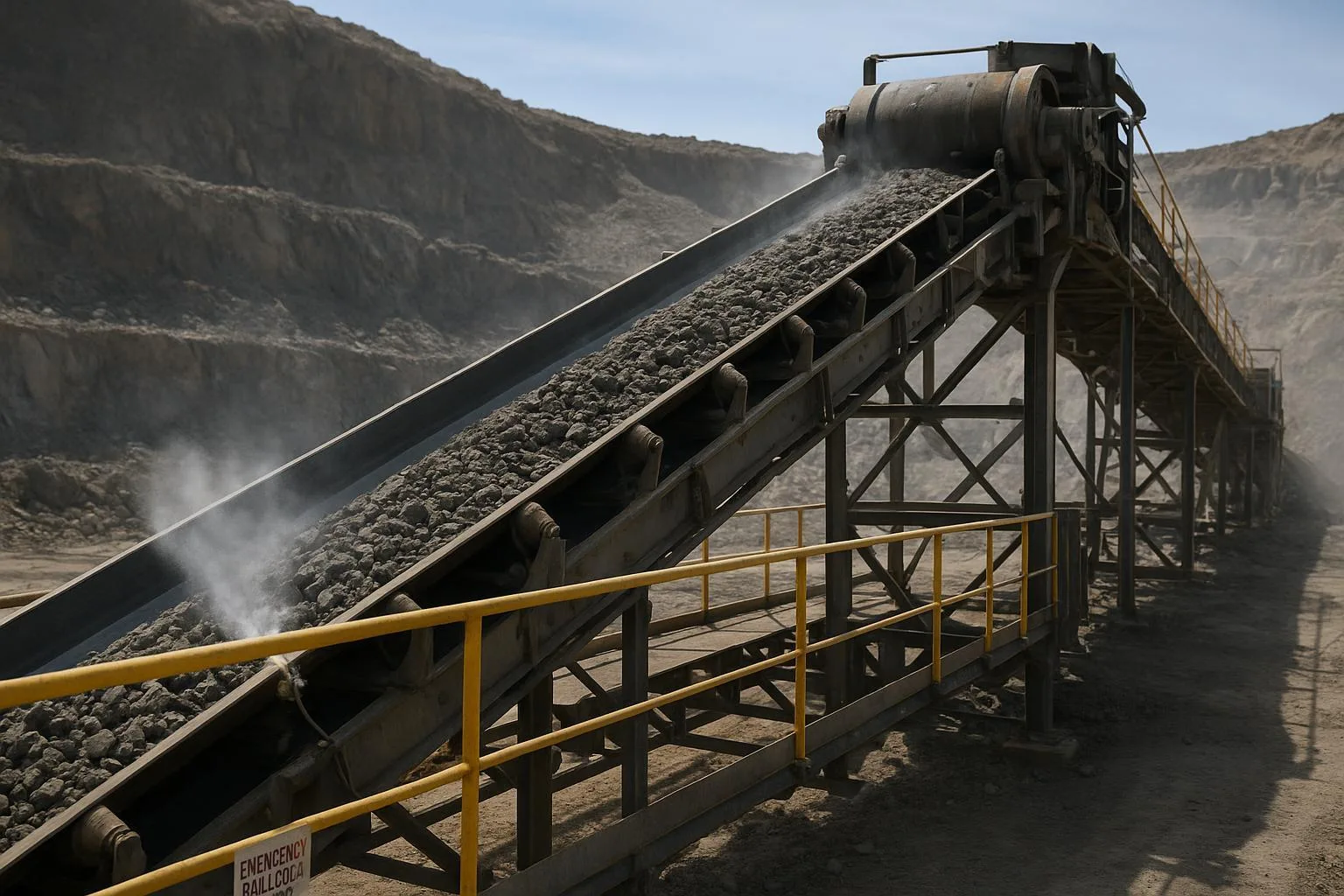
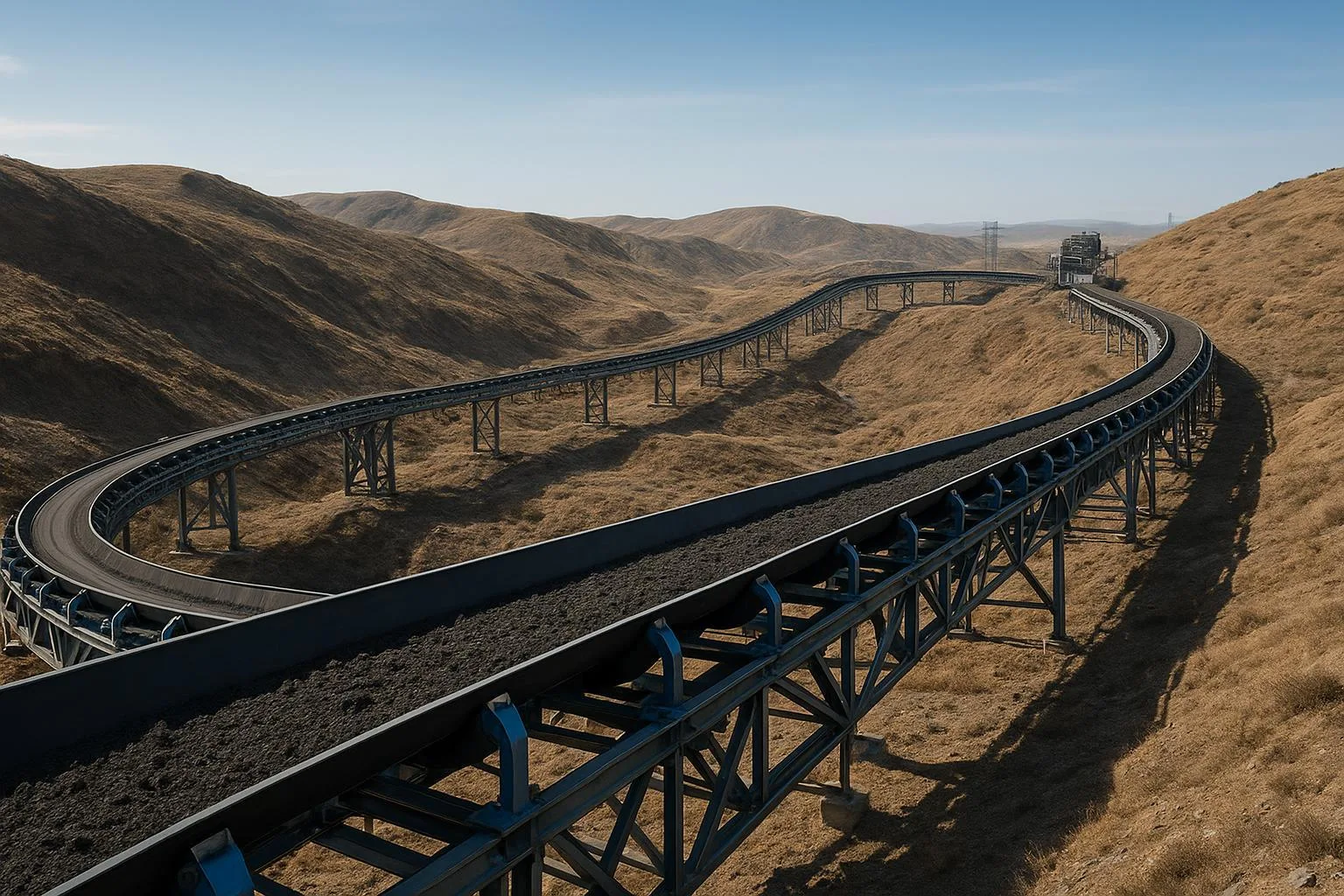
Mining and quarrying: Long overland conveyors move ore or coal to processing with fewer transfer points; in-plant belts handle crushing, screening, and storage. Strong guarding and pull-cord emergency stops along travelways are common practice in regulated mines.
-
Cement: From quarry to raw mill and from clinker cooler to finish grinding, conveyors move highly abrasive and sometimes hot material. Heat-resistant covers and well-sealed loading zones are standard.
-
Ports and logistics: Quay conveyors and travelling shiploaders transfer bulk to and from stockyards. Wind and salt exposure drive material and component selection.
-
Power generation: Coal and biomass fuel lines favor enclosed conveyors and reliable belt cleaning to limit carryback and dust.
-
Manufacturing and packaging: Cleaner environments call for light belts and static control where needed; for vertical or steep inclines, sidewall belts can be an option—see a concise overview of sidewall applications in the Further Reading note below.
Further reading from the manufacturer’s knowledge base: a short explainer on sidewall belts for steep inclines is available under Sidewall Conveyor Belts on the BisonConvey site.
Selection and implementation guide
Choosing the right conveyor is a structured process. Here is a practical flow you can adapt for RFQs and internal design reviews.
Step-by-step selection flow
-
Define duty and capacity: tph, bulk density, lump size, abrasiveness, temperature, moisture, and duty cycle.
-
Fix geometry and routing: length, lift, curves or transfers, available take-up length, and environmental exposure.
-
Choose belt construction: textile EP or NN for general plant lengths; steel cord for long, high-tension routes. Select cover grade for abrasion, heat, oil, or flame resistance.
-
Select idler class and spacing: align with load severity and environment. Tighten spacing through loading zones to control sag and sealing.
-
Select pulleys and lagging: choose drum or wing per duty; verify load rating and face width; select lagging to meet traction and wear needs; confirm minimum diameters per ISO 3684.
-
Size drives and confirm traction: calculate effective tension and power using an ISO 5048 style method; check drive wrap angle and lagging so the traction ratio stays within the capstan limit.
-
Engineer transfers and sealing: design chutes for centered loading, correct trajectory, impact control, and dust containment; specify primary and secondary cleaners.
-
Safety and compliance: plan fixed or interlocked guards at nip points, emergency pull-cords where people walk, and lockout procedures.
Key calculations and checks with standards context
Effective tension FE is the sum of rolling resistance on the carry and return runs, elevation lift, and special resistances such as skirt friction and cleaners. Drive power P ≈ FE × v ÷ η, where v is belt speed and η overall efficiency. This aligns with the method scope in ISO 5048, while open academic summaries of DIN 22101 style equations offer useful derivations that match industry practice. Traction at the drive follows the capstan relation T1/T2 ≤ e^(μ·α); improve traction by increasing wrap angle, using higher friction lagging, or adjusting tension. For belt integrity, keep maximum running tension below allowable working tension and verify minimum pulley diameters per ISO 3684 for the chosen carcass and cover thicknesses.
For formal definitions, see the ISO catalogue overviews for ISO 5048 and ISO 3684. For day-to-day engineering math, public university papers that summarize DIN 22101 style equations are a practical companion.
Practical example with a supplier neutral note
A cement cooler to silo conveyor moves 300 tph clinker at 120 °C over 85 m with a 12 m lift. An EP textile belt with a heat resistant cover per ISO 14890 suits the temperature; tighter idler spacing through the loading zone improves sealing; a rubber grooved lagging on the drive pulley improves traction. A CEMA 502 class selection appropriate for plant duty and an ANSI CEMA B105.1 drum pulley with sufficient face width and load rating meet the mechanical requirements. Vendors can provide certified prints for idlers and pulleys to verify fit. In practice, teams often ask a component supplier to cross check the chosen class, lagging type, and minimum diameters. Where helpful, an experienced manufacturer such as BisonConvey can supply belts, idlers, and pulleys to the above specs and provide drawings for approval before fabrication.
Pre-commissioning checklist
-
Verify structure alignment, centerline, and level; confirm pulley and idler squareness.
-
Check belt splice quality and direction; tension per procedure and verify take-up travel.
-
Test emergency stops and sequence interlocks; document results.
-
Set and tension primary and secondary cleaners; inspect skirting contact and support.
-
Run empty and loaded tests; confirm tracking, sealing, and vibration/noise limits; retighten as required after run in.
Common problems and troubleshooting
A root cause mindset pays off. Many chronic problems trace to loading, alignment, tension, and sealing. The quick reference table below summarizes frequent symptoms, likely causes, verification, and fixes.
Failure mode quick reference
| Problem | Likely root causes | Verification steps | Corrective actions |
|---|---|---|---|
| Mistracking | Off center loading, misaligned frames, uneven idler heights, material buildup on rolls | Check loading profile; measure frame squareness; inspect roll rotation | Center loading; realign structure; clean or replace seized rolls; add tracking devices where needed |
| Slippage at drive | Low tension, insufficient wrap, worn or wrong lagging, moisture or fines on pulley | Observe startup and loading; inspect lagging; check take up travel | Increase tension; increase wrap angle; re lag with higher friction; improve belt cleaning |
| Spillage and carryback | Poor transfer design, inadequate skirting, belt sag, worn cleaners | Inspect chute trajectory; check skirt pressure and belt support; measure cleaner blade wear | Rework chute plates; improve loading zone support; tension or replace cleaners; adjust skirt liners |
| Idler failures | Contamination ingress, overload, misalignment causing edge loading | Listen for noise; feel for hot bearings; check sealing and spacing | Upgrade seals; correct loading; replace with correct class and spacing; add guards |
| Cover wear or splice damage | Abrasion from material or structure, heat, mistracking, incorrect splice geometry | Inspect contact points; measure belt thickness; inspect splice profile | Remove contact points; choose tougher or heat resistant cover; correct tracking; resplice to spec |
Applied practice notes: Routine inspection at defined intervals, correct belt cleaner installation and tensioning, and stabilizing the belt in loading zones are emphasized in industry guidance from Martin Engineering. Their Foundations materials describe dust containment as a sequence—first contain, then collect—so you do not chase dust with collection alone.
Maintenance and reliability best practices
A practical plan blends routine inspections, planned replacements, and condition monitoring—and always validates safety systems. Rising idler temperature or noise indicates seal failure; rapid cleaner blade wear points to carryback or tensioning issues; abnormal tracking only under load suggests loading geometry or chute asymmetry; a thinning belt center often reflects abrasive fines while edge wear hints at structure contact.
Tiered maintenance program
-
Shift or daily: Visual walkdown of loading zones and return side; confirm belt tracking; check cleaner tension and wear; verify guards and pull cords are intact; housekeeping at transfer points.
-
Weekly: Spot check idler noise and temperature; verify take up position; inspect lagging surface and skirting wear; document minor alignment corrections.
-
Monthly to quarterly: Measure belt thickness and splice condition; function test emergency stops in line with site policy; vibration checks on critical pulleys and drives; review trends.
-
Annual or shutdown: Full alignment survey; NDT on critical pulleys where applicable; lagging replacement planning; idler frame audits and batch replacements.
Safety and compliance reminders
-
Guard nip points with fixed or interlocked guards, not just signs and training. Guidance from the UK HSE underscores eliminating or positively guarding roller nip hazards as the preferred hierarchy.
-
Install and test emergency stop devices along travelways; mines often document monthly tests per internal policy and regulator expectations under MSHA programs.
-
Enforce lockout tagout during all maintenance near moving parts and when guards are removed; OSHA 1910.147 sets the U.S. baseline for LOTO practice.
Standards and references in context
-
Power and tension method: see ISO’s overview of ISO 5048 for the standard’s scope and definitions; use public university papers summarizing DIN 22101 style equations for open derivations that align with practice.
-
Minimum pulley diameters: ISO’s catalogue page for ISO 3684 outlines the applicability limits and purpose of the method.
-
Belts: ISO 14890 (textile carcass) and ISO 15236 series (steel cord) define general requirements, dimensions, and performance.
-
Electrical properties: ISO 284 for conveyor belts and ISO 21178 for light belts specify resistance requirements and tests important for static control.
-
Idlers and pulleys: CEMA Standard 502 standardizes troughing and return idler dimensions and classes; ANSI CEMA B105.1 (drum) and CEMA 501.1 (wing) specify pulley construction and recommended load ratings.
-
Safety: OSHA 1910 series and MSHA program policy and safety topics for conveyors set U.S. expectations; the UK HSE’s nip hazard guidance offers widely respected best practices on guarding hierarchy.
Representative starting points include ISO’s catalogue page for ISO 3684 and CEMA’s publications resource for CEMA 502 and pulley specifications, alongside Martin Engineering’s public inspection and belt cleaner resources for applied maintenance techniques.
Conclusion and next steps
The industrial uses of belt conveyor systems are broad, but the selection and reliability principles are consistent. Define duty and geometry clearly, select components against recognized standards, verify traction and minimum pulley diameters, design transfers that load the belt cleanly, and maintain tension, sealing, and housekeeping. Troubleshoot root causes rather than symptoms, and validate safety systems on a schedule.
Action plan you can start this week: review one critical conveyor using the selection flow and verify traction, pulley diameters, and loading geometry against your current duty; walk the system with the failure mode table and log corrective actions; and confirm your emergency stop testing cadence and lockout procedures match your regulatory framework.
If you need component specifications reviewed or drawings provided for belts, idlers, or pulleys, you can start a technical discussion with BisonConvey’s engineering team for custom configurations and approval prints.
Author Senior Mechanical Engineer, Bulk Material Handling 15+ years in mining, cement, and terminals; field commissioning and reliability audits across overland and in-plant conveyors.
Further Reading
-
Sidewall Conveyor Belts overview: https://bisonconvey.com/products/sidewall-belts
-
Belt Conveyor System Design guide: https://bisonconvey.com/blog/belt-conveyor-system-design-ultimate-guide/
-
Conveyor Belt Installation guide: https://bisonconvey.com/blog/conveyor-belt-installation-ultimate-guide/
References
-
ISO overview for minimum pulley diameters, ISO 3684: https://www.iso.org/standard/9149.html
-
ISO overview for general textile belts, ISO 14890: https://www.iso.org/standard/88543.html
-
ISO overview for steel cord belts, ISO 15236 series: https://www.iso.org/obp/ui/en/
-
CEMA publications index for idlers and pulleys: https://cemanet.org/resources/publications/
-
OSHA conveyor references overview 1910 series: https://www.osha.gov/laws-regs/regulations/standardnumber/1910
-
MSHA conveyor safety topic and program policy letters: https://www.msha.gov/safety-and-health/safety-and-health-materials/safety-topics/safety-topic-conveyor-systems
-
Martin Engineering inspection priorities and cleaner guidance: https://blog.martin-eng.com/the-9-most-critical-points-of-belt-conveyor-inspection