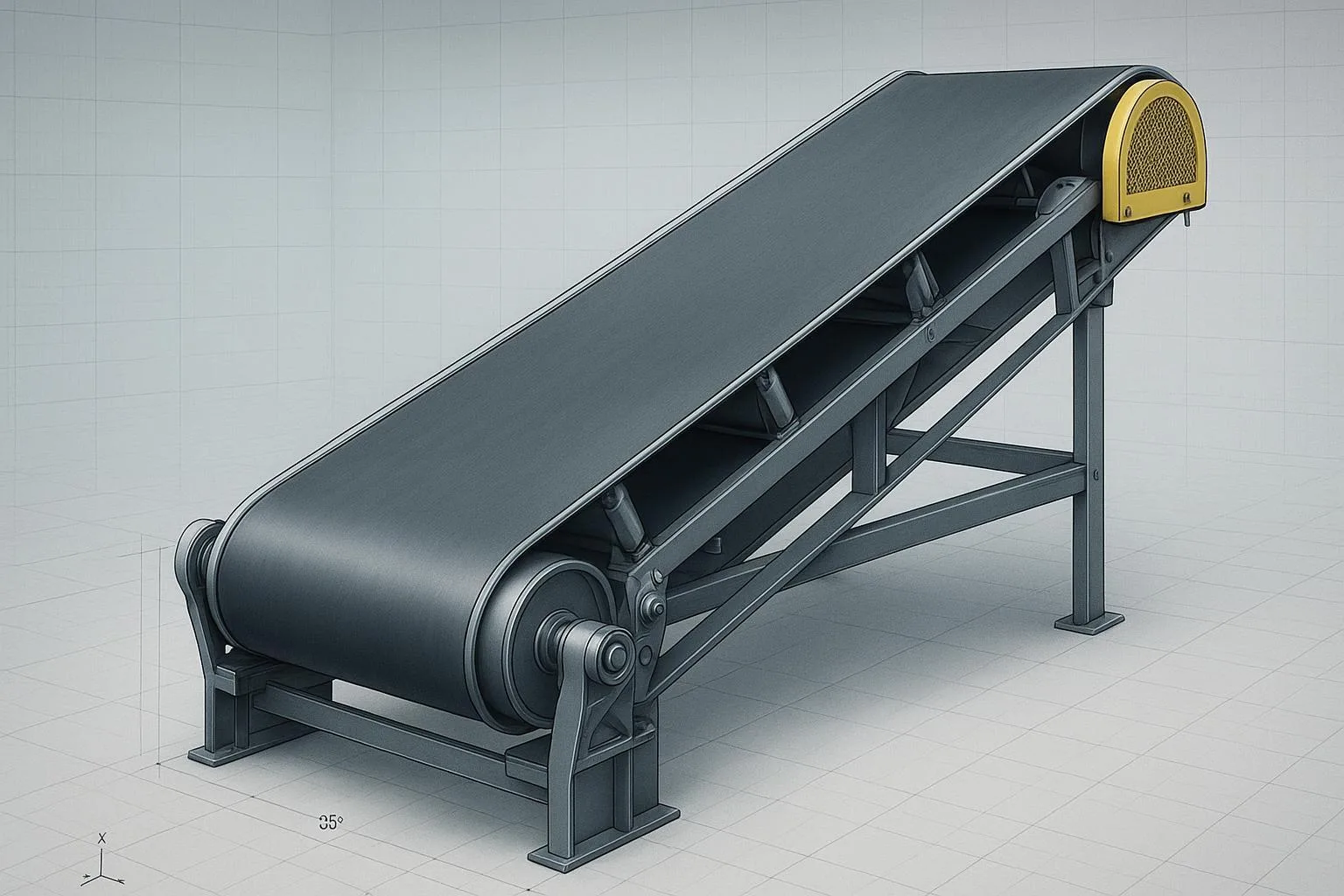
Conveyor Belt Installation Guide
Getting a conveyor to start true, track straight, and run safely for years isn’t luck—it’s the result of disciplined installation grounded in standards and verified measurements. In this Conveyor Belt Installation Guide, I’ll walk through core concepts, step‑by‑step procedures, commissioning checks, and field‑tested troubleshooting—referencing CEMA, ISO, OSHA, ASME, and DIN where they apply.
Key takeaways
-
Correct storage, handling, alignment, and splicing determine most of a belt’s service life; fix issues before power‑up, not after.
-
Align structure, pulleys, and idlers to CEMA practices; verify with laser or piano‑wire measurements and record results for QA.
-
Choose splice method and pulley lagging based on duty, downtime tolerance, and ISO/CEMA guidance; verify workmanship with documented QC.
-
Commission in stages—no‑load to full‑load—while monitoring tracking, tension/sag, power draw, and safety systems per OSHA/ASME.
-
Use a repeatable acceptance checklist and keep logs; if tracking drifts, diagnose causes methodically rather than over‑adjusting.
Core concepts engineers must align on
Belt constructions and ISO references
Conveyor belts broadly fall into two families:
-
Textile‑reinforced belts (EP/NN): specified under ISO 14890 for construction and properties. These are common across mining, cement, and terminals for short to medium flights. See ISO’s catalogue entry for scope and definitions in ISO 14890:2013 on the official site: ISO — ISO 14890 rubber‑/plastics‑covered conveyor belts page: https://www.iso.org/standard/61047.html
-
Steel cord belts: governed by ISO 15236 (series). They support high tensions and long flights; splicing practices and acceptance tests are addressed in ISO 15236‑4 listings on iso.org.
What this means for installation: belt handling, minimum bend diameters, and splice design/QA differ. Always apply the belt manufacturer’s method alongside ISO references for acceptance testing.
Idlers and CEMA classes (what they standardize)
CEMA No. 502 standardizes idler dimensions and classes (B through F, with later additions such as G), aligning load and life expectations so designers can select rolls and frames consistently. Public CEMA committee minutes confirm ongoing updates to class dimensions and training device guidance. Engineers should choose the class to suit calculated loads and desired L10 bearing life, then set spacing to control sag and power draw. For an accessible overview of idler support roles consistent with CEMA conventions, see Martin Engineering’s knowledge base on belt support.
Pulleys, alignment, and lagging choices
-
Alignment: Head, tail, and snub/bend pulleys must be parallel and square to the conveyor centerline; verify with laser tools. Many plant specifications target tight parallelism and minimal angular error to avoid chronic tracking issues; definitive installation tolerances are guided by CEMA’s Belt Book Appendix D (paid access; see CEMA technical downloads index for acquisition details).
-
Lagging: Select lagging to match abrasion, moisture, and traction needs. Ceramic tiles in rubber improve traction and life in abrasive, high‑tension service; grooved rubber helps shed water and fines; plain rubber is adequate for milder duties. Dodge Industrial and Douglas Manufacturing catalogues discuss these selection cues and pulley machining quality.
Tension, sag, and take‑up systems
Running tension and belt sag are two sides of the same coin. The target sag range is set to stabilize tracking, manage impact, and maintain wrap/traction. Take‑up systems (gravity, screw, hydraulic) provide and maintain this tension through the running envelope. During commissioning, verify the available take‑up travel and actual sag against design assumptions (often derived from DIN 22101 style calculations and CEMA methods).
Pre‑installation planning and safety
Before a wrench turns, the goal is to eliminate known failure modes—storage damage, frame twist, out‑of‑square pulleys, and mis‑threading.
-
Storage and handling: Keep belts in a cool, dry, UV‑protected area; don’t stack rolls unless allowed; lift with wide slings and never drag the belt. These practices are consistent across OEM manuals such as ContiTech/Goodyear installation guides indexed by Goodyear Rubber Products’ official catalogue pages.
-
Site readiness: Check stringers for level and centerline straightness; torque structural fasteners; confirm guards can be installed per OSHA and ASME.
-
Energy control and guarding: Apply lockout/tagout per OSHA 29 CFR 1910.147, including the testing/positioning provisions in §1910.147(f)(1). Verify machine guarding per OSHA 29 CFR 1910.212 general requirements before any powered jogs. For conveyor‑specific safety expectations (E‑stops, guarding scope), align with the Safety Standard for Conveyors and Related Equipment described in the ANSI overview of ASME B20.1‑2024.
-
Procurement/spec readiness: Ensure your purchase order language references the governing standards for belting, idlers, alignment, and safety (example clauses appear later in this guide).
Step‑by‑step installation procedures
Threading sequence and preparation
-
Lock out all energy sources and verify zero energy.
-
Inspect pulleys and idlers for damage; confirm rotational freedom and mounting torque.
-
Position the belt roll near the take‑up or tail (per OEM method). Orient carrying side correctly.
-
Pull the belt using a lead rope or winch through the conveyor path with minimal drag; never clamp to belt covers where it can cause ply damage.
-
Set a light pre‑tension at the take‑up sufficient for splice layup.
OEM installation manuals from ContiTech/Goodyear and fabric belt references from Habasit and Lewco detail safe handling, threading, and preparation methods; consult the specific manual for your belt type for illustrations and device setups.
Belt splicing steps and selection
Splice selection is a trade‑off between downtime, life, and duty. Textile belts often use hot or cold vulcanized splices; mechanical fasteners serve quick installs and repairs. Steel cord belts require engineered hot‑vulcanized bias splices with controlled geometry and QC.
Splice methods at a glance
| Method | Typical use | Downtime | Longevity | Notes and references |
|---|---|---|---|---|
| Hot vulcanized (textile) | Permanent service | High | High | Acceptance per ISO 14890; follow OEM recipes (pressure/time/temperature). |
| Cold vulcanized | Moderate duty or time‑limited windows | Medium | Medium | Faster cure; climate‑sensitive; follow OEM adhesive specs. |
| Mechanical fasteners | Temporary/repair/short belts | Low | Lower | Rapid install; more noise/wear; tracking‑sensitive. |
| Hot vulcanized (steel cord) | Long, high‑tension service | High | Very high | ISO 15236‑4 governs vulcanized joints; geometry and QC must be documented. |
For steel cord geometry, Sempertrans’ published instructions describe bias angles (e.g., ~22°), step patterns, and layup tolerances that promote straight tracking; see Sempertrans steel cord splicing instructions on the manufacturer’s site. Always adopt your belt OEM’s specific parameters.
Pulley alignment and conveyor idler installation
-
Establish a conveyor centerline using survey control. Align pulleys square and parallel to this line; measure rim‑to‑stringer distances and use laser tools or piano wire as your primary reference. Public catalogues like Douglas Manufacturing’s highlight machined faces and concentricity as prerequisites for accurate alignment.
-
Install troughing and return idlers per CEMA 502 dimensions for the selected class. Reference the center roll as your datum (not the frame sides) when aligning idlers; this practice is repeatedly emphasized in CEMA committee documents discussing Appendix D alignment.
-
Set initial idler spacing to suit the calculated load and sag targets. Typical engineering practices discussed in public CEMA committee agendas show carry spacing around 1.0–1.5 m, return 2.4–3.7 m, and impact zones ~0.6 m with CEMA 575 beds—verify against your design.
Initial tensioning and take‑up setup
After splicing and alignment, move to controlled tensioning:
-
Verify take‑up travel is clear and adequate for expected stretch/creep.
-
Apply initial tension to achieve a modest sag in typical spans (engineers commonly target on the order of 0.5–1.5% of span, application‑dependent). This stabilizes tracking and avoids drive slippage; confirm by measurement, not feel.
-
If available, compare running tension and power during gradual loading to design estimates from DIN 22101 style calculations. The CEMA‑hosted paper on the world’s longest conventional overland conveyor (CV1103) illustrates the importance of realistic rolling resistance factors (f‑value) in predicting power and tension.
Take‑up systems quick comparison
| Take‑up type | Strengths | Watch‑outs | Best fit |
|---|---|---|---|
| Gravity | Self‑adjusts to loads, simple | Space, mass, travel limits | Long conveyors with variable load |
| Screw | Compact, low cost | Manual adjustment; set‑and‑forget risks | Short conveyors, fixed load |
| Hydraulic | Precise, instrumented control | Complexity, maintenance | High‑tension or critical tracking control |
Commissioning and acceptance tests
The right mindset is “verify, then trust.” Commissioning should be staged and documented.
-
No‑load run: With guards in place per OSHA 1910.212 and E‑stops identified consistent with ASME B20.1 scope, jog and then run at nominal speed. Observe tracking and idler/pulley behavior. Martin Engineering’s technical writing cites CEMA‑derived “normal belt deviation” windows around a few centimeters (e.g., on the order of +25 mm / −±12 mm) under steady conditions; treat such values as typical guidance and verify against your standards and OEM.
-
Staged loading: Increase load to 25%, 50%, 75%, and 100% while monitoring tracking, take‑up position, and motor amps. Compare power to DIN 22101 calculations; large deviations often indicate idler drag or misalignment.
-
Tension and sag checks: Measure sag at representative spans and adjust take‑up to target range; confirm wrap at the drive and inspect for slippage.
-
Capacity verification: Cross‑check belt width, speed, trough angle, and surcharge assumptions against observed flow. For a quick reality check on theoretical capacity during commissioning, use the BisonConvey Conveyor Belt Capacity Calculator: https://bisonconvey.com/tools/conveyor-belt-capacity-calculator
-
Acceptance period: Maintain a 7–30 day log capturing tracking drift, splice behavior, idler temperatures/noise, and power trends before handover.
Primary references for the above workflow include CEMA technical downloads (Belt Book/Appendix D) for alignment philosophy, OSHA 1910.147 and 1910.212 for safety integration, the ANSI overview of ASME B20.1 for conveyor safety scope, Martin Engineering’s CEMA‑based tracking commentary, and the CEMA‑hosted CV1103 paper for power/tension context.
Troubleshooting common problems
-
Persistent one‑direction wander: Often an out‑of‑square splice or a mis‑aligned pulley. Verify splice geometry (bias, steps, centerline) per your OEM method—Sempertrans’ guide shows how tight layup control supports straight tracking—and measure pulley parallelism.
-
Wander that reverses with belt direction: Start with return idlers and the first contact point after the head pulley; small angular misalignment here produces large tracking effects. Align using the center roll datum per CEMA practice.
-
Edge fraying or uneven edge wear: Chronic mistracking or contaminated return idlers. Clean carryback, replace seized rolls, and re‑survey idler frames for twist.
-
Drive slippage in damp conditions: Verify lagging selection (grooved or ceramic) and increase belt‑to‑pulley wrap where possible using snub/bend pulleys.
-
Abnormally high power: Check idler rotation (spin‑down, temperature), belt rubbing points, and structure squareness; compare measured power to DIN‑based estimates to localize friction anomalies.
For accessible primers that align with CEMA logic, see Martin Engineering’s knowledge base on belt support and their World Fertilizer article discussing CEMA‑derived deviation ranges under real‑world conditions.
Maintenance best practices and inspection
-
Routine inspections: Walk the line during operation with appropriate safety controls; listen for idler noise, feel for vibration, and look for belt wander or buildup at return rolls. Replace rough‑running idlers promptly to prevent cascading damage.
-
Guarding and emergency systems: Verify guards remain in place and effective per OSHA 1910.212, and that emergency stops remain clearly identified and functional in line with ASME B20.1 scope.
-
Splice audits: Document each splice with photos, dimensions, and cure parameters; re‑inspect after break‑in.
-
Take‑up and tension: Record take‑up position routinely to track elongation/creep; adjust within the designed travel.
-
Recordkeeping: Maintain alignment survey data, torque checks, splice QC sheets, and commissioning logs; these are invaluable when diagnosing future issues.
Industry example: neutral selection logic in wet, abrasive duty
A coastal port upgrades a 1,000‑mm belt handling wet iron ore. After structural alignment to CEMA practices, the team selects CEMA‑rated D‑class troughing idlers at 1.2‑m spacing in the carry with impact beds at the loading zone, a ceramic‑lagged head pulley to improve traction in wet weather, and a gravity take‑up sized for seasonal load variation. This configuration reduces slippage events and stabilizes tracking through the rainy season without changing belt speed or width. Components similar to this configuration are supplied by providers such as BisonConvey, which offers belts, idlers, and pulleys engineered for heavy‑duty service.
Annex: standards and spec snippets
-
Alignment and installation philosophy: CEMA Belt Conveyors for Bulk Materials (Belt Book) Appendix D; access via the CEMA technical downloads index: https://cemanet.org/resources/technical-downloads/
-
Idlers: Specify compliance with CEMA No. 502 dimensions for the selected class; see CEMA idler committee updates on cemanet.org confirming class dimension standardization.
-
Belting (textile): “Conveyor belting shall conform to ISO 14890; acceptance testing to include tensile and adhesion per relevant ISO methods.” ISO catalogue entry: https://www.iso.org/standard/61047.html
-
Belting (steel cord): “Splices shall conform to ISO 15236‑4 with documented geometry and QC.” ISO 15236 series catalogue: https://www.iso.org/committee/48414/x/catalogue/
-
Safety: “Apply lockout/tagout per OSHA 29 CFR 1910.147 and verify guarding per OSHA 29 CFR 1910.212 before any powered test.” LOTO standard: https://www.osha.gov/laws-regs/regulations/standardnumber/1910/1910.147; Guarding standard: https://www.osha.gov/laws-regs/regulations/standardnumber/1910/1910.212
-
Conveyor safety scope and E‑stops: See the ANSI overview of ASME B20.1‑2024: https://blog.ansi.org/ansi/asme-b20-1-2024-safety-standard-conveyors/
-
Splicing geometry example and QC emphasis (steel cord): Sempertrans instructions: https://conveyor-belts.semperitgroup.com/fileadmin/user_upload/MediaLibrary/ConveyorBelts/Media/Downloads/Steelcord_Belt_Splicing_Instructions-EN-web.pdf
-
Pulley machining/lagging selection cues: Douglas Manufacturing catalogue: https://douglasmanufacturing.com/media/Douglas_Catalog.pdf and Dodge Industrial conveyor components page: https://dodgeindustrial.com/products/mechanical-drives-couplings-conveyor-components/
-
Commissioning power/tension context: CEMA‑hosted overland conveyor paper (CV1103): https://cemanet.org/wp-content/uploads/2019/09/Worlds-Longest-Single-Flight-Conventional-Overland-Belt-Conveyor.pdf
-
Tracking deviation discussion grounded in CEMA: Martin Engineering World Fertilizer article: https://static.martin-eng.com/www.martin-eng.com/articles/World%20Fertilizer%20clip%20(CEMA%20Conveyor%20Belt%20Mistracking)%20Oct,%202024.01.pdf
Conclusion and next steps
Here’s the deal: an installation that’s square, well‑spliced, appropriately tensioned, and commissioned with discipline will save far more time and money than any heroic troubleshooting after startup. Use this Conveyor Belt Installation Guide as your baseline process: confirm safety controls (OSHA/ASME), reference CEMA for alignment, apply ISO for belt acceptance, and verify performance against DIN‑style calculations during commissioning. Keep your survey files, splice QC, and run‑in logs; future you will thank present you.
If you need help specifying belts, idlers, or pulleys for a unique duty or environment, you can contact BisonConvey for engineering support and custom component options.