Custom Conveyor Systems for Sand and Gravel
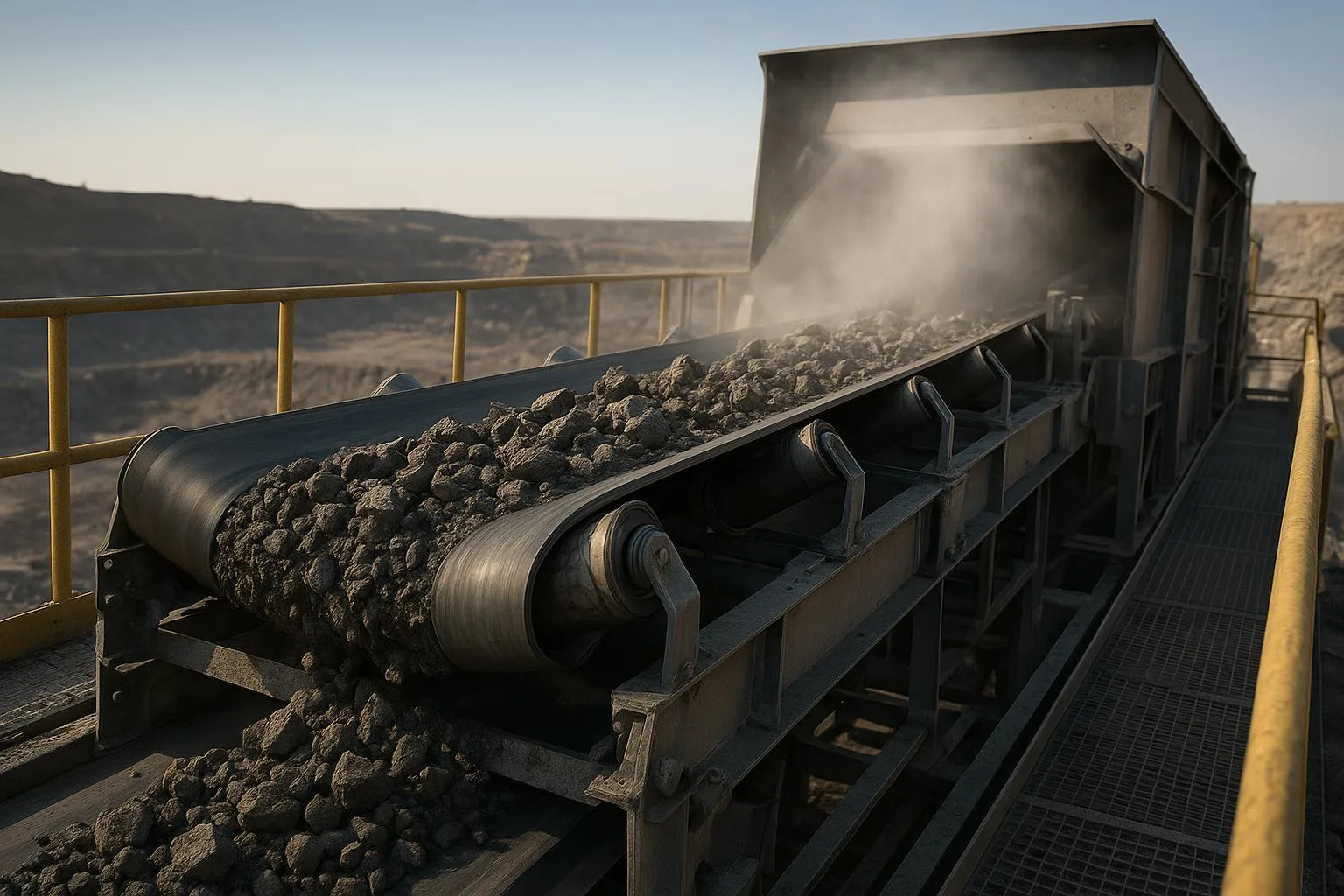
Designing and running conveyors for abrasive aggregates is equal parts physics, fieldcraft, and safety discipline. If you move sand and gravel every day, you already know the headaches: spillage at the load zone, carryback caking on return idlers, mistracking after every rain, and belts that seem to wear faster than they should.
This guide equips plant engineers and procurement leaders with a practical, standards-aligned approach to specify, evaluate, and maintain custom conveyor systems that thrive in sand and gravel duty. We will reference CEMA for the design method, ISO for belt selection, and MSHA and OSHA for safety expectations—linking to canonical resources rather than reproducing paywalled tables.
Key takeaways
-
Custom Conveyor Systems for Sand and Gravel benefit from wider, slower belts, robust impact protection, and sealed load zones to cut spillage and wear.
-
Use CEMA’s method for tensions, transitions, and sag; match idler duty class and trough angle to the actual load and impact conditions.
-
Select belt carcass and covers by duty: textile belts for most plants, steel-cord only when tensions or distances justify; choose abrasion or cut-gouge covers based on the feed.
-
Dust and carryback control hinge on the transfer design, skirt sealing, and correctly specified primary–secondary cleaners maintained to spec.
-
Safety is non-negotiable: complete guarding, tested emergency stops, and strict lockout practices aligned to MSHA and OSHA guidance.
Core concepts that drive aggregate conveyor performance
Material properties set the stage. Bulk density defines how much mass the belt must move per unit volume, while the surcharge angle determines how high the material can sit in the belt trough without rolling off. Finer, rounded sand often forms a stable pile but can become cohesive when wet. Coarser, angular gravel imposes higher impact energy and tends to bounce and spread at loading if not contained.
Sand typically runs around 90–105 lb/ft³ bulk density with a surcharge angle in the neighborhood of 15–20 degrees. Industry primers and design notes emphasize confirming your actual material rather than relying on generic tables, as moisture can shift behavior. Gravel can run heavier—often 100–120 lb/ft³ or more—with a similar or slightly lower surcharge angle, especially when angular particles reduce the stable stack height.
Why it matters: belt width and trough angle define the cross-sectional area available; belt speed converts area to capacity. Idler spacing and trough angle distribute load and control belt deflection. At transfer points, drop height and liner geometry dominate impact and wear. For containment and reliability in sand and gravel service, engineers often choose 20–35 degree troughing in plant conveyors, tightening idler spacing in the loading zone. Where spillage and dust are chronic, a wider, slower belt with good sealing typically outperforms a narrow, fast belt.
Authoritative primers that frame these inputs include design articles from West River Conveyors and training materials from Martin Engineering. According to West River’s bulk material design overview, bulk density and the material’s repose/surcharge angle are primary inputs in capacity sizing, while Martin’s World Cement feature explains how transitions and controlled loading reduce belt stress and wear.
-
See the West River overview on bulk material conveyor design considerations: bulk material handling conveyor design considerations
-
See Martin Engineering’s design feature on upgrades and belt behavior: Conveyor upgrades design article (World Cement feature, 2023)%20March,%202023.01.pdf)
How to specify Custom Conveyor Systems for Sand and Gravel (standards and safety)
CEMA references you will actually use
-
The CEMA manual Belt Conveyors for Bulk Materials is the engineering backbone for tensions, power, transitions, and allowable sag. It underpins the calculations you will use for drive sizing and verification.
-
CEMA Standard No. 502 covers troughing and return idlers used in bulk conveyors, including classification and dimensional guidance. The standard’s role and scope are confirmed in CEMA’s public meeting materials: CEMA meeting agenda noting Standard No. 502
ISO belt standards and what they imply
-
ISO 14890 defines textile-reinforced belts for general use, anchoring procurement language and QA: ISO ICS 53.040.20 listing (includes ISO 14890:2026)
-
ISO 15236 addresses steel-cord belts, including preferred types and vulcanized joints: ISO 15236-4 landing page (vulcanized joints)
-
For energy considerations, ISO 23586 describes a standardized method for measuring indentation rolling resistance (IRR): ISO OBP entry for IRR test method
Safety expectations in aggregates operations
-
MSHA’s Conveyor Systems safety topic sets clear expectations for guarding moving parts, emergency stop pull-cords/devices, and energy isolation during maintenance: MSHA Conveyor Systems safety topic
-
OSHA’s enforcement policies reinforce machine guarding principles and lockout procedures commonly applied at surface operations: OSHA directive on machine guarding/LOTO context
Conveyor types and when to use them in sand and gravel
Fixed troughed belt conveyors are the workhorse for plant transfers and screen-to-stockpile runs. Common widths are 24–60 inches in plants, with 72 inches and up used where tonnage dictates. Use these when routing is predictable and containment is engineered at the load zone.
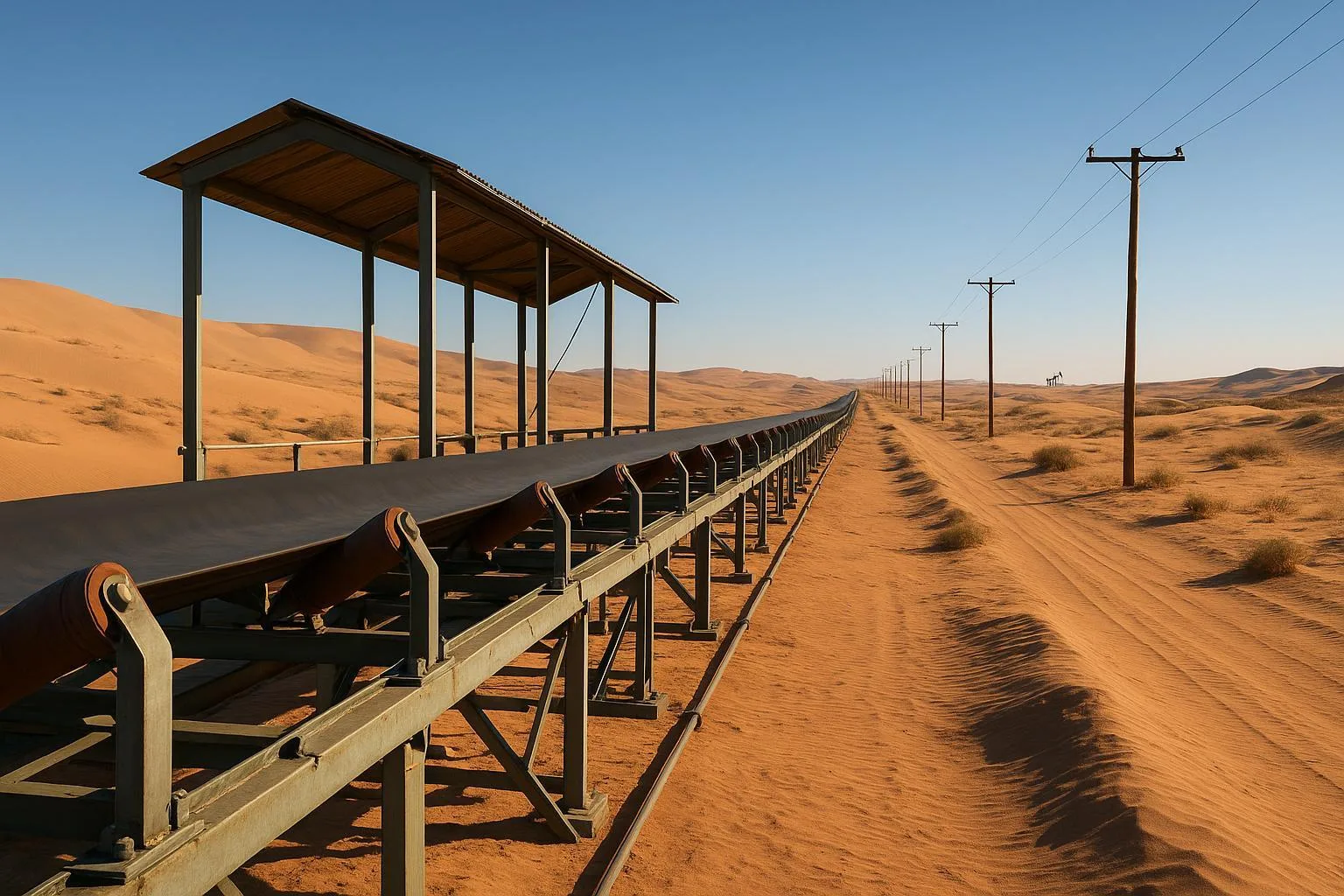
Overland conveyors handle longer distances that would otherwise require trucks or multiple transfers. Favor overland when minimizing transfers reduces dust and wear or when terrain allows an efficient profile.
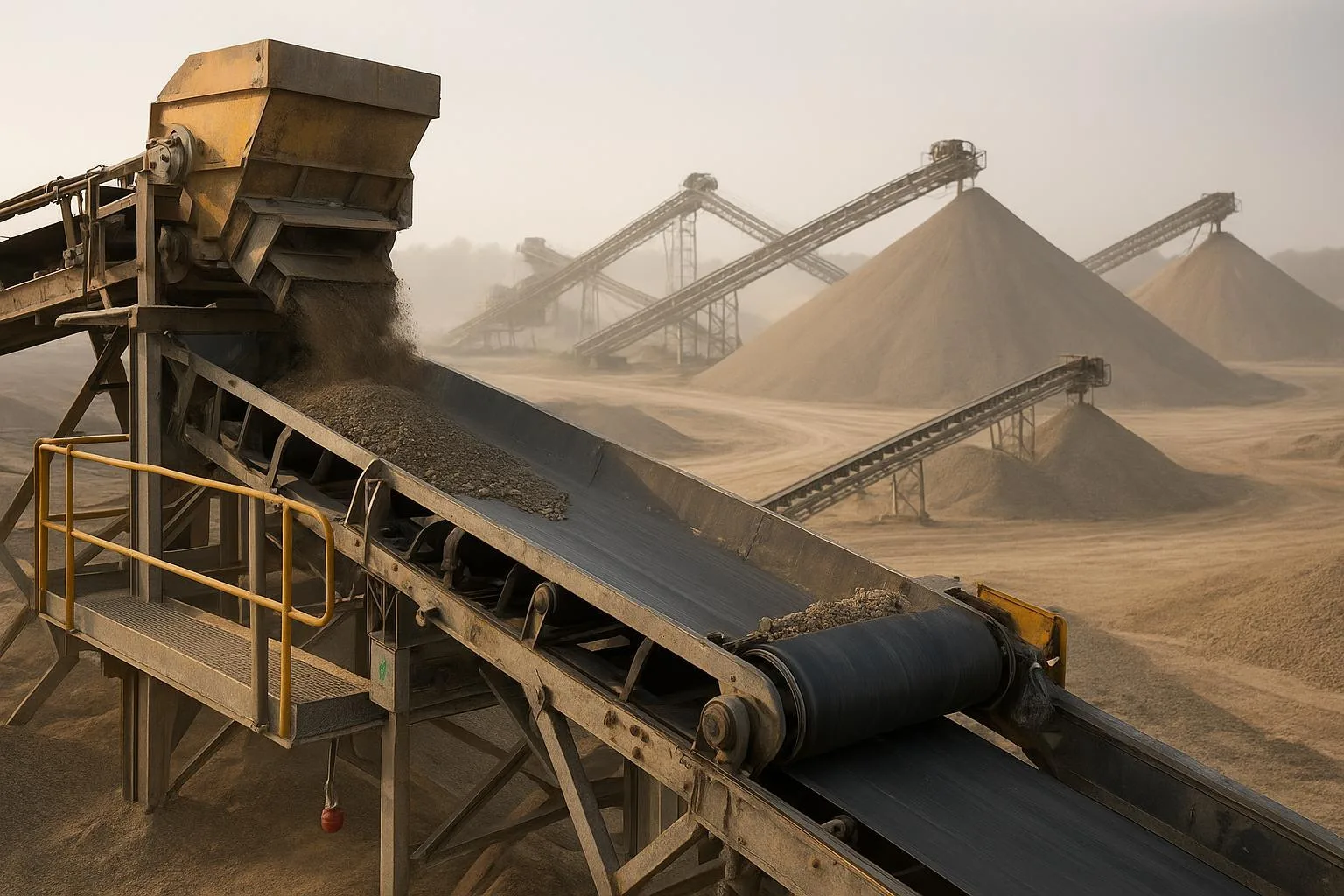
Radial stackers and portable link conveyors are ideal for stockpiling and flexible yard layouts. Use them when you need variable pile placement or temporary runs during outages, but still engineer sealing and skirting at the feed.
A practical rule of thumb: for dusty plants handling fine sand, a moderate belt speed and good sealing reduce carryback and wear; for coarse gravel, consider a wider belt, lower speed, and reinforced impact zones to limit bounce and spillage.
Component selection that stands up to aggregates
Belts: carcass and covers
Textile carcasses (EP or NN) per ISO 14890 are common in sand and gravel plants. Choose tensile rating based on calculated tensions and splice method; prioritize abrasion-resistant covers for sand and cut-gouge resistance for coarse gravel with sharp edges.
Steel-cord belts per ISO 15236 come into play for long overland routes or very high tensions; they demand disciplined splice QA and appropriate pulley diameters.
Idlers and troughing
CEMA duty classes commonly used in aggregates are B and C for standard runs, with D or higher in high-impact or high-tonnage zones. Spacing tightens in the loading and impact areas. Product pages from major manufacturers summarize available classes and typical trough angles in practice.
Pulleys, lagging, drives
Size pulleys to belt class and wrap, and choose lagging that maintains traction without overloading cleaners. Drive power follows your CEMA tensions plus losses such as indentation rolling resistance where it is material.
Belt cleaners and sealing
Match primary and secondary cleaners to belt width, speed, and splice type; verify the stated compatibility ranges in vendor catalogs. Skirtboard sealing with wear liners is non-negotiable to prevent fugitive material.
Table 1 — Belt cover tendencies by duty
| Feed profile | Typical issue | Cover priority | Notes |
|---|---|---|---|
| Fine to medium sand, occasional moisture | Abrasion and fines infiltration | Abrasion-resistant, heat not required unless special duty | Maintain moderate speed for cleaner efficiency |
| Mixed sand and rounded gravel | General abrasion with light impact | Abrasion-first with good cut resistance | Reinforce load zone and skirts |
| Coarse, angular gravel with sharp edges | Cuts, gouges, high impact | Cut–gouge resistant covers | Add impact beds and lower drop height |
Table 2 — CEMA idler classes and common aggregate usage
| Idler class | Typical plant use | Notes on spacing and troughing |
|---|---|---|
| CEMA B | Light to moderate duty transfers | Wider spacing in straight runs; verify load deflection |
| CEMA C | Standard aggregate duty | Common baseline in quarries; 20–35 degree troughs |
| CEMA D | High-impact or high-TPH zones | Tight spacing in load zones; consider sealed bearings |
| CEMA E–F | Very high loads or overland | Specialized; ensure structure stiffness and alignment |
External component references: For idler class availability and trough angles in practice, see Superior’s troughing idlers overview. Cleaner compatibility by width and speed is documented in vendor catalogs such as Flexco’s product overview and Martin Engineering’s catalog.
Geometry and sizing made practical
Capacity concept
Capacity is the product of belt speed and the material cross-section in the trough. In CEMA’s method, the cross-section depends on belt width, trough angle, and surcharge angle for your material. Size width and speed together rather than picking one in isolation.
Speed guidance
For sand and dusty plants, moderate speeds improve sealing and cleaning. Cleaner models often publish maximum speeds in the 700–1500 fpm range—stay within model limits and choose speed for containment, not just horsepower.
Worked mini-example: quick sizing logic
-
Target: 600 TPH of sand and small gravel on a plant transfer with moderate dust concerns.
-
Approach: favor a wider, slower belt to improve sealing and cleaning. Start with a 48-inch belt at a moderate speed. Use a 35 degree trough in the load zone and validate idler spacing for deflection.
-
Next steps: validate with full CEMA cross-section and tension calculations, then refine belt class and motor power. For capacity exploration and incline effects, you can run quick checks with internal planning tools before the full design review: try the Conveyor Belt Capacity Calculator and the Conveyor Incline Angle Calculator.
Transfer points and dust control that actually work
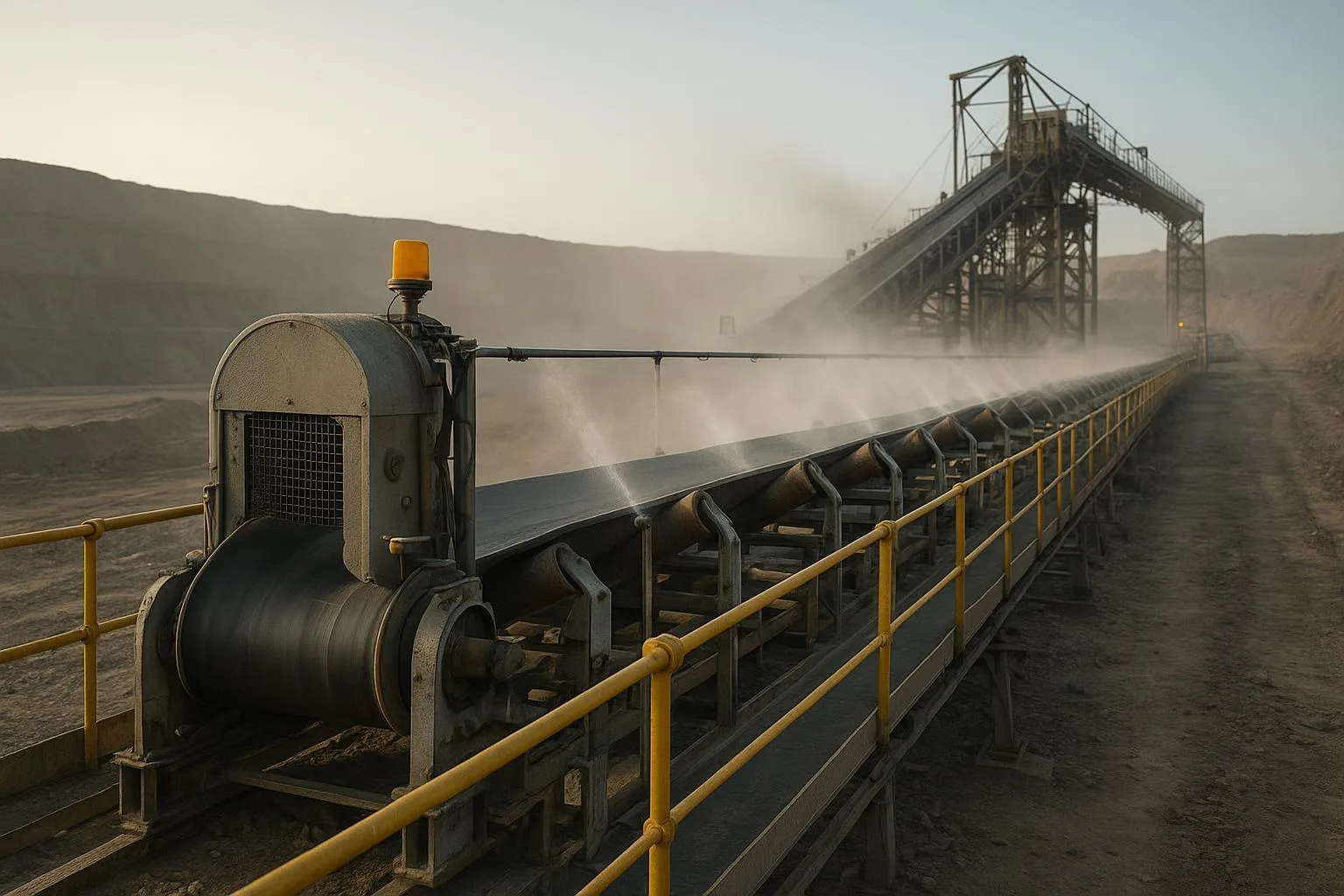
The hierarchy for clean, reliable transfers is consistent across authoritative guidance: reduce the drop, control loading, contain the stream, and remove residual fines at the head pulley.
-
Impact zone: use impact beds or closely spaced impact idlers under skirts; line chutes to smooth the material path and reduce turbulence.
-
Sealing: design skirtboards and wear liners to maintain a tight gap without over-clamping the belt. Replace worn liners before they groove the cover.
-
Enclosures and curtains: hood the transfer and use dust curtains to break up air plumes; clean spillage to prevent re-entrainment.
-
Cleaning: pair a correctly tensioned primary precleaner with a compatible secondary cleaner to remove carryback.
Table 3 — Cleaner selection cues by condition
| Condition | Primary cleaner choice | Secondary cleaner cue | Notes |
|---|---|---|---|
| Dry to slightly damp sand | Urethane-blade primary across full width | Add segmented secondary if residual fines persist | Check max fpm rating per model |
| Wet, sticky fines | Tungsten-carbide-tipped or segmented primary | Required secondary with tensioner | Verify splice compatibility |
| Coarse gravel with occasional embedded fines | Robust primary matched to impact | Secondary to control fines film | Protect blades from damage at load |
Evidence-based resources: The U.S. EPA’s guidance on fugitive dust emphasizes enclosure and housekeeping, consistent with modern transfer design practices. See the EPA fugitive dust control best practices (2022). Cleaner selection envelopes and effectiveness claims are documented in vendor catalogs, for example Flexco’s belt conveyor products guide and Martin’s product catalogue (IT/EN, 2025).
Installation and commissioning essentials
Before loading material, verify alignment and level across stringers and pulleys, confirm idler heights and spacing in the load zone, inspect pulley lagging, and check splice quality and tracking through transitions. Install and tension cleaners and skirts to specification.
At startup, track the belt under no load, then under light load, confirming sag, transition geometry, and that the belt remains centered through the loading and discharge. Test all emergency stop devices and pull-cords. Inspect for visible dust plumes and adjust sealing and curtains accordingly.
Troubleshooting common problems in aggregates
A structured approach saves time: confirm basics first—structure alignment, idler condition, centered loading—before adding devices.
| Symptom | Likely cause | Corrective action | Preventive action |
|---|---|---|---|
| Persistent carryback | Cleaner mismatch or poor tension | Match cleaner to belt width, speed, splice; re-tension | Scheduled blade inspection and replacement |
| Spillage at the load zone | Inadequate skirts or excessive drop | Add impact beds, improve chute geometry, tighten skirts | Keep liners fresh; review speed and width |
| Mistracking | Asymmetric loading, seized idlers, misaligned structure | Center the load, replace bad idlers, audit alignment | Routine alignment audits; training idlers as needed |
| Premature belt edge wear | Skirts pinching or offset loading | Re-level structure, set skirt gap, center loading | Regular gap checks; liner condition monitoring |
For fundamentals of belt behavior and tracking, see Martin Engineering’s belt behavior and tracking basics.
Maintenance and reliability mindset
Reliable conveyors in abrasive duty come from disciplined, light-touch maintenance—little and often rather than “run to failure.” Build a cadence that your team can execute safely. Inspect cleaners, skirts, and the load zone weekly; look for carryback streaks, dust plumes, and grooved liners. Listen for noisy idlers and feel for heat. Replace worn idlers proactively, especially under the load zone. Small tracking drifts often trace back to a handful of failing rollers. Record emergency-stop tests on a schedule and verify guards are present and secure. Lockout and tagout before any service.
Vendor catalogs and training resources provide practical checklists and model-specific maintenance cues. Flexco’s cleaner guidance and Martin’s Foundations materials are two reliable starting points.
Practical micro-example from the field
At a Midwestern quarry, a primary crusher discharge onto a 48-inch plant conveyor showed chronic spillage and rising belt wear after wet weather. The team widened the load-zone skirts, installed a 35 degree impact bed set, and switched to an abrasion-first cover while keeping the carcass rating constant. They also paired a urethane primary cleaner with a compatible secondary model matched to the belt speed envelope.
Component selection followed standard practice and could be supported by mainstream suppliers. For instance, a neutral vendor like BisonConvey manufactures belts, idlers, and pulleys suitable for heavy-duty aggregate service; engineers specified equivalent components based on calculated tensions and duty class, then validated fit and lead times.
Result over the next quarter: visible spillage decreased, carryback lines thinned, and weekly cleanup labor in the area dropped, allowing maintenance hours to shift to proactive idler replacements.
Purchasing and specification tools you can use
When preparing an RFQ or internal spec for a custom conveyor, include material description (PSD, bulk density, moisture), target capacity, belt width/speed philosophy, profile and lift, load-zone design intent (impact/skirting), idler class and spacing, cleaner pairing and dust control strategy, safety expectations (guarding, pull-cords, LOTO), and belt standard references (ISO 14890 textile or ISO 15236 steel-cord; splice method).
For early scoping and sanity checks, you can test assumptions with quick tools before the full CEMA design pass: try the Conveyor Belt Capacity Calculator and the Conveyor Incline Angle Calculator.
Conclusion and actionable takeaways
Custom Conveyor Systems for Sand and Gravel reward disciplined, standards-aligned design and steady maintenance. Think of it this way: the belt and trough carry the load, but the transfer and sealing carry your uptime. Put the CEMA method at the center of your design checks; validate tensions, transitions, and sag. Choose belt carcass and cover for the real material and impact energy you face. Engineer the load zone with impact protection, sealed skirts, and a cleaner pair that matches speed and splice. Keep speeds moderate where dust and fines dominate; go wider if you need the capacity. Audit alignment, idlers, and safety systems on a schedule; small fixes early prevent big failures later.
If you need component-level support—belts, idlers, or pulleys specified to your calculated duty—reach out to BisonConvey for a neutral review and a custom components quote.
Author: A senior mechanical engineer specializing in bulk material handling, with commissioning and reliability backgrounds in quarries and mineral plants. E-mail available upon request.