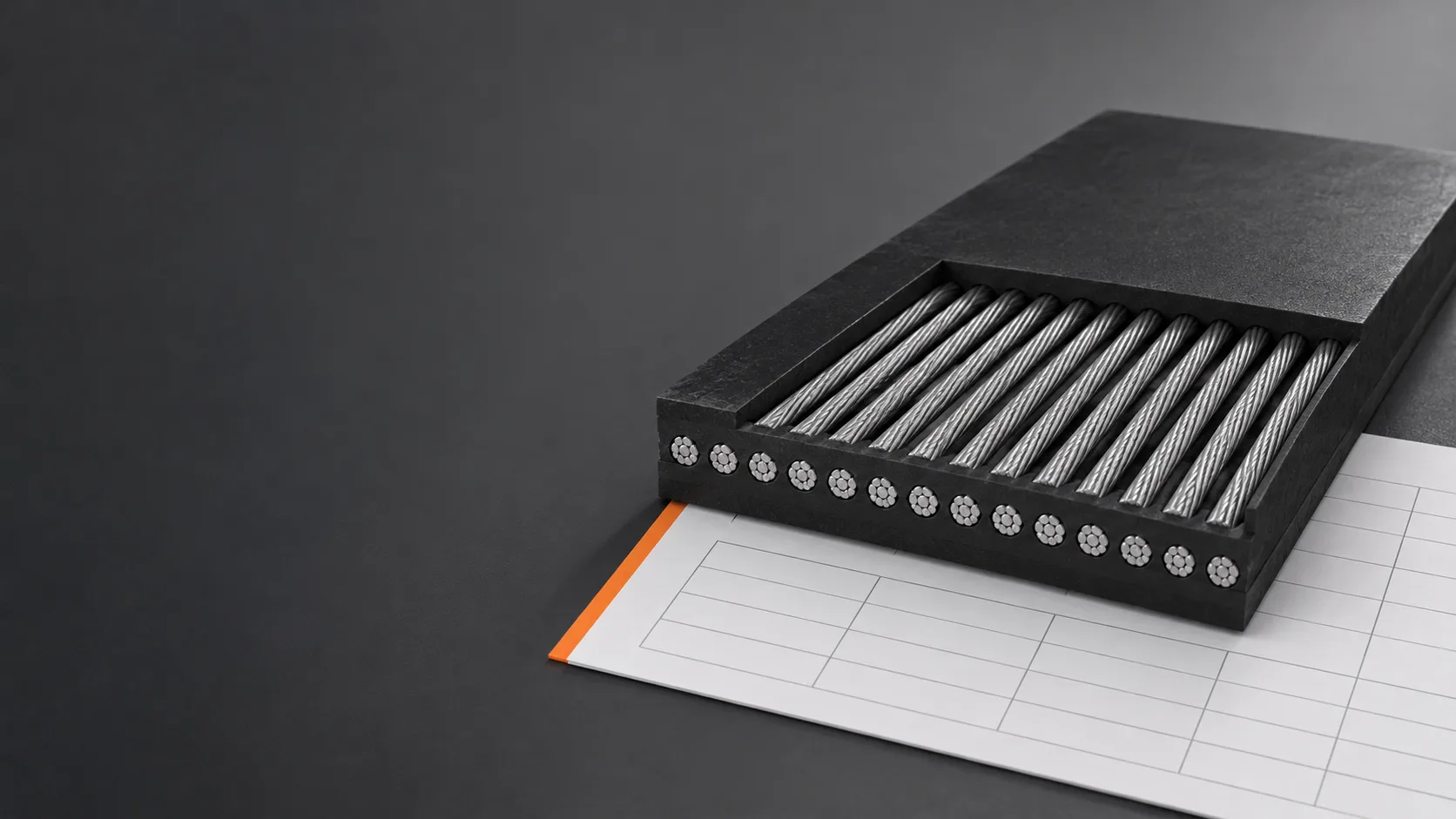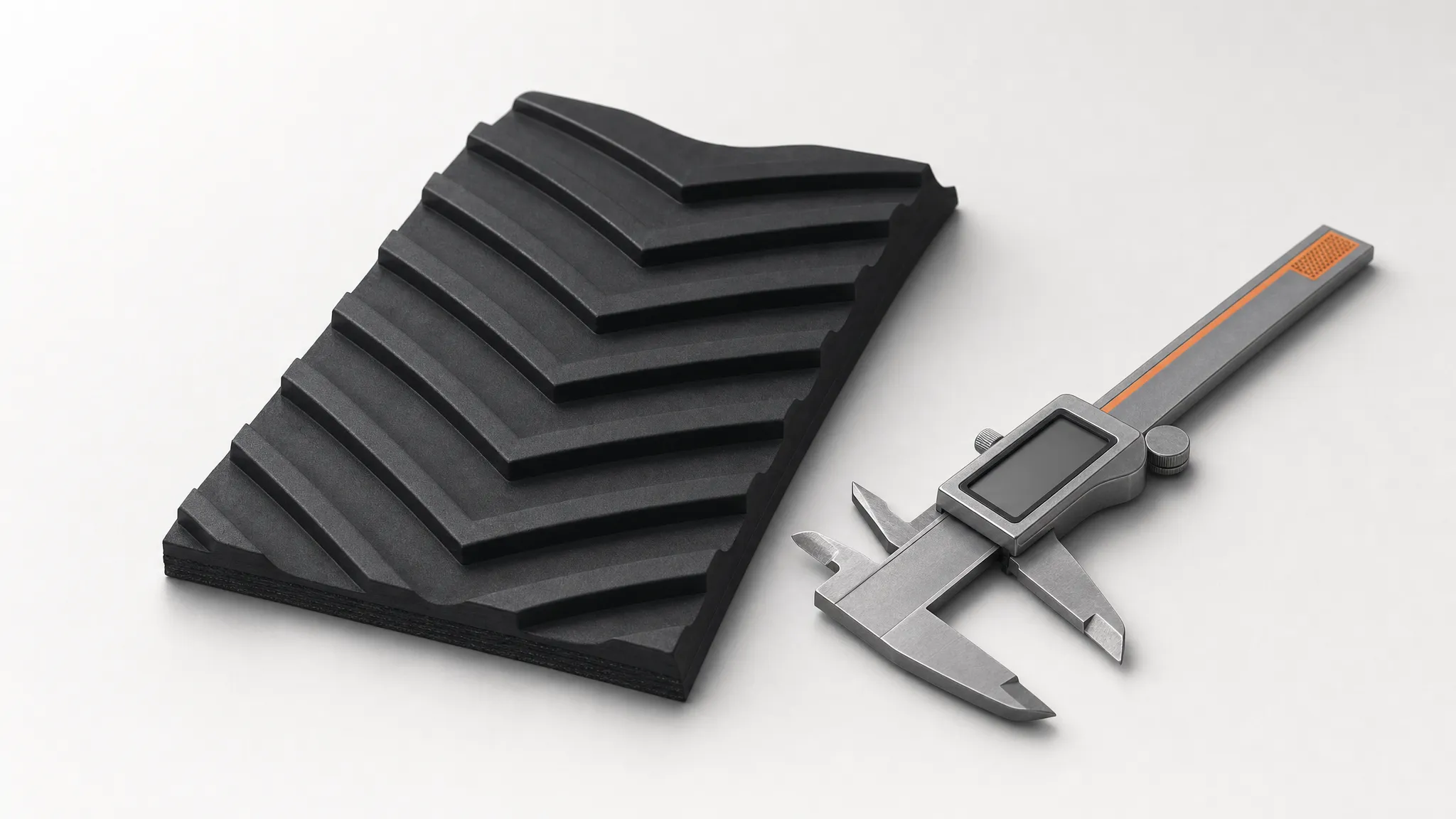
A chevron conveyor belt specification needs a base-belt record, a dimensioned pattern drawing, and a check against the conveyor that will carry it. Belt width and nominal cleat height alone leave room for incompatible quotations. Record the operating duty, define the profile and its clear edges, check the conveyor interfaces, then state exactly what length and delivery form you want priced.
The result should be a request for quotation that suppliers can answer against the same requirements. Keep unknown items visible and separate a preliminary offer from an approved replacement specification. This workflow covers rubber chevron belts for industrial bulk materials; it does not approve a conveyor design or provide installation instructions.
1. Start your chevron conveyor belt specification with the duty
Collect the application data before selecting a pattern code. For an existing conveyor, start with its approved drawings, belt records and operating information. A worn belt photograph helps identify the arrangement, but it cannot establish its original strength, cover grade or unworn cleat height.
| Input | What to put in the RFQ |
|---|---|
| Material | Material name, bulk density, normal and largest lump size, fines and shape |
| Changing conditions | Normal and wet-weather moisture, stickiness, oil or chemical exposure |
| Temperature | Material and ambient temperatures, including sustained and short-duration conditions |
| Conveyor duty | Normal and peak throughput, belt speed, inclination and loading arrangement |
| Operating cycle | Starts, stops, loaded restarts and any reversing operation |
| Reason for purchase | Like-for-like replacement, changed duty or a new conveyor; describe the observed problem |
Treat the required incline as an application input. A profile that works with one material condition may behave differently when moisture, loading or particle size changes. A height code is not an approval for a particular slope. If the belt type itself remains undecided, use the separate material-based incline selection guide before asking suppliers to price a fixed arrangement.
For a replacement, distinguish “retain the existing arrangement” from “correct slide-back or spillage.” Those requests can require different reviews. State whether the proposed belt must fit unchanged equipment or whether modifications may be considered. Otherwise one supplier may price a direct replacement while another assumes new return supports or cleaning equipment.
Complete this step with: one duty sheet, an identified conveyor and a clear statement of what may change.
2. Write the base-belt construction separately
The chevrons describe the carrying surface. The belt beneath them still needs its own specification: width, carcass construction, strength, ply count where applicable, cover thicknesses and cover requirements.
Copy the full existing designation when it is legible, along with the document or marking it came from. Ask the supplier to explain the proposed designation rather than treating similar-looking codes as interchangeable. Make clear whether a stated strength refers to the complete belt, an individual ply or another rating convention. Do not infer the construction from overall thickness alone.
Record the top and bottom cover thicknesses separately. Ask for the total base-belt thickness excluding the projecting profile, and specify the profile height from the carrying-cover surface. This prevents “belt thickness” from meaning the base construction in one quotation and the tallest overall section in another.
Abrasion resistance, oil resistance and temperature suitability are separate requirements. Identify the actual exposure and request the proposed compound and supporting product documentation. “Heavy duty” is too vague to compare. If a test standard or customer specification is required, identify its edition and acceptance requirements; ask the supplier to state what evidence is available for the offered construction.
Also record the required edge construction. Avoid silently substituting cut edges for moulded edges, or vice versa, when replacing an existing belt.
Complete this step with: a base-belt description that can be reviewed independently of the pattern drawing, with uncertain legacy information clearly identified.
3. Attach a dimensioned chevron pattern drawing
A useful chevron belt pattern drawing identifies more than its height. It shows the arrangement in plan view, the profile section and the intended running direction. A supplier's pattern name or code should refer to a specific drawing and revision, not substitute for one.
| Drawing field | What it means | What to confirm |
|---|---|---|
| Overall belt width, B | Full width across the base belt | Nominal dimension and agreed tolerance |
| Profile width, Wp | Transverse envelope occupied by the pattern | Its position relative to both belt edges |
| Clear edge lands, eL and eR | Unprofiled strips outside that envelope | Left and right dimensions separately |
| Cleat height, h | Projection above the carrying-cover surface | Measurement datum; new rather than worn height |
| Repeat pitch, P | Distance between corresponding points on successive repeats | Measurement direction and reference points |
| Pattern geometry | Open or closed arrangement, gaps and profile section | Drawing revision and running-direction arrow |
Where the profile envelope and the two clear edge lands cover the full width, the drawing should satisfy B = eL + Wp + eR. Do not automatically divide the remaining width equally: confirm that the pattern is centered. An offset pattern needs both edge dimensions stated.
DYNA Engineering's chevron catalogue illustrates why these dimensions need distinct labels: its designs identify belt width, cleat width, pitch and profile height separately. Use a catalogue to identify the required fields, then obtain the drawing for the actual offered product. Codes from different suppliers need not describe identical geometry.
Ask how the profile is formed and joined to the base belt. For example, Fenner Dunlop's profiled-belt description identifies a continuous moulding and vulcanizing process for its own product. That is a construction detail to verify on an offer, not a process to assume for every chevron belt or supplier.
Complete this step with: one referenced drawing that makes chevron belt dimensions, orientation and measurement datums unambiguous.
4. Check pulleys, the return run and cleaning equipment
Give the supplier the conveyor interfaces before accepting a proposed construction. This is particularly important when changing cleat height, base thickness, carcass or pattern layout.
Use existing drawings and approved records first. Any physical inspection or measurement around the conveyor must follow the site's isolation procedure and be performed by appropriately qualified personnel. Do not inspect a moving belt to complete an RFQ.
Check every relevant bend
List drive, tail, bend and snub pulley diameters, their positions and any reverse bending. Ask for minimum permitted diameters for the offered base-belt and profile combination, together with any restrictions relevant to the duty.
A single “minimum pulley” figure without a defined construction and pulley role is difficult to assess. For the wider selection logic, the minimum pulley diameter selection guide explains which belt and duty inputs need review. A general calculation cannot replace the proposed belt supplier's limits.
Review what touches the profile
On the return run, the profiled surface may contact the support arrangement. Ask whether the existing return rollers suit the proposed layout and what changes, if any, are required. Interquip's chevron belting information discusses both nested patterns at return idlers and recessed edges for skirtboard contact. These are interface considerations, not details that can be settled from overall belt width alone.
Locate the skirt seals relative to the unprofiled edge lands. Review troughing and support geometry as well: a profile drawing viewed flat does not establish suitability for the installed support arrangement.
Give the supplier the cleaner type and its contact position. Ask whether the existing cleaner can operate on the proposed profile and how cleaning is intended to work. Include discharge requirements, especially where retained material or carryback is already a problem. Do not assume that a different profile can pass unchanged through every existing accessory.
Complete this step with: written confirmation of compatibility or a named list of equipment changes requiring further review.
5. Define length, splice preparation and roll splits
“Supply one belt, length as existing” is an incomplete purchasing instruction. State the delivery form and the measurement basis so the quoted quantity corresponds to what the installation needs.
| Delivery form | Define explicitly |
|---|---|
| Open belt for site splicing | Supplied cut length; whether splice preparation or allowance is included |
| Factory-endless belt | Required finished circumference and the agreed measurement method |
| Multiple rolls | Length of each roll, intended splice locations and permitted handling dimensions |
Record the take-up position or reference used for an existing installation. Distinguish an estimated route length from a verified replacement length. If drawings are incomplete, a preliminary belt-length calculation can support the discussion, but it does not determine splice allowance, supplied cut length or finished circumference by itself.
Identify the proposed splice method and who will prepare and execute it. Ask how the profile arrangement is treated across the joint, including orientation and any required profile-free area. Mechanical lacing, a vulcanized joint and a factory-endless supply should not be treated as equivalent delivery descriptions. Their suitability requires review against the actual construction and conveyor.
Then state maximum roll diameter, allowable handling mass, access restrictions and any required roll split. Ask the supplier to confirm roll dimensions and mass before shipment. A quotation for the right total length may still be unsuitable if the delivery cannot pass through the site's access route or be handled with the available equipment.
Specify identification marks for conveyor reference, roll sequence and running direction where needed. Request the proposed packaging, storage instructions and protection for the profiles; avoid prescribing a universal winding arrangement without supplier confirmation.
Complete this step with: a length and delivery schedule whose quantities, preparation and handling limits can be checked against each offer.
6. Issue the RFQ and close quotation deviations
Package the duty sheet, base-belt record, pattern drawing and delivery schedule together. Give each attachment a revision or date. This prevents a revised profile drawing from being compared with an offer based on an earlier one.
Use the following request structure when preparing a chevron conveyor belt RFQ. It specifies what an answer should address; enter the actual project information from the preceding steps.
Identify the conveyor and state whether equipment changes are permitted.
Reference the duty sheet and base-belt specification by revision.
Reference the pattern drawing, including direction and dimensional tolerances.
Confirm the proposed construction and each pulley/interface requirement.
State open length or finished circumference and the measurement basis.
Identify splice preparation, roll splits, handling limits and packaging.
List the product documents and inspection evidence included in the offer.
Return all exceptions in a separate deviation schedule.
Confirm price basis, delivery scope and proposed lead time for this request.
Ask suppliers to mark each requirement as confirmed, proposed alternative, or information required. An unanswered field remains unresolved; it should not become an assumed acceptance when purchase documents are prepared.
| Offer item | What the buyer should resolve |
|---|---|
| Different pattern code or pitch | Compare the actual drawings and interfaces; approve any substitution explicitly |
| Different base construction or covers | Request the technical basis and identify which requirements change |
| Length quoted without a measurement basis | Obtain clarification before comparing quantities or price |
| Packing, splice preparation or inspection excluded | Establish responsibility and include the difference in the comparison |
| Suitability stated without supporting detail | Request the applicable construction limits and product-specific documents |
A preliminary quotation can contain an alternative or an unresolved question. Before order release, reconcile those items into the accepted specification and offer. The purpose of the deviation schedule is to keep a lower price, a changed construction and an excluded service from looking like the same proposal.
For supplier-scope discussions, the chevron belt product overview provides the category reference. Send the duty sheet and drawing through a chevron belt specification inquiry. BisonConvey can coordinate the requirements with suppliers; availability, technical documents, delivery terms and the parties responsible for the order require project-specific confirmation.