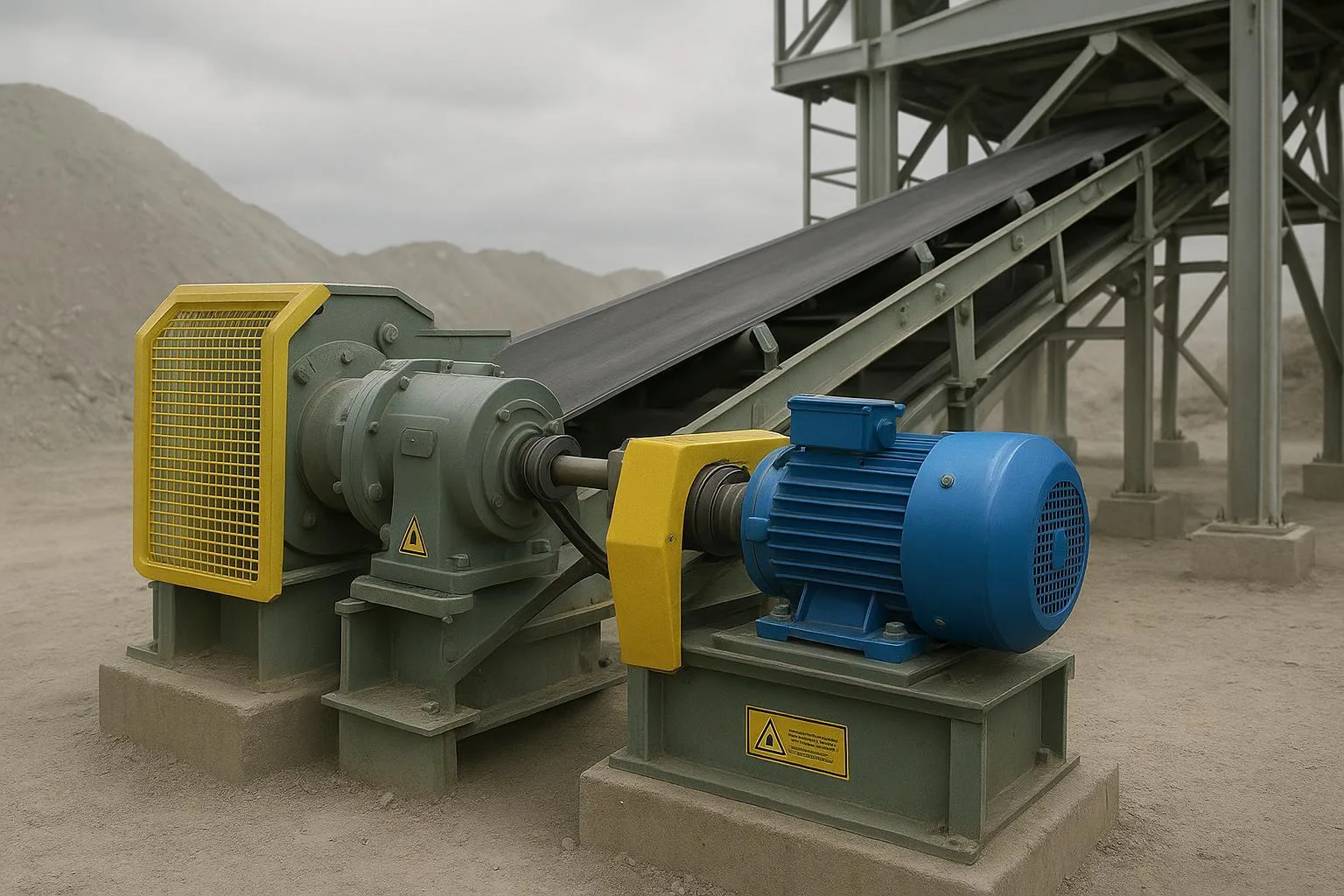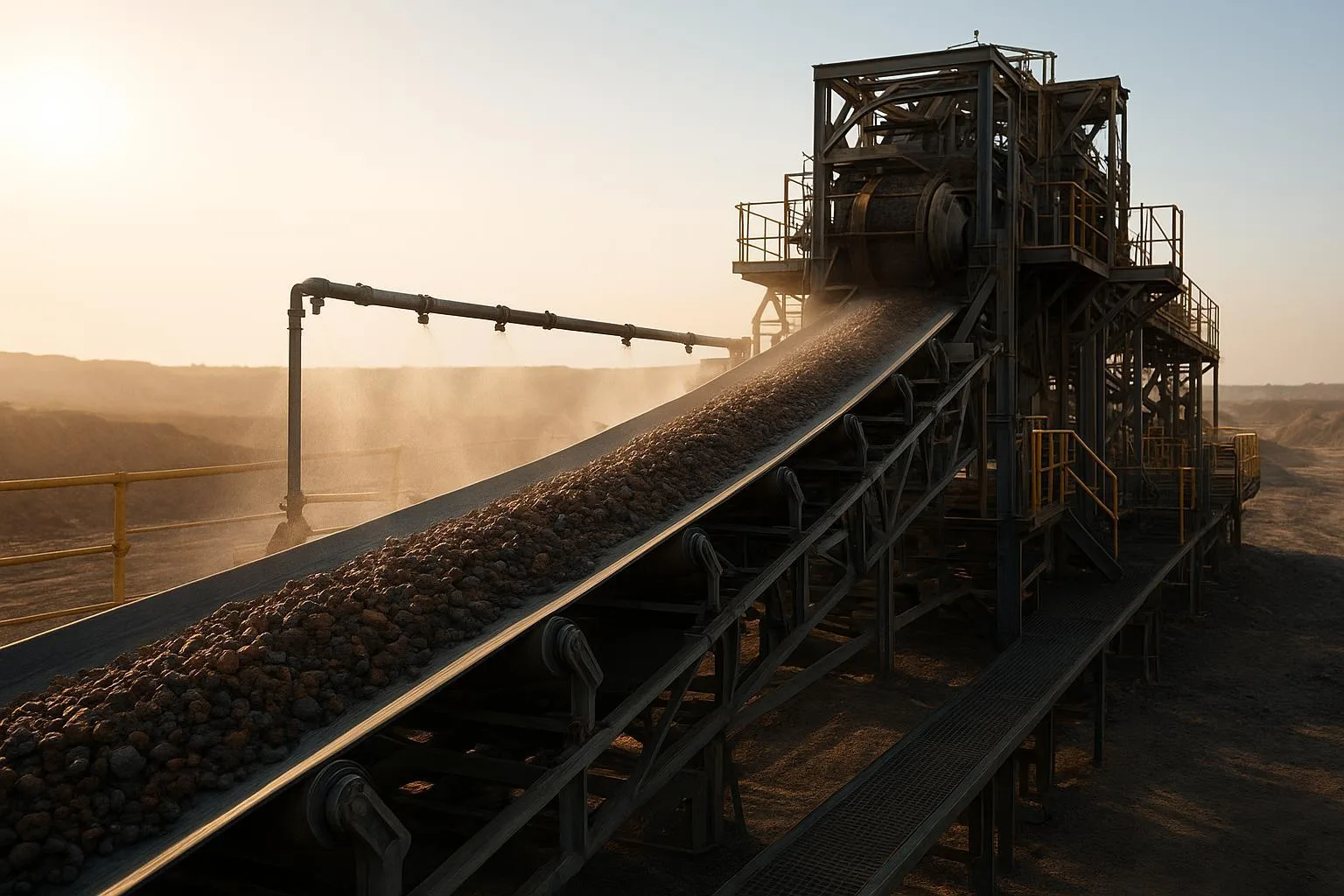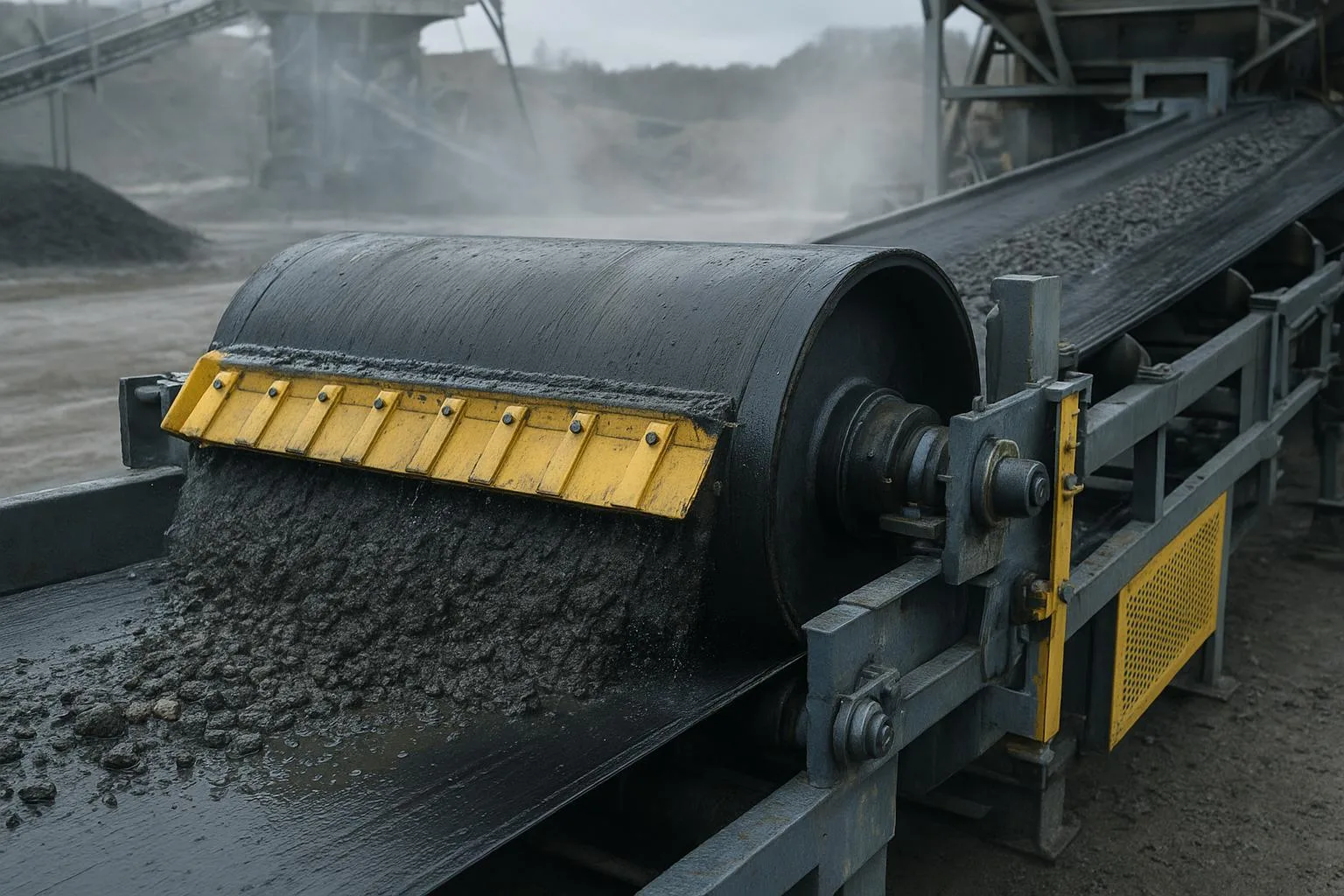
A clean discharge keeps your system honest. Belt scrapers—also called belt cleaners—remove residual material (carryback) at the head pulley so it doesn’t fall along the return run, foul idlers, or build up in chutes. If you’re responsible for uptime, dust control, and maintenance cost, picking the right scraper system is a high‑leverage decision.
This guide explains, in practical engineering terms, how to choose conveyor belt scrapers for your duty: what each cleaner stage does, how CEMA’s classification helps you specify correctly, where blade materials fit, and what to check during installation, troubleshooting, and lifecycle maintenance.
Key takeaways
-
Start with classification, not guesswork: use CEMA 576 to match cleaner capability to your application severity.
-
Use stages: a primary cleaner at the head pulley for bulk removal and a secondary for fines; add a washbox or specialty unit for very sticky or profiled belts.
-
Choose blade materials for the duty and the belt: polyurethane is belt‑friendly; tungsten carbide resists abrasion but needs splice care.
-
Commission like you mean it: align, apply minimum effective tension, and retension after the first 24–48 hours of break‑in.
-
Track performance with KPIs (carryback, cleanup hours, wear rate) and tighten your maintenance rhythm to TCO, not calendar dates.
Core concepts of belt scrapers
Primary, secondary, and tertiary cleaners
-
Primary cleaner (precleaner): Mounted on the head pulley, just before material discharge. It removes the bulk of carryback with light, even pressure and typically uses a single or segmented polyurethane blade. It’s your first line of defense.
-
Secondary cleaner: Installed on the return side just after the head pulley discharge. It targets residual fines the primary leaves behind. Secondary designs often use segmented tips—frequently tungsten carbide for high‑abrasion or high‑speed service—spring or torsion tensioners, and robust brackets.
-
Tertiary and specialty options: For very sticky or clay‑rich materials, a washbox or water‑assisted cleaner can further reduce carryback. For chevron or ribbed belts, use finger, V‑profile, or brush cleaners designed to “step over” profiles; a flat blade will bridge ribs and underperform.
According to the Conveyor Equipment Manufacturers Association, application classification is the right starting point for cleaner selection. CEMA’s standard provides a consistent method to score belt and material factors and point you to a suitable system. See the overview in the association’s publication listing and the current standard in CEMA Standard No. 576 (2021), with access via CEMA’s publications index and technical downloads.
For a practical perspective on cleaner stages and mounting, leading OEM literature outlines typical configurations and why multi‑stage cleaning is recommended for wet or high‑speed duty. An industry article also notes how the 7th edition of Belt Conveyors for Bulk Materials incorporates the belt‑cleaner classification approach; see Martin Engineering’s overview of the new CEMA belt‑cleaner standard.
Blade and tip materials explained
-
Polyurethane (PU): Compliant and belt‑friendly. Ideal as a primary blade across many duties. Choose the grade for temperature, chemical exposure, and stickiness. In abrasive service, PU will wear faster but is forgiving around splices.
-
Tungsten carbide (TC): Extremely wear‑resistant; common on secondary cleaners handling abrasive fines and higher speeds. Requires attention to mechanical splices—poor or frequent fasteners can accelerate tip wear or nick the belt. On belts with high‑quality vulcanized splices, TC can offer long life.
-
Ceramic or alloy tips: Used in some severe or high‑temperature designs. Validate compatibility with belt cover hardness and splice type.
Contact mechanics in plain language
-
Tension: Start at the minimum effective tension that achieves full, even contact. Too little tension leaves streaks; too much adds drag and accelerates blade and belt wear. For a deep dive on tensioning nuances, see Flexco’s engineering blog on belt cleaner tensioning.
-
Contact angle and pulley diameter: A larger head pulley increases the blade’s wrap angle and can improve contact stability, but each cleaner has limits—always size to your pulley diameter and belt speed.
-
Segmentation and compliance: Segmented blades conform to local irregularities and splices, maintaining contact while limiting peak pressure.
How to Choose Conveyor Belt Scrapers with standards
What CEMA 576 scores and why it matters
CEMA Standard No. 576 establishes a uniform way to classify belt‑cleaner applications so you can specify a cleaner system with a rating that meets or exceeds your duty. It scores key inputs—belt width, belt speed, splice factors, and material abrasiveness and stickiness/moisture—and maps the total to an application class. Cleaner models may be rated by manufacturers to a class. Using the class avoids both under‑cleaning (carryback, buildup) and over‑aggressive systems (excess wear, energy draw).
- Source: See the standard PDF and listings via CEMA: CEMA 576 (2021) PDF and CEMA publications index.
A simple worked example
Imagine a 1,200 mm belt running 4.0 m/s with a single vulcanized splice, carrying damp limestone fines that smear easily and have moderate abrasiveness. Your belt is in good condition. Scoring those inputs per CEMA 576 yields an application class in the mid range (illustrative). A class‑matched solution would be a segmented polyurethane primary at the head pulley plus a secondary cleaner with abrasion‑resistant tips. If residual fines remain due to stickiness, consider adding a washbox.
Note: Always perform the actual scoring with the standard; the example is representative only.
Suitability matrix by application class
| CEMA application class | Typical duty characteristics | Recommended cleaner configuration |
|---|---|---|
| Lower classes | Dry, free‑flowing material; moderate speed; quality vulcanized splice | Primary polyurethane at head pulley; consider light secondary if dust‑sensitive |
| Mid classes | Damp/sticky fines or moderate abrasiveness; 3–5 m/s | Segmented PU primary + secondary cleaner (carbide or wear‑resistant tips); plan 24–48 h retension |
| Higher classes | Very sticky clay or highly abrasive fines; high speed; frequent splices | Multi‑stage: robust primary + heavy‑duty secondary; add washbox or specialty cleaner; verify splice compatibility |
Selection workflow—step by step
The most reliable path for conveyor belt cleaner selection follows a standards‑first sequence. If your goal is “How to Choose Conveyor Belt Scrapers” with confidence, use this workflow for precise conveyor belt cleaner selection.
1. Classify the application
Score belt and material factors per CEMA 576 and determine the application class. Document your assumptions (belt speed, width, splice type/quantity, material stickiness and abrasiveness), and keep the worksheet with your spec.
- Evidence: The official CEMA 576 standard and listings on the association site describe the scoring method and class mapping: CEMA 576 (2021) PDF; publications index.
2. Choose the configuration
-
Primary cleaner at the head pulley is nearly universal.
-
Add a secondary cleaner just after discharge for fines, especially for sticky or high‑speed duties.
-
For chevron/ribbed belts or very sticky mixes, specify a specialty profile cleaner or washbox.
Vendor guides from leading OEMs outline why multi‑stage cleaning improves performance in sticky or high‑speed service (e.g., Martin Engineering belt cleaners overview).
3. Validate compatibility
-
Splices: Carbide tips can abrade or chip on poor or frequent mechanical splices; prefer compliant tips or splice‑friendly designs when fasteners are numerous.
-
Belt cover hardness and temperature: Match PU grade or select high‑temperature/chemical‑resistant materials as needed.
-
Profiled belts: Use finger/brush designs to track over ribs.
For a systems view of how cleaners, pulleys, and idlers interact, see our internal guide on components integration: Conveyor belt system components — ultimate guide.
4. Size to speed and pulley geometry
Each cleaner has allowable ranges for belt speed and minimum head‑pulley diameter. Overspeeding or undersizing increases wear and chatter.
5. Plan access and guarding
Confirm mounting structure, safe access for inspection and blade changes, and appropriate guarding. Follow site safety procedures for isolation and lockout.
- Safety note: OSHA’s Control of Hazardous Energy requires de‑energization and lockout/tagout during servicing; see OSHA 29 CFR 1910.147. Mining operations should align with MSHA’s Powered Haulage guidance on housekeeping and conveyor access.
6. Commission with discipline
Align the pole square to the belt, set initial tension to the minimum effective level, run and observe, adjust for uniform contact, and retension after 24–48 hours of break‑in. Flexco installation manuals reinforce these steps for primary and secondary cleaners (e.g., EZS2 IOM).
Installation and commissioning
Mounting, alignment, and initial tension
-
Mount the primary on the head pulley at the recommended pole elevation. Center the pole and square the brackets to the beltline.
-
Set initial tension lightly—just enough for full, even contact across the belt width. Over‑tensioning increases drag, wear, and can mark the belt.
-
Lock tensioners and recheck after a brief run. For more detail on tensioning best practices, see Flexco’s tensioning explainer.
First 24–48 hours and splice notes
-
Expect a short break‑in as blades seat. After 24–48 hours, stop, verify isolation, inspect contact patterns, check fasteners/tensioners, and retension as required.
-
If you have numerous mechanical splices, inspect them closely for interaction with tips; consider compliant or splice‑friendly tip designs if wear patterns develop.
Troubleshooting and common problems
Use this quick diagnostic to connect symptoms to likely causes and fixes. For belt tracking issues related to buildup, see how to correct misalignment in our focused engineering guide: How to fix conveyor belt misalignment.
| Symptom | Likely cause | Corrective action | Prevention |
|---|---|---|---|
| Streaks of material lines after discharge | Insufficient tension or uneven contact | Realign pole; set to minimum effective tension for full contact | Add early post‑start inspection; use segmented blades to conform |
| Blade chatter or bounce | Under‑tensioning; unstable belt path | Increase tension to spec; stabilize belt path if needed | Verify speed/diameter limits; keep tension within range |
| Accelerated blade wear | Over‑tensioning; abrasive duty with soft tips; damaged splice | Reduce tension; switch to wear‑resistant tips; repair splice | Class‑match to duty; schedule inspections by duty hours |
| Carryback returns after initial success | Loss of tension; worn segments; debris in tensioner | Clean and retension; replace worn blades; service tensioner | Set retension cadence; keep assemblies clean |
| Belt nicks at splice | Aggressive tips contacting mechanical fasteners | Use splice‑friendly tips; reduce pressure; adjust cleaner location | Prefer vulcanized splices where possible; validate compatibility |
For the system impact of carryback on idlers, see our engineering explainer on return‑run contamination and component interaction: Belt conveyor idlers — definition and importance.
Maintenance and lifecycle economics
Cleaning systems pay for themselves when you maintain them deliberately. Think in operating hours and tonnage, not calendar months.
-
Inspection intervals: In moderate duty, inspect weekly at first to establish wear rate; extend once stable. In severe sticky or abrasive service, inspect daily during commissioning, then set a cadence by duty hours.
-
Blade replacement triggers: Replace when wear indicators show, when contact cannot be restored by retensioning, or when streaking persists after alignment.
-
Tension management: Many underperforming systems are simply under‑tensioned after break‑in. Build retension into your PMs.
-
KPIs to track: Carryback mass or cleaning efficiency, cleanup labor hours, wear life (hours/tons), and downtime attributed to cleaning‑related issues. Vendor literature often cites precleaners removing a majority of carryback and multi‑stage systems exceeding nine‑tenths cleaning efficiency—directional targets only; validate on site.
For a system‑level perspective on why belt cleaning matters to availability and power draw, see our engineering guide: Belt conveyor system design — ultimate guide.
Real‑world scenarios
Wet sticky fines at 3.5–5 m/s
Duty: Damp clay‑rich fines that smear; moderate speed, single vulcanized splice.
Recommendation: Segmented polyurethane primary on the head pulley plus a secondary cleaner with wear‑resistant tips. Plan a washbox if residual remains unacceptable. Inspect at 24–48 hours and retension. Long‑tail note: belt scraper for wet sticky material.
High‑abrasion dry duty at 5–6 m/s
Duty: Crushed clinker/ore fines, high speed, good belt condition.
Recommendation: Robust primary with abrasion‑resistant PU, secondary with tungsten carbide segments and a stable tensioner. Start with minimum effective pressure and observe wear lines; set inspection cadence by throughput hours. Long‑tail note: tungsten carbide vs polyurethane scraper.
Chevron belt handling damp clay
Duty: Ribbed belt moving damp clay lumps; profiles bridge under flat blades.
Recommendation: Chevron/finger or brush cleaner designed to step over ribs; accept that “perfect” cleaning is unlikely. Complement with return‑side measures and housekeeping. Long‑tail note: primary vs secondary belt cleaner alternatives for chevron belts.
Multiple mechanical splices in short succession
Duty: Frequent fasteners across the belt length.
Recommendation: Avoid aggressive carbide tips in direct, constant contact with the splices. Favor compliant primaries and a secondary model designed to tolerate fasteners, and lower set pressure. Long‑tail note: conveyor belt cleaner selection with mechanical splices.
FAQs
-
What’s the fastest way to start “How to Choose Conveyor Belt Scrapers” on an existing line? Begin with CEMA 576 scoring to classify the duty, then choose a primary + secondary configuration that meets or exceeds that class. Validate compatibility with your splice type and belt geometry before ordering. This is the essence of CEMA 576 belt cleaner classification.
-
How do I balance tungsten carbide vs polyurethane scraper tips? Use polyurethane where belt friendliness and splice tolerance matter most, especially on primaries. Use tungsten carbide on secondary positions for abrasive, high‑speed fines—provided splice quality allows it.
-
Do I always need a secondary cleaner? Not always, but for sticky or fine materials, high speeds, or dust‑sensitive operations, a secondary is often the difference between housekeeping hours and a clean return run.
-
What about reversing belts? Specify cleaners designed for reversing operation or use dual cleaners positioned for each direction. Confirm with the OEM’s speed and diameter limits.
Conclusion and next steps
Choosing belt scrapers with confidence means anchoring decisions in standards, sizing to your geometry and speed, and commissioning with discipline. Start with CEMA 576 classification, select a primary and secondary that meet or exceed the class, validate compatibility with splices and profiles, and build early retension checks into your PMs. Track carryback, wear, and cleanup labor to tune your setup over time.
If you need system‑level support—belts, idlers, and pulleys that work in concert with a well‑specified cleaner—consider speaking with BisonConvey about component options and custom configurations for your duty.
References
-
CEMA — official standard and listings: CEMA 576 (2021) PDF; publications index; technical downloads.
-
Industry context on Belt Book inclusion of the cleaner classification: Martin Engineering’s overview of the new CEMA belt‑cleaner standard.
-
Tensioning best practices and IOM example: Flexco belt cleaner tensioning explainer; EZS2 secondary cleaner IOM.
-
Safety: OSHA 29 CFR 1910.147 — Control of hazardous energy; MSHA Powered Haulage guidance.