Title tag (meta): Conveyor Belt Design Resources: An Engineer’s Guide
Meta description: Authoritative conveyor belt design resources with CEMA/DIN/ISO, OEM manuals, practical formulas, examples, troubleshooting, and a checklist for reliable systems.
Conveyor Belt Design Resources: The Engineer’s Ultimate Guide
If you’re sizing, selecting, or upgrading a belt conveyor, the fastest way to better decisions is to work from proven, authoritative references. This guide curates the Conveyor Belt Design Resources engineers actually use on the job—standards like CEMA, DIN, and ISO, plus manufacturer manuals—for calculations, component limits, troubleshooting patterns, and field-proven best practices.
Key takeaways
-
Start with a recognized design basis (CEMA 7th, DIN 22101, or ISO 5048) and stick to one method consistently across the project.
-
Always verify minimum pulley diameter and transition lengths against the actual belt manufacturer’s datasheet before freezing layout.
-
Expect to combine a standard for calculations with OEM manuals for implementation limits and maintenance practices.
-
Document idler spacing by sag criteria, not just rules of thumb; confirm trough angle compatibility with belt construction.
-
Build reliability in early: specify cleaning, sealing, and monitoring alongside power, tension, and pulleys.
Conveyor Belt Design Resources: curated downloads and purchase links
Use this short-list to source the core references quickly. Choose your basis (CEMA, DIN, or ISO) and pair it with OEM guidance.
-
CEMA 7th Edition store page — official purchase and edition notes: CEMA, Belt Conveyors for Bulk Materials, 7th Ed.
-
DIN 22101:2011-12 catalog entry (Beuth/DIN Media): DIN 22101 — Basis for calculation and dimensioning
-
ISO 5048:1989 OBP scope page: ISO 5048 — Operating power and tensile forces
-
ISO 14890 latest catalog listing: ISO 14890 — Textile belt specification
-
ISO 15236 series (steel cord belts): ISO 15236-1:2016 — Design and requirements
-
Historical method (withdrawn): ISO 3684 — Determination of minimum pulley diameters
-
OEM, pulleys: PCI Conveyor Pulley Selection Guide (2023)
-
Maintenance best practices: Metso Conveyor Solutions Handbook and Martin Engineering inspection checklist
The standards that matter
When people say “the handbook,” they usually mean one of three families. Choose the one that aligns with your region, client preference, and code environment.
-
CEMA: North American baseline for resistances, power/tension, idlers, pulleys, and loading.
-
DIN: European calculation basis with explicit resistance coefficients and braking/holding treatment.
-
ISO: Global harmonization for calculations and belt product specifications (textile and steel cord).
Below is a quick comparison to help you decide where to begin.
Short guidance on selection:
-
If your stakeholders expect North American practice and rich application guidance, use CEMA 7th.
-
If your client’s master specs or EU codes apply, anchor on DIN 22101.
-
If your scope demands international product alignment, pair ISO 5048 calculations with ISO 14890 (textile) or ISO 15236 (steel cord) for belt specifications.
Core concepts and formulas made practical
Let’s ground the design in a few shared definitions and checks used across standards:
-
Resistances: Split into primary (rolling resistance and lift) and secondary (belt flexure over idlers, skirtboard friction, scrapers, pulleys). CEMA 7th structures these resistances; DIN 22101 provides coefficients and braking/holding treatment. See the official store and catalog pages linked above for section-level details.
-
Effective tension (Te): The total running tension required to move the belt and material at steady state. Once Te is known, motor power P follows from P = Te × belt speed, with unit-consistent conversion. For long overlands or high lift, verify starting and braking cases beyond steady state.
-
Take-up: Gravity take-ups accommodate elongation and startup transients better than screw take-ups. Provide adequate travel (often 1–1.5% of center distance for textile; less for steel cord, but confirm with the OEM).
-
Idlers: Choose trough angle (often 20–45 degrees) and spacing by sag criteria (e.g., 1–2% of belt width under load is a common target in many designs). Document the calculation, not just a spacing table.
-
Transitions: Flat-to-trough and trough-to-flat transitions must limit edge strain and avoid center overloading. Use the belt maker’s transition guidance and verify with the actual carcass properties.
-
Pulley selection: Select diameters and face widths per calculation method and verify the minimum pulley diameter for conveyor belts against the manufacturer’s datasheet for the chosen carcass rating and loading.
Worked capacity check (fast sanity screen):
- For a quick throughput estimate on a 3-roll 35-degree trough, use an equivalent cross-section method, then multiply by belt speed and bulk density. For a practical shortcut, try a calculator that implements the common method; for example, this belt capacity calculator uses typical inputs like width, speed, bulk density, trough angle, and surcharge angle. See the internal tool here: belt capacity calculator.
Component selection quick guide
Belt constructions (textile vs steel cord)
-
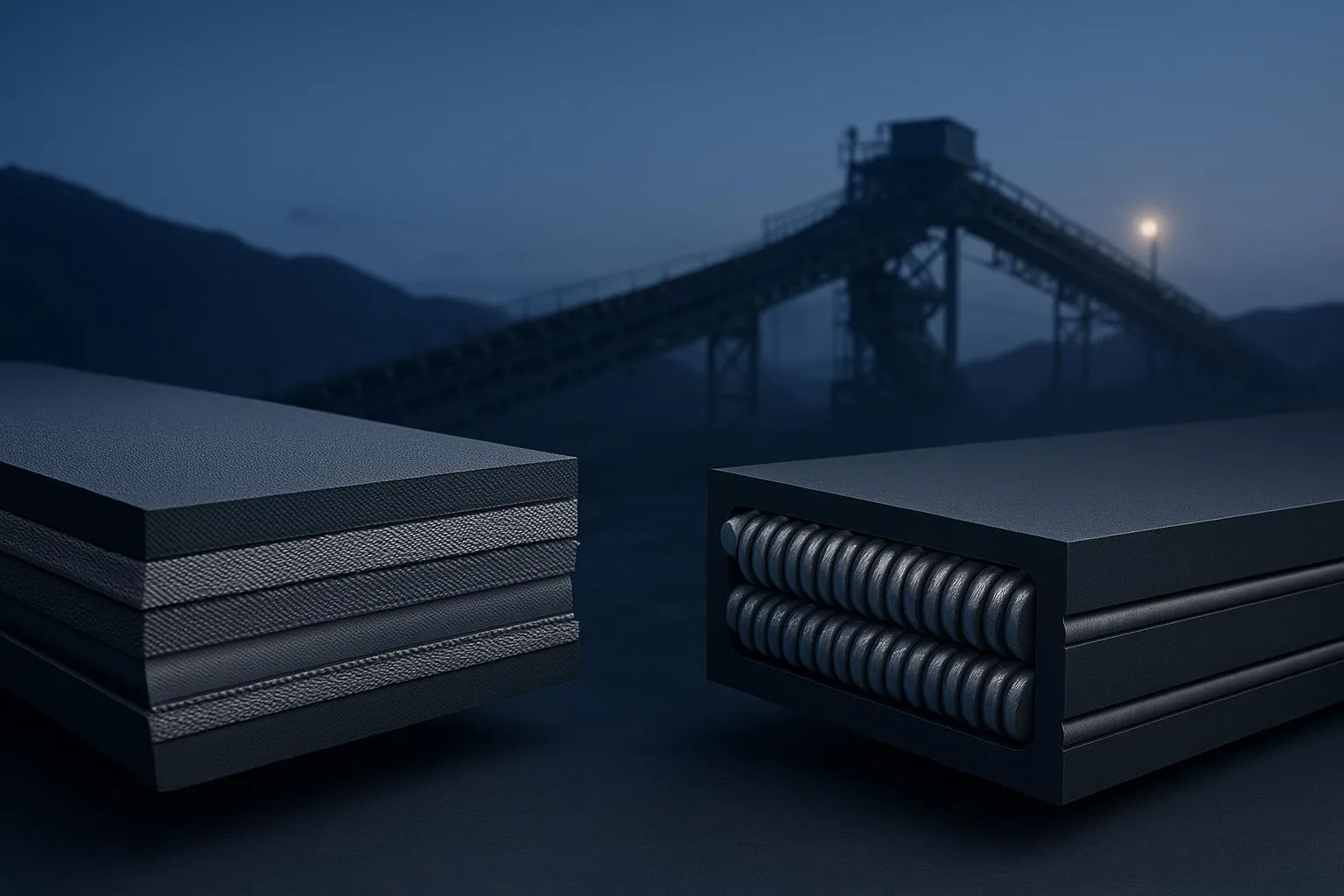
Textile (EP/NN): Versatile for short-to-medium conveyors with moderate tensions. Specify according to the relevant textile belt product standard; for general use, refer to the latest catalog listing for ISO 14890 for construction and cover categories.
-
Steel cord: Required for high tensions, long centers, and small elongation. Use the ISO 15236 series for steel cord belt design, preferred types, special belts, and vulcanized joints beginning with ISO 15236-1:2016. Coordinate splice design with the belt maker early.
Cover selection (service conditions)
-
Abrasion: High-impact ores and clinker demand high-wear covers.
-
Heat: Clinker and sinter conveyors drive thermal selection; ensure the cover grade and carcass are rated for the peak and continuous temperatures.
-
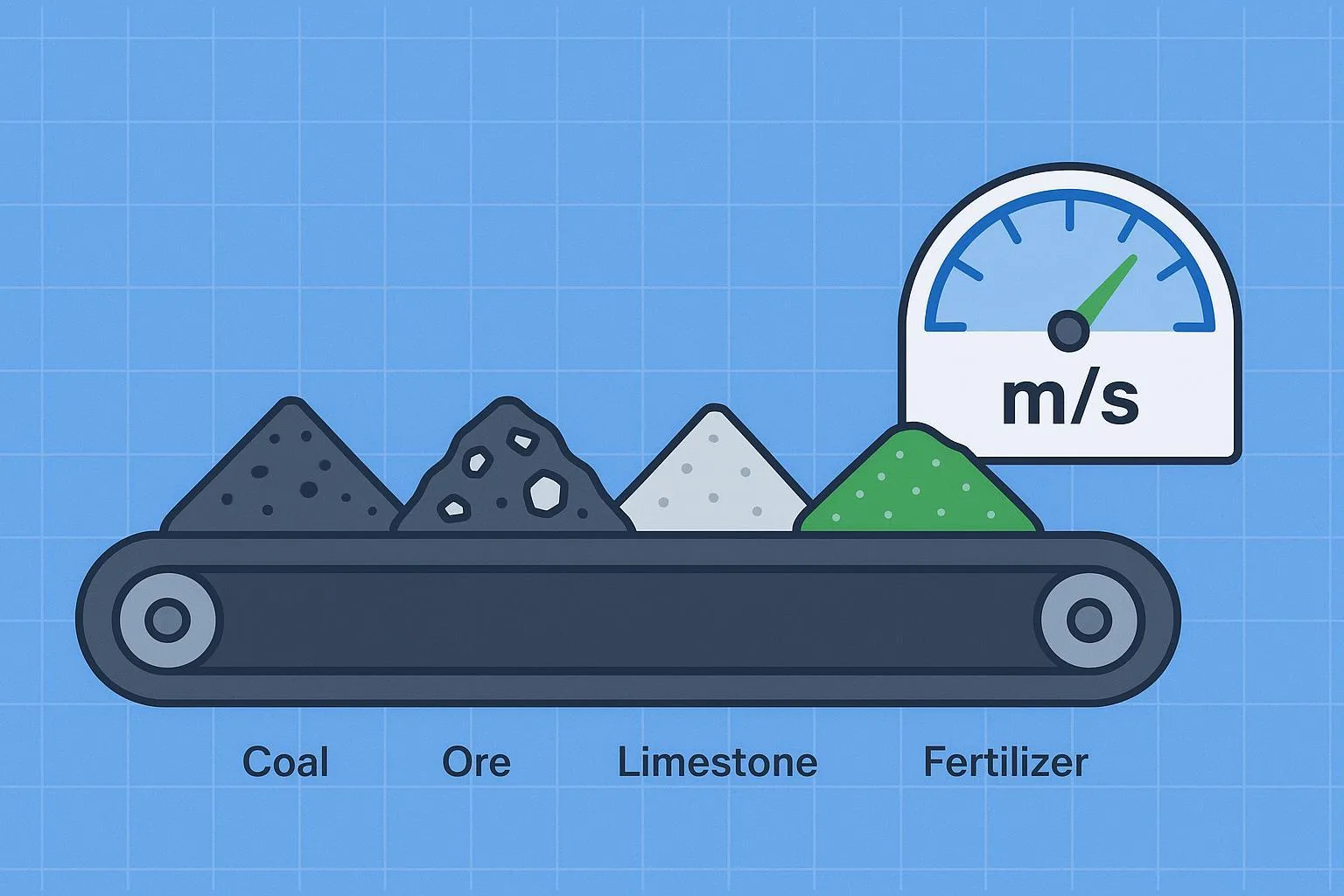
Chemical/corrosion: Port stockyards and fertilizers may require oil/chemical-resistant covers and corrosion-resistant hardware.
Pulleys and lagging
- Follow a structured selection process for diameter, face width, shaft, hub, and lagging. For engineer-facing verification formulas (tube stress, shaft sizing, crown), see the PCI Conveyor Pulley Selection Guide (2023). Confirm final diameters against the belt datasheet Dmin and check wrap angles and lagging type (ceramic vs rubber) for traction.
Idlers and spacing
- Select idler rating and sealing for the environment (dust, water) and set spacing by sag criterion. Confirm trough angle compatibility with the chosen belt’s troughability. Carryback conditions may warrant impact idlers and closer spacing near loading points.
Take-up and braking
- Gravity take-ups on long conveyors improve tension stability. For incline conveyors, verify holdback/braking torque for power loss and emergency stops per your chosen standard.
Real-world scenarios
Scenario 1: Overland conveyor in a hard rock mine
-
Situation: 1,600 t/h crushed granite; 1200 mm belt; 3.5 m/s; 4 km center; +60 m lift; ambient dust and rain.
-
Approach: Use CEMA 7th or DIN 22101 consistently for resistances and effective tension. Calculate primary rolling resistance, lift, and secondary components (belt flexure, skirt friction near loading, pulley resistances). Size pulleys preliminarily, then check Dmin against the selected steel cord belt datasheet. Verify take-up travel and dynamic starting (soft-start or VFD). For pulleys, validate tube stress and shaft under combined belt tensions using PCI methods, then re-check wrap and lagging selection.
-
Why it matters: Overland systems are sensitive to secondary resistances and transitions. A Dmin miss or insufficient take-up travel can lead to splice fatigue or chronic slippage.
-
References: Resistances and Te per CEMA 7th Ed. or DIN 22101; steel cord requirements via ISO 15236-1; pulley verification via PCI 2023 guide.
Scenario 2: Cement plant clinker conveyor
-
Situation: 500 t/h at 120°C clinker; 1000 mm belt; 2.0 m/s; frequent starts; abrasive, hot fines.
-
Approach: Select a heat-resistant cover grade and belt construction suitable for sustained 120°C service as guided by the current ISO textile or steel cord product specifications (start with ISO 14890 for textile belts or ISO 15236 for steel cord). Confirm pulley lagging selection for heat and traction, and verify minimum pulley diameters considering elevated temperature fatigue. Space idlers to control sag with hot, more compliant covers. Add primary and secondary cleaners rated for heat, and specify high-temperature sealing at the transfer point.
-
Why it matters: Heat accelerates cover and splice degradation; the wrong cover grade or lagging leads to rapid wear and downtime.
-
References: Product spec alignment via ISO listings; calculations per your chosen standard; maintenance practices from Metso and Martin sources below.
Troubleshooting and reliability
Use these quick symptom-to-action patterns on site. They complement your “conveyor maintenance best practices” program.
-
Belt mistracking
-
Likely causes: Off-center loading, seized/uneven idlers, material build-up on return rollers, misaligned frames.
-
Actions: Clean and free spinning of idlers; verify frame alignment; adjust training idlers near trouble spots; correct loading chute alignment. For inspection focus areas, see the checklist in Martin’s guidance on the most critical points of belt conveyor inspection (2023, Martin Engineering).
-
-
Slippage at the drive
-
Likely causes: Insufficient wrap angle, worn or wrong lagging, low take-up tension, wet or muddy belt.
-
Actions: Increase wrap using a snub if geometry allows; upgrade to ceramic lagging; verify take-up; improve belt cleaning and water management. Lagging and wrap checks pair well with the verification steps in the PCI Pulley Selection Guide (2023, PCI Manufacturing).
-
-
Spillage and carryback
-
Likely causes: Inadequate sealing, overloaded or misaligned transfer, insufficient or poorly tensioned cleaners.
-
Actions: Upgrade skirt seals; optimize chute geometry; install primary/secondary cleaners and set correct tension. Martin’s Foundations ecosystem details cleaner selection and tensioning principles; see their overview of belt cleaner tensioning systems and devices (Martin Engineering knowledge base).
-
-
Excessive belt or idler wear
-
Likely causes: Aggressive fines, mis-troughing, poor sealing, incorrect idler spacing.
-
Actions: Add wear liners; recheck trough angle and belt troughability; tighten spacing by sag criteria at high-load regions; ensure dust control. For broader component reliability, consult Metso’s vendor-neutral Conveyor Solutions Handbook (Metso, 2020s catalog asset).
-
Best practices and implementation checklist
-
Fix your basis of design
- Decide early: CEMA 7th, DIN 22101, or ISO 5048. Note it in the spec and keep all resistances and tensions consistent with that framework.
-
Verify belt-specific limits with the OEM
- Obtain the actual datasheet for the selected belt family. Confirm Dmin for drive/tail/snub/bend, transition lengths, troughability, and splice allowances. Remember: although historically referenced, ISO 3684 is withdrawn; final Dmin comes from the belt maker and current product standards.
-
Document idler spacing by calculation
- Show sag-based spacing for each region (loading, carry, return). Choose seals and ratings for the environment (dust, water, heat).
-
Pulley and drive details
- Validate pulley tubes, shafts, and hubs against combined tensions; confirm lagging type and thickness by duty; ensure wrap angles meet traction requirements. Use engineering checks such as those in the PCI 2023 guide.
-
Transitions and take-up
- Lay out flat-to-trough and trough-to-flat transitions per the belt’s guidance; allocate adequate take-up travel; plan for startup and braking events.
-
Commissioning and maintenance
- Include cleaners, sealing, and dust control in the base scope. Establish inspection routes and intervals; enforce lock-out/tag-out for all interventions. For a field-ready checklist culture, see Martin Engineering’s safety and inspection resources (publisher pages above).
-
Quick capacity checks during design
- Use a simple calculator for early what-if studies and to communicate with stakeholders. The internal belt capacity calculator is a practical way to validate early sizing assumptions.
Next steps
If you’re building your internal library of Conveyor Belt Design Resources, anchor your calculations in a recognized standard (CEMA, DIN, or ISO), then pair it with the relevant OEM manuals for the belt family you’ll use. For component supply and application support on belts, idlers, and pulleys in demanding duties, contact BisonConvey for neutral, engineering-first guidance. And when you formalize your spec, cite the exact edition years—CEMA 7th, DIN 22101:2011-12, ISO 5048:1989, ISO 14890 current catalog edition, and ISO 15236 parts—to keep reviews crisp.
References cited in-line above
-
CEMA, Belt Conveyors for Bulk Materials, 7th Ed., official store page (CEMA, 2020 second printing details)
-
DIN 22101:2011-12 catalog page (DIN Media/Beuth)
-
ISO 5048:1989 OBP scope page (ISO)
-
ISO 14890 ICS listing showing latest edition (ISO/TC 41/SC 3)
-
ISO 15236-1:2016 catalog page (ISO)
-
ISO 3684 withdrawn catalog page (ISO)
-
PCI Conveyor Pulley Selection Guide, 2023 (PCI Manufacturing)
-
Martin Engineering inspection and cleaner-tensioning resources (Martin Engineering)
-
Metso Conveyor Solutions Handbook PDF (Metso)