1. Separate a CEMA class from a complete idler specification
Start by treating a CEMA class as a rated component family, not as a complete purchase specification. A class helps you narrow the type of roll, bearing, shell, seal, and duty package that may suit the application. It does not prove that a quoted idler can carry the actual load at your belt speed, spacing, material condition, and operating environment.
This matters because belt width is often the first fact available on an old drawing, and it is tempting to replace a worn idler with “the same class for this width.” Width can help identify compatible dimensions, but it does not capture the load imposed by throughput, spacing, belt mass, or a changed material. A familiar class letter is equally incomplete if production has increased since the conveyor was commissioned.
The published description of CEMA Standard No. 502-2022 covers dimensions and selection guidance for troughing idlers and return rollers. The 2022 edition also updates selection examples. Use the applicable standard and the supplier's current rating table for the final choice; do not infer a capacity from a class letter alone.
The working principle for this guide is simple:
Select the class from the governing load and duty for each zone, then verify the exact roll package against the manufacturer's rating.
If you need the terminology before beginning, see the CEMA idler class definition. It explains the A–F naming convention without duplicating the selection process here.
Expected result: you have stopped treating belt width, a catalogue photo, or an existing class label as the approval for a replacement idler.
2. Build an input sheet for each conveyor zone
You need one input line for every zone that can see a different load or service condition. A normal carry run, a skirted loading zone, and a return run do not have identical loads simply because they use the same belt. Start with the operating case that produces the highest credible demand for that zone, then keep lower-load cases for comparison.
| Input | Why it is needed | Typical source |
|---|---|---|
| Belt width and belt mass per metre | Sets geometry context and the distributed empty-belt weight. | Belt data sheet and general arrangement drawing |
| Material mass per metre | Determines the live load on the carrying strand. | Capacity calculation at the selected belt speed |
| Idler spacing | Converts distributed belt/material mass into a load on each supported span. | Layout drawing; use the actual local pitch |
| Belt speed and operating hours | Affect roll speed, bearing life, heat, and the manufacturer's rating basis. | Drive schedule and operating profile |
| Material density, lump size, moisture and abrasiveness | Identify impact, wear, build-up, and environmental modifiers. | Material specification and transfer-chute review |
| Idler function | Separates troughing/carry, return, impact, self-aligning, and special-purpose packages. | Conveyor layout and maintenance history |
| Environment | Changes seal, shell, coating, and corrosion requirements. | Site conditions: water, dust, salt, chemicals, temperature |
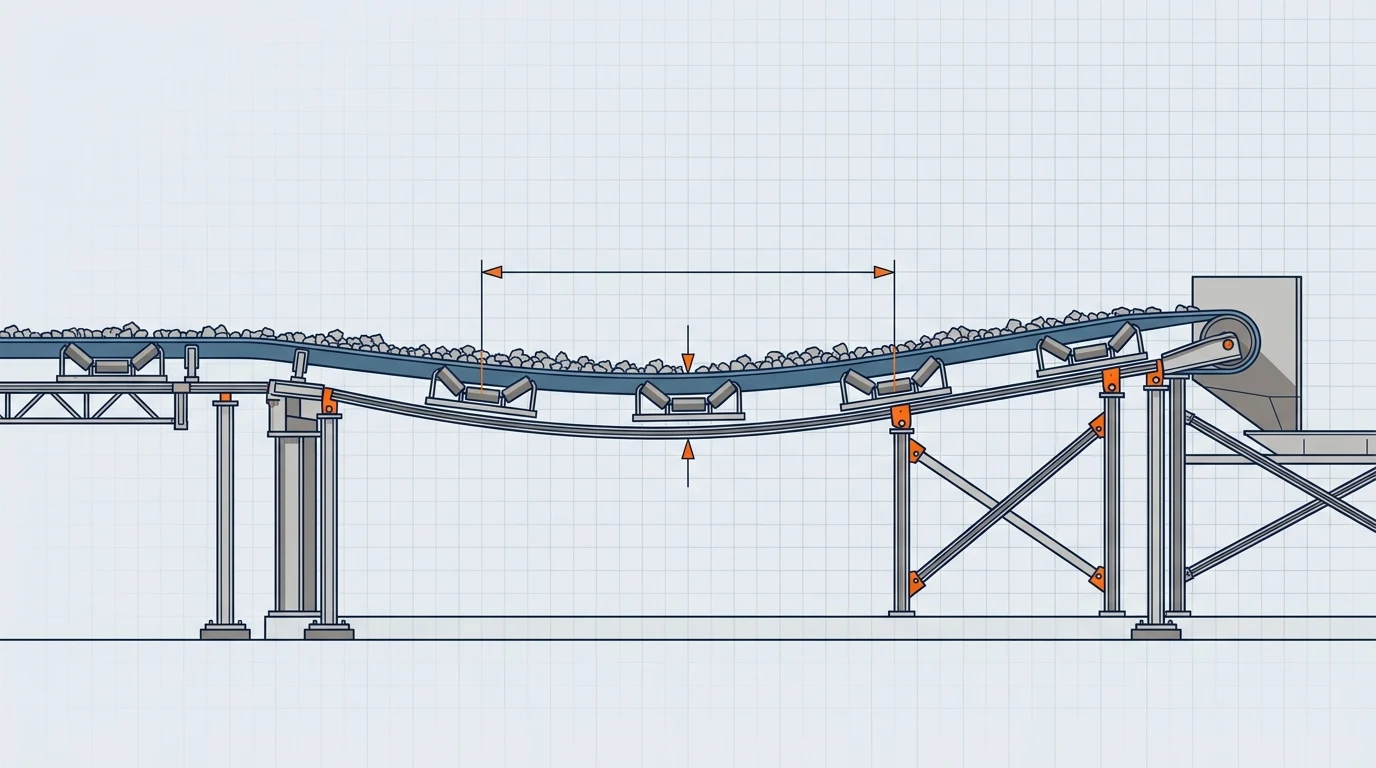
Do not insert a plant-wide “standard spacing” where a transfer zone uses closer centers, or use the loaded carry-run material mass for the return strand. The link between spacing and support load is one reason a belt sag and idler spacing guide should sit beside the class-selection worksheet. A change in spacing can reduce the load per idler set, but it also changes sag, quantity, structure loading, and cost.
At this stage, list the idler function beside the inputs. An impact set under a transfer chute may need a materially different roll and frame package from a normal troughing set even when their static belt loads look close. Similarly, a wet salt or fertilizer conveyor may need corrosion protection that a dry aggregate line does not.
Expected result: you have a zone-by-zone input sheet, not a single class assumption copied across the whole conveyor.
3. Calculate a screening load before opening a class chart
Use a transparent screening calculation to expose the inputs before you consult a CEMA table or request a supplier recommendation. For a loaded carrying span, the static vertical load supported by one idler set can be screened as:
W_screen = (m_b + m_m) × g × s
Where:
m_b= belt mass per metre (kg/m)m_m= material mass per metre at the operating point (kg/m)g= gravitational acceleration (9.80665 m/s²)s= local idler spacing (m)
For example, a 22 kg/m belt carrying 48 kg/m of material over 1.2 m spacing produces a set-level static screen of about 824 N:
(22 + 48) × 9.80665 × 1.2 = 824 N
That result is intentionally not a CEMA class selection and is not the load rating for one roller. A troughing set distributes load across its rolls, while the actual selection also needs geometry, belt speed, roll diameter, dynamic/impact effects, and the supplier's published rating method. Use the calculation to spot missing inputs and to compare zones consistently; then use the applicable CEMA procedure and manufacturer table to determine the governing roll load and rating.
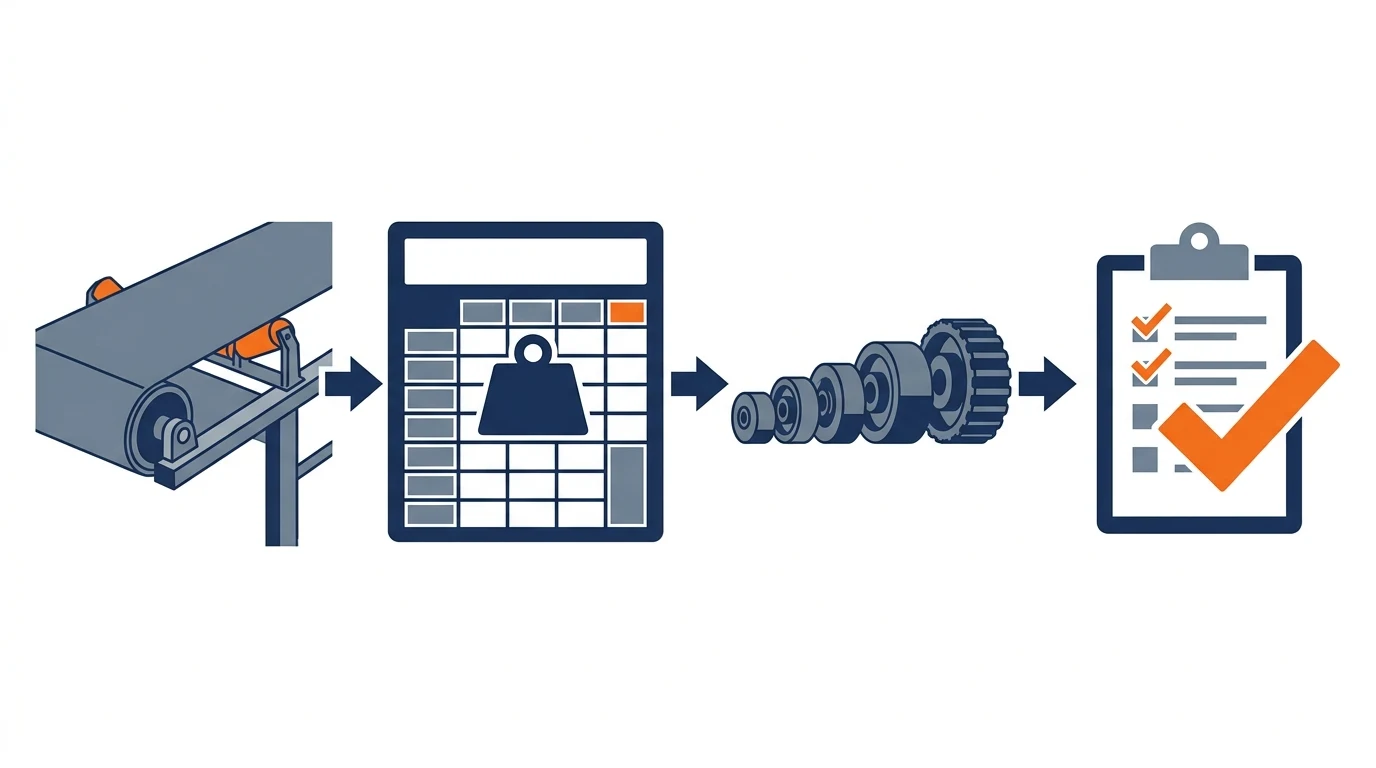
Martin Engineering makes the same practical distinction: idler life depends on seals, bearings, shell thickness, speed, lump size, bulk density, maintenance, environment, temperature, and the class required to handle the maximum calculated idler load. Its CEMA application note also shows why a lower-class roll with a similar diameter is not necessarily an equivalent replacement.
For each zone, record the screening load, calculation case, local spacing, and whether the value is static, transient, or impact-influenced. If a capacity increase, belt-speed change, or new material has occurred since the original design, include both the old and current cases. The gap between them is often more useful than an inherited class label.
Expected result: you have a traceable screening load for every relevant zone and know which variables must be validated before a rating can be approved.
4. Use the CEMA class as a shortlist, not a final answer
Now use the class system to create a shortlist. CEMA class labels are useful because they describe a progression in duty, but they are not a universal capacity chart. Exact roll diameters, bearings, seals, frame designs, widths, and rated loads must come from the applicable standard edition and the supplier's current data.
| Class family | Relative duty position | Typical reason it enters the shortlist | What still needs confirmation |
|---|---|---|---|
| A | Lightest end | Light, low-demand applications where the available product range includes Class A. | Actual available diameter, bearing package, and rated load |
| B | Light bulk duty | Lower-load bulk conveying and smaller conveyors. | Load rating at the real speed and spacing |
| C | Medium bulk duty | General industrial bulk service when the load and duty exceed light-duty assumptions. | Roll diameter, shell, bearing life, and environment |
| D | Heavy duty | Higher tonnage, abrasion, larger loads, or more demanding operation. | Exact rating, frame, impact and service margin |
| E | Very heavy duty | Severe bulk service, wider belts, or high-duty systems. | Supplier configuration and full mechanical review |
| F | Highest-duty end | The most demanding class range where the relevant standard/catalogue supports it. | Manufacturer's current table, availability, and project calculation |
The class order above is deliberately qualitative. For example, a 5-inch roll from one class is not automatically interchangeable with a 5-inch roll from another: bearings, shell, seals and rated duty may differ. Luff Industries similarly lists load capacity, belt width, spacing, speed, material characteristics and lump size together—not as independent shortcuts—in its CEMA rating guide.
Use the CEMA Idler Class Selector only as an early triage aid. It makes width, speed, density, and lump-size assumptions visible and returns a preliminary starting category. It does not calculate an official CEMA 502 rating, replace the calculated idler-load check, or certify a supplier's roll. If its output conflicts with the existing installation or a supplier quote, resolve the inputs and rating basis rather than choosing the lower-cost answer by default.
Expected result: you have a preliminary class range with the assumptions attached, not an unsupported “CEMA C” or “CEMA D” entry on a purchase order.
5. Check carry, return and impact zones separately
Run the selection logic separately in the zones where the belt support changes. This is the practical step most likely to prevent a correct general class from being misapplied at the most severe point on the conveyor.
| Zone | What makes it different | Selection action |
|---|---|---|
| Normal carry run | Carries belt plus material at the local pitch and running condition. | Use the maximum credible loaded operating case and check sag alongside idler load. |
| Return run | Carries mainly the empty belt, but may see carryback, flutter, and a different local tension. | Calculate the empty-belt condition separately; do not inherit the carry-side selection automatically. |
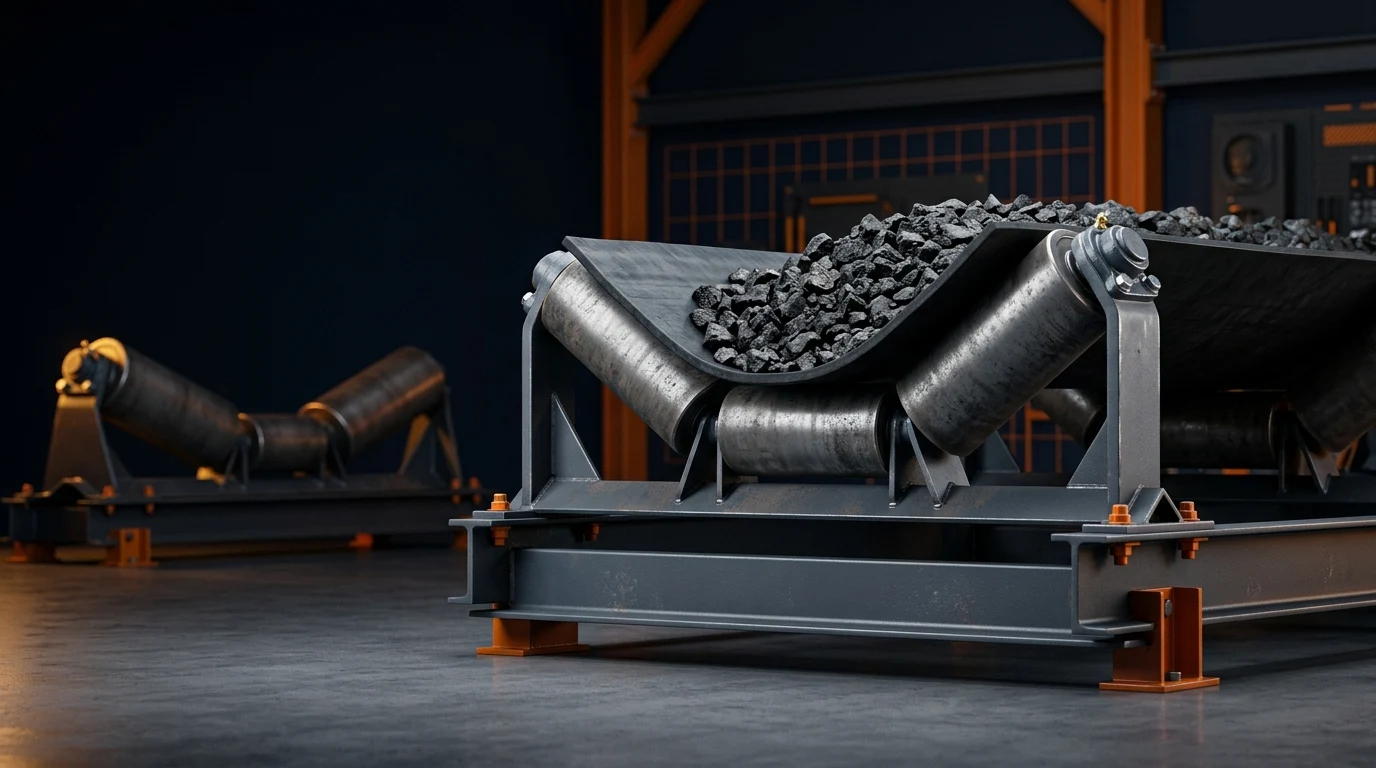
| Loading/impact zone | Experiences falling material, concentrated load, and more severe belt protection needs. | Review drop height, lump size, loading centring and impact conditions; specify an impact idler specification rather than a standard carry roll by habit. |
| Wet or corrosive zone | Can shorten seal and shell life even when the load is modest. | Specify material and sealing requirements, including stainless steel idler options where the environment warrants them. |
| Abrasive duty | Accelerates shell wear and can increase maintenance exposure. | Review shell/lagging construction and consider ceramic-lagged idlers where their wear role fits the application. |
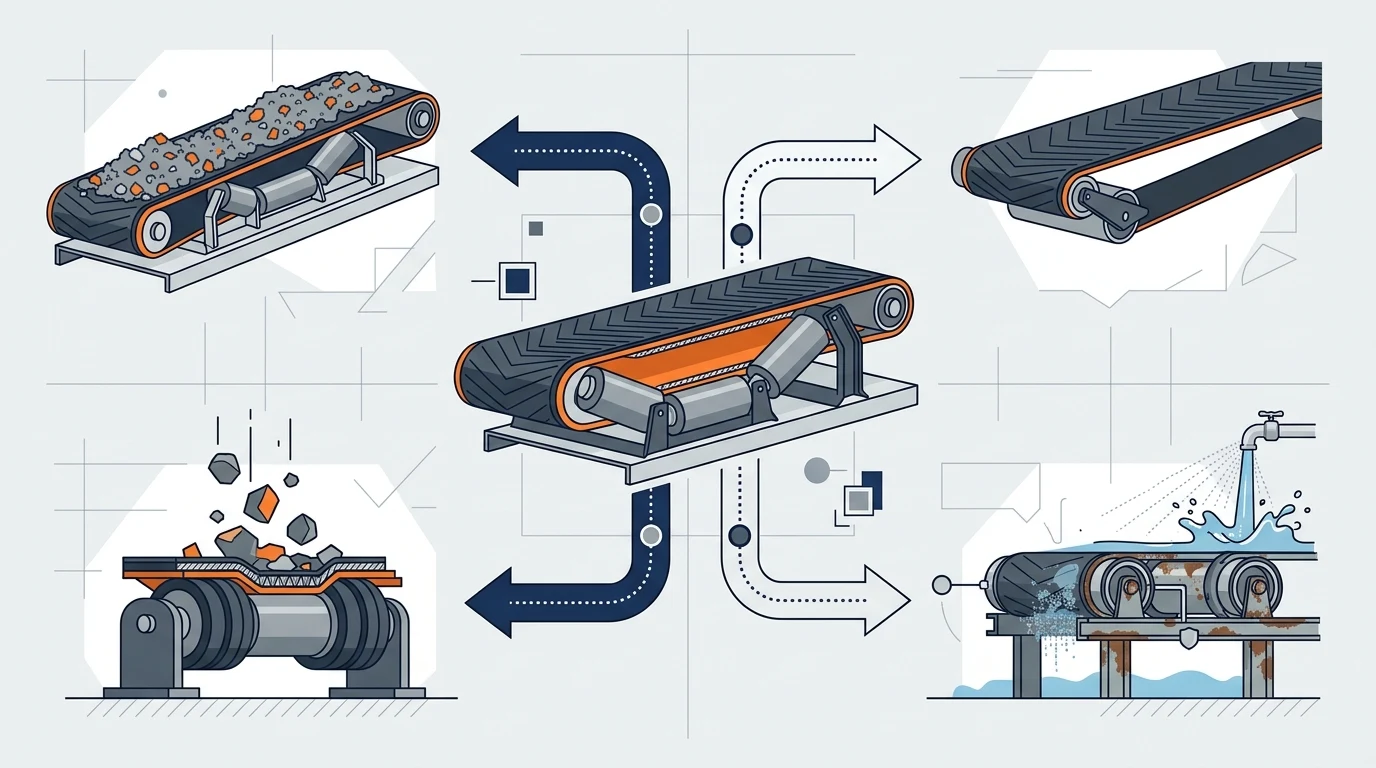
Do not use an environmental option as a substitute for the class/rated-load check. Stainless steel can solve a corrosion problem; ceramic lagging can solve a wear problem; neither makes an under-rated bearing package acceptable. Likewise, moving to a higher letter may not solve a transfer point that suffers from off-centre loading, excessive drop height, or poor chute control.
The correct output is therefore a zone schedule, not one global class. The schedule may include the same class in several zones, but that should be the result of the check rather than an assumption made at the beginning.
Expected result: carry, return, impact, and special-environment requirements are documented separately, with each special requirement tied to its actual failure risk.
6. Release a rated-load validation brief before buying
Before sending an RFQ or approving a replacement, hand the supplier a compact validation brief. Ask them to confirm the idler configuration and rated load against the stated operating conditions—not merely to quote the class letter you requested.
| Include in the RFQ or review pack | Why it prevents a bad substitution |
|---|---|
| Conveyor layout with carry, return and loading zones identified | Connects each idler to its actual function and local pitch |
| Belt width, belt mass, speed, capacity, and material mass per metre | Lets the supplier reproduce the governing load case |
| Material density, lump size, moisture, abrasiveness, and temperature | Flags impact, wear, sealing, and environmental requirements |
| Screening-load worksheet and all operating cases | Shows which assumptions must be checked rather than hidden |
| Proposed class, roll diameter, frame type, shell/seal requirements, and quantity | Makes the requested package unambiguous |
| Applicable standard edition and requested rated-load confirmation | Prevents an informal class label from being treated as final engineering approval |
Ask for the supplier's published load-rating basis, the proposed roll/bearing/seal configuration, any stated speed or spacing limits, and confirmation of the impact-zone arrangement. If the conveyor was uprated, include the old and new duty so the reviewer can see why a like-for-like replacement may no longer be suitable.
Use the CEMA Idler Class Selector to organise an initial class shortlist, then request a BisonConvey idler review with the zone schedule and validation brief. The fastest route to the right idler is not a guessed letter—it is a transparent load-and-duty record that a manufacturer can verify.
Avoid these four selection errors
- Selecting from belt width alone: width narrows the dimensional field but does not calculate the governing load.
- Treating roll diameter as the class: similar diameters can carry different bearings, shell thicknesses, seals, and ratings.
- Copying the carry-run class into the impact zone: transfer duty requires its own load and impact review.
- Buying the lowest-cost “equivalent” without a rating basis: an apparently equivalent lower-class roll can shorten bearing life and increase change-outs.