Essential Safety Features for Mining Conveyors
If you run or specify belt conveyors in mines, you already know the line between safe, steady production and a serious incident can be thin. This guide distills the Essential Safety Features for Mining Conveyors you should expect on modern systems, why they matter, and how to implement and maintain them with confidence. The focus is practical: what regulators require, what good engineering practice adds, and how to verify performance in the field.
Key takeaways
-
Guard moving parts and nip points; verify start-up warnings; provide safe crossings; and enforce LOTO—these are non‑negotiables in U.S. mines per MSHA’s conveyor safety guidance, complemented by OSHA’s machine guarding and LOTO rules in plants.
-
Treat emergency stops as a complementary safeguard—per ISO 13850 principles—not a substitute for guarding; design for continuous pull-cord coverage where people work along the run.
-
Add condition monitoring—misalignment, rip, slip/zero-speed—to catch problems early and shut down safely; set parameters via risk assessment and OEM guidance.
-
On inclined conveyors, include backstops/holdbacks; inside galleries, combine fire-resistant belts with early detection and suppression.
-
Document commissioning checks, test safety devices routinely, and keep access/walkways compliant; small gaps (a loose pull-cord, a missing guard fastener) are common failure seeds.
Compliance anchors for essential safety features
When you justify capex or defend design choices, it helps to cite primary sources. In U.S. mining, MSHA’s rules establish the floor; OSHA’s general-industry rules often apply inside processing plants; ISO standards frame functional-safety principles.
-
MSHA’s overview on conveyors highlights guarding, emergency pull‑cords, start‑up warnings, safe crossings, and LOTO. See the regulator’s summary in MSHA’s Safety Topic: Conveyor Systems.
-
Specific eCFR sections frequently referenced in audits include start-up warnings (30 CFR §56.14201 / §57.14201), guarding of moving machine parts (§56/57.14107), and conveyor crossings (§56/57.14202). Use the eCFR for exact wording and keep site SOPs aligned.
-
OSHA complements mining rules with machine guarding (§1910.212 overview) and control of hazardous energy (§1910.147 eTool) for servicing and maintenance in plants.
-
ISO clarifies that an emergency stop is a complementary measure. For a plain-English overview, see this ISO 13850 explainer.
Standard-to-practice summary
Core safety features and how they work
Mining conveyors operate in abrasive, heavy-load conditions. Below are the features I expect to see during audits and commissioning, with plain-language explanations and typical, non‑prescriptive parameters drawn from industry practice and OEM guidance.
Guarding of moving parts and nip points
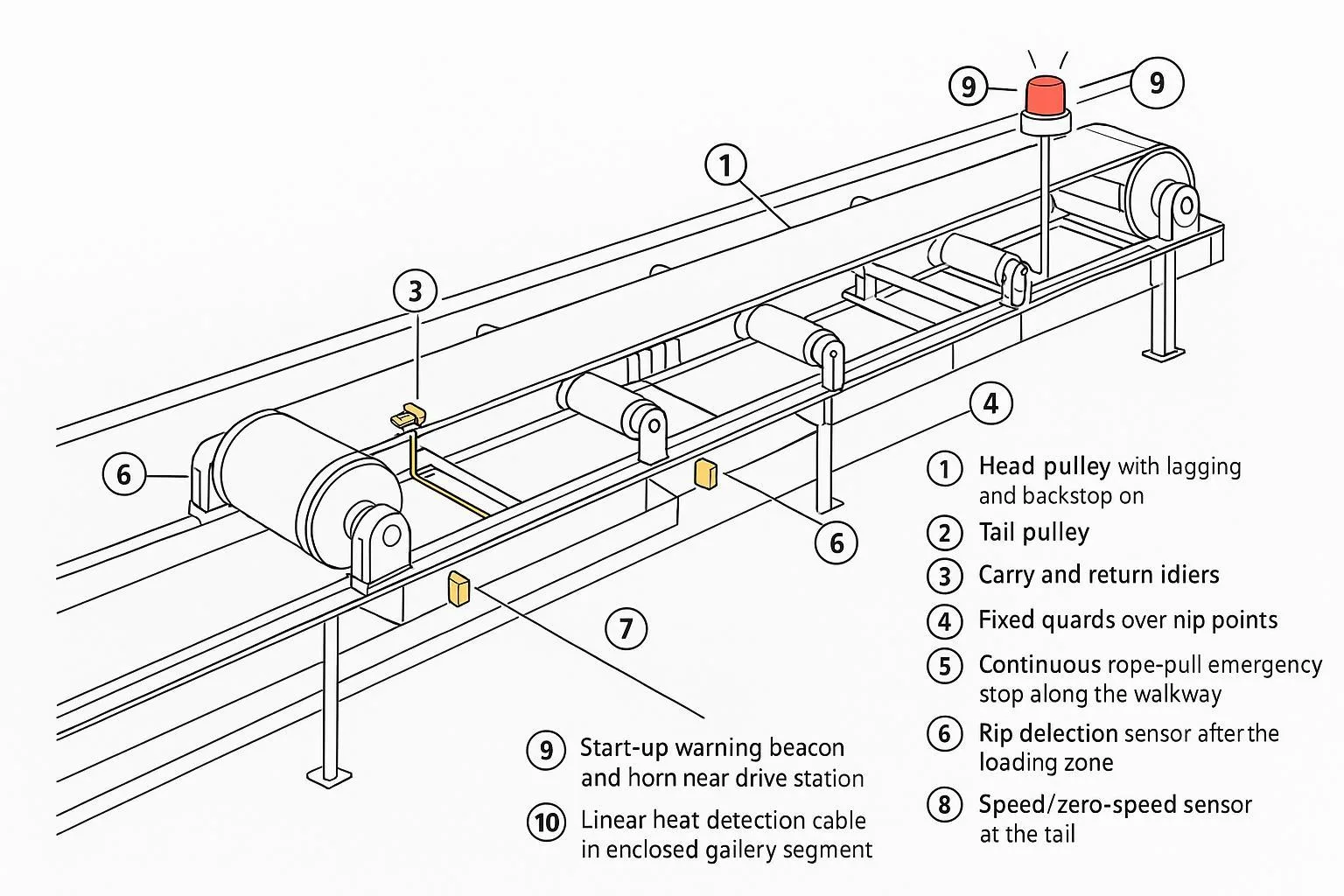
What it is and why it matters: Guards stop people from contacting rotating parts—carry/return idlers, head/tail and snub pulleys, take-up assemblies, and couplings. Missing or poorly designed guarding is a frequent root cause in entanglement incidents. MSHA’s guarding expectation is summarized in §56/57.14107 and OSHA’s §1910.212 general requirements.
Engineering notes:
-
Prefer fixed guards for routine operation. Use interlocked or adjustable guards only where necessary for cleaning or inspection.
-
Close gaps near pinch points and along returns adjacent to walkways. Avoid guard openings that admit fingers near nip points.
-
After maintenance, verify guards are reinstalled with all fasteners; missing quarter‑turns are a common oversight.
Inspection tip: Walk the line weekly; tug on guards to check integrity and confirm they don’t rattle or flex into moving parts.
Emergency stop systems (rope-pull and local E-stops)
Positioning: Per ISO 13850, E-stops are complementary, not a replacement for safeguarding. In mining, provide continuous pull-cord coverage along accessible runs plus prominent local mushroom pushbuttons at strategic points. See ISO 13850’s scope and a plain-English summary in MachinerySafety101’s explainer.
Typical layout examples (for risk assessment, not fixed values):
-
Continuous pull-cord along walkways at a reachable height (often around 0.9–1.5 m). Ensure actuation with modest force and in both directions. Support intervals are commonly around 30 m, with stations or indicators at intervals up to roughly 100 m in some designs; closer spacing may be justified near loading points or high-speed belts.
-
Use de‑energize‑to‑trip wiring and require manual reset at each actuated device. Provide zone indication so operators can locate the trip quickly.
Commissioning checks: Tension and test the rope, verify all contacts change state, confirm the system won’t restart until the warning cycle completes after a reset, and document test frequency.
Start-up prewarnings and start sequence
Requirement in U.S. mines: If the entire belt isn’t visible from the start switch, give an audible or visible warning before starting (see 30 CFR §56.14201). If it is visible, the operator must visually confirm the belt is clear before start. Many sites standardize a 3–10 s pre-alarm; your SOP should specify the duration and any restart delay after an E-stop reset. MSHA’s conveyor safety topic reiterates this requirement—see MSHA’s guidance.
Good practice: Combine horns with flashing beacons near drives, integrate prestart logic that blocks motion until the warning completes, and include a local start/inching mode only after proper isolation when maintenance is underway.
Detection and monitoring (misalignment, rip, slip/zero-speed)
Belt misalignment (sway) switches: Install on both sides near head and tail (and at intervals on long runs) to catch off-tracking early. Typical OEM examples use a staged approach—alarm at a modest lever deflection (say ~10–20°), trip at a larger deflection (~25–35°). Maintain normal clearance of roughly a centimeter from the belt edge; tune to your belt width, speed, and structure. See representative OEM notes from Schmersal and others for setpoint ranges.
Rip detection: Options include embedded-loop electromagnetic systems, loopless algorithmic detection, and camera/vision approaches. Place sensors immediately after high‑impact loading and at key intervals on long conveyors. Interlock confirmed rips to an immediate stop and log belt position via encoder counts for fast location. For background on approaches, see industry explainers from established vendors.
Slip/underspeed/zero-speed monitoring: Compare sensed speed to expected speed; alarm or trip on significant underspeed or zero pulses. Include a startup bypass window to avoid nuisance trips, and choose fail‑safe devices that trip when de‑energized or if sensors fail.
Mechanical protections: backstops/holdbacks
Purpose: On inclined conveyors, a backstop prevents reverse runback if power is lost. Without one, rollback can cause severe damage and injury. See an engineering overview of runback prevention in West River’s backstop primer.
Engineering notes: Select for reverse torque with margin, mount on the low‑speed shaft where practical, and protect the unit from contamination. Verify torque arm alignment and condition during PMs, and confirm free rotation in forward direction with positive lock in reverse. Selection/maintenance notes from backstop manufacturers (e.g., Formsprag/Marland) provide additional detail.
Fire detection, suppression, and FR belt selection
Risk profile: Enclosed galleries and tunnels concentrate heat and smoke; overheated bearings or pulley lagging can ignite dust or residues; burning belts generate heavy smoke. FM Global’s guidance for conveyors outlines common protection schemes; see FM Global DS 7-11 (2020).
Controls to combine:
-
Specify flame‑retardant and antistatic belt compounds per applicable standards for your operation (surface vs underground). For surface belts, consult recognized references on FR classifications and testing (e.g., EN 12882/ISO 340 context in Fenner Dunlop’s buyer’s guide). Underground coal has separate MSHA approvals.
-
Install early detection such as linear heat detection cable along galleries and thermal/IR detection for hot objects on moving belts near drives and take‑ups (e.g., Luna/LIOS application notes).
-
Provide suppression—spray/sprinklers in enclosed sections—and interlock detection to initiate belt stop and suppression automatically.
Safe access, crossings, platforms, walkways, signage
Designated crossovers and bridges prevent unsafe stepping over or under belts. Maintain clear travelways with guardrails where required and protect openings. These expectations are reflected in MSHA’s crossings rules and OSHA’s walking‑working surfaces materials—see MSHA conveyor crossings and OSHA resources.
LOTO and safe work for cleaning and maintenance
Lock out, tag out, and verify zero energy before you clear jams, clean, or service. Do not rely on start/stop buttons for isolation. Reinstall guards before restart, and document group LOTO when multiple crews are involved. OSHA’s program is summarized in the LOTO eTool and MSHA reinforces the same principle in its conveyor safety topic.
Selection and implementation guidance
Component choices and layout heuristics
-
Belts: In high‑risk fire areas or enclosed spaces, specify flame‑retardant compounds appropriate to the duty. For long overlands or high tensions, steel cord belts offer elongation and monitoring advantages; ensure compatibility with selected rip detection. For more on heavy‑duty applications, see our industries overview of steel cord belts.
-
Idlers: Use impact idlers and rubber‑disc return idlers near loading; training idlers where structural constraints limit idler alignment; maintain sealing to avoid seized rolls that create heat.
-
Pulleys: Choose lagging to control slip; match lagging type to moisture and load. Design for inspection access to bearings and guards.
-
Controls: Centralize safety circuits in a safety‑rated controller where feasible; prefer de‑energize‑to‑trip logic; provide clear HMI diagnostics for which device tripped and where.
Commissioning checklist snapshot
-
Verify all guards in place; measure clearances at nip points near walkways.
-
Pull‑cord tensioned, trip tested at intervals, and zone identification confirmed.
-
Prestart alarms (horns/beacons) function; restart delay enforced after E‑stop reset.
-
Misalignment, rip, and speed sensors set to OEM defaults, then tuned during hot commissioning.
-
Backstop direction and torque arm alignment verified; lubrication plan loaded into CMMS.
-
Fire detection zones mapped; suppression interlocks tested during dry‑run.
Troubleshooting common safety failures
Loose pull‑cord and nuisance trips: If operators report intermittent trips in windy sections, check rope sag and support spacing. Re‑tension the cable, add intermediate anchors, and confirm switch travel. In several audits, simply adding a support post resolved false trips.
Heat and slip at the drive: When lagging wears, slip spikes during wet conditions; speed monitors may alarm. Inspect lagging thickness and surface condition, verify take‑up travel and tension setpoints, and consider a temporary derate until relagging is scheduled. Heat at the drive elevates fire risk—don’t ignore it.
Chronic belt wander near the tail: Examine loading alignment, chute skirt contact, and idler frames for squareness. Misalignment switches should not be your alignment strategy; they are guards against damage. Realign frames and correct loading presentation.
Guards removed after maintenance: If you keep finding missing fasteners, add a post‑maintenance checklist and a visual tag that can’t be signed off until a lead verifies guard integrity. A simple paint mark across fasteners can expose loosening during weekly walks.
Maintenance and inspection schedules
A disciplined program catches small issues before they escalate. The table below offers a concise view you can adapt to your CMMS. Frequencies are examples—use your risk assessment and duty cycle to finalize.
Setting and maintaining correct belt tensions is foundational to tracking, slip, and component life. For quick calculations during commissioning or troubleshooting, try the Belt Tension Calculator tool on our site: conveyor belt tension calculator.
Modern enhancements worth considering
-
Functional safety building blocks: When safety functions (e.g., emergency stop, guard interlock) are implemented via a controller, design to appropriate performance levels (PL) or SIL targets. Use certified devices and architectures with diagnostics, and validate stop times against hazard distances.
-
Remote monitoring: Many mines now stream sensor states (misalignment, speed, temperature) to centralized control. Trending helps catch slow‑burn issues—bearing heat rise, frequent misalignment alarms—before they become shutdowns.
-
Vision-based detection: High‑speed cameras and AI can spot abnormal loading, tears, or hot objects. They don’t replace physical protection but can shorten response times and incident investigations.
Two brief field lessons
A near‑miss stopped by a rope‑pull: During a cleanup on a tripper conveyor, a spillage slide hit the return run. The technician felt the belt tug and yanked the pull‑cord. Post‑incident review found the pull‑cord height was perfect for a gloved hand and stations were visible every few dozen meters—small layout choices that paid off.
Rollback avoided by a backstop: On an inclined reclaim, a power dip stalled the drive under full load. The backstop held cleanly, buying the crew time to isolate and clear. Maintenance later found contamination in the backstop housing—caught before it compromised torque capacity thanks to a scheduled inspection.
Conclusion: actionable next steps
Here’s the deal: safe conveyors come from layers—robust engineering controls, disciplined procedures, and routine verification. If you’re upgrading or auditing a line, start with the hard requirements (guarding, warnings, crossings, LOTO), then add monitoring (misalignment, rip, speed), and finish with incline/backstop and fire controls suited to your environment. Document your commissioning tests and keep them on a calendar.
If you need help selecting belts, idlers, or pulleys that support these safety requirements, or want an extra set of eyes on a commissioning checklist, speak with a specialist. BisonConvey supplies conveyor belts, idlers, pulleys, and related components that can be specified to support your safety objectives. To discuss project specifics, you can also contact our engineering team.
—
Sources and further reading
-
MSHA Safety Topic — Conveyor Systems: authoritative overview of guarding, pull‑cords, warnings, crossings, and LOTO.
-
eCFR 30 CFR §56.14201 and Part 56 Subpart M index for guarding (§56/57.14107) and crossings (§56/57.14202) pointers.
-
OSHA machine guarding standards and LOTO eTool — complementary requirements in plants.
-
ISO 13850 and a plain-English explainer — emergency stop function principles as a complementary safeguard.