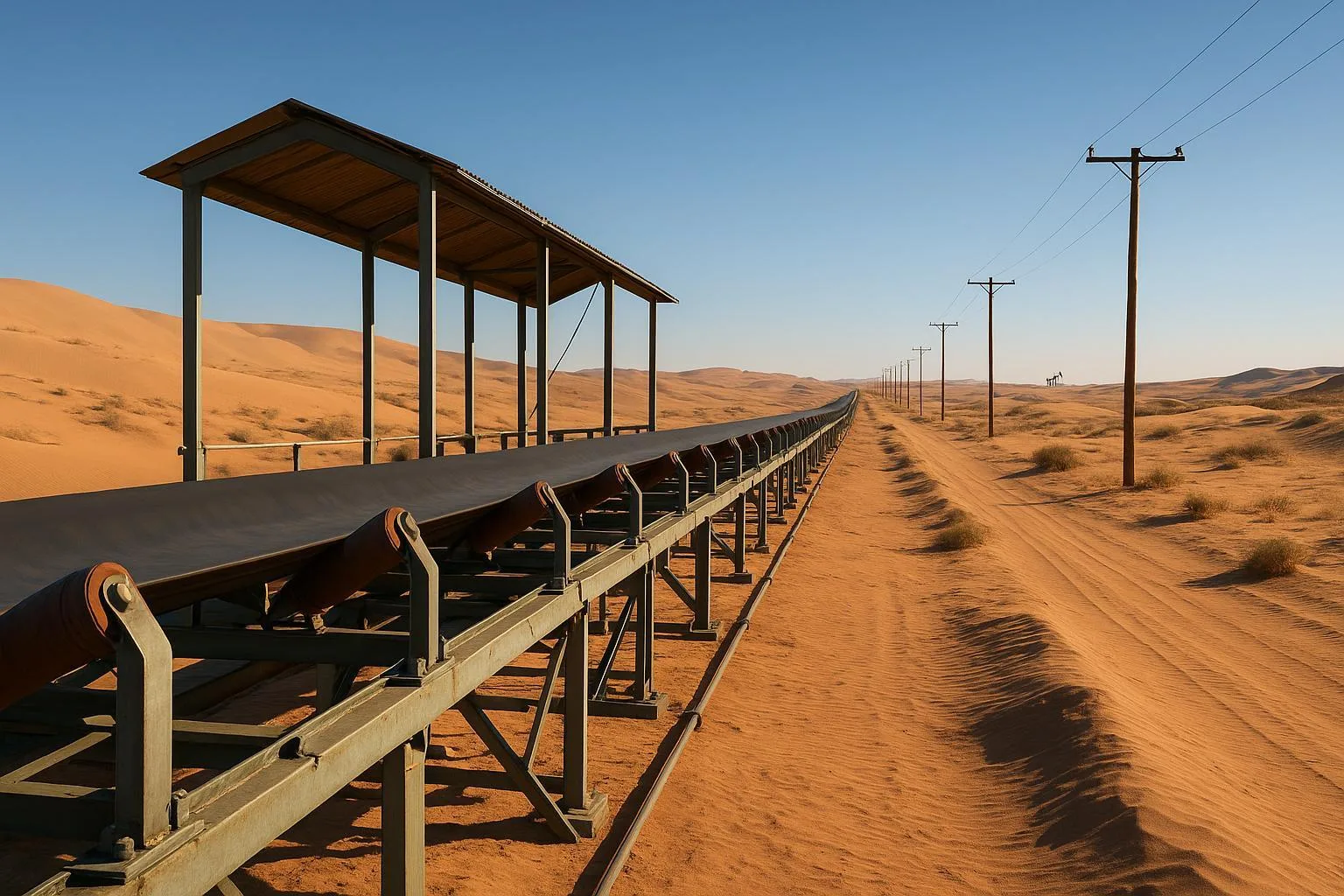
Bulk Material Handling Conveyor Design Considerations
Designing a conveyor for bulk solids isn’t just picking a belt width and calling it a day. The right choices balance capacity, wear, energy, safety, maintainability, and dust control. This guide summarizes the bulk material handling conveyor design considerations that matter most—grounded in accepted methods and reinforced by field experience.
You’ll find practical guidance on capacity and belt speed, ISO/DIN power and tension method families, idler angles and spacing, transfer-chute principles, combustible dust and safety, and the day‑two realities of troubleshooting and maintenance.
Key takeaways
-
Start with material and duty requirements, then size width and speed together; validate power/tensions with ISO 5048 or DIN 22101 method families.
-
Control dust and spillage at the source: stable belt support, proper skirting, and well‑designed transfer chutes do more than any downstream fix.
-
Keep idler sag to about 1–2% and avoid loading on transitions; that single discipline prevents many tracking and sealing issues.
-
Safety is design‑in, not bolt‑on: plan guarding, emergency stops, startup alarms, and lockout access from the first layout.
Core concepts and bulk conveyor design parameters
Getting the fundamentals right up front prevents expensive retrofits. Think of a belt conveyor like a moving trough: its capacity equals the cross‑sectional area of material on the belt times belt speed.
Capacity, cross‑section, and surcharge angle
-
Cross‑sectional area depends on belt width, troughing angle (commonly 20°, 35°, or 45° on three‑roll idlers), surcharge angle, and fill factor.
-
The surcharge angle reflects how the material “settles” on a moving belt; higher surcharge increases stable fill. Load centering and consistent surcharge help control spillage at transfers.
-
Practical implication: If you need more capacity, your primary levers are belt width, trough angle, and speed. Wider belts reduce speed‑related dust and wear but increase structure and idler cost.
-
For terminology and industry context, see the glossary maintained by ConveyorBeltGuide in their comprehensive overview of belt engineering terms. For conceptual capacity math and geometry, Martin Engineering’s Foundations materials illustrate how trough angle and surcharge shape the material profile.
For quick checks while scoping, try the in‑browser Conveyor Belt Capacity Calculator on BisonConvey’s tools page: the calculator uses width, speed, trough/surcharge angles, and bulk density to estimate capacity. Link: Conveyor Belt Capacity Calculator.
Belt speed selection
Speed is a classic trade‑off: faster belts move more tons per hour on a given width, but they also elevate wear, noise, dust, and the risk of spillage if transfers and sealing aren’t engineered accordingly. Many plants operate general‑duty belts at or below roughly 3.5–4.6 m/s depending on material and component choices; dusty, sticky, or highly abrasive streams often run slower. Continental’s public case materials show closed‑trough coal systems operating near 4 m/s when enclosure and transfer design support it.
Need help converting drum RPM and diameter to belt speed during sizing? Use the Conveyor Belt Speed Calculator for a quick reality check.
Method families: CEMA, ISO 5048, DIN 22101
-
CEMA (Belt Conveyors for Bulk Materials) is the North American practice guide, widely used for idler angles, transition practices, skirtboard geometry, and general capacity/speed guidance. Many public resources summarize its concepts.
-
ISO 5048 and DIN 22101 provide calculation frameworks for operating power and belt tensions. Software packages implement both. They differ in coefficients and resistance build‑up, so results won’t match exactly—pick one method family and stay consistent through design iterations. Public documentation from Helix DeltaT and Overland Conveyor describes these approaches.
Authoritative public overviews and help pages include:
-
ISO/DIN calculation context via the Helix DeltaT online help and method notes (ISO 5048, DIN 22101).
-
Terminology and engineering primers aggregated by ConveyorBeltGuide.
Standards and compliance for Bulk Material Handling Conveyor Design Considerations
Standards don’t design the conveyor for you—but they define the safe envelope and common language.
-
CEMA practice: Public summaries outline typical trough angles (20°, 35°, 45°), idler spacing aligned to sag control (≈2% typical outside loading zones), transition distances, and skirtboard geometry. See Martin Engineering’s Foundations knowledge pages for CEMA‑aligned explanations.
-
ISO 5048 and DIN 22101: Method families for calculating effective resistances, power, and belt tensions; include adders for skirt friction and other localized resistances. Use one consistently and document coefficients.
-
ASME B20.1 and OSHA (1910.212, 1910.219, 1926.555): Provide the framework for guarding, controls, startup warnings, and safe access. Plan fixed/interlocked guards over accessible pulleys and rotating parts; include pull‑cords/emergency stops where a risk assessment indicates need; ensure lockout/tagout before servicing.
-
NFPA 654 (combustible particulate solids): For combustible dust hazards, the priorities are containment, housekeeping, ignition control, and, when required by hazard analysis, explosion protection and deflagration isolation. Design chutes/covers to prevent visible dust, bond/ground conductive parts, and provide plug detection with automatic shutdown.
Selected public references for context:
-
Practical method summaries: the Helix DeltaT help sections on ISO/DIN power and tensions (ISO 5048; DIN 22101) and skirt friction adders: Helix DeltaT Help – Methods and Calculations.
-
CEMA‑aligned practice explained in Martin Engineering’s Foundations materials, including transition distance and idler support: Martin Foundations – Transitions and Support.
-
OSHA machine guarding standards for conveyors: OSHA 1910.212 Machine Guarding and OSHA 1910.219 Power Transmission.
-
NFPA combustible dust program context and updates: NFPA 654 overview and statements.
A practical sizing and calculation workflow
Here’s a straightforward approach you can reuse on scoping studies and RFQs.
-
Requirements capture → Material properties (bulk density, angle of repose/surcharge, lump size, abrasiveness, moisture, temperature); capacity and surge; geometry (lift, length, routing constraints); environment (wind, corrosion, dust sensitivity, housekeeping access).
-
Preliminary sizing → Choose an initial belt width/speed pair that meets capacity with a reasonable fill factor and manageable speed; screen idler trough angle (20°/35°/45°) and spacing to target about 1–2% sag (closer spacing in loading zones); estimate power/tensions with either ISO 5048 or DIN 22101; check pulley diameters vs. belt construction and tension utilization.
-
Controls and safety → Plan pull‑cords/emergency stops, speed/misalignment switches, and guarding per ASME B20.1/OSHA; consider dust hazard analysis applicability (NFPA 654); enclose and seal transfers; provide plug detection and interlocks.
-
Verification and refinement → Iterate geometry and components to reduce wear and spillage (e.g., adjust speed, raise trough angle, refine chute). Validate transition distances before loading points; define a commissioning plan covering tracking, cleaner setup, sealing, startup alarms, and interlock tests.
Tip: When working out lift vs. length trade‑offs, the Conveyor Incline Angle Calculator can sanity‑check your slope and help evaluate when you’re approaching the limits for your material.
Symbolic example (conceptual, not numeric): Given required capacity Q and bulk density ρ, select width W and trough angle α to yield cross‑section A(W, α, surcharge). Pick speed v so that Q ≈ A·v·ρ·fill. Apply ISO 5048 (or DIN 22101) to estimate effective resistance, then compute steady‑state power P = F·v and tensions T1/T2 including localized adders (e.g., skirt friction). Verify pulley diameters and wrap; size take‑up to maintain tension through load cycles.
Component selection: belts, idlers, pulleys
Fabric vs. steel‑cord belt selection cues
Choosing the carcass is one of the highest‑impact decisions. Here’s a comparison you can copy into your RFQ notes.
| Aspect | EP/NN (Fabric) | Steel‑Cord |
|---|---|---|
| Typical use | Short‑to‑medium length, moderate tensions | Long distance, high tension, low elongation |
| Elongation | Higher; more take‑up travel | Very low; stable tracking over long spans |
| Splicing | Faster, simpler equipment | Specialized, longer cure times |
| Min. pulley diameter | Set by carcass thickness and maker coefficients | Set by cord fatigue/contact pressure vs. % rated tension |
| Cost profile | Lower upfront; more stretch management | Higher upfront; reduced stretch and fewer take‑up issues |
| When to prefer | Frequent stops/starts, shorter routes, simpler maintenance | Overland, steep lifts, high power, precise control |
For a deeper discussion of trade‑offs, see BisonConvey’s engineering article: EP vs. steel cord conveyor belts comparison.
Idlers: trough angles and spacing
-
Trough angles of 20°, 35°, and 45° are common. Higher angles increase cross‑section but can load belt edges; confirm transition distances.
-
Spacing: Outside loading zones, design to about 2% sag; inside loading zones, 1% or less is typical to stabilize the belt for sealing and reduce dust escape. This is consistent with public CEMA‑aligned guidance in Martin Engineering Foundations.
-
Quality matters: roundness, balance, sealing, and alignment strongly affect rolling resistance and belt life. For factors that affect idler selection (width, speed, lump size, abrasiveness), see Rulmeca’s public design context overview.
Concept table: idler spacing vs. sag targets
| Zone | Target sag | Implications |
|---|---|---|
| Loading zone | ≈ 1% | Closer spacing or slider/impact beds; improves sealing and reduces dust leaks |
| Carry outside loading | ≈ 2% | Longer spacing for energy efficiency; monitor for dust/spillage at higher speeds |
| Return | As needed | Control vibration/buildup; consider cleaners and plows to reduce carryback |
Pulleys: diameter, wrap, and lagging
-
Minimum diameters scale with belt construction and tension utilization. Fabric belts follow manufacturer coefficient rules; steel‑cord belts are limited by cord fatigue and contact pressure. Fenner Dunlop’s public brochures illustrate how minimum pulley diameters rise with percentage of rated tension.
-
Lagging: Ceramic or grooved rubber lagging can restore traction and reduce slip; confirm cleaner compatibility.
-
Wrap and take‑up: Ensure adequate wrap on drive pulley(s); choose gravity vs. hydraulic take‑up based on length and load variability.
Transfers and chutes: where dust, wear, and spillage begin (or end)
A well‑designed transfer is the cheapest dust collector you’ll ever buy. Here’s the deal: if you match the discharge stream’s direction and speed to the receiving belt and keep the belt line stable and sealed, you’ll prevent most downstream problems.
-
Enclose from discharge pulley through a settling zone to contain dust and noise.
-
Use hood‑and‑spoon or equivalent geometry to align the stream; avoid free‑fall impacts where possible.
-
Start the head chute after the last full transition idler; don’t load on a transitioning belt.
-
Provide generous cross‑sectional area; use abrasion‑resistant liners and impact‑resistant components.
-
Stabilize the belt in the loading zone with closer idler spacing or impact beds; maintain robust skirt seals.
-
Control dust by containment first, then apply suppression or collection. Slow air to allow settling with curtains and baffles. Public Foundations materials from Martin Engineering detail these practices and show retrofit examples.
Practical applications and real‑world scenarios
Mining overland conveyor
High capacity over long distances points toward steel‑cord belts, low‑rolling‑resistance idlers, and careful tension/power modeling. Use ISO 5048 or DIN 22101 consistently, evaluate take‑up strategy, and check transitions and curves. Closed or covered designs can support higher speeds when dust is a concern.
Cement plant kiln‑feed incline
Heat‑resistant covers, conservative belt speed, close control of loading‑zone sealing, and diligent housekeeping dominate success. Incline limits depend on material properties; verify with pilot runs when feasible.
Port terminal ship‑loader
Wind, dust control, and cleanup access drive the design. Scrapers and plows minimize carryback onto mobile equipment. Enclosures and transfer‑chute direction control matter; some enclosed systems publicly operate near 4 m/s when engineered for dust control, as shown in Continental’s case materials.
Micro‑example (neutral): Many facilities specify components from reputable suppliers to match these needs. For instance, BisonConvey supplies belts (EP/NN and steel‑cord), idlers, and pulleys that can be configured to the material and duty—useful when standardizing spares and aligning specifications across multiple sites.
Selection and implementation roadmap
Define the material and duty; size width and speed together; compute power and tensions with a chosen method; and design transfers and supports that keep material stable.
During RFQs and project kickoff, progress through these phases:
-
Define requirements and constraints.
-
Preliminary sizing and component screening.
-
Safety and controls planning.
-
Verification, transitions check, and commissioning plan.
Tip: When working out lift vs. length trade‑offs, the Conveyor Incline Angle Calculator helps confirm you’re within practical limits for your material and belt type.
Troubleshooting and root‑cause cues (field‑proven)
Tracking and misalignment issues often trace back to structure, pulley squareness, idler alignment, or off‑center loading. Before installing trainers, realign the structure, repair or replace seized/bent rolls, clean buildup, and confirm splice squareness and adequate tension. Martin Engineering’s public knowledge base outlines a disciplined sequence.
If spillage and dusting persist, stabilize the loading zone with closer idler spacing or impact beds and improve skirt sealing. Revisit chute geometry; when entrainment is excessive, lowering speed can help. For carryback, use properly selected primary and secondary cleaners, keep them tensioned, and clean return rolls and pulleys to avoid induced mistracking. Belt slip typically signals worn or inappropriate lagging, overload, or insufficient take‑up travel—restore traction with correct lagging and verify drive sizing against calculated loads.
Best practices and maintenance that extend belt life
Set an inspection cadence that matches duty severity. Walk the line regularly: listen for noisy or seized idlers, check edges and splices, verify cleaner tension and contact, inspect chute liners and skirt seals, and track dust build‑up. Trend power draw, belt speed, temperatures, and vibration; wire misalignment and speed switches into shutdown interlocks so small issues don’t snowball. Stock critical idlers, cleaner blades, lagging, and splice kits in proportion to risk and lead time. Above all, follow OSHA machine‑guarding rules and lockout/tagout before removing guards or servicing anything that rotates.
FAQ
What’s the fastest way to narrow belt width vs. speed?
Start from required capacity and bulk density. Use a preliminary fill factor and trough angle to get cross‑section, then iterate width and speed pairs until Q ≈ A·v·ρ fits with acceptable dust and wear. The Capacity Calculator helps visualize the trade‑offs.
Which method should I choose for power and tension—ISO 5048 or DIN 22101?
Pick one and stay consistent. Both are recognized; differences in coefficients mean results vary. Document assumptions and validate with measurements during commissioning.
How close should idlers be in the loading zone?
Design to about 1% sag (closer spacing or support beds) to stabilize the belt for sealing. Outside loading, 2% sag is commonly used for efficiency—per public CEMA‑aligned guidance.
How do I know if combustible dust standards apply?
If your material forms clouds or fine layers that can ignite, NFPA 654 concepts likely apply. Perform a dust hazard analysis and plan containment, housekeeping, ignition control, and, when required, explosion protection and isolation.
Conclusion and next steps
Solid conveyor design is about disciplined trade‑offs. Define the material and duty, size width and speed together, calculate power and tensions with a consistent method, stabilize and seal the loading zone, and design transfers that guide—not blast—the material. Build in guarding, interlocks, and housekeeping access from the start, and verify assumptions during commissioning.
If you’d like a second set of eyes on belt, idler, or pulley specifications—or to align components across multiple plants—reach out to the team at BisonConvey for neutral, component‑level support and custom configurations.
References (selected, public overviews)
-
ISO/DIN power and tension methods and skirt friction adders: Helix DeltaT – Methods and Calculations.
-
CEMA‑aligned practice on transitions/idler support: Martin Engineering – Transition Distance and Foundations Book PDF.
-
Terminology and belt engineering primers: ConveyorBeltGuide – Belt Terms.
-
OSHA machine guarding: OSHA 1910.212.
-
NFPA combustible dust program: NFPA 654 statements.