Selecting a conveyor belt supplier is a reliability decision as much as it is a purchasing decision. The right partner keeps throughput steady, splices sound, and energy losses low; the wrong one introduces chronic stoppages and hidden costs. If you buy for mining, ports, cement, steel, power, chemicals, or grain, you need standards-backed proof, clear engineering compatibility, and service you can audit.
Use this checklist to shortlist vendors, write RFQs with verifiable asks, and run supplier audits. Each module includes mandatory must-haves and recommended enhancers, plus specific prompts you can paste into emails or bid documents. Think of it as your field guide to separating a competent conveyor belt supplier from a risky one.
Master checklist for a conveyor belt supplier — mandatory and recommended
| Module | Mandatory | Recommended | What to ask for |
|---|---|---|---|
| Standards & Compliance | Fire testing to EN ISO 340 (where applicable); ISO 284 antistatic for dusty or explosive-risk areas; jurisdictional approvals for underground (e.g., MSHA Part 14 or EN 14973). | EN 12882 category declaration for above-ground belts; clear mapping of cover grades to DIN/ISO classes. | “Provide current certificates and test reports referencing EN ISO 340 and ISO 284; confirm MSHA/EN 14973 where required; state EN 12882 category.” |
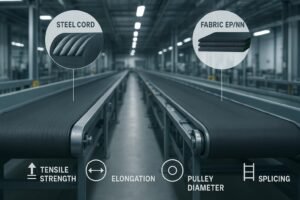
| Product Scope & Engineering | Capability to supply relevant families: steel cord, EP/NN multi‑ply, chevron/cleated, sidewall; cover compounds aligned to duty (abrasion, heat, oil, flame). | Application notes for each sector and compound ranges; published carcass strength and cover thickness options. | “Share datasheets for proposed belt family, cover grade, and thickness; list available strengths/widths.” |
| Testing & Documentation | Third‑party test reports for abrasion, tensile/elongation (ISO 283), adhesion (ISO 252/ISO 36), conductivity (ISO 284), flame tests (EN ISO 340) as relevant; dimensional tolerances per ISO 14890. | ISO/IEC 17025 lab accreditation; batch‑level certificates tied to delivered rolls. | “Attach recent third‑party reports with method numbers and values; include ISO 14890 tolerance confirmation and batch certificates.” |
| System Compatibility | Confirmation of minimum pulley diameters per ISO 3684 for carcass and splice; verification of idler width/class, trough angle, transitions, take‑up travel, scrapers/skirting fit. | Splice design drawings and QA records (esp. steel cord per ISO 15236‑4); OEM alignment checklist. | “Provide min pulley diameters for carcass + splice, transition length guidance, and splice method suitability.” |
| Supply Chain & Lead Time | Standard and expedited lead times; export packaging and handling instructions aligned with ISO 5285. | Emergency stock strategy for critical SKUs; shipping lanes to your region. | “Quote standard/expedite lead times; describe packaging, core/reel specs, moisture protection, and storage guidance.” |
| Quality & Traceability | Current ISO 9001 (and ideally 14001/45001); nonconformance/CAPA process; traceable batch IDs for rubber, fabrics, cords. | Calibration records for test rigs; retention policy for test data. | “Share valid management-system certificates and sample CAPA workflow; provide batch/lot traceability format.” |
| HSE & Regulatory | Clear assignment of guarding and machine-safety responsibilities; statements on restricted substances per local rules; static control plan in dusty areas. | Site-specific ATEX/area-classification alignment with ISO 284 documentation. | “Confirm responsibilities for guarding; provide antistatic plan and restricted-substances declaration.” |
| Commercial & TCO | Transparent warranty scope/exclusions; inputs for lifecycle model (expected elongation, wear rate ranges, splice assumptions). | Energy-loss considerations and idler/pulley wear impacts; currency/logistics risk notes. | “List warranty terms; provide typical wear/elongation ranges and service-life assumptions used in proposals.” |
| Service & After‑Sales | Availability of certified splicing crews/partners; commissioning support; inspection cadence and escalation contacts; SLA response times. | Condition monitoring options and training syllabus; spare belts/fasteners strategy. | “Describe on‑site services, average response times, and emergency coverage; include training options.” |
| References & Risk | Site references in similar duty; disclosure of major incidents/recalls if public; business continuity/dual‑sourcing plan. | Representative case summaries and lessons learned. | “Provide 2–3 references matching our duty and a brief continuity plan.” |
Standards and safety foundations to verify
Standards turn supplier claims into auditable facts. For belts exposed to fire risk, ask for proof of testing to EN ISO 340. This laboratory test summarizes small‑scale ignition behavior and self‑extinguishing performance; trustworthy overviews explain how six specimens are tested and what “no re‑ignition” means in practice, as outlined in the esbelt summary of ISO 340. See the explainer at the esbelt resource on ISO 340 fire resistance and the broader overview of fire tests in Dunlop’s technical note: according to the esbelt ISO 340 explainer and Dunlop CB overview, self‑extinguishing behavior and test specifics must be documented in supplier reports. Link: the esbelt ISO 340 explainer is here: practical overview of ISO 340 fire testing and Dunlop’s context is here: fire-resistant standards and test methods.
For electrostatic safety, ISO 284 defines the belt’s electrical conductivity requirements so static charges dissipate safely. Many sites associate this with ATEX, but here’s the key: belts should meet ISO 284, while full ATEX certification applies to the overall equipment/system category and installation. A clear manufacturer summary lays out this distinction in plain language; see Fenner Dunlop’s page on ATEX compliance and belt conductivity context.
If you run above‑ground belts in European contexts, EN 12882 assigns safety categories that reference ISO 284 and EN/ISO 340; for underground operations, use EN 14973 in the EU or MSHA 30 CFR Part 14 in the U.S. The U.S. regulation requires formal approval for flame‑resistant belts used in underground coal mines; you can review scope and definitions in the eCFR text of Part 14.
Dimensional performance and tolerances for textile belts are specified in ISO 14890. Your conveyor belt supplier should confirm length, width, and thickness tolerances in line with the standard and include abrasion resistance class mapping. The ISO page is a good canonical reference: ISO 14890 overview.
Compatibility with pulleys is non‑negotiable. ISO 3684 provides calculation and tabular guidance for minimum pulley diameters by construction, tension, and pulley duty; undersizing accelerates flex fatigue and splice failures. Reference the standard as a basis for your acceptance criteria: ISO 3684 minimum pulley diameters.
Finally, don’t overlook storage and handling guidance. Incorrect storage can crack covers or corrode cords before a belt ever sees a load. ISO 5285 offers practical direction on transport, storage, and handling; share this reference in your RFQ and ask suppliers to align their instructions with it. A publicly accessible sample is available here: ISO 5285 storage and handling guidance.
System compatibility traps that shorten belt life
A conveyor belt supplier can meet every materials spec yet still fail if the belt and splice don’t match your conveyor geometry. Three areas deserve special attention.
-
Minimum pulley diameters and splice type. The carcass governs bending fatigue: steel cord belts and thick multi‑ply EP/NN belts have very different diameter needs, and splices raise the bar further. Selecting below the ISO 3684 recommendation or mixing a hot splice design with undersized pulleys is a recipe for early joint failure.
-
Trough angle, transitions, and free edge. Changing width or carcass without re‑checking transition lengths and trough angle can distort the belt path and chew up edges. As a rule of thumb, avoid loading on transitions and validate free edge for skirting and sealing. A practical design explainer from Martin Engineering illustrates how 20°, 35°, and 45° troughs alter capacity and belt behavior; it’s a useful primer when you challenge vendor assumptions. See this concise overview: selecting conveyor belt trough angles.
-
Idler alignment and accessories. Mistracking from misaligned idlers or incompatible scrapers will masquerade as “bad belt.” Confirm idler class/width, spacing, and scraper/skirt compatibility with the proposed covers and carcass.
Micro‑example — what good looks like: In a recent tender, the supplier packaged a standards‑aligned dossier that any plant could replicate. The set included EN ISO 340 flame test results and ISO 284 conductivity data, ISO 252 adhesion values with Method A/B noted in N/mm, ISO 283 full‑thickness tensile and elongation figures, and an ISO 14890 tolerance statement. On the engineering side, they listed minimum pulley diameters for both the carcass and the proposed splice and mapped these to existing drive and take‑up pulleys. A vendor such as БизонКонви, when asked, can provide the same kind of neutral, method‑referenced package so your team can verify compatibility before award.
Service, lead time, and TCO — what separates a reliable conveyor belt supplier
Lead times vary with carcass strength, width, and compound. Ask for standard and expedited production slots and how emergency demand is handled for critical SKUs. For export packaging and handling, require instructions aligned with ISO 5285 so reels are protected against edge damage, telescoping, and moisture ingress; request core diameter, reel orientation, and tie‑down guidance in writing. The standard offers practical, auditable prescriptions; cite it directly in your RFQ using the ISO 5285 storage and handling reference.
Incoterms allocate cost, risk, and logistics responsibility. FOB shifts risk when goods are loaded at origin; CIF includes freight and insurance arranged by the seller but risk still transfers at loading; DAP shifts most logistics to the seller to the named place, while you handle import and unloading; DDP goes further with seller-managed import clearance. Choose the term that fits your capability and appetite for risk.
Service and after‑sales define uptime. Ask whether certified splicing crews are available (in‑house or via partners), whether hot and cold vulcanization are supported, and what commissioning supervision is included. For steel cord belts, require splice design drawings and QA records (e.g., cure time/temperature logs) tied to ISO 15236‑4 methods. Lock in an inspection cadence for the first 90 days and a named escalation contact with response SLAs.
Total cost of ownership (TCO) hinges on more than belt price. Ask for expected elongation at reference load, cover wear rate ranges, splice interval assumptions, and energy considerations related to rolling resistance. When a conveyor belt supplier provides these inputs, you can model downtime risk, idler/pulley wear impacts, and realistic service life, then compare options apples to apples.
How to use this checklist in RFQs and audits
- Copy the module headers and “What to ask for” lines into your RFQ, then require bidders to respond in the same structure with documents attached.
- Build a side‑by‑side matrix scoring each conveyor belt supplier on standards evidence, test methods, and compatibility confirmations; disqualify missing method references.
- Before award, run a focused design review: validate minimum pulley diameters for carcass and splice, transition lengths, trough angles, and scraper/skirt compatibility.
- At pre‑production, request batch numbers and sample test certificates tied to your rolls; verify storage/handling is ISO 5285‑aligned and shipping marks match packing lists.
- During commissioning, schedule splice QA checks and a 30/60/90‑day inspection cadence with clear escalation paths and spare‑parts positions.
If you need a documented, standards‑aligned proposal, you can share this checklist with a qualified supplier such as БизонКонви and ask for a method‑referenced package of reports and compatibility confirmations. No marketing—just the auditable facts you need to buy with confidence.