If you’re looking for the most durable conveyor roller, here’s the deal: no single material wins everywhere. Durability hinges on the dominant failure mode in your application—abrasion, corrosion, impact at loading zones, contamination at the seals, high load/speed deflection, temperature, or chemicals. This comparison pulls together current, citable guidance and maps roller types to the environments where they actually last the longest.
Scope note: This review reflects typical CEMA B–F idlers and common OEM offerings as of 2026-04-18. Pricing and options vary by region and supplier and are subject to change.
TL;DR: Ceramic-coated contact surfaces excel in extreme abrasion; stainless or polymer/composite shells resist wet and chloride-rich corrosion; impact/rubber-disc rollers and impact beds survive drop-energy in loading zones; heavy-duty steel rollers dominate ultra–high load and high-speed trunk lines; UHMWPE/composites help with lower noise, lower mass, and often lower rolling resistance in many plants. The “most durable conveyor roller” is the one aligned to your primary failure mode.
Side-by-side comparison: Which roller is most durable by environment
The goal of this table is to help you choose the most durable conveyor roller for your scenario—not to crown a single universal winner. Qualitative ratings reflect current industry practice and cited mechanisms; where hard numbers are necessary, consult your supplier’s datasheets and site-specific tests.
| Material / Type | Best-for scenarios | Abrasion / wear | Corrosion resistance | Impact / shock | Bearing & seal protection | Load rating / CEMA fit | Temp / chemical compatibility | Rolling resistance / energy | Noise | Typical maintenance/MTBF | Lifecycle cost (qualitative) |
|---|---|---|---|---|---|---|---|---|---|---|---|
| Carbon steel roller | High-load trunk lines where abrasion is moderate and conditions are dry | Good against sliding fines; can wear in sharp, dry ores | Fair; needs coatings/paint/galv; susceptible to rust | Fair; shell can dent under heavy drops | Depends on seal design; multi‑stage labyrinth preferred | Strong in higher classes; readily available in E/F | Excellent high-temp tolerance; chemicals depend on coating | Baseline; depends on seal drag and concentricity | Baseline; heavier mass | Regular inspections; intervals vary by environment | Often lowest purchase price; TCO rises if corrosion/abrasion severe |
| Stainless steel roller (304/316) | Wet/corrosive: ports, salt, fertilizer, washdown | Good; not purpose-built for extreme abrasion | Excellent; 316/316L preferred for chlorides | Fair–Good; similar mechanics to steel | Depends on seal design; stainless helps resist corrosion at housings | Strong; available across CEMA classes | Broad temp range; good chemical resistance; grade-dependent | Baseline; mass similar to steel | Baseline | Longer intervals in wet/corrosive service | Higher purchase price; can reduce corrosion-related downtime |
| UHMWPE/HDPE polymer roller | Wet/corrosive plants; energy/noise-sensitive sites | Good in sliding abrasion; low-friction surface | Excellent; polymers don’t rust | Fair; shells won’t dent easily but stiffness is lower than steel | Depends on seal design; polymers don’t eliminate ingress risk | Moderate; verify class/shaft for load & speed | Continuous service typically to ~80°C (grade-dependent) | Often low due to low mass and low-drag seals (vendor-dependent) | Often lower | Intervals can be longer in wet/dusty plants; vendor-dependent | Purchase price varies; potential OPEX gains via handling/energy |
| Composite/fiber-reinforced roller | Similar to UHMWPE but with stiffer shells | Good; formulation-dependent | Excellent; no rust | Fair–Good; improved stiffness vs pure polymer | Depends on seal design | Moderate–Strong; check OEM ratings | Formulation-dependent; check datasheet | Often low (vendor-dependent) | Often lower | Similar to polymer; vendor-dependent | Mid-range TCO; potential energy/handling benefits |
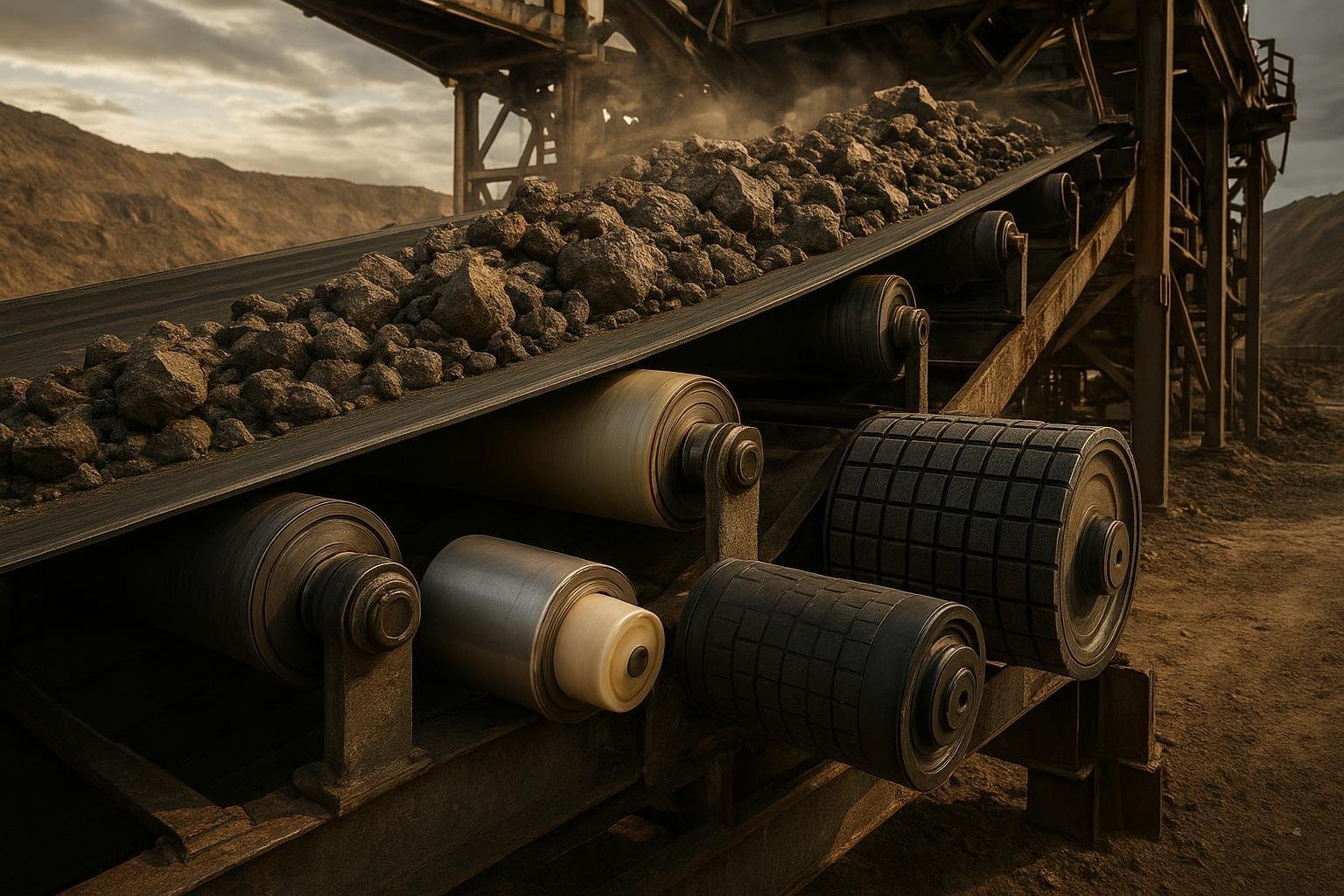
| Ceramic-coated contact surface (e.g., pulleys; some rollers) | Abrasive-dry or wet/slurry where traction and wear life matter | Excellent; high hardness and textured tiles | Excellent (ceramic is inert) | N/A for shell denting; coating is brittle but wear-resistant | N/A (coating doesn’t seal); bearing life unaffected by coating | Used primarily on pulleys; some specialty rollers | Excellent chemical/temperature tolerance | Neutral to rolling resistance | Neutral | Long surface life in abrasive duty | Higher upfront; can cut re-lagging frequency |
| Impact / rubber-disc rollers (loading zone) | High drop heights, large lump sizes at transfer points | Good; discs absorb surface scuffing | Neutral; depends on core material | Excellent for shock absorption | Often enhanced sealing; impact zones still harsh | Sized to duty; often paired with impact beds | Similar to base roller; rubber temp limits apply | Neutral | Often quieter at impact | Extends belt/roller life in loading zones | Adds cost in loading sections; pays back via fewer failures |
Note: Ceramic contact surfaces are most commonly applied to pulleys rather than standard carry/return rollers; we include them here because abrasion-driven durability often hinges on pulley traction and wear. See the sources referenced in the deep-dive sections below.
How to choose the most durable conveyor roller by scenario
- If your dominant failure mode is abrasive wear in dry, dusty mines or quarries, use ceramic contact surfaces on drive pulleys and consider hard-wearing shells in the carry/return set; ceramic’s hardness and texture retain traction and resist abrasion in harsh ore service, as outlined in Flexco’s ceramic lagging guides.
- If the environment is wet, salty, or chemically aggressive (ports, fertilizer blending, frequent washdown), stainless steel (preferably 316/316L in chloride service) or polymer/composite rollers typically preserve shell integrity and reduce corrosion-driven bearing failures.
- If failures originate in the loading zone—dented shells, broken brackets, seized bearings after big drops—install impact/rubber-disc rollers or an impact bed/cradle in the first idler spaces to absorb energy before standard idlers take the load.
- If the conveyor is a high-load/high-speed trunk line (overland or plant trunk), heavy-duty steel rollers correctly sized to CEMA class E/F provide the stiffness and deflection control needed for long life at speed.
Think of it this way: match the material to the physics that’s killing your rollers.
Abrasion and wear: why ceramic textures and low-friction polymers help
In abrasive service, two mechanisms matter: surface hardness and contact traction. Ceramic tiles bonded to pulley surfaces provide very high hardness and a textured interface, enhancing grip and resisting abrasive wear far better than rubber lagging. Flexco documents these benefits and use cases in The Ultimate Flex-Lag Tech Guide and related product literature, noting improved wet traction and extended service in abrasive conditions. See the discussion in the Ultimate Flex‑Lag Tech Guide by Flexco (2021) for mechanism-level rationale and selection factors: the document explains how tile geometry and hardness support wear life and traction in wet and dry abrasion scenarios, and why ceramic is chosen over softer laggings in many mines and quarries. Reference: Flexco — The Ultimate Flex‑Lag Tech Guide (2021).
- According to the Flexco technical literature, ceramic lagging is particularly strong in abrasive and wet traction scenarios, helping maintain drive friction and resist surface wear over extended intervals. See the overview in the Flexco guide: The Ultimate Flex‑Lag Tech Guide (2021) for selection context and field rationale. Source: Flexco — The Ultimate Flex‑Lag Tech Guide.
UHMWPE shells are also widely used where sliding abrasion from fines and sticky materials is a problem; the polymer’s low surface energy and self-lubricating nature reduce material adhesion and scuffing. While this article avoids numerical wear-rate claims without a public test PDF, the mechanism is straightforward: a slick, low-friction surface reduces abrasive drag and fines buildup, which can improve service intervals in dusty plants.
- Explore ceramic durability considerations in practice on BisonConvey’s ceramic pulley lagging page for application context: BisonConvey Ceramic Pulley Lagging.
Citations for this section:
- Flexco’s comprehensive ceramic lagging overview in the Ultimate Flex‑Lag Tech Guide describes wear and traction mechanisms and when ceramic is preferred in abrasive or wet service: see The Ultimate Flex‑Lag Tech Guide (2021) by Flexco: Flexco — The Ultimate Flex‑Lag Tech Guide.
Corrosion resistance: why 316 stainless and polymers win in chloride service
In ports, salt handling, fertilizer blending, and frequent washdown, corrosion—not abrasion—often drives replacement. Here, austenitic stainless steels outperform carbon steel because they resist pitting and crevice corrosion. Importantly, 316/316L contains molybdenum, improving resistance to chloride attack compared with 304/304L. Outokumpu provides authoritative guidance on stainless behavior in atmospheric and chloride-rich environments, and Ulbrich’s technical explainer details the 304 vs 316 alloying differences and where each is appropriate.
- According to Outokumpu’s corrosion guidance (2025), 316/316L is better suited than 304/304L for chloride-bearing environments due to molybdenum additions that improve pitting resistance. See: Outokumpu — Stainless steel and atmospheric corrosion: what you need to know.
- For a concise alloy comparison covering where 304 vs 316 is typically chosen, see Ulbrich’s overview: Ulbrich — Grade 304 vs 316 stainless steel: what’s the difference?.
Polymers and composites also avoid rust entirely, making them attractive in constant moisture or chemical-mist environments. You still need robust sealing to protect bearings from water ingress, but the shell itself won’t pit.
If your plant handles corrosives yet also needs abrasion resistance, a hybrid approach is common: stainless or polymer/composite rollers in most sections, paired with ceramic lagging on the drive pulley for traction and abrasive resilience.
- For polymer options in context, see BisonConvey’s UHMWPE page: BisonConvey UHMWPE Rollers.
Impact survival in loading zones: when to use impact rollers and beds
Loading and transfer points are the most punishing locations on a conveyor. Dented shells, broken brackets, and seized bearings typically trace back to uncontrolled drop heights and large lump energies. The fix is well known in bulk handling: use impact/rubber‑disc rollers or install an impact bed/cradle across the loading zone.
- Martin Engineering’s Foundations resources explain how impact cradles distribute load and reduce localized belt and idler damage in transfer points, with practical alignment guidance for installers (2024): Martin Engineering — Belt conveyor impact cradle alignment.
In practice, many plants combine impact idlers or a modular impact bed in the first several idler spaces, then transition back to standard trough idlers once the belt is stabilized. Ensure your bed/roller selection and spacing match your lump size, drop height, and belt speed.
- For trough idler and loading-zone options in context, see: BisonConvey — Trough idlers and return rollers.
Bearing and seal protection: multi-stage labyrinths matter
Even the strongest shell fails early if dust, slurry, or wash water gets past the seals. Multi‑stage labyrinth systems with grease-filled chambers are a proven approach for harsh mining and cement plants. While specific ingress ratings are typically vendor-proprietary, heavy-duty designs document the use of multi-lip or labyrinth stacks to slow contaminants before they reach the bearing. Rulmeca’s heavy-duty PSV roller literature describes hermetic labyrinth sealing for mining/construction duty—a representative example of the architecture used across premium idlers.
- For an overview of a heavy-duty labyrinth concept in a mainstream OEM range, see: Rulmeca — Steel rollers PSV (labyrinth sealing overview).
Key takeaway here: specify seal architecture, not just shell material. In wet, dusty, or sticky service, sealing decisions often dominate MTBF.
Load rating and deflection: choose the right CEMA class for high-load/high-speed lines
Durability on long, fast trunk conveyors depends on shaft diameter, bearing selection, and frame stiffness—choices grouped by CEMA idler classes (B through F). While the definitive load/deflection tables live in CEMA 502 and OEM datasheets, public committee documents and OEM pages illustrate how higher classes map to heavier duty. For example, CEMA E idlers are used on higher-load conveyors with larger shaft diameters to control deflection at speed. When your primary requirement is carrying capacity and alignment at high tonnage, heavy-duty steel rollers correctly sized to CEMA E/F typically offer the longest service life.
- Context references: CEMA committee agenda materials reference class selection in relation to accessories and impact components (2018/2019). See: CEMA — Bulk Conveyor Accessories Committee agenda set (2018).
- OEM example of class positioning: Rulmeca — CEMA E overview.
Temperature and chemical compatibility: match the polymer grade and alloy to the exposure
UHMWPE’s continuous service temperature is typically around 80°C for standard grades, with specialty “hot” formulations extending higher, and excellent performance at very low temperatures. That makes UHMWPE attractive in many ambient and cold environments where chemicals or moisture are present. Stainless steels cover far higher temperature ranges and a broad chemical spectrum, but alloy selection (and possible coatings) still matters.
- Material reference: MCAM’s TIVAR 1000 datasheet specifies continuous service guidance and chemical notes for UHMW‑PE: MCAM — TIVAR 1000 UHMW‑PE datasheet.
If your process involves hot clinker, sinter, or elevated-temperature dryers, steel or stainless shells are more appropriate than polymers unless a high‑temperature polymer grade is explicitly approved by the supplier.
Rolling resistance, energy, noise, and handling safety
Idlers influence power draw via seal drag, concentricity, and mass. Polymer/composite rollers often reduce mass and can be paired with low-drag seals, which helps lower rolling resistance in many plants. However, quantified savings are vendor- and installation-dependent; always ask for measured torque or kW/ton data before assuming an energy payback. From a safety perspective, lighter rollers reduce manual handling risk and can make change-outs faster, which indirectly supports higher uptime.
If noise exposure is a concern, polymer/composite rollers tend to operate more quietly than steel due to material damping. Again, seek site-measured dBA data from the vendor or your own trials.
Lifecycle cost and maintenance planning
For procurement, the durable choice is the one with the lowest total cost of ownership (TCO): purchase price + installation + energy + maintenance + downtime. Build a simple model with your site’s energy rate ($/kWh), labor cost per change-out, typical replacement intervals by section (loading, carry, return), and any safety-related premiums. Track mean time between failures (MTBF) by location, not just by roller type; loading zones and wet sections almost always need different plans than dry, steady-state runs.
A quick maintenance cadence that works well in harsh duty: frequent visual checks in loading zones, quarterly random spin checks across the line, and annual section-by-section audits with replacement plans anchored to failure data rather than fixed calendars.
Migration notes: moving from steel to UHMWPE/composites
If you’re considering replacing steel rollers with UHMWPE or composite shells, verify shaft diameter and bearing selection against your CEMA class and belt speed; confirm that frame tolerances and mounting hardware accept the new roller’s end-cap geometry; and ask vendors for runout and seal-drag specs so you can estimate any energy differences. Plan a pilot in one conveyor section before a plant-wide change, capturing weight handling, installation time, and any cleanliness or noise improvements.
Pricing and availability
As of 2026-04-18, pricing and availability vary widely by diameter, CEMA class, coatings/grades (e.g., 304 vs 316), and freight. Treat all price/performance guidance as subject to change and request current quotations and lead times before finalizing specifications.
FAQ
Which roller lasts longest in abrasive mining environments?
Ceramic contact surfaces on drive pulleys are particularly strong in abrasive duties because tile hardness and texture maintain traction and resist wear in harsh, dusty conditions, as described in Flexco’s technical guide (2021). See: Flexco — The Ultimate Flex‑Lag Tech Guide. In carry/return rollers, hard-wearing shells and good sealing complement ceramic on pulleys for an abrasion-focused setup.
What should I specify for the most durable conveyor roller in wet or marine conditions?
Stainless steel—preferably 316/316L in chloride-bearing environments—or polymer/composite rollers generally outlast painted or galvanized carbon steel because they resist rust and pitting. Outokumpu explains why 316’s molybdenum content improves chloride resistance, and Ulbrich outlines 304 vs 316 selection differences: Outokumpu — Atmospheric corrosion guidance и Ulbrich — 304 vs 316 explainer.
Are impact idlers really more durable in loading zones than standard rollers?
Yes—because they’re designed to absorb drop energy that would otherwise dent shells and shock bearings. Martin Engineering’s Foundations resources explain how impact cradles and rollers distribute load and protect the belt and idlers during material drops: Martin Engineering — Impact cradle alignment.
Where do seal designs fit into durability—don’t shell materials matter more?
In harsh, wet, or dusty plants, seal architecture can dominate life. Multi‑stage labyrinth systems slow contaminant ingress before it reaches the bearings. Rulmeca’s heavy-duty PSV range describes this approach as used in mining/cement duty: Rulmeca — Steel rollers PSV (labyrinth sealing overview). Choose both the right shell material and a robust seal stack for the environment.
If you want application-specific guidance or datasheets for the roller types discussed here, you can review product context pages and request specifications from manufacturers such as BisonConvey: BisonConvey — UHMWPE Rollers, BisonConvey — Trough idlers and return rollers, and BisonConvey — Ceramic pulley lagging.