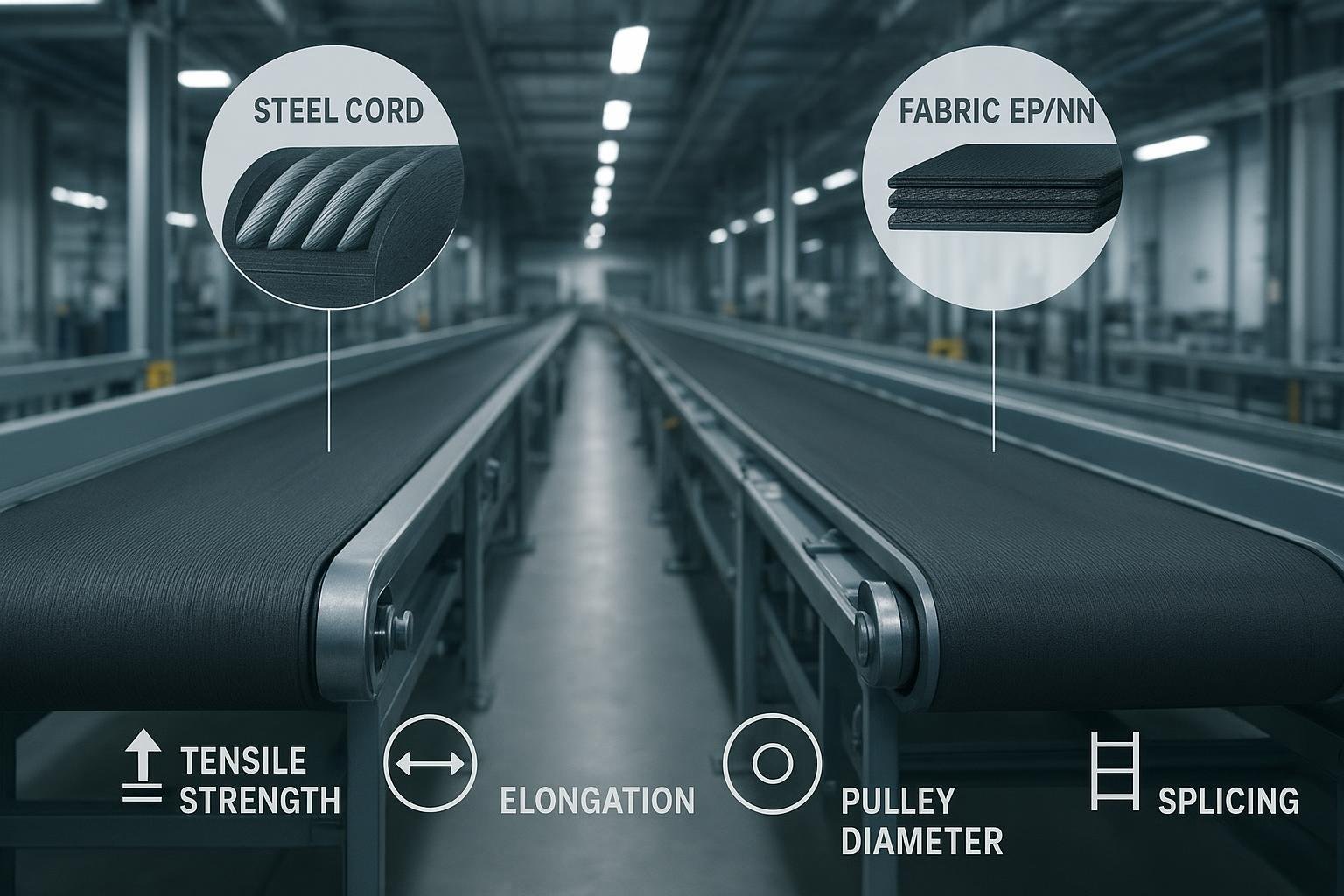
If you’re weighing a steel cord vs fabric conveyor belt for an upcoming project or retrofit, here’s the short answer: neither is universally “better.” Steel cord belts typically win on very high tension, long-distance, straight runs where low operating elongation and energy efficiency matter most. EP/NN fabric belts usually win on short-to-medium runs, tight pulley diameters, complex routing, and fast maintenance turnarounds.
Think of it this way: a steel cord belt is a high-torque highway hauler—built for long, steady pulls with minimal stretch—while a fabric belt is a nimble city runner—more flexible, easier to splice, and friendlier to compact layouts. Your site constraints, downtime windows, and compliance needs decide the winner.
Below is a compact side-by-side to anchor your decision, followed by deeper guidance, standards notes, and an FAQ.
Steel cord vs fabric conveyor belt: fast comparison
| Dimension | Steel cord belt | EP/NN fabric belt |
|---|---|---|
| Tensile capacity (N/mm class) | Very high ST ratings suitable for long, high-tension service | Moderate-to-high PN ratings for plant runs and shorter conveyors |
| Operating elongation | Typically very low in service; stable tracking at high loads | Higher than steel cord; requires more take-up travel and retensioning |
| Flexibility & min pulley diameter | Stiffer; larger minimum pulley diameters per ISO 3684 method | More flexible; supports smaller pulleys per ISO 3684 method |
| Splicing & field repair | Hot vulcanized splices require skilled crews and longer outages | Hot/cold vulcanized or mechanical options; quicker, simpler repairs |
| Impact, cut & rip behavior | Excellent for large, heavy lumps; rip detection/monitoring options exist | Good general-purpose resilience; specific designs can improve rip resistance |
| Lifecycle & monitoring | Compatible with cord condition monitoring ecosystems | Visual inspections and splice QA are straightforward; fewer specialized tools |
| Energy efficiency options | Often paired with low rolling resistance (LRR) covers for long overlands | Energy gains mainly from covers/idlers; less pronounced on short runs |
| Cost & TCO | Higher CAPEX; pays back on long, heavy, straight conveyors | Lower CAPEX; wins where runs are shorter or maintenance windows are tight |
| Compliance variants | Available with FR/antistatic-certified constructions | Available with FR/antistatic-certified constructions |
| Typical applications | Overland, high-tonnage, straight-line conveyors | Plant conveyors with curves, small pulleys, frequent starts/stops |
How to choose the right carcass type (and avoid rework)
Start by plotting four constraints: conveyor length and working tension, minimum pulley diameters (drive, tail, snub, take-up), planned downtime per outage, and compliance needs. If you’re above several hundred meters with high working tensions and relatively straight geometry, steel cord usually pencils out. If your layout forces small pulleys or multiple curves—or if you need faster splices due to limited maintenance windows—fabric tends to win.
A practical decision rule: if pulley diameters or layout compel small wrap radii, fabric’s flexibility and simpler splicing are often decisive. If tension stability, low stretch, and energy per ton-kilometer dominate, steel cord plus LRR covers is hard to beat. When in doubt, model both options with realistic downtime and energy assumptions before locking the spec.
Tensile capacity and elongation stability
At a system level, tensile rating and in-service elongation drive belt control, take-up travel, and tracking behavior. Steel cord belts are engineered for very high ST ratings and typically exhibit very low operating elongation, which helps maintain stable tension and reduces retensioning cycles on long or heavily loaded conveyors. EP/NN fabric belts cover a broad range of plant duties and are proven workhorses, but their higher in-service stretch generally means more frequent adjustments and a bit more take-up travel planning.
Standards context: steel cord belts are addressed in the ISO 15236 family, and textile belts in ISO 14890; minimum pulley diameter calculations for both carcass types use the ISO 3684 method. For selection and retrofit work, many engineers consult vendor pulley tables that are aligned to the ISO 3684 method for calculating minimum pulley diameters.
Flexibility and minimum pulley diameters
Pulley diameter is the quiet constraint that sinks many retrofits. Fabric belts are inherently more flexible, allowing smaller pulleys and tighter routing without over-bending the carcass. Steel cord belts, with higher bending stiffness, generally require larger pulleys, and violating those minima can accelerate fatigue and cover cracking.
What to do in practice: document actual pulley diameters and take-up travel before you choose the carcass. If your snubs or take-up stations are already small, EP/NN fabric is often the safer fit unless you redesign key pulleys. If you’re planning a new, straight, long conveyor, you can purpose-build pulley sizes for a steel cord specification from day one.
Splicing and maintenance windows
Splicing method, expected splice strength, and outage duration are as important as belt price. For fabric belts, both hot and cold vulcanization are widely used; process steps, geometry, and quality controls are detailed in REMA TIP TOP’s hot splicing instructions for fabric belts. If you need a primer on splice types and trade-offs, Almex’s Splice Types 101 is a solid overview.
Steel cord belts typically rely on hot vulcanized splices executed by specialized crews and presses. Done correctly, these splices are robust for long, high-tension service—but prep and cure time often means longer outages, which must be scheduled into your production plan. If your plant can’t spare that window, the practical edge shifts toward EP/NN fabric, where acceptable short-term mechanical joins or quicker cold splices can keep you running until a planned hot splice.
Energy efficiency and low rolling resistance covers
On long conveyors, rolling resistance in the bottom cover can dominate power draw. Several manufacturers document meaningful savings from low rolling resistance (LRR) compounds for overland service. Continental, for example, introduced an energy label and reports case outcomes showing double-digit savings for long overlands with LRR classes when compared to standard compounds; see the Continental energy efficiency label explainer por el contexto.
While both carcass types can be paired with LRR covers, steel cord belts on long, straight conveyors typically capture the most benefit thanks to low elongation and steady-state operation. In plants with short runs and many starts/stops, the LRR payback is smaller; idler maintenance and alignment may deliver a better return.
Lifecycle and monitoring considerations
Critical, long-haul conveyors demand condition visibility. Steel cord belts are compatible with cord condition monitoring ecosystems that can detect certain damage modes and splice issues in operation; Continental’s CONTI CordProtect overview illustrates how such systems fit into predictive maintenance strategies. Fabric belts tend to rely more on routine visual inspections, cover thickness checks, and disciplined splice QA. The best choice depends on your criticality class and the cost of unplanned downtime.
Compliance and safety (FR/antistatic)
If your application requires flame resistance and antistatic properties—whether for surface plants with dust hazards or underground service—specify belts that are certified to applicable standards. Depending on jurisdiction and duty, this may involve ISO 340, EN 12882, EN 14973, and/or MSHA certifications. Both steel cord and fabric constructions are available in certified variants. Confirm the exact class and test method with your supplier and retain certificates with your maintenance documentation.
Pricing and TCO notes (as of 2026-04-17)
Budget decisions should weigh more than belt-per-meter pricing. Model five-year TCO with, at minimum: belt cost, splice/installation labor, expected splice count, planned outage hours, cost per hour of downtime, drive power (kWh) over expected duty, and inspection/monitoring costs. As a rule of thumb, steel cord lines typically show higher CAPEX but can win on TCO for long, high-throughput, straight runs—especially when LRR covers are specified and maintained. Fabric often wins TCO for shorter, complex layouts with frequent maintenance windows.
Scope and volatility note: prices and certification portfolios vary by region, rating, width, and cover compound, and they can change quickly. Treat any budgetary figures as indicative and time-stamp your quotes.
When a system approach helps
End-to-end performance depends on the interaction between carcass, covers, idlers, pulleys, and alignment practices. Some manufacturers offer belts alongside engineered idlers, pulleys, and motorized rollers to reduce rolling resistance and extend service life. For example, BisonConvey provides steel cord and EP/NN belts together with compatible idlers and pulleys, and offers application-driven selection support to help optimize total cost of ownership for a specified duty. Learn more at BisonConvey. Use this kind of integrated support when you’re balancing pulley sizes, take-up travel, target energy draw, and outage windows.
FAQ
-
Which is better for long-distance conveyors: steel cord or fabric?
- For long, straight, high-tension conveyors, steel cord is generally preferred due to very low operating elongation and high tensile ratings. Pairing with LRR covers can further reduce energy on overlands; see Continental’s published context in the energy efficiency label explainer.
-
What minimum pulley diameter differences matter most?
- Steel cord belts typically require larger minimum pulley diameters than fabric belts. Engineers use vendor tables based on the ISO 3684 method for calculating minimum pulley diameters to verify drive, tail, snub, and take-up sizes before finalizing a spec.
-
How do hot vs cold splices differ for fabric belts?
- Hot vulcanization uses heat and pressure to cure stepped ends; cold vulcanization uses adhesives at ambient temperature. Both require careful prep, geometry, and QA. Process-level guidance is documented in REMA TIP TOP’s hot splicing instructions.
-
Can I monitor steel cord belt health in operation?
- Yes. Steel cord belts are compatible with condition monitoring systems that assess certain damage modes and splice integrity; Continental’s CONTI CordProtect is one example of this ecosystem approach.
-
When should I switch from fabric to steel cord?
- Consider converting when your conveyor length and working tension increase beyond what your fabric belt handles comfortably; when take-up travel for elongation becomes a chronic issue; or when energy use on a long, straight line becomes a priority and LRR covers on a steel cord belt can deliver measurable savings.
Bottom line
Pick the carcass type that matches your layout and maintenance reality, not just the nameplate strength. Document pulley diameters, tension and take-up ranges, expected outage windows, and compliance requirements. Then compare a steel cord option against a fabric option using the same duty assumptions and a five-year TCO model. If you’d like a sanity check, engage a qualified belt manufacturer or installer and share your pulley and tension data—your future uptime depends on it.