Radial Stacker Conveyor Costs and ROI
A radial stacker can be one of the most cost-effective ways to build consistent stockpiles in aggregates, mining, cement, and ports. Yet justifying the purchase means understanding both line‑item costs and the real levers of payback. In this guide, I’ll break down the radial stacker cost structure and show how ROI is created—through labor/time savings, less rehandling and segregation, and higher usable stockpile capacity—using engineering principles, standards, and real‑world examples.
Key takeaways
-
Upfront prices for common configurations typically sit around $50,000–$170,000 depending on length, width, mobility, and controls, as described by the industry analysis from West River Conveyors on radial stacker costs.
-
Telescoping/luffing designs can expand usable stockpile capacity and reduce segregation; Telestack documents stockpile capacity gains of about 30% under suitable conditions in its radial telescopic guidance.
-
The strongest ROI drivers are fewer wheel‑loader hours, reduced double handling, better product consistency, and uptime from high‑quality components and preventive maintenance.
-
Use standards and safe practices: capacity and tension methods align with CEMA/ISO 5048; implement LOTO and guarding per OSHA/MSHA.
Core concepts and technical foundations
How a radial stacker works
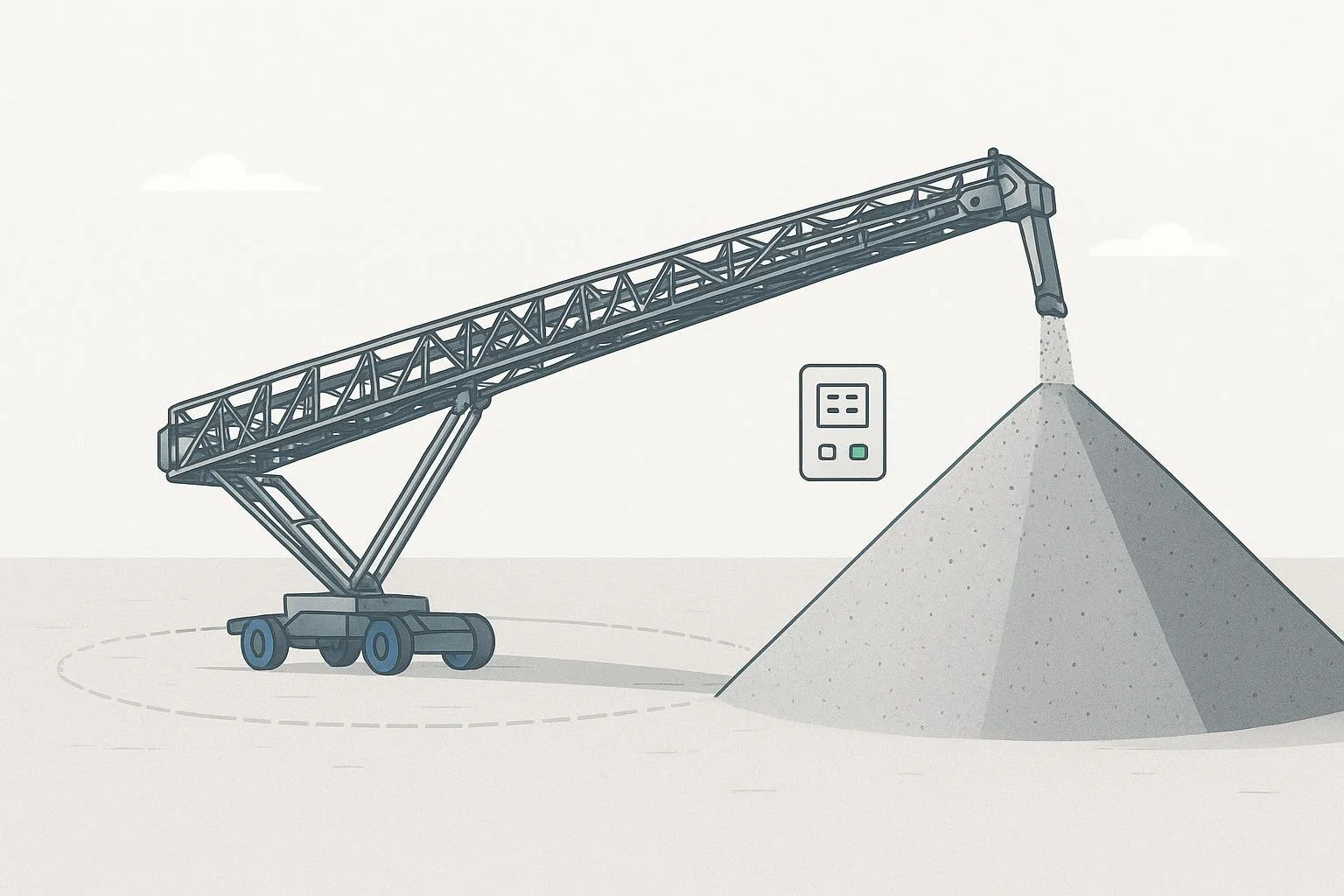
A radial stacker is a conveyor that rotates on a radial undercarriage, sweeping a semi‑circular arc so material is placed in overlapping windrows. The result is a broad, fan‑shaped stockpile with lower rehandling versus dumping with a loader. Telescopic models add one or more nested boom sections, and luffing control varies discharge height. Those two capabilities reduce drop height (less fines and dust), improve layer control, and increase stockpile capacity on the same footprint.
Why does telescoping matter? Think of it this way: lowering the drop height and building in thin, controlled layers minimizes segregation. That keeps gradations in spec and cuts the need to remix piles later.
Components and what they influence
-
Truss and head/tail frames: Structural stiffness controls alignment and vibration; quality steelwork improves long‑term tracking and power efficiency.
-
Belt, pulleys, and take‑up: The carcass choice (e.g., EP fabric) and pulley lagging impact tracking, slip, and wear. Correct take‑up travel prevents slippage as the belt stretches.
-
Idlers and troughing sets: Class and spacing determine load support, power losses, and belt life. Match duty to impact zones and tonnage.
-
Drive, reducer, and VFD: The drive must supply required torque across the duty cycle; variable frequency drives (VFDs) enable speed control and gentle starts.
-
Mobility and undercarriage: Wheel loads and ground bearing influence foundations and the quality of the arc travel.
-
Controls and safety: Interlocks, e‑stops, and integration with plant PLCs make automated stockpile “recipes” possible—while enforcing safe operation.
Standards and safety anchors
-
Engineering method: Drive power and belt tensions are calculated per ISO 5048 (operating power on the driving pulley, resistances to motion). ISO formalizes units and symbols—align your calculations with the ISO 5048 power/tension standard.
-
Industry practice: Capacity/width/speed selection and idler classes follow the CEMA Belt Conveyors for Bulk Materials (7th ed.).
-
Safety: Apply Lockout/Tagout for servicing in line with OSHA’s 1910.147 LOTO guidance. Mining operations should follow MSHA best practices, including guarded pinch points and remote e‑stops; see the 2023 MSHA fatality alert on conveyor hazards.
Cost breakdown: Radial Stacker Conveyor Costs and ROI in practice
Public list prices vary, but industry sources point to a typical range of roughly $50,000–$170,000 for common aggregate stackers, driven by length, width, mobility, and controls. Beyond the headline number, it helps your budget discussion to understand which subsystems move the needle.
What drives CAPEX
The following table summarizes component influence based on an industry overview by West River and common practice. Actual shares vary by spec, vendor, and options.
Installation and commissioning add to the total: site prep/foundations for the radial path, power drops and cable management, parameter setup for VFD/PLC, alignment checks, test runs, and operator training.
Example configurations (illustrative, not quotes)
-
Basic fixed radial stacker: portable frame; manual height; fixed speed; minimal controls. Lowest CAPEX; highest segregation risk.
-
Mid‑spec radial stacker: powered raise; VFD speed control; better guarding and access; improved reliability.
-
Telescopic radial stacker: telescoping boom, luffing, automated pile patterns with PLC. Highest CAPEX; best segregation control and capacity on a fixed footprint—attractive when product quality or space is tight.
Fixed radial vs telescopic vs wheel loader stockpiling
For the telescopic benefits cited above, see Telestack’s OEM documentation on radial telescopic capacity and segregation control via luffing and automated patterns in its radial telescopic guidance and compare the mechanisms described by Superior’s TeleStacker overview.
OPEX and ROI modeling
If CAPEX sets the bar to clear, OPEX and productivity deliver the payoff. Here are the main economic levers—and a simple way to model them.
Energy and power: methods and a quick example
Drive power follows the familiar pattern: required belt pull × belt speed. ISO 5048 defines the resistances to motion and the operating power at the drive pulley, using SI units. Conversions are standard: kW = HP × 0.7457 and HP = kW × 1.341.
Worked example (simplified):
-
Assume a 36‑in (900 mm) x 120‑ft (36.5 m) stacker running 400 short tph (≈363 t/h) at 2.5 m/s with typical rolling and lifting resistances. Engineering calculation yields a required power near, say, 18–22 kW under nominal loading. With a 0.75 load factor across the shift, annual energy ≈ 20 kW × 0.75 × 4,000 h = 60,000 kWh. At $0.12/kWh, that’s ~$7,200/year in electricity.
-
VFDs can trim kWh when the stacker runs below nameplate tonnage and reduce peak loads on starts. The exact savings depend on duty cycles; industry guidance emphasizes case‑by‑case modeling rather than a fixed percentage.
If you want to check capacity and belt speed quickly, use your plant’s calculators or run quick estimates with tools like the BisonConvey Conveyor Belt Capacity Calculator and Belt Speed Calculator.
Maintenance and wear items
In my experience, wear and reliability—not energy—often dominate stacker OPEX. Focus on:
-
Idlers: bearing failures from contamination or misalignment; select class to duty, seal quality to dust level, and spacing to load. Keep critical spares.
-
Belt and cleaners: cover wear and carryback control; proper scraper tensioning reduces cleanup labor and spillage.
-
Pulleys and lagging: maintain traction; watch for lagging debonding and replace before slip damages the belt.
Track KPIs such as kWh per tonne, rehandling hours, mean time between idler failures, belt repair incidents per 1,000 hours, and unplanned downtime.
ROI levers that move the needle
-
Rehandling and loader-hour avoidance: A conveyor places material directly; fewer loader passes means less fuel, tires, and labor. If a loader hour fully burdened is, say, $120 and a stacker saves 6 hours/day, you’re near $720/day in operating savings before quality benefits.
-
Segregation control and quality: Telescoping/luffing and recipes keep fines and coarse fractions in spec, reducing rework and write‑offs.
-
Capacity on a tight footprint: Telescopic designs reclaim usable volume; when land is constrained, this can be decisive.
-
Uptime: Quality idlers, pulleys, and belt splices reduce unplanned stops—small percentages here compound over a year.
Selection and implementation guidelines
Sizing the conveyor: from TPH to belt width and speed
Start with your required throughput and material characteristics (density, lump size) and select a belt width and speed that achieve stable loading. CEMA practice provides ranges for speed and loading for common belt widths; stay within published ranges for your material class and trough angle. For the support system, map idler classes (CEMA B/C/D) to duty: avoid light classes in impact zones, specify sealing for dusty environments, and confirm spacing versus load.
For a deeper refresher on idler choices and field failure modes, see BisonConvey’s idler selection and importance explainer. If the stacker feed is on an incline, consider whether a profiled belt is warranted; for general‑purpose duties, BisonConvey’s fabric belt reference page provides typical carcass options.
Controls and automation
A variable frequency drive enables speed matching to upstream process flow, reduces mechanical stress on starts, and lets you tune pile patterns. Automating “recipes” through a PLC improves consistency and reduces operator workload. A practical tip: during commissioning, document the parameter set (accel/decel ramps, torque limits) and upload a backup to the plant’s maintenance server.
Foundations, mobility, and cable management
-
Verify ground bearing capacity and wheel loads along the radial arc; soft spots will cause uneven travel and misalignment.
-
Plan for power cable management across the sweep; festoon or reel systems prevent snags.
-
Provide guarded access and safe walkways where frequent inspection points exist—rollers, scrapers, and take‑up.
Commissioning checklist highlights:
-
Frame and idler alignment verified; belt spliced to spec and tracked under no‑load and load.
-
VFD/PLC parameters validated; e‑stops and interlocks tested; signage per CEMA safety program.
-
Operators trained; spare kits on hand (idler sets, scraper blades, belt repair materials, and lagging kit).
Common problems and troubleshooting
Belt tracking and tension: Heat, misalignment, buildup, or poor transition distances can walk a belt off center. If tracking requires constant correction, stop and correct root causes—idler squaring, pulley alignment, and loading point geometry—before damaging edges. For a structured approach, see BisonConvey’s conveyor belt tracking theory guide.
Premature idler failures: If bearings run hot or noisy early in life, look for contamination pathways and sealing inadequacy; also check trough angle and spacing versus load to avoid overload. Upgrading to higher‑class or sealed‑for‑life idlers can pay back in high‑dust duties.
Dust and segregation: Excessive drop height at the head increases dust and separates fines from coarse. Telescoping and luffing reduce drop height, while chutes or adjustable hoods help direct the stream.
Controls faults and unsafe starts: If nuisance trips or torque limits activate, review accel/decel ramps and mechanical binds. Always apply LOTO and test e‑stops; keep procedures aligned with OSHA 1910.147 and site rules.
Best practices and maintenance economics
Set inspection cadence by radial travel cycles, not just hours. Listen for idler noise as the stacker sweeps; thermal scan bearings periodically. Verify scraper blade wear and belt cover thickness; adjust tension to avoid carryback. Lubricate per OEM intervals, or specify sealed idlers if relubrication is impractical in dusty environments.
Stock a pragmatic spares kit: two idler sets per 100 m of conveyor, spare scraper blades, a belt repair kit, and pulley lagging materials. Track KPIs monthly: rehandling hours, kWh per tonne, MTBF on idlers, and unplanned downtime. A few percent improvement in each adds up to a strong annualized ROI.
Conclusion and next steps
You don’t buy a radial stacker only for the sticker price—you buy it for lower rehandling, better product quality, and predictable uptime. The right configuration (and component quality) turns those gains into a fast payback, especially where loaders are burning hours to build piles or where segregation sends product out of spec. If you’re weighing telescopic options, ground it in your real duty cycle, product tolerances, and site constraints. Here’s the deal: a cleanly engineered, well‑maintained stacker is a quiet profit center.
-
Build your model with real hours and loader costs; quantify kWh with ISO‑aligned power estimates and your utility rates.
-
Focus on reliability inputs—idler class and sealing, scraper performance, belt quality—because downtime penalties dominate.
-
Where segregation or space is tight, test the telescopic case; OEM documentation supports meaningful gains when applied correctly.
If you need component guidance to support uptime—belts, idlers, and pulleys—consider the neutral resources and product pages at BisonConvey, and reach out for a custom spares kit aligned to your duty and inspection cadence.
References and further reading (selected):
-
Cost ranges and line‑item influence: West River Conveyors’ analysis of stacker costs and their general stacking conveyors overview.
-
Telescopic benefits and mechanisms: Telestack’s radial telescopic guidance; mechanisms also described by Superior’s TeleStacker overview.
-
Power/tension method: ISO 5048.
-
Safety: OSHA 1910.147 Lockout/Tagout fact sheet; MSHA conveyor fatality alert (2023).