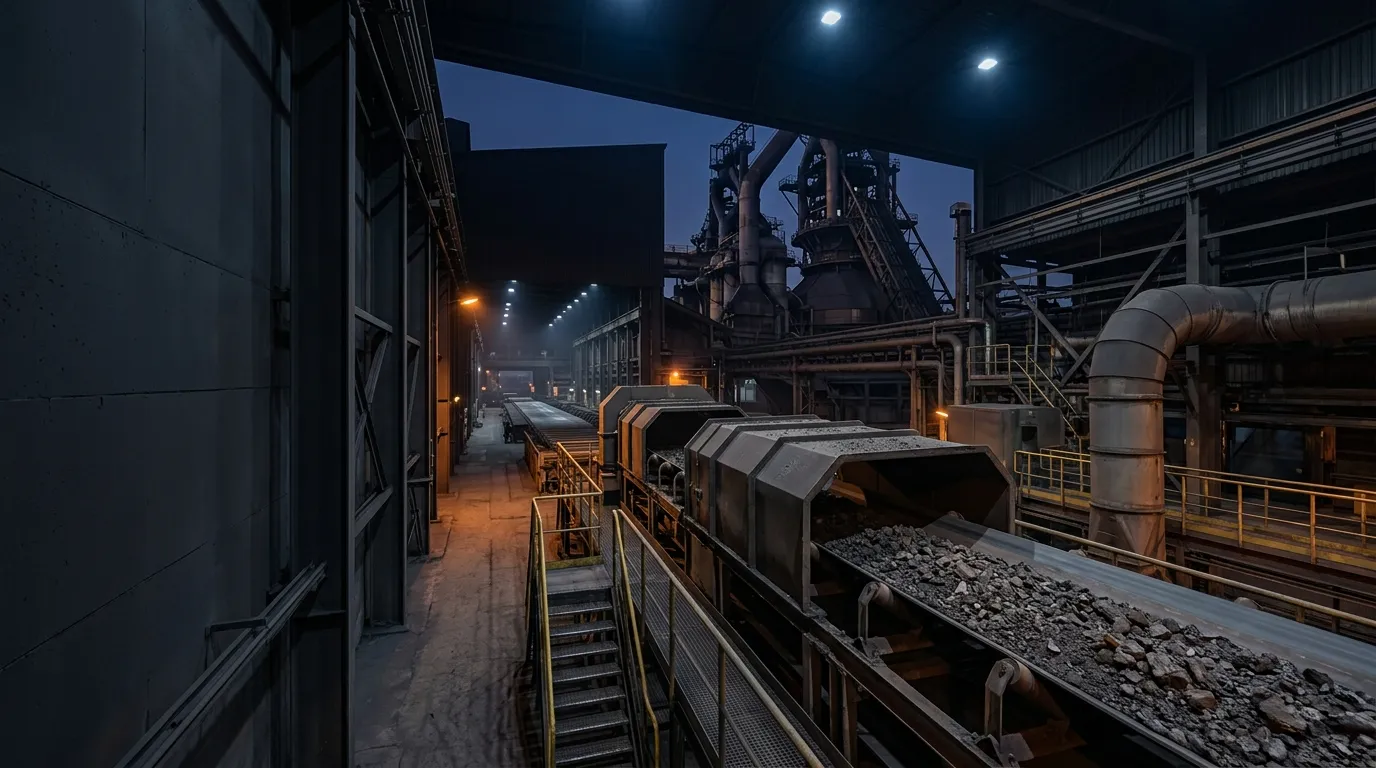
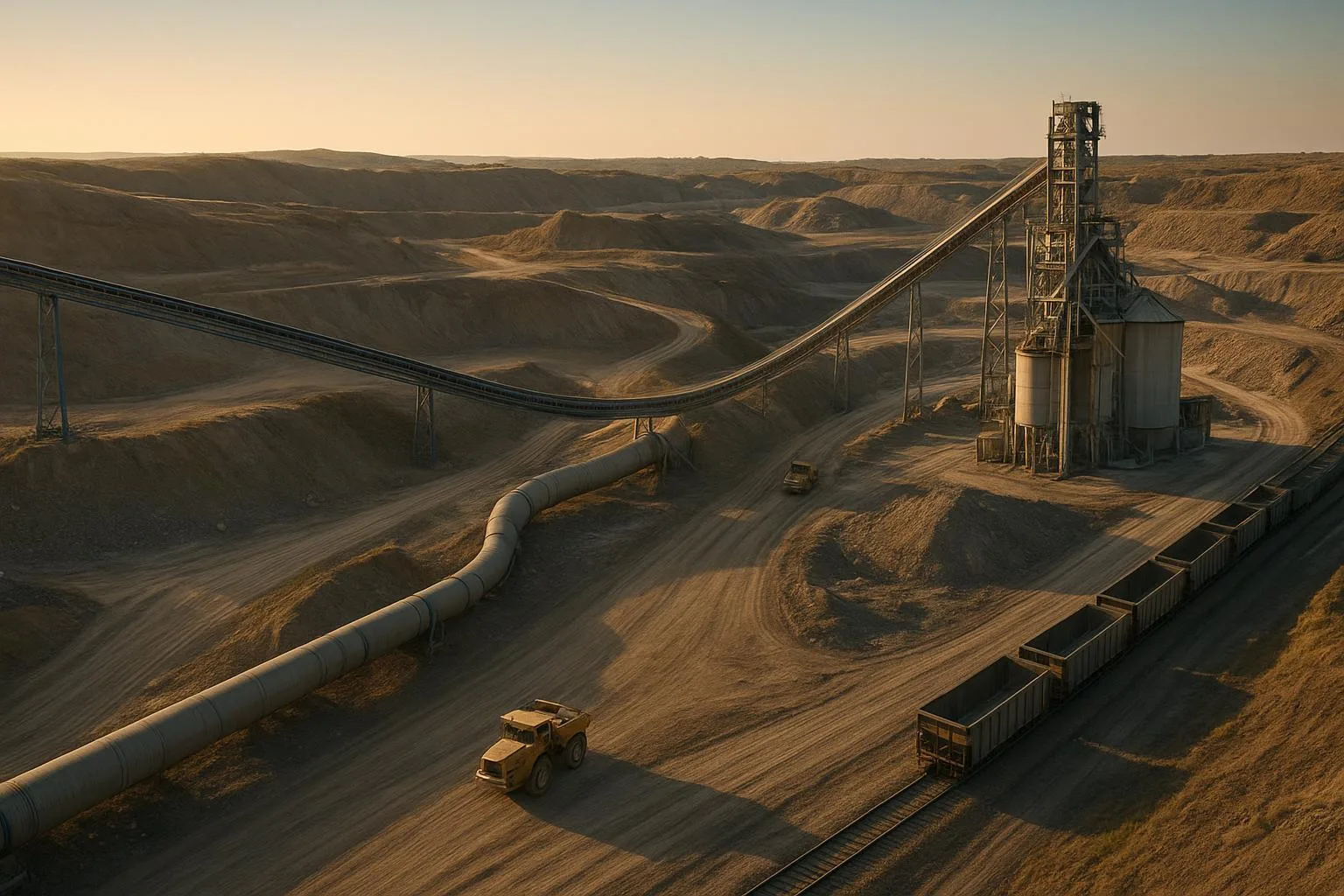
A power plant coal handling conveyor is not one uniform belt line. The coal route from unloading to the bunker has different risks from the routes serving crushers, transfer towers, stockpiles, and interfaces with ash or flue-gas-desulfurization (FGD) equipment. A useful specification therefore starts with operating zones, material state, and failure consequences—not with a familiar belt grade.
This guide gives project, maintenance, and procurement teams a practical way to define that scope. It focuses on belt conveyors and their interfaces; it does not assume that every ash or FGD stream should be handled by a belt conveyor. The final arrangement must be checked against the plant's process design, local requirements, and the equipment supplier's data.
Start with a material-and-route map, not a belt datasheet
The most useful first deliverable for a coal handling upgrade is a simple route map. Give every conveyor a tag and record what enters it, where it discharges, and what happens if it stops. That separates coal conveying duty from the very different materials around the boiler island.
| Operating zone | Typical material and condition | What normally drives the design decision |
|---|---|---|
| Unloading and reclaim | Run-of-mine or delivered coal; variable lump size, moisture, tramp material | Impact energy, surge capacity, abrasion, access for cleanup |
| Crusher and transfer tower | Sized coal plus fines and dust | Controlled loading, sealing, tracking, idler support |
| Bunker / boiler feed | Crushed coal; often continuous duty and limited downtime windows | Availability, belt tracking, dust containment, maintenance access |
| Ash-handling interface | Fly ash, bottom ash, or boiler slag, depending on the process | Temperature, moisture, abrasiveness, and whether a belt is suitable at all |
| FGD interface | Dry solids or wet sludge, depending on the technology | Material state, corrosion exposure, drainage, cleanability |
This distinction is more than terminology. The U.S. EPA identifies fly ash, bottom ash, boiler slag, and FGD material as coal-combustion residuals, and notes that FGD material can be either a wet sludge or a dry powdered solid depending on the control system. That is why an ash or FGD interface cannot automatically inherit the coal-belt specification. Review the actual process stream first: EPA's CCR overview is a helpful high-level reference for the material categories.
For a coal route, capture these inputs before asking for a belt or a quotation:
- Design and normal capacity, plus maximum surge rate in t/h
- Belt width, speed, centre distance, lift, and drive arrangement
- Coal size distribution, fines percentage, bulk density, moisture, and temperature
- Receiving-point drop height, feed direction, and expected loading profile
- Indoor/outdoor exposure, dust-control arrangement, washdown, and corrosion conditions
- Required availability, shutdown window, and access constraints for splicing or idler changeout
The conveyor belt capacity calculator is a useful early check for throughput assumptions. Follow it with a belt tension calculation once the route profile, resistances, and operating cases are defined. Neither replaces a project design calculation; both make early assumptions visible before they get embedded in an RFQ.
Treat unloading-to-bunker conveying as a chain of duty zones
The coal path often begins at a truck, rail, barge, or stockpile reclaim point, passes through sizing or crushing, then feeds transfer towers and bunkers. A DOE project description illustrates this familiar pattern: coal was received at storage or a coal conveyor system, moved by larger belts to a bunker room, then distributed to bunkers. The exact layout varies by plant, but the lesson is durable: a conveyor system must be specified as connected flights and transfer points, not as independent rolls of belt. See the DOE process description.
Unloading, reclaim, and crusher feed
These are usually the harshest coal transfer zones. Intermittent truck or hopper discharge creates a loading pattern that is very different from the steady running load used in a simple capacity calculation. Large lumps, foreign objects, and short high-rate surges can damage covers, deform idlers, and destabilize a belt before it reaches normal speed.
Specify the receiving zone as a system:
- Define maximum lump size and credible drop height, not only average particle size.
- Identify the impact-support length and the transition into normal troughing idlers.
- Provide impact idlers for the loading zone or an appropriately engineered impact bed where support continuity and sealing require it.
- Specify belt-cleaner, scraper, and spill-cleanup access so material does not accumulate around rotating components.
For many short and medium-length coal flights, an EP fabric conveyor belt is a sensible construction to evaluate. It is not a default answer: carcass rating, pulley diameters, tension, splice method, cover grade, and operating environment still decide whether it is suitable. Long, high-tension, or demanding take-up cases may instead require a steel cord belt construction.
Transfer towers and bunker feed
On bunker-feed lines, the financial impact of a small transfer problem can exceed the cost of the belt itself. Poor loading direction creates belt slip under the material stream; poor support lets the belt sag under skirts; poor containment turns fines into dust, carryback, and tracking problems.
Design each transfer to place material near the receiving belt's direction and speed. Then verify the details that keep that intent true in service:
- Chute geometry and liner arrangement must control the stream rather than let coal ricochet onto the belt.
- The impact zone needs enough support to keep the sealing line stable.
- Skirting needs a straight, supported belt surface; over-tightening a seal to compensate for sag will increase drag and wear.
- The transfer tower needs inspection doors and a safe cleaning path for the material that will inevitably accumulate.
For a deeper engineering checklist, see the belt conveyor transfer chute design guide. If chronic drift is already visible, investigate the loading profile, idler condition, pulley alignment, and take-up before treating a tracker as the whole solution; this conveyor belt tracking guide provides a practical troubleshooting sequence.
Ash and FGD interfaces require a separate suitability check
It is tempting to list “coal and ash handling” as one scope item. That language can hide the key decision: is the material actually appropriate for a belt conveyor at that location?
Bottom ash may be wet and abrasive. Boiler slag may bring thermal and handling constraints. Fly ash may be handled in an enclosed pneumatic or mechanical system rather than an open belt. FGD material can be a dry powder or wet slurry-like material. Those differences affect belt cover, corrosion protection, drainage, transfer geometry, enclosure, and the choice of conveying technology itself.
Where a belt is confirmed as appropriate, specify its interface conditions explicitly:
| Question for the process team | Why it changes the conveyor scope |
|---|---|
| Is the material dry, damp, saturated, or slurry-like? | Determines whether a belt, feeder, screw, pneumatic system, or another method is viable. |
| What is the maximum material temperature at the belt? | Drives cover and carcass suitability; do not infer it from the boiler temperature. |
| Is the stream corrosive or does it require washdown? | Changes frame coating, idler seals, drainage, and maintenance access. |
| Can fines become airborne? | Changes enclosure, dust collection, and inspection requirements. |
| Is the stream continuous, batch, or emergency-only? | Changes duty cycle, redundancy, and spares strategy. |
If the conveyed material temperature and the project design support a belt solution, heat-resistant conveyor belts may be evaluated for the actual duty. Do not select them simply because a stream is “near the boiler.” Temperature at the loading point, exposure time, material moisture, and local heat sources must be measured or provided by the process team.
Build reliability into the specification at the transfer points
Coal conveying systems are often maintained during constrained outage windows. That makes repeat failures around one loading point particularly expensive. Write reliability requirements into the RFQ rather than leaving them as site expectations.
First, name the inspection and maintenance tasks: belt tracking checks, scraper adjustment, idler replacement, chute liner changeout, spill removal, and splice access. Then ensure the layout permits them. A quotation that includes a belt but ignores the access path, pulley lagging, idler arrangement, or transition support is not yet a system quotation.
Second, distinguish condition monitoring from final safety design. Guidance for coal-mine belts highlights practical fire-prevention fundamentals such as addressing damaged idlers, belt slip, and coal spillage. Those principles are relevant to any coal system, but a power plant must follow its own jurisdictional, insurer, owner, and process-safety requirements—not mine guidance by substitution. MSHA's fire-protection bulletin is useful background on these maintenance risks.
At minimum, document the required interfaces for:
- Belt misalignment and belt-slip detection where the plant design calls for it
- Start-up and emergency-stop sequence with upstream/downstream equipment
- Guards, pull-wire or other emergency devices, and lockout access in accordance with the site's applicable rules
- Dust suppression, extraction, or enclosure responsibility at each transfer
- Spillage containment and a housekeeping method that does not compromise access
- Critical spares: idlers, scrapers, chute liners, pulley lagging materials, and approved splice materials
Use the CEMA idler class selector to make a preliminary idler-duty check from known belt and material inputs. Confirm the final class, spacing, load-zone configuration, and bearing/seal selection with the project design and the idler manufacturer's published limits.
What a quote-ready power plant conveyor RFQ should contain
An effective RFQ lets suppliers quote comparable equipment and lets the buyer see what is still unknown. Split it into one sheet per conveyor flight and one sheet per transfer interface.
For each conveyor flight, include:
- Conveyor tag, service description, layout drawing, and process flow direction
- Capacity range, belt width and speed, centre distance, lift, drive power, and take-up type
- Material data: coal or residue type, bulk density, top size, fines, moisture, temperature, and abrasion observations
- Belt construction under consideration, required strength, cover thickness, cover grade, and splice preference
- Pulley diameters, lagging requirement, idler spacing, and load-zone support arrangement
- Environmental conditions, including dust, washdown, corrosive exposure, and ambient temperatures
For each transfer or interface, include:
- Source and receiving conveyor tags, elevation difference, feed direction, and maximum drop height
- Chute, liner, skirt, cleaner, dust-control, and access scope—clearly assigned by party
- Required instrumentation and control interfaces
- Acceptance criteria: documentation, inspection points, spares, warranty boundary, and commissioning support
The right question for a supplier is not only “What is the price per metre?” It is “Which inputs are you using for this duty, what is excluded, and what must be confirmed before manufacture?” That conversation exposes scope gaps early and produces a more dependable installed system.
Conclusion
Power plant coal handling conveyors should be planned as a connected system from unloading or reclaim to bunkers, with transfer points treated as primary reliability assets. Ash and FGD areas belong in the same project map, but they need their own material-state and technology review—not a copied coal-belt specification.
For a belt replacement, transfer retrofit, or new coal-handling line, send the route, duty data, and any existing drawings for a practical review. BisonConvey can help scope the belt, pulleys, idlers, and transfer-point interfaces as one coordinated supply package, while identifying the process information that needs confirmation before quotation.