
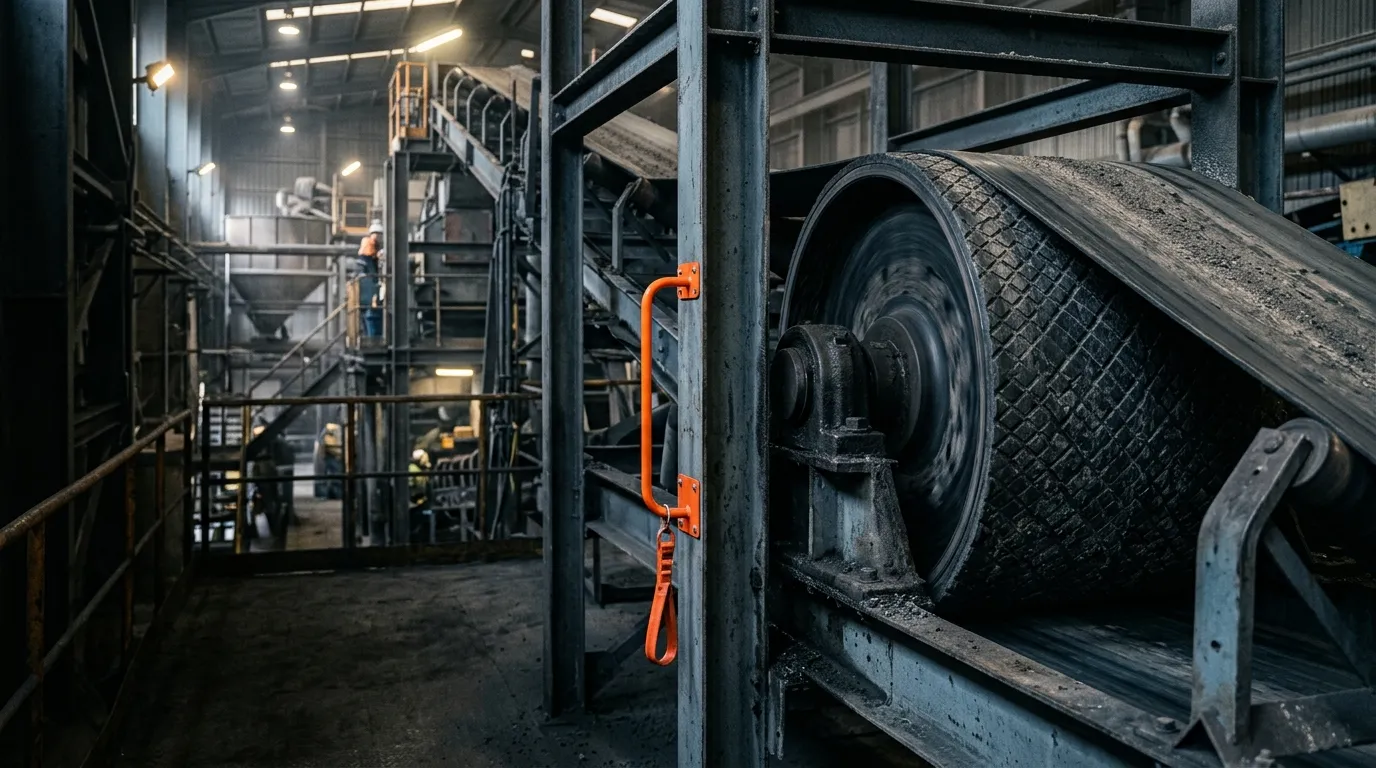
What a conveyor pulley actually does
A conveyor pulley is a rotating drum that drives, redirects, or tensions the belt in a belt conveyor—the powered head pulley turns the belt through friction, while unpowered tail, snub, bend, and take-up pulleys route the belt around the circuit and keep it tight. Every belt conveyor has at least two pulleys (a head and a tail); a typical long unit adds two to four more for wrap, tension, and direction changes.
Mechanically, a pulley is simple: a cylindrical shell, two end discs, a shaft, and bearing assemblies, usually with a locking element connecting shaft to shell. What varies is the job each one does and the load it carries.
The distinction that trips people up: pulleys are not idlers. Idlers are small free-rolling rollers that support the belt between pulleys; pulleys are larger drums that drive the belt or change its direction. If you are naming parts on a drawing, the labelled conveyor system parts diagram shows where every pulley sits relative to the drive unit, idlers, and loading point.
Pulley types: what each one is for
Think of pulleys as a system of roles rather than a parts list. Each role solves one mechanical problem, and the layout below covers almost every conventional belt conveyor.
| Pulley | Location | What it does | Powered? |
|---|---|---|---|
| Drive (head) pulley | Discharge end | Transmits motor torque to the belt by friction | Yes |
| Tail pulley | Loading end | Redirects the belt onto the return run | No |
| Snub pulley | Beside the drive pulley | Increases the belt's wrap angle around the drive | No |
| Bend pulley | Wherever the belt path turns | Changes direction, e.g. into a take-up | No |
| Take-up pulley | On the take-up carriage | Applies and maintains belt tension | No |
Drive pulley (head pulley)
The drive pulley is the only pulley that transmits power. It converts motor torque—through a gearbox and coupling—into belt traction at the drum surface. When it sits at the discharge end, which is the common arrangement, it is also called the head pulley; on a tail-driven or intermediate-drive conveyor, the driving pulley is elsewhere.
How much traction a drive can transmit is governed by the capstan (Eytelwein) equation: the ratio of tight-side to slack-side tension T₁/T₂ equals e^(μθ), where μ is the friction coefficient between belt and drum and θ is the wrap angle. That equation explains two design moves you see on every heavy-duty conveyor: lagging raises μ, and snub pulleys raise θ. Together they let the drive develop more effective tension without raising belt tension, which would otherwise shorten belt and splice life.
Specifying a drive pulley means deciding shell diameter (driven by the belt's bending limit, below), face width (matched to belt width), shaft size (from the resultant belt load), and lagging type. Our drive pulley specifications cover the 500–2000 mm range with rubber, grooved, or ceramic lagging options, and the drive pulley glossary entry walks through the T₁/T₂ relationship in more detail.
Tail pulley
The tail pulley sits at the loading end and redirects the belt from the carrying run onto the return run. It runs unpowered and usually takes no part in tensioning, though on short conveyors it is often also the take-up pulley.
Tail pulleys on dirty or wet conveyors are a common source of carryback build-up—material sticks to the drum, builds a ridge, and steers the belt off-centre. Lagging the tail face (or choosing a wing-style shell where material shedding matters) reduces the build-up that drives mistracking.
Snub pulley
A snub pulley sits immediately next to the drive pulley and deflects the belt so it wraps further around the drive. That extra wrap angle is its entire purpose: because transmissible traction rises with θ, a snub pulley buys grip without increasing belt tension. It transmits no drive torque itself.
Snub pulleys are compact—typically 200–630 mm in diameter—and often lagged because they run against the belt's dirty side, where carryback can build up on a bare steel face. Our snub pulley range lists the standard sizes and lagging options.
Bend pulley
Bend pulleys change the belt's direction anywhere the path turns: routing the return strand around an obstacle, deflecting the belt into a take-up, or aligning the belt onto the drive. They reduce belt stress by keeping the path smooth instead of letting the belt rub against structure.
Unlike a snub pulley, a bend pulley has no fixed position next to the drive—it exists to route the belt, not to help the drive grip. The bend pulley options cover 320–1250 mm drums with plain steel or rubber-lagged faces.
Take-up pulley
The take-up pulley rides on the take-up carriage and applies tension to the belt. It exists because belts stretch: fabric belts elongate in service, and a fixed centre distance would slowly go slack, reducing drive grip and letting the belt sag between idlers.
Two common take-up arrangements: a screw take-up on short conveyors (a fixed adjustment at the tail) and a gravity take-up on longer conveyors (a weighted carriage that maintains constant tension as the belt stretches). The take-up pulley itself is usually a bend or tail pulley mounted on the carriage.
Lagging and crown: the two surfaces that matter
Two surface details separate a pulley that performs from one that causes chronic problems: lagging on the face and crown across the width.
Lagging is a rubber, ceramic, or polyurethane layer bonded to the drum. It does two jobs: it raises the friction coefficient μ so the drive transmits more torque before slip, and it protects the drum from wear. The numbers matter: a bare steel face against a rubber belt gives roughly μ ≈ 0.25 dry and as low as 0.10 wet, while plain rubber lagging reaches about 0.40 and grooved or ceramic surfaces go higher. Because the capstan equation is exponential in μ, even a modest lagging upgrade sharply increases the torque a drive can transmit. The pulley lagging glossary entry lists the μ values per material.
Grooved patterns (diamond or herringbone) also channel water and fines away from the contact patch, which is why most outdoor drive pulleys are grooved rather than plain. On non-drive pulleys, lagging is chosen for wear life and to stop material build-up rather than for grip—our rubber-lagged pulley options cover drive, bend, and tail duty with hot-vulcanized covers.
As a rough field guide:
| Surface | Typical friction coefficient μ (dry) | Best for |
|---|---|---|
| Bare steel | ~0.25 | Clean, low-slip applications; tail/bend duty |
| Plain rubber lagging | ~0.40 | General drive duty |
| Grooved (herringbone) rubber | ~0.45 | Wet or dusty outdoor drives |
| Ceramic-tile lagging | 0.50+ | High-torque drives, ports, high-humidity |
Wet conditions cut every figure roughly in half, which is why rain, washdown, or condensation turns an under-lagged drive into a chronic slip problem.
Crown is a slight convex profile across the pulley face. It makes the belt self-centre as it passes over the drum: the belt rides up toward the larger centre diameter, counteracting the small side forces that otherwise push it off-centre. Crown is standard on most tail, bend, and take-up pulleys; drive pulleys are sometimes left flat when lagging would flatten the crown anyway.
How to choose the right pulley
Selection comes down to four checks, roughly in this order:
- Minimum diameter. The belt's carcass has a bending limit: wrap it around too small a drum and the plies or steel cords over-flex, which shortens splice life and leads to carcass fatigue. DIN 22101 gives minimum pulley diameters as a function of belt rating and tension utilization; ISO 5048 is the parallel design basis for power and tension calculation. Our pulley diameter calculator runs the DIN 22101 diameter check from belt construction and tension inputs.
- Shaft load. The shaft is sized from the resultant belt load (tight-side plus slack-side tension, vector-summed) with deflection and fatigue checks. Under-sizing the shaft is the classic cause of premature bearing failure on long overland conveyors.
- Face width. Face width is matched to belt width plus a small overhang so the belt edge never runs off the drum, especially under transient mistracking.
- Surface. Lagging choice (plain vs grooved vs ceramic) follows the environment—wet, dusty, high-slip, or high-build-up conditions each change the recommendation. The Conveyor Equipment Manufacturers Association (CEMA) publishes the standard pulley design and application guidance most North American plants specify against (CEMA).
If you are buying rather than engineering, the standard commercial grades help you match duty to price:
| CEMA-style duty class | Typical service | What it changes |
|---|---|---|
| Light (package, small belts) | Warehouse, unit handling | Smaller shell, lighter shaft |
| Medium | Aggregate, portable plants | Standard shell and bearing |
| Heavy | Mines, quarries, ports | Larger diameters, heavier shaft |
| Extra-heavy / engineered | Overland, high-tension conveyors | Custom shell, special alloys, NDT |
Under-classing a pulley shows up as bearing failures or shaft deflection years before shell failure—the drum looks fine while the bearings die quietly.
For high-power systems, a single drive may not be able to transmit the required effective tension at any reasonable μ and θ. The standard answer is more drive contact: a dual-drive arrangement with two pulleys, or a gearless drive where the motor is integrated into the drive pulley.
Common pulley problems and how to diagnose them
Most pulley failures announce themselves through three symptoms. Match the symptom to the cause before ordering parts.
| Symptom | Likely cause | Check first |
|---|---|---|
| Belt slips under load | Wrap angle or μ too low (bare steel, wet belt) | Lagging condition; snub position; take-up tension |
| Localised lagging wear | Misalignment, heavy skew, or belt scraping the drum | Pulley alignment, belt path, belt cleaner condition |
| Belt drifts off-centre at one end | Crown worn flat, carryback build-up, or shaft misalignment | Tail/bend pulley crown, drum face build-up, shaft level |
| Bearing runs hot or noisy | Shaft undersized, misalignment, or contamination | Shaft deflection check, bearing seals, alignment |
Two field habits prevent most pulley problems from becoming downtime: keep the drum face clean (carryback build-up on a tail or snub pulley is a steering defect as much as a wear issue—Martin Engineering describes it as the conveyor's biggest maintenance cost driver), and check pulley alignment after any structural work—a shifted shaft that nobody noticed will show up as mistracking hundreds of metres away.
For a fuller troubleshooting path that covers the whole belt path, our guide to fixing belt mistracking walks through causes in the order to check them.
Next steps
If you are specifying pulleys for a new conveyor or upgrading an existing drive, start with the four checks above and document your belt construction, tension, and environment. Those three inputs settle diameter, shaft, face width, and lagging—and they are exactly what our engineers ask for when reviewing a spec.
The full pulley and idler range lists drive, bend, snub, and take-up pulleys together with the idlers that support the belt between them, so you can source a matched set from one supplier.
