Conveyor Belt Repair Methods
Choosing the right conveyor belt repair method is the difference between a safe, lasting fix and another unexpected stoppage next week. This guide explains the core options—hot vulcanization, cold vulcanization, mechanical fasteners, and patch/spot repairs—then maps them to belt type, duty, downtime window, and compliance constraints. You’ll also find field-tested tips, troubleshooting advice, and standards references to help you minimize risk and get back to steady production.
Key takeaways
-
The best Conveyor Belt Repair Methods depend on belt construction, operating duty, downtime window, and regulatory environment.
-
Hot vulcanization generally delivers the longest service life when executed correctly; mechanical fasteners restore uptime fastest but with lower splice efficiency.
-
Always anchor repair work to safety standards: lockout/tagout (LOTO), guarding, and—where applicable—MSHA-approved flame-resistant materials.
-
Surface preparation, alignment/squaring, and post-repair inspection prevent most premature failures.
Core concepts and technical foundations
Belt families shape your repair options. Textile (EP/NN) belts, covered under ISO 14890 for general service, readily accept hot vulcanized splices and mechanical fasteners; cold-bonded patches work well for localized damage when time is tight. Steel cord (ST) belts, addressed in the ISO 15236 series—especially Part 4 for vulcanized joints—require manufacturer-specific joint geometries and careful post-installation inspection. Public documents intentionally avoid prescriptive dimensions, so rely on OEM manuals in tandem with the ISO/TC 41/SC 3 catalogue listings.
Splicing and bonding share a few fundamentals. Vulcanization bonds rubber to rubber. Hot vulcanization uses controlled heat and pressure; cold vulcanization relies on two‑part adhesives at ambient temperature. Skiving (a tapered removal of cover/plies) prevents a thickness “step,” and squaring the ends maintains centerline and avoids tracking issues after start‑up.
Keep safety and compliance front and center. OSHA’s Lockout/Tagout rule (29 CFR 1910.147) requires an energy control program for servicing and verification before work. Guarding requirements under 29 CFR 1910.212/1910.219 apply during operation; restore guards before restart. In U.S. mining, MSHA Part 14 governs approval of flame‑resistant belts for underground coal and expects splices and repairs to maintain those properties per Part 75 references. To reduce carryback that accelerates wear at splices, apply CEMA’s 576-2021 application class method and specify cleaners that meet or exceed the class.
Authoritative sources for the above include the ISO catalogue entries for ISO 14890 and the ISO 15236 series, OSHA 29 CFR 1910.147 for LOTO, MSHA 30 CFR Part 14 for flame‑resistant belts, and the public CEMA 576-2021 PDF for cleaner classification.
The main Conveyor Belt Repair Methods
Below are four primary approaches. Selection depends on belt type, duty, access, and outage duration.
Hot vulcanization
For high‑tension and critical conveyors, hot vulcanization is the permanent solution of choice. After LOTO, technicians square and mark centerlines, remove damaged sections if needed (a Dutchman splice), skive covers and plies, meticulously clean bonding surfaces, then assemble the splice with compatible gum stocks. A vulcanizing press applies controlled time, temperature, and pressure; cooling under pressure stabilizes the bond before trimming and inspection. Acceptance hinges on a clean visual profile (no voids or blisters), continuity of centerline, and a record of cure parameters. The appeal is clear: when executed correctly, it tends to deliver the highest return to original strength and the longest service life. The trade‑off is planning—press access, trained personnel, and recipe control are non‑negotiable. Practice overviews from DYNA Engineering and MIR align with this view.
Cold vulcanization (chemical/adhesive bonding)
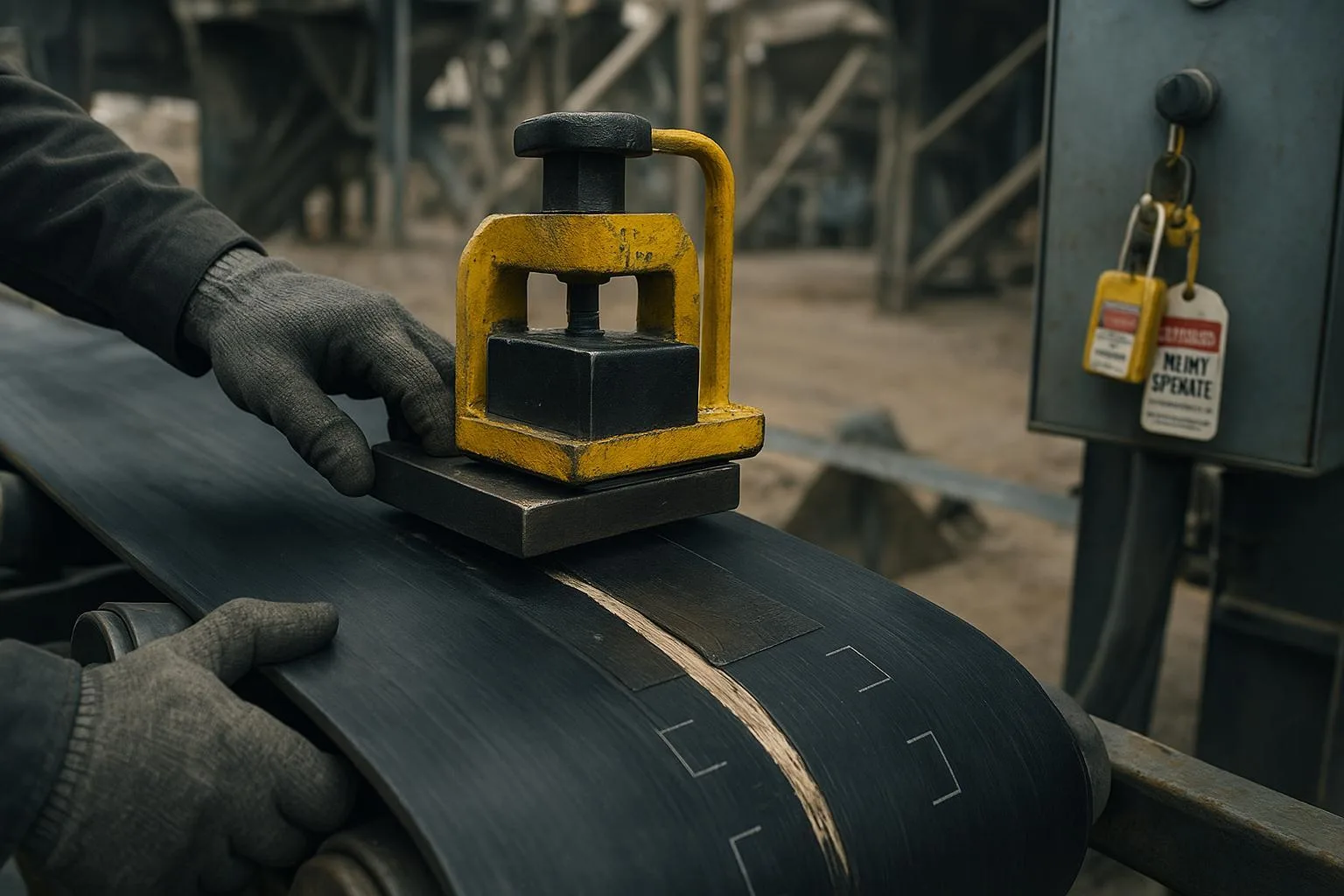
When presses can’t reach the site or the window is tight, cold bonding is a practical alternative for interim splices and patches. The process echoes the hot method’s preparation steps—LOTO, squaring, skiving—but relies on two‑part adhesives, uniform contact pressure via clamps or weights, and an environment within the adhesive’s temperature and humidity range. Cures typically need time before full load; field guides such as MIR’s note day‑scale dwell times. Success rises or falls with surface preparation and environmental control. Expect moderate bond performance relative to hot vulcanization and plan to revisit with a hot splice during the next outage on critical lines.
Mechanical fasteners and stitching systems
For the fastest restart, mechanical fasteners are hard to beat. After LOTO and squaring, you select a fastener series based on belt thickness, minimum pulley diameter, and mechanical rating, then install with the manufacturer’s tooling. This yields a removable splice that’s easy to inspect. The trade‑offs are lower splice efficiency and a higher chance of snagging at loading points, particularly without countersinking or adequate impact support. Before choosing a series and size, confirm constraints in an official selection table; Flexco’s Mechanical Belt Fasteners Intro Guide consolidates thickness and pulley minima across popular systems.
Patches and spot repairs
Local holes, edge tears, and cover gouges can be addressed with patches. Define the defect, skive to a smooth taper, clean and prime, and bond a compatible patch by hot vulcanization or cold adhesive. Roll or press to expel air, cure, and dress edges. Patches are cost‑effective when the carcass remains sound; in impact zones, they may act as an interim measure until a permanent splice is scheduled. Case‑based discussions from MIR and Belzona illustrate the approach and typical pitfalls.
Side‑by‑side comparison of Conveyor Belt Repair Methods
Notes: Performance depends on materials, workmanship, and OEM instructions. For steel‑cord belts, consult OEM splicing manuals and ISO 15236‑4 before prescribing any geometry or cure cycle.
Selection and implementation guidelines
Think of selection as a balance between reliability, time, and constraints. On high‑tension or steel‑cord lines where failure risk is unacceptable, prioritize a hot vulcanized splice and use mechanical or cold‑bond measures only as a bridge to the next outage. On moderate‑duty textile belts, all methods are on the table; choose based on the available window and desired service life. In underground coal, ensure belts and repair materials comply with MSHA Part 14 approvals and associated Part 75 requirements. For high‑temperature processes (clinker, foundry), confirm heat compatibility of compounds and adhesives. Finally, reduce post‑repair wear by applying CEMA 576’s application class and specifying cleaners accordingly; confirm the cleaner design is compatible with your splice type.
Before installing any fastener, validate belt thickness, minimum pulley diameter, and rating with an official table. Flexco’s Mechanical Belt Fasteners Intro Guide is a concise reference. After any method, re‑tension and track the belt, then document results and inspection intervals.
Common problems and troubleshooting
Delamination after cold bonding often shows up as lifted edges, blisters, or a visible adhesive line. Root causes include inadequate prep, contamination, under‑cure, or out‑of‑spec temperature/humidity. The fix is predictable: re‑prepare surfaces, control the environment, respect pot life and cure time, and plan a hot splice at the next outage on critical belts.
Splice misalignment drives tracking drift and edge fray. The usual culprits are unsquared ends, skewed geometry, or uneven tensioning. Use squaring tools and centerline marks, verify idler/pulley alignment, retrack with training idlers, and check your layout before curing. Blair Rubber’s splicing tips offer practical layout checks.
Carryback accelerates wear near splices, especially if cleaner duty is underspecified. Calculate the application class and select cleaners per the CEMA 576‑2021 framework; match scraper blades and pressure to your splice profile.
Fastener pull‑out or snagging at loading zones typically traces to under‑rated fasteners, inadequate countersinking/skiving, or insufficient impact protection. Reselect by thickness, pulley diameter, and rating per manufacturer tables; add impact bars/beds; and migrate to a hot splice at the next outage if the duty demands it.
Best practices and maintenance tips
Surface preparation remains the number one success factor. Lock out and verify isolation, square ends, mark centerlines, and skive with smooth tapers rather than sharp steps. Abrade, vacuum, and solvent‑clean according to your kit’s instructions, and control temperature/humidity during cold bonding.
Monitor and document cures. For hot vulcanization, record platen temperatures and pressure, and allow controlled cooling under pressure before demolding. Simple checks like temperature‑indicating crayons can help verify platen uniformity—always secondary to OEM procedures. For cold bonds, respect dwell times before loading and perform a careful visual inspection before start‑up.
Adopt a short inspection cadence after restart: one hour, 24 hours, then fold into routine rounds. Watch temperature, visual condition, and tracking stability. Track KPIs like MTTR and MTBF to quantify improvements, and maintain a repair log that captures method, material batch/lot, cure parameters, inspection notes, and any changes to cleaner class or settings.
Short industry scenarios
Mining (steel‑cord trunk belt). A longitudinal slit appears 6 m from an existing splice on a high‑tension ST belt, and no eight‑hour outage is available. A temporary mechanical fastener section stabilizes the slit and restores service. The permanent correction is a hot vulcanized Dutchman splice at the next outage, executed per the OEM design and validated with NDT (e.g., X‑ray). This approach is consistent with the ISO 15236‑4 emphasis on vulcanized joints for ST belts.
Cement plant (clinker line). Heat‑brittled cover and a localized gouge near the loading zone demand attention. During a short stop, a cold‑bond patch with heat‑compatible adhesive and compound is installed. At the next outage, the section is replaced and hot‑spliced. Cleaner selection is upgraded using the CEMA 576 class method to cut carryback, which aggravated wear.
Port/terminal (aggregate conveyor). An impact event causes an edge tear, but the shutdown window is short. The team squares the belt and installs mechanical fasteners across the tear to restore flow, countersinking/skiving to reduce snag risk. A permanent hot splice and new impact bars per CEMA component guidance are planned for the outage.
Appendix: Quick‑reference sources (selected)
-
ISO conveyor belt catalogues for textile and steel‑cord belts: ISO/TC 41/SC 3 and ICS 53.040.20 listings for ISO 14890 and ISO 15236 series — https://www.iso.org/ics/53.040.20.html and https://www.iso.org/committee/48414/x/catalogue/
-
OSHA Lockout/Tagout requirements: 29 CFR 1910.147 — https://www.osha.gov/laws-regs/regulations/standardnumber/1910/1910.147
-
MSHA flame‑resistant belts: 30 CFR Part 14 — https://www.ecfr.gov/current/title-30/chapter-I/subchapter-A/part-14
-
CEMA 576‑2021 cleaner classification (public PDF) — https://cemanet.org/wp-content/uploads/2022/06/576-2021-With-New-Logo.pdf
-
Practice guides: MIR’s Guide to conveyor belt maintenance & repair (PDF) — https://mir-belting.com/wp-content/uploads/2019/10/Guide-to-conveyor-belt-maintenance-and-repair.pdf; DYNA Engineering’s hot vs cold bonding overview — https://www.dynaeng.com.au/blog/cold-v-hot-vulcanised-bonding/; Flexco’s Mechanical Belt Fasteners Intro Guide — https://documentlibrary.flexco.com/X5970_enAU_5313_MBFIntroGuide_011922.pdf; Blair Rubber’s splicing tips — https://blairrubber.com/conveyor-belt-splicing-tips/; Belzona’s ripped‑belt repair context — https://blog.belzona.com/ripped-conveyor-belt-repair/
Conclusion: What to do next
-
If uptime is paramount and you can’t secure a press window, use mechanical fasteners or a cold‑bond patch to bridge—then schedule a hot vulcanized splice at the next outage.
-
Match the method to belt type and environment: textile vs. steel‑cord, ambient vs. high‑heat, surface vs. underground.
-
Anchor every repair in LOTO, guarding, and—if applicable—MSHA‑approved materials; document cure parameters and inspection results.
-
Reduce post‑repair wear by selecting belt cleaners using the CEMA 576 class method and verifying compatibility with your splice.
Looking for help specifying belts, idlers, or pulleys to support durable repairs and stable operation? Contact BisonConvey for component selection support and custom solutions: https://bisonconvey.com