Conveyor Belt Pricing and Cost Factors
If you buy belts by the meter but live with them for years, price tags can be deceptive. The right belt may cost more up front yet deliver far lower annualized cost through longer life, fewer splices, lower power, and safer operation. This guide breaks down Conveyor Belt Pricing and Cost Factors from an engineer’s perspective so you can specify confidently, compare quotes on equal footing, and optimize total cost of ownership.
Key takeaways
-
Sticker price is only one line item; belt choice influences energy, splices, downtime, and safety compliance, which dominate lifecycle cost.
-
Carcass type and rating drive strength, elongation, minimum pulley diameters, splice method, and price.
-
Cover compound and thickness set wear life and compliance; specialty compounds carry premiums but often reduce annualized cost if matched to duty.
-
System design choices like idler spacing, pulley sizing, and loading transitions materially affect belt life and power draw.
-
Compliance with ISO and EN fire safety requirements raises material and testing costs but is non‑negotiable where mandated.
-
A complete RFQ with duty details is the fastest path to apples‑to‑apples pricing and reliable lead times.
Quick price orientation for 2026
Here’s the deal: credible public, dated price‑per‑meter ranges vary widely by geography, width, carcass, cover build, compliance class, minimum order quantities, and logistics. Use any online ranges as budgetary signals only and validate by RFQ against your exact specification. For TCO planning, think in terms of annualized cost: belt price plus installation and splicing plus planned repairs plus downtime exposure over expected life. An industry framing of these cost buckets is outlined in the Fenner Dunlop EMEA overview of whole‑life cost; see the conceptual structure in the public TCO calculator guide.
Core concepts and technical foundations
Carcass types and what they change
Textile fabric belts
-
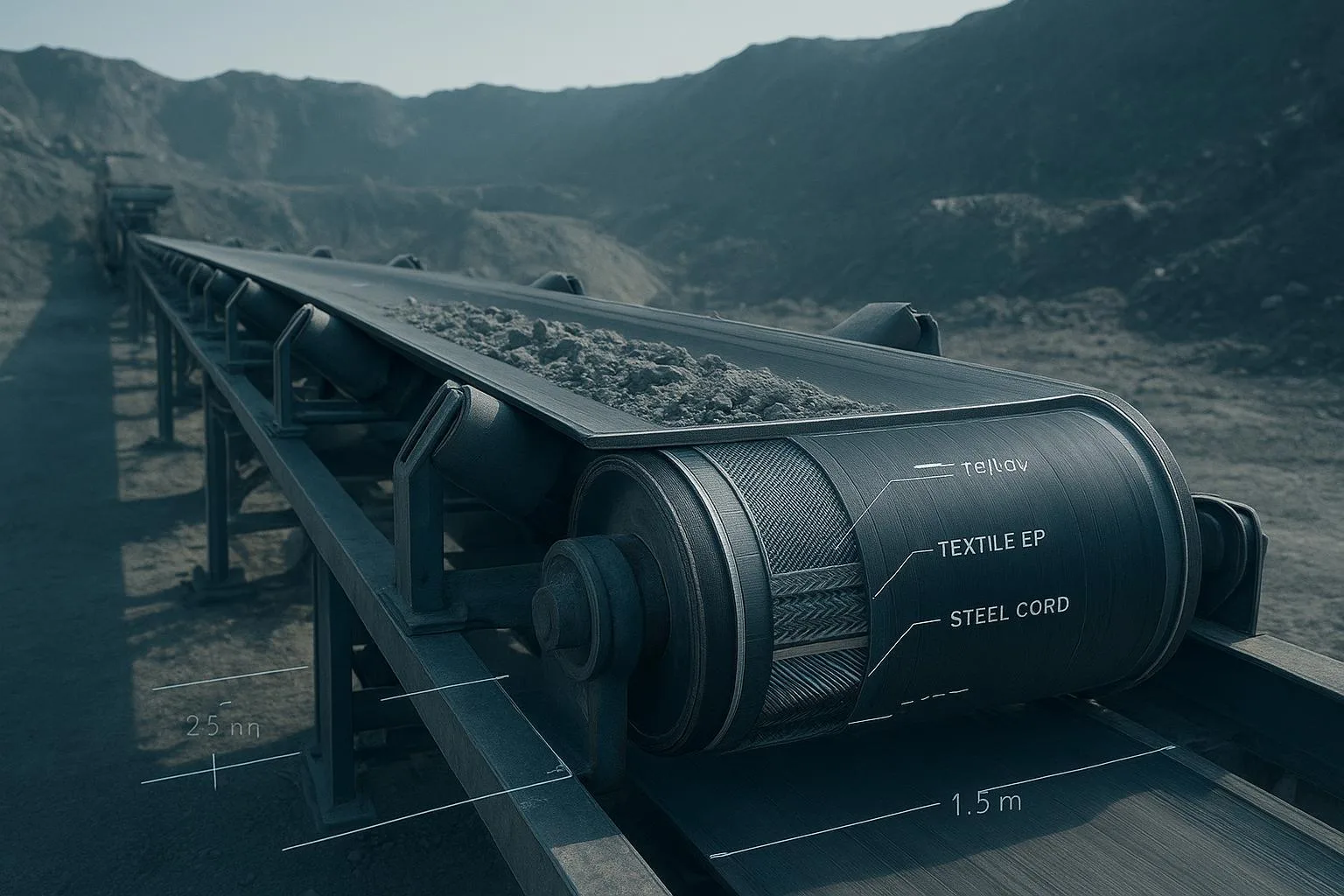
EP belts use polyester warp and polyamide weft. They offer good strength with relatively low stretch under load, straightforward hot vulcanized splicing, and broad availability. Typical applications include quarries, aggregates, and plant conveyors up to medium tensions.
-
NN belts use nylon in both directions. They have higher elastic stretch and good impact absorption. They’re common where impact is severe and take‑up stroke is available.
Steel cord belts
- ST belts embed longitudinal steel cords in rubber. They deliver very low elongation, high tensile ratings, and suitability for long, high‑tension conveyors with fewer splices. They require larger pulleys, specialized hot vulcanized splicing, and higher capex but can lower Opex over long runs.
Manufacturer catalogs such as the Sempertrans product catalogue summarize construction differences and selection guidance for textile and steel cord belts; see the Sempertrans product catalogue for an overview.
What does carcass choice influence?
-
Minimum pulley diameter: governed by belt stiffness and tension; steel cord belts typically require larger diameters. Methods align with ISO 3684 principles and manufacturer tables; see representative methodology and examples in the SIG Conveyor Belt Catalogue.
-
Splice method: textile belts accept mechanical, cold, or hot vulcanized splices; steel cord belts primarily use hot vulcanized splices.
-
Elongation and take‑up: steel cord elongation is minimal, reducing take‑up requirements relative to textile belts of similar duty.
Cover compounds and grades
The belt’s rubber covers protect the carcass and meet environmental demands. Common families include general purpose SBR, abrasion‑resistant, heat‑resistant, oil‑resistant, and fire‑resistant compounds. Specialty covers carry material and testing premiums but often extend life or enable compliance where required. For an example of flame‑retardant cover positioning and properties, consult Sempertrans Transflam product information.
Key tests and standards that influence compound choice and cost:
-
Fire resistance for surface use: ISO 340 self‑extinguishing test; often paired with antistatic ISO 284.
-
EN 12882 for above‑ground classes and EN 14973 for underground belts add drum friction and stricter electrical criteria for hazardous atmospheres.
-
Abrasion resistance: ISO 4649. Textile belt specification framework: ISO 14890.
Authoritative explainers from manufacturers summarize these normative requirements and testing impacts, such as Dunlop Conveyor Belting’s overview of fire standards in Fire resistant standards and test methods and the Fenner Dunlop EMEA fire‑resistant buyer’s guide.
Splicing methods and lifecycle impact
-
Mechanical fasteners: Lowest installation cost and downtime; suitable for short shutdown windows and some maintenance access constraints. Potential downsides include reduced cleaner compatibility and possible wear at the fastener.
-
Cold vulcanization: Chemical bonding at ambient temperatures; avoids a press but needs careful surface prep and cure time.
-
Hot vulcanization: Press‑cured rubber splice that, when executed correctly, delivers the strongest, most fatigue‑resistant joint. It has the highest upfront cost and longest shutdown but typically the best lifecycle on high‑tension fabric and steel cord belts. For a balanced primer on splicing choices and trade‑offs, see Flexco’s splicing overview and Martin Engineering’s vulcanized splice fundamentals.
System design choices that shape cost
-
Idler spacing and support: Tighter spacing in loading zones reduces belt sag, improves sealing, and can lower power and cover wear; spacing can be relaxed on the return strand when conditions allow. Practical guidance is summarized in the PPI Idler Selection Guide.
-
Transition distances and loading: Load after the belt reaches full trough to avoid edge overload and spillage. Martin Engineering’s knowledge base outlines common pitfalls and remedies in Ten common mistakes in conveyor specification and related transition guidance.
-
Pulley sizing: Larger pulleys reduce bending stress and can extend belt and splice life, but increase pulley and structure cost. Selection follows manufacturer tables rooted in ISO and CEMA methods; representative approaches appear in SIG’s catalog methodology.
How choices affect TCO
Think of TCO as a balance among five levers: belt price, energy use, maintenance and splicing, downtime risk, and compliance. Adjusting one lever changes the others. Two common examples illustrate the trade‑offs.
Example A — Long overland conveyor
- Upgrading from EP to steel cord raises capex but lowers elongation, enables fewer splices, and typically extends splice life. Larger pulleys and a hot‑splice campaign add initial cost, but annualized savings can accrue through reduced maintenance, fewer shutdowns, and stable tracking on long runs.
Example B — Hot material or oil exposure
- A general‑purpose cover might be cheap initially, but heat or oil embrittles and swells rubber, causing rapid cover loss and carcass damage. A heat‑ or oil‑resistant compound costs more per meter yet can multiply service life, shrinking annualized cost.
A simple way to frame evaluation is to compare annualized cost per operating year or per million tons conveyed. Conceptually:
Annualized cost ≈ (Belt price + Splicing and installation + Planned repairs + Expected downtime cost) ÷ Expected life
While the algebra is straightforward, the engineering inputs matter: proper idler spacing reduces drag and cover wear; adequate transition distance curbs edge wear; correctly sized pulleys lower bending fatigue on the neutral axis of the carcass. Those design choices often make more difference to TCO than marginal differences in quoted belt price.
What drives Conveyor Belt Pricing and Cost Factors
Procurement teams often ask why two “similar” belts differ so much in price. In most cases, at least one of these cost drivers is different:
-
Width and thickness: more material per meter.
-
Carcass rating and type: higher N/mm or PIW and steel cords raise cost.
-
Cover compound and thickness: specialty compounds and thicker covers add cost and weight.
-
Compliance and testing: ISO 340 or EN 14973 certification adds compound cost and QA/testing overhead.
-
Splice scope: mechanical vs vulcanized, number of splices, and field conditions.
-
Minimum order and lead time: shorter runs and rush orders carry premiums.
-
Logistics: long or wide belts, reels, export packaging, and route constraints.
If two quotes differ significantly, check each item above and ensure both vendors are pricing the same specification and scope.
Practical selection and procurement guide
Before you reach out for quotes, assemble a clear, complete RFQ. It speeds pricing, reduces assumptions, and improves outcomes. Use this checklist as your template.
-
Belt length and width; belt speed; design capacity and material details including bulk density, lump size, abrasiveness, temperature, and oil or chemical exposure
-
Environment and compliance requirements including fire zone classification; required standards such as ISO 340 for self‑extinguishing behavior, ISO 284 for antistatic properties, and EN 12882 or EN 14973 as applicable
-
Carcass type and rating including EP, NN, or steel cord with N/mm or PIW; desired elongation behavior and take‑up constraints
-
Cover compound and thickness including top and bottom cover builds and any special lagging or cleat requirements
-
Pulley diameters and lagging; idler spacing and trough angle; transition distances and loading arrangements
-
Splice preference and site constraints including mechanical vs cold vs hot vulcanized, available shutdown windows, and ambient conditions for splicing
-
Cleaners, skirting, sealing, and dust control expectations; impact area support and loading zone hardware
-
Lead time targets, warranty expectations, inspection or third‑party testing needs, and delivery constraints or packaging requirements
When quotes arrive, normalize them by confirming the same carcass rating, cover build, standards compliance, splice scope, and shipment terms. Ask vendors to state minimum pulley diameters and recommended splice geometry explicitly; this is a strong proxy for whether the proposed belt truly matches your duty.
Case‑style scenarios and selection logic
Quarry conveyor under heavy abrasion
-
Duty: sharp aggregates, high fall height, moderate length.
-
Selection logic: prioritize abrasion‑resistant cover with adequate thickness and robust skirting support; EP carcass often suits the length and tension. Tighter idler spacing in the loading zone and correct transition length cut edge wear. The abrasion‑resistant cover may carry a premium but typically extends life significantly relative to general‑purpose compounds.
Port and ship‑loader transfer
-
Duty: long runs, variable loading, high availability requirement.
-
Selection logic: steel cord reduces elongation and splice count. Larger pulleys are justified by splice and fatigue life improvements. Hot vulcanized splices are planned during scheduled outages. Cleaner compatibility and water‑assisted washing reduce carryback and power draw over time.
Cement plant clinker and hot materials
-
Duty: elevated temperatures and abrasive dust.
-
Selection logic: heat‑resistant compound is essential; select rating to maintain tensile properties at temperature. Skirting and sealing quality drive wear and dust control. If oil exposure exists downstream, consider dual‑resistant compounds. Compliance to ISO 340 may be required in covered or enclosed runs.
Comparison of carcass and cover choices
Below is a compact, qualitative matrix to help frame trade‑offs. Use it as a conversation starter with vendors and your reliability team.
Troubleshooting and cost impact matrix
Use this matrix to link visible symptoms to likely causes and cost‑effective corrective actions.
Best practices and maintenance routines
-
Plan inspections on a fixed cadence. Experienced teams often do quick visual checks per shift and deeper inspections twice per month, focusing on alignment, idler rotation, skirting pressure, and cleaner setup. Practical checklists are illustrated throughout Martin Engineering’s inspection articles, including their summary of critical points of belt inspection.
-
Respect transitions. Maintain full‑trough transition distance before loading and use impact beds where drops are severe to stabilize the belt line.
-
Set cleaner pressure correctly. Over‑pressure eats blades and covers; under‑pressure leaves carryback. Center blades and verify tracking under load.
-
Protect splices. Keep tools, moisture, and contaminants away during prep and cure; document cure times and temperatures for quality records.
-
Lockout and tagout. Always follow LOTO procedures and fire safety protocols, and monitor hot bearings or seized idlers that can create friction ignition sources. Manufacturer explainers on fire standards, such as Dunlop’s overview cited earlier, underscore why compliance and maintenance both matter to risk reduction.
Conclusion and next steps
Conveyor Belt Pricing and Cost Factors cannot be judged on unit price alone. Carcass construction, cover compound, splice strategy, and the design of idlers, pulleys, and loading zones all interact to determine energy use, wear rate, downtime risk, and compliance costs. If you define your duty precisely, request quotes against the same spec, and evaluate annualized cost rather than sticker price, you’ll make better, safer, and more economical decisions.
Ready to review a specification or discuss trade‑offs for your site conditions? The engineering team at BisonConvey can review your duty details and provide a grounded recommendation and quote.