Determining the mass per unit length of a conveyor belt (often written as Wb in Imperial or m′/qB in SI) is a small step with big consequences. Belt weight feeds directly into power and tension calculations, idler loading and spacing, gravity take‑up sizing, reel handling, and shipping. Get it wrong and you risk underpowered drives, premature bearing failures, or unsafe lifting plans. Get it right and you design with confidence, budget accurately, and move material safely.
Key takeaways
-
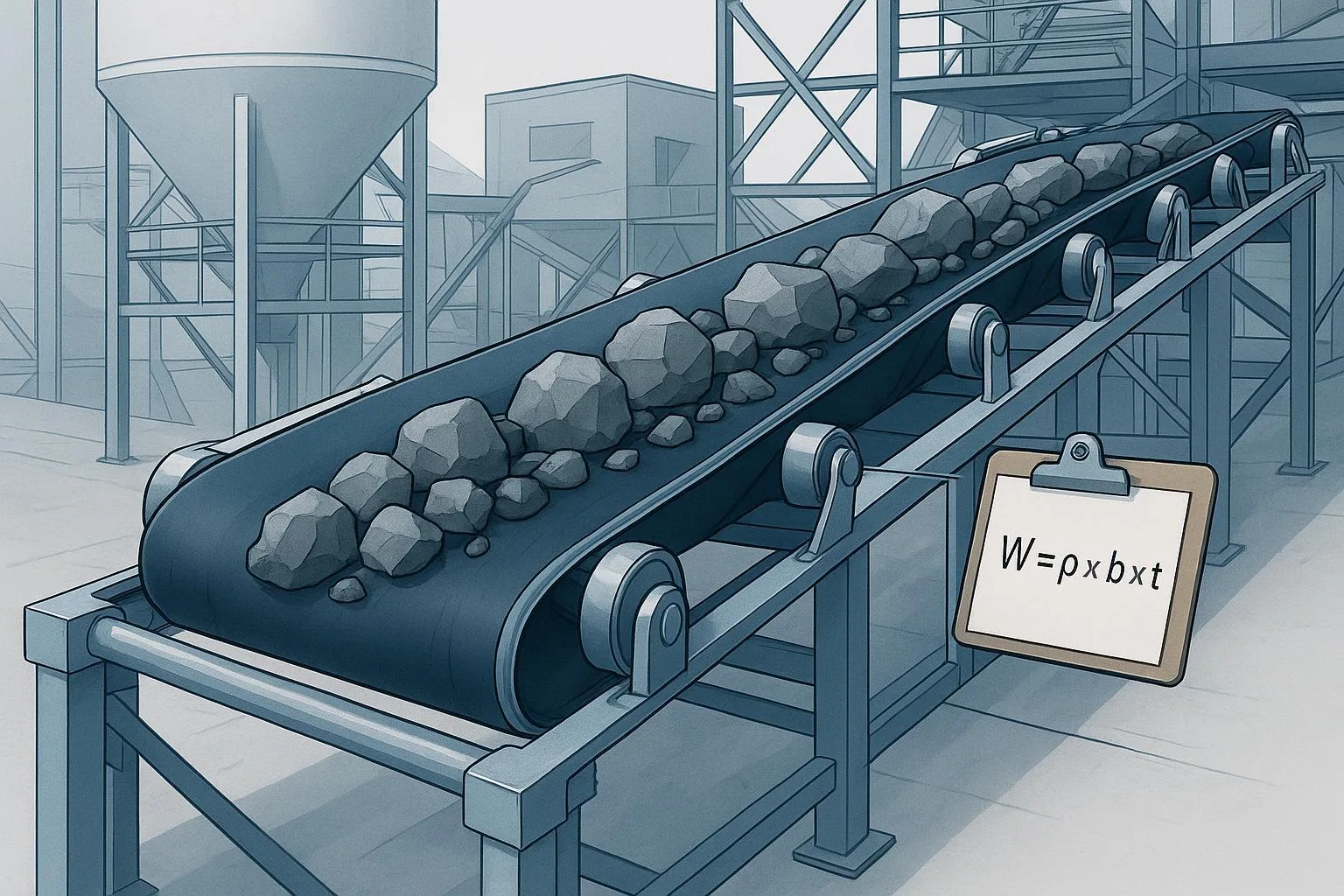
The most reliable path is to use the manufacturer’s “mass per meter” (or component breakdown) for the exact construction. When unavailable, a composite‑density estimate using W = ρ × b × t gives a fast, defensible approximation.
-
Belt mass per unit length is used explicitly in the CEMA effective tension framework and as moving mass in ISO/DIN‑style methods; higher belt mass increases power, tension, and counterweight requirements.
-
Always document assumptions, keep units consistent, and cross‑check results (e.g., against an online calculator) before committing to drive or lifting decisions.
Core concepts and terminology
Before we calculate, let’s align on a few terms you’ll see in datasheets and standards.
-
Belt mass per unit length: m′ (kg/m) in SI or Wb (lb/ft) in US customary. In some catalogs you’ll also see mass per unit area, m″ (kg/m²); multiply by width (m) to convert to m′.
-
Belt constructions:
-
EP/NN textile belts: layers (plies) of polyester/nylon fabric with skim rubber between, plus rubber covers (top/bottom).
-
Steel cord (ST) belts: longitudinal steel cords embedded in rubber with top/bottom covers; sometimes breaker plies or transverse reinforcements.
-
-
Covers and carcass: The carcass carries tension; covers provide abrasion/impact/chemical protection. Total thickness t is the sum of covers plus carcass thickness.
-
Apparent (composite) density ρapp: An effective density for the entire belt cross‑section (rubber + fabric/cords). Useful when you must estimate mass from geometry.
Where this value is used in design:
-
In the CEMA method for effective tension, the belt’s own weight appears on the carrying and return strands (terms Ky·Wb and 0.015·Wb). See the summary in the engineering note from Rulmeca’s overview of CEMA tension calculations: How to calculate conveyor belt tensions (Rulmeca).
-
In ISO/DIN‑style approaches (e.g., ISO 5048 as implemented in modern software), belt mass forms part of the moving mass in main resistance calculations; the Helix Delta‑T help confirms ISO methods without reproducing paywalled content: Helix Delta‑T help — ISO method overview.
How to calculate industrial conveyor belt weight: methods and examples
There are three practical paths. Use Method A whenever the exact datasheet is available; use Method B for quick estimates or early‑stage studies; and use Method C as a sense check.
Method A — Manufacturer datasheet or component‑sum (preferred)
The gold standard is to pull the belt’s “mass per meter” (kg/m or lb/ft) straight from the manufacturer’s datasheet for your exact construction (width, carcass rating, cover gauges, compound, and any extras such as breaker plies). If the datasheet lists components by area (kg/m²), sum them and multiply by width (m):
m′ [kg/m] = (Top cover kg/m² + Bottom cover kg/m² + Carcass kg/m² + Extras kg/m²) × Width [m]
This component‑sum approach is explicitly described in reputable catalogs; for example, an Australian engineering brochure notes that total belt mass per unit length is obtained by adding cover and carcass masses per unit area and multiplying by width, as summarized in the REMA Tip Top conveyor belting data note.
Worked example A1 (EP textile belt, using component‑sum, SI → Imperial):
-
Assumptions: 1000 mm wide, 3‑ply EP 200 (EP200/3), covers 10 + 6 mm, standard abrasion‑resistant rubber. OEM provides component masses by area (illustrative values for methodology):
-
Top cover: 1.20 kg/m² per mm → for 10 mm, 12.0 kg/m²
-
Bottom cover: 1.20 kg/m² per mm → for 6 mm, 7.2 kg/m²
-
Carcass (EP200/3 with skim): 6.5 kg/m² (from datasheet line item)
-
No breaker plies or extras
-
-
Step 1 — Sum per‑area masses: 12.0 + 7.2 + 6.5 = 25.7 kg/m²
-
Step 2 — Multiply by width: width = 1.000 m → m′ = 25.7 kg/m
-
Step 3 — Convert to lb/ft: 25.7 × 0.67197 ≈ 17.3 lb/ft
-
Step 4 — Reel mass estimate: if length L = 300 m, belt mass ≈ 25.7 × 300 = 7,710 kg (not including reel hardware). Add supplier‑confirmed hardware mass before lifting.
Worked example A2 (EP textile belt, variant thickness impact):
- If the top cover were 12 mm instead of 10 mm (other specs unchanged), added mass per area = 2 mm × 1.20 ≈ 2.4 kg/m². New sum = 25.7 + 2.4 = 28.1 kg/m² → m′ ≈ 28.1 kg/m (18.9 lb/ft). A modest cover change shifts reel weights and drive power noticeably on long conveyors.
Method B — Composite density approximation (fast estimate)
When detailed datasheets aren’t on hand, estimate linear mass from cross‑section geometry:
m′ [kg/m] = ρapp [kg/m³] × b [m] × t [m]
Indicative ranges to select ρapp:
-
Rubber compounds (covers/skim): roughly 1.10–1.35 g/cm³ (1100–1350 kg/m³).
-
Full EP belts (apparent density): typically 1.30–1.55 g/cm³ for common ply counts and cover sets.
-
Steel cord belts can be higher than EP of the same thickness due to cord steel (≈ 7.85 g/cm³) content embedded in rubber.
Background on rubber density measurement (lab context) is given in ISO’s rubber testing index and several belt density explainers; see the ISO rubber density index page for standards context.
Worked example B1 (steel cord belt, SI → Imperial):
-
Assumptions: 1200 mm wide ST1000 with 8 + 6 mm covers; overall thickness ~ 8 + core + 6 ≈ 24 mm (approximation for illustration). We select ρapp = 1.60 g/cm³ (1600 kg/m³) to reflect steel cord content.
-
Geometry: b = 1.200 m; t = 0.024 m; ρapp = 1600 kg/m³.
-
Linear mass: m′ = 1600 × 1.200 × 0.024 = 46.1 kg/m
-
Convert to lb/ft: 46.1 × 0.67197 ≈ 31.0 lb/ft
Worked example B2 (EP belt via composite density, cross‑check against A1):
-
Assume the same EP200/3 belt as A1 with total thickness t ≈ 10 + (carcass ~6–7) + 6 ≈ 23 mm. Choose ρapp = 1.45 g/cm³ (1450 kg/m³) for a typical EP construction.
-
b = 1.000 m; t = 0.023 m; m′ = 1450 × 1.000 × 0.023 = 33.35 kg/m.
-
This exceeds the component‑sum result (25.7 kg/m) by ~30%, showing why density assumptions must be handled carefully. If we instead pick ρapp = 1.25 g/cm³, m′ falls to 28.75 kg/m (closer to the A1 value). Conclusion: composite density is sensitive; whenever possible, use Method A.
Practical tip: For each additional 1 mm of cover thickness across 1.0 m width, mass increases on the order of 1.1–1.3 kg per meter, depending on compound density. Use this to quickly gauge the impact of thicker top covers on reel weights.
Method C — Online calculators (sense check)
Once you have an estimate, it’s good practice to compare it to a calculator built around the same geometry. One example is the Continental Belting conveyor belt weight calculator. Treat such tools as a cross‑check rather than a design authority—publishers often note results are for guidance only and inputs may not capture every reinforcement detail.
Comparison table — which method to use and when
Practical applications in design and operations
Why all this care about m′ or Wb? Because belt weight shows up repeatedly in engineering and logistics decisions.
-
Power and tension sizing (CEMA and ISO/DIN framing). In the CEMA effective tension equation, Wb appears on both the carrying and return strands, contributing to Ky·Wb and a return friction term (≈ 0.015·Wb). Rulmeca’s technical overview summarizes where Wb enters the formula and how it affects power: see the descriptive explainer in Rulmeca’s CEMA tension overview. Within ISO/DIN‑style methods, belt mass is part of the moving mass used in main resistance calculations; the Helix Delta‑T help index for ISO 5048 provides accessible context.
-
Idler loading and spacing. Heavier belts increase idler bearing loads even with no material on the belt. For long centers or high speeds, check OEM idler selection charts using belt+load mass, and confirm that spacing keeps bearing L10 life acceptable.
-
Gravity take‑up counterweight. Counterweight calculations include moving mass (belt + load) and allowances for rolling resistance. A higher m′ increases the minimum counterweight to maintain target sag (often 1.5–3% on the carrying strand for troughed belts).
-
Brakes and drives. Increased belt mass raises starting torque and stopping energy, affecting motor sizing and brake torque/heat capacity.
-
Logistics and lifting. Reel weight ≈ m′ × length + hardware (steel core/flanges/locking bars). Always verify the hardware mass with the supplier’s packing list. For length planning before ordering or cutting, you can use the internal tool Conveyor Belt Length Calculator to estimate belt length from center‑to‑center geometry and wrap angles, then convert to reel mass with your m′.
Illustrative power sensitivity (thought experiment): if Ky on your conveyor is 0.03 and the belt’s Wb increases by 4 lb/ft due to a thicker top cover, the carrying strand resistance term adds roughly 0.12 lb/ft per foot of conveyor—a non‑trivial addition on long runs that multiplies directly into required drive power.
Selection and implementation guidelines
Engineers and buyers can avoid most pitfalls by following a consistent workflow.
- Gather authoritative inputs
-
Ask the manufacturer for the exact “mass per meter” for your nominated construction and width. If only areal masses are given, request the component breakdown (covers, carcass, reinforcements) in kg/m².
-
Confirm cover gauges after finishing (top/bottom), carcass rating, and any extras like breaker plies, transverse reinforcements, cleats, or sidewalls.
-
Record compound type (abrasion‑resistant, heat‑resistant, oil‑resistant) because density shifts with fillers.
- Calculate and cross‑check
-
Perform the primary calculation using Method A or B and retain a unit‑checked worksheet. Convert to both SI and Imperial if your team uses mixed units.
-
Cross‑check with an online calculator (Method C). Investigate discrepancies >10% by revisiting thickness, density assumptions, or reinforcement content.
- Verify on receipt and before lifts
-
Spot‑check new deliveries: measure belt width/thickness at several points; cut a short sample, weigh it on a calibrated scale, and back‑solve for m′. Keep QA logs tied to reel IDs.
-
For lifting plans, add a conservative allowance for reel hardware if the packing list is not yet available, and always comply with site rigging standards and OEM handling instructions.
- Keep calculations auditable
- Version control your spreadsheets; add an assumptions tab with date, source links, and contact names. Have a peer review critical calculations like drive sizing and counterweight mass.
Unit conversion mini‑table (quick reference)
Common problems and troubleshooting
-
Datasheet vs measured weight don’t match. Re‑measure thickness (worn covers reduce mass), check compound density, and ensure the reel is the specified construction. Ask the supplier to confirm actual cover gauges and any hidden reinforcements or breakers.
-
Unit conversion errors. Double‑check mm→m and kg/m→lb/ft. A common slip is using 2.205 lb/kg directly on kg/m; the correct linear conversion is 1 kg/m = 0.67197 lb/ft.
-
Ignoring steel cord contribution. Estimating with rubber density alone undercounts m′ on steel cord belts. Increase ρapp appropriately or use an OEM component‑sum.
-
Applying EP assumptions to ST belts. Steel cord spacing, cord diameter, and rubber penetration vary by product line, so two belts with the same thickness can differ materially in m′.
-
Special constructions. Cleats, sidewalls, and extra breakers add significant mass. Include them explicitly, or apply an allowance and confirm with the OEM.
Best practices and maintenance tips
-
Always request OEM mass‑per‑meter for the exact belt construction; if you must estimate, document every assumption (ρapp, thickness, extras) and add a ±5–10% contingency in early designs.
-
Verify at goods receipt: sample‑weigh and measure thickness; reconcile against paperwork. Keep QA logs by reel ID/heat code.
-
Maintain consistent units within a project and include a unit key in your worksheet. Where teams mix SI and Imperial, print both values.
-
For design, run a sensitivity: How do ±10% changes in m′ affect drive power, take‑up mass, and brake torque? Ensure margins remain acceptable.
-
Handling and storage: Follow reel OEM guidance for lifting points and storage orientation; never lift by the belt itself. Confirm crane/fork capacity with margin over estimated total reel mass.
Conclusion and actionable takeaways
Here’s the bottom line: use the precise datasheet when you can, estimate carefully when you must, and always cross‑check before making design or lifting commitments. A concise workflow you can take to the field:
-
Obtain OEM m′ (kg/m) or component masses (kg/m²) and width.
-
If OEM data isn’t available, estimate with m′ = ρapp × b × t and document ρapp.
-
Convert units carefully and cross‑check with an online calculator.
-
Apply m′ in power/tension, idler loading, and take‑up calculations; confirm margins.
-
Estimate reel mass = m′ × length + hardware and verify with packing lists before lifts.
If you need exact mass‑per‑meter values for a specific belt construction or a sanity‑checked calculation sheet for your application, BisonConvey can provide datasheets for its belts and assist with engineering calculations on request.
References and further reading
-
CEMA framing with Wb placement explained in Rulmeca’s engineering note: How to calculate conveyor belt tensions (Rulmeca)
-
ISO/DIN context in modern software help: Helix Delta‑T help — ISO method overview
-
Component‑sum method statement: REMA Tip Top conveyor belting data note
-
Online estimation tool: Continental Belting — Conveyor belt weight calculator
-
OEM brochure context for mining belts: Fenner Dunlop Americas — Mining brochure
-
Rubber density standards index: ISO — Rubber testing (density) index
Meta title: How to calculate industrial conveyor belt weight (with examples)
Meta description: Learn practical methods to calculate conveyor belt weight—datasheet, composite density, and calculator checks—with worked examples, unit conversions, and engineering tips.