2026 Aggregate and Bulk Material Transport Options Comparison
Choosing how to move rock, ore, clinker, or sand isn’t just an equipment purchase—it’s a long-term operating decision that sets your throughput, energy use, emissions, and safety exposure for years. This comparison puts plant engineers and procurement on firm footing with a standards-driven view across eleven transport modes. Where quantitative numbers vary by site, we anchor methods to familiar references like power calculations from ISO 5048 and belt cleaning classification from CEMA 576.
Key takeaways
-
For fixed, continuous, high-throughput duty over moderate to long distances, overland or pipe conveyors usually deliver the lowest specific energy and emissions per ton when engineered per ISO 5048.
-
For variable routes or temporary flows, haul trucks win on flexibility—even with higher energy and dust at loading and roads.
-
For very long linehaul with terminal access, rail dominates on fuel efficiency and scalability; the Association of American Railroads notes rail is roughly three to four times more fuel‑efficient than trucks in recent studies, summarized in its Rail Industry Overview.
-
Inside plants, drag‑chain (en‑masse) or screw conveyors offer enclosed, compact transfers; bucket elevators specialize in vertical lift.
-
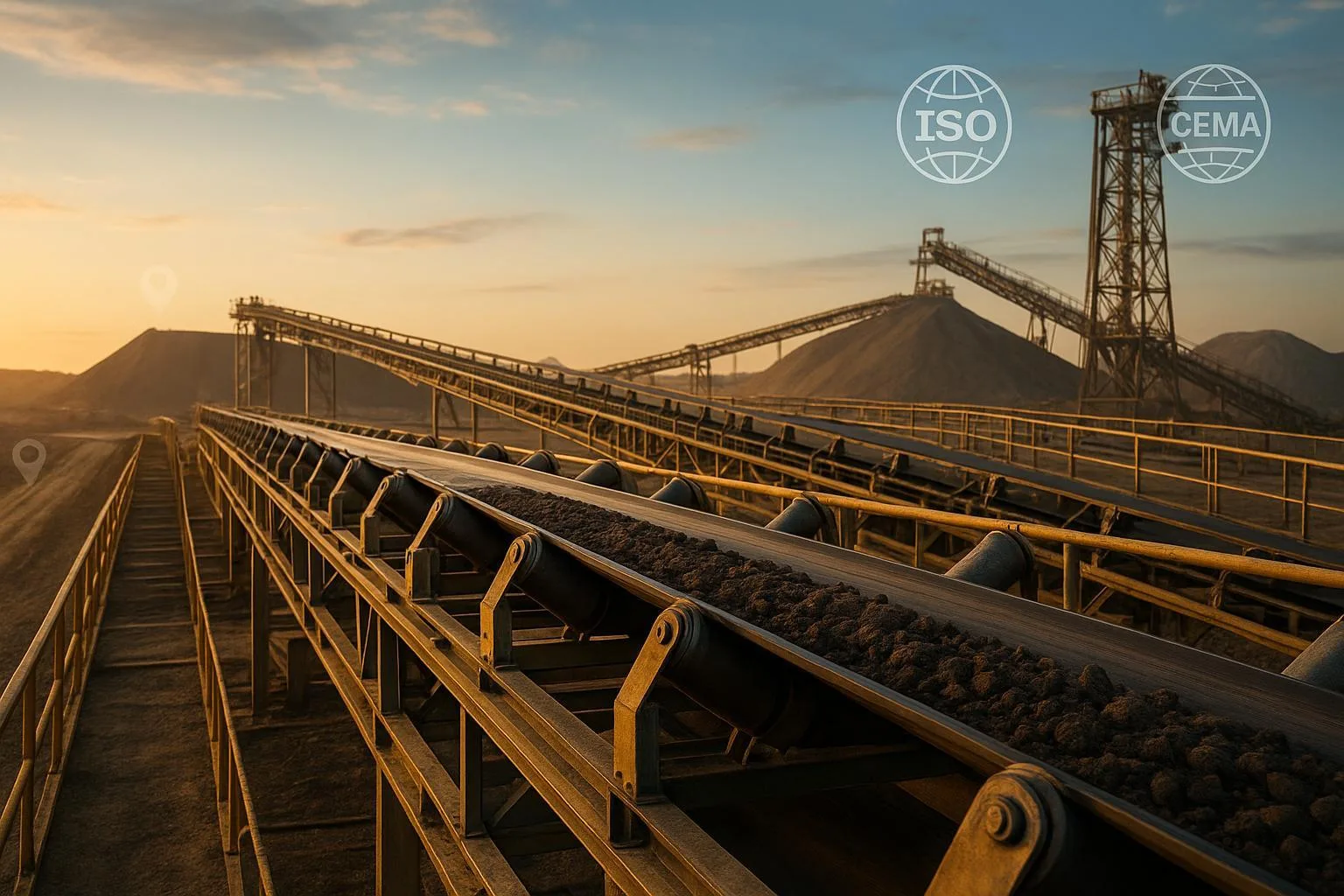
Use CEMA- and ISO-referenced specs to cut risk: idlers per CEMA 502-2022, belt cleaning per CEMA 576, pulley diameters per ISO 3684.
Aggregate and Bulk Material Transport Options Comparison
This section consolidates the comparison dimensions engineers ask for most: throughput, routing, energy, cost drivers, dust/emissions, flexibility, reliability, safety, vertical lift, and standards alignment. Use it as the baseline to draft your spec and RFP language.
Master table summary of transport modes
Below is a concise, engineering-first snapshot across the modes most often shortlisted. Values are relative and scenario-dependent; use them to steer concept selection and RFP scope.
How the modes work in plain terms
Belt and overland conveyors
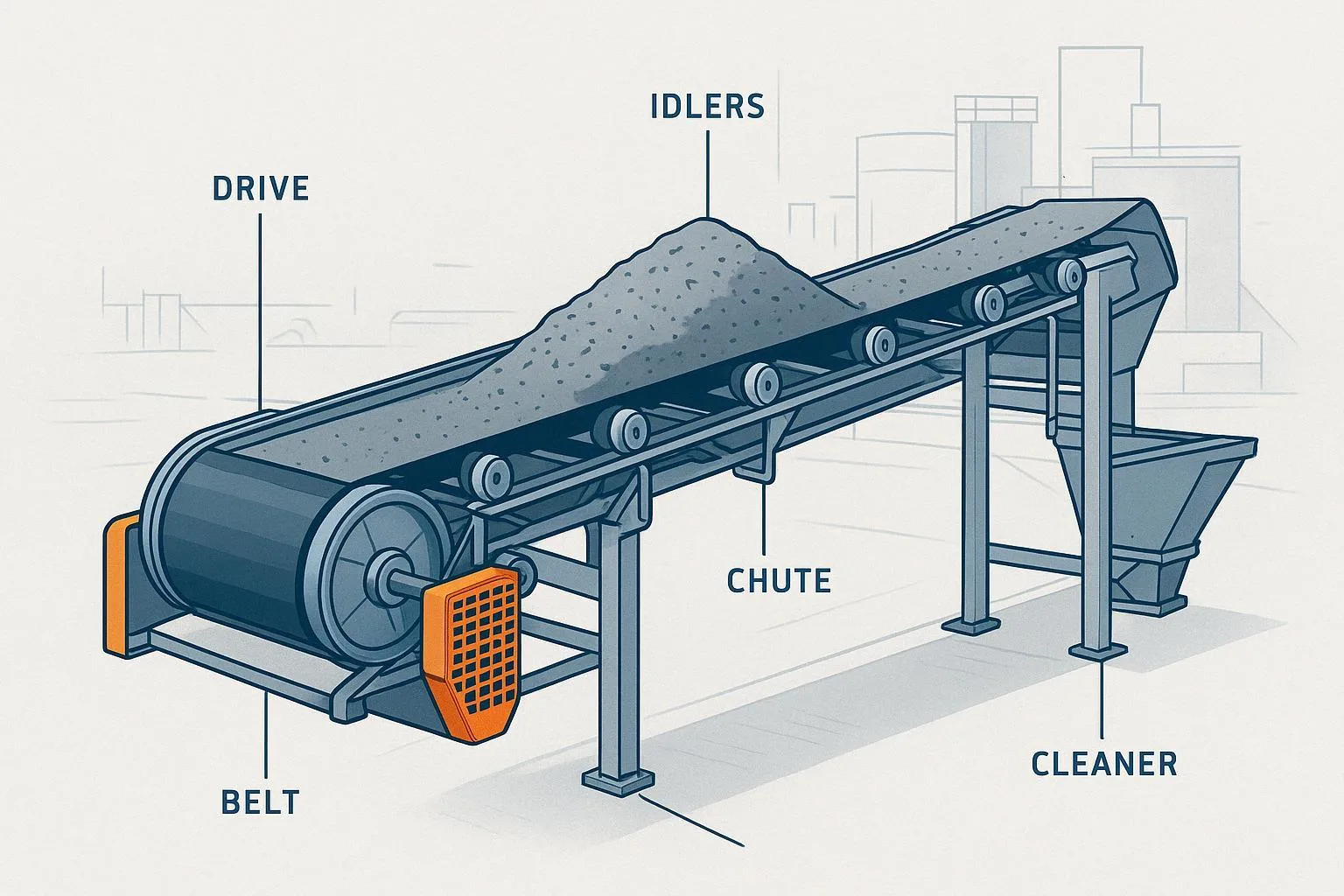
Troughing idlers support a moving belt that carries material continuously. Overland variants extend the principle over kilometers with engineered curves, drives, and tension systems. Power is sized by ISO 5048; designers convert drive power to specific energy by kWh per ton using kW divided by tph at steady load. Cleaning and transfer design follow the severity classes in CEMA 576.
Pipe conveyors
A pipe belt forms a closed tube using idler hexagons, containing dust and enabling tighter routing through curves. Expect slightly higher power than an equivalent open trough due to belt forming and additional rolling resistance. Large single‑flight examples exist; TAKRAF notes tube conveyors up to ~7 km per flight in its 2024 sustainability report.
Screw and drag‑chain conveyors
Screws meter material along a trough; capacity depends on diameter, pitch, and bulk density. Engineering tables from KWS and Kase provide design starting points, such as the KWS screw conveyor capacity guide and the Kase engineering guide. Drag‑chain (en‑masse) conveyors move a bed of material at low speed in an enclosed housing; OEMs report port and cement duties in the hundreds of tph, for example CDM’s ports range in 150–700 MTPH.
Pneumatic conveying
Dilute phase uses high air velocity and low solids loading—good for robust powders but higher energy. Dense phase uses pulses at higher pressures and lower velocities to reduce degradation and wear; controls are more complex. Both are fully enclosed and can navigate tight plant layouts.
Bucket elevators
The workhorse for vertical lifts to bins and silos. Continuous or centrifugal designs carry material in buckets on a belt or chain. Casings enclose dust; alignments and head pulley lagging affect belt life. Pulley diameters are selected per ISO 3684’s method for belt construction.
Truck haulage and rail
Trucks shine when routes change or are temporary. For energy planning, the U.S. FHWA notes medium/heavy trucks can move one ton of freight 151 miles per gallon of diesel in its 2024 energy and emissions plan—a useful benchmark for order‑of‑magnitude comparisons. Rail dominates long linehaul; the AAR summarizes that rail is roughly 3–4× more fuel‑efficient than trucks in its Rail Industry Overview.
Aerial ropeways
Specialized for difficult terrain, spanning valleys or water where rights‑of‑way are constrained. Bulk implementations borrow from passenger ropeway technology and require specialized engineering and inspections.
Scenario guidance to pick the right mode
Fixed high throughput
If your route is fixed and steady above ~500 tph with 24/7 duty, an overland conveyor typically delivers the lowest energy per ton and lowest emissions among mechanical options. Choose a pipe conveyor when dust containment or multiple horizontal curves are decisive.
Variable routes or temporary operations
If the route changes weekly or seasonally, trucks keep your project agile despite higher OPEX. Consider mobile conveyors only once a corridor stabilizes.
Very long linehaul with terminal access
Beyond roughly 30–50 miles where rail exists at both ends, rail’s linehaul economics and energy efficiency tend to beat road haulage.
Short enclosed plant transfers
For abrasive, dusty transfers between process steps, pick drag‑chain for robust enclosure at moderate speeds; select screws for short runs and metering into equipment.
Vertical lift to bins or silos
For lifts above ~20 m in tight footprints, bucket elevators are purpose‑built and efficient. Pneumatic can lift powders where routing favors piping and degradation limits demand dense phase.
Complex terrain or rights of way
When crossing rivers or steep valleys with minimal ground impact, a ropeway may be feasible; validate capacity and permitting early in concept.
Cost and energy drivers you can control
-
Power method and verification: Use ISO 5048 for conveyor power and convert to specific energy (kW divided by tph). Measure rolling resistance and verify idler quality to tighten estimates.
-
Belt speed vs width: Wider, slower belts can reduce wear and spillage; faster, narrower belts can reduce CAPEX but may raise maintenance.
-
Transfer count and geometry: Each transfer adds dust, carryback, and maintenance. Gentle profiles and fewer transfers lower total cost.
-
Mobile vs fixed labor: Trucks concentrate OPEX in fuel and labor; conveyors concentrate in power and periodic component replacement.
-
Terminals and civils: Rail and ropeways hinge on terminal and civil works. Overland conveyors hinge on earthworks, foundations, and electrical.
For deeper detail on overland CAPEX and OPEX drivers, commissioning risks, and specification methods, see the internal guide: Overland Conveyor System Cost: The Engineer’s Ultimate Guide.
Reliability, maintenance, and safety essentials
-
Idlers, pulleys, and cleaners: Follow dimensional and selection guidance in CEMA 502-2022 for idlers, size pulleys according to ISO 3684’s method, and choose belt cleaners using the application severity classes in CEMA 576.
-
Failure modes to plan for: carryback and buildup at return idlers and pulleys, mistracking from loading asymmetry, idler sealing and lubrication failures, and spillage at transfers.
-
Safety: Fixed conveyors lower exposure to mobile‑equipment incidents but introduce nip and entanglement hazards; guard and lockout to standards. Trucks and loaders add traffic and collision risk. Pneumatic systems require attention to pressure safety and dust explosion controls.
A simple method example for energy planning
Think of steady conveyor energy like a meter: if a 1,000 tph overland conveyor requires 250 kW at the drive under ISO 5048 calculations, the specific energy is 0.25 kWh per ton. Multiply by your annual tonnage to estimate electricity consumption, then compare against trucking’s energy proxy using the FHWA’s ton‑miles‑per‑gallon benchmark. This isn’t a bid number, but it’s a fast way to sanity‑check mode selection.
Also consider when specifying conveyors
When you land on belt or overland solutions, component choices materially affect power, uptime, and dust control. Selecting idlers with low rolling resistance and robust sealing, specifying pulleys to ISO 3684‑derived diameters with suitable lagging, and matching belt cleaners to your CEMA 576 class can help reduce power demand, extend belt life, and cut carryback when matched to the application. If you need a standards‑based starting point or a component shortlist, review BisonConvey’s overland conveyor cost guide and reach out for engineering‑backed specifications.
FAQ
When do conveyors beat trucks on cost and emissions?
When the route is fixed and throughput is continuous at moderate to high tph. Electrically driven conveyors sized by ISO 5048 often yield lower kWh per ton than diesel haulage. As duty hours rise, conveyor OPEX scales more gently than truck fleets that add drivers, fuel, and maintenance.
Dense phase or dilute phase for powders?
Use dense phase when product degradation and wear at bends are concerns; it operates at lower velocities and higher pressures. Choose dilute phase for robust powders where simpler controls and steady flow are preferred, accepting higher air power.
When should I choose a pipe conveyor over a troughed belt?
When dust containment is mandatory, spillage must be minimized, or routing requires multiple curves and tighter corridors. Expect higher CAPEX and slightly higher power, offset by enclosure and permitting advantages.
How high can a bucket elevator go?
Elevators routinely handle vertical lifts to bins and silos in the tens of meters, with higher lifts feasible per OEM design. They concentrate maintenance in head and boot sections and require precise alignment.
How far can a single conveyor flight run?
Single flights in the multi‑kilometer range are common for overland and pipe conveyors when engineered appropriately; tube conveyor examples up to ~7 km are noted in TAKRAF’s public materials.
Final guidance and next steps
Start with scenarios: lock your distance, throughput, dust sensitivity, and route flexibility. Screen two or three modes with the table above, then run first‑pass power and capacity checks using ISO 5048 for conveyors and FHWA/AAR benchmarks for mobile or rail options. Engage OEMs early to refine curves, grades, and transfers. If your shortlist includes belt or overland conveyors and you want components specified to standards with commissioning in mind, contact BisonConvey for a neutral, standards‑based component package that fits your duty.