Overland Conveyor System Cost: The Engineer’s Ultimate Guide
If you’re scoping an overland conveyor, cost clarity is the difference between a viable project and a stranded concept. Overland conveyors move bulk materials over kilometers with a stable, predictable cost per ton—but only when design choices, route geometry, and maintenance are handled with discipline. This guide explains Overland Conveyor System Cost in practical terms: what sits in CAPEX and OPEX, which engineering decisions move the needle, how standards (CEMA, ISO 5048, DIN 22101) shape power and tension, and a simple workflow for early screening.
Key takeaways
-
Overland Conveyor System Cost is driven most by length, vertical lift, route geometry, belt selection, idler quality/spacing, and the number of transfer points.
-
CAPEX and OPEX are tightly linked: power and tension calculations (per CEMA, ISO 5048, DIN 22101) determine belt strength, drive size, and ultimately both equipment and energy cost.
-
Indentation rolling resistance and vertical lift dominate energy demand on long routes; low-rolling-resistance (LRR) bottom covers and optimized idlers materially reduce OPEX.
-
Horizontal/vertical curves and fewer transfers can lower structures and housekeeping, but require proper curve analysis and controls.
-
A transparent screening workflow beats “cost per km” rules of thumb—state assumptions, pick a standard, calculate power/tension, then map outputs to cost buckets.
CAPEX vs OPEX — what’s in the cost and why it matters
A lifecycle view is essential. CAPEX (capital expenditure) sets the physical baseline; OPEX (operating expenditure) compounds every hour the system runs. Reducing initial spend at the expense of energy or reliability rarely pays back on an overland asset with high utilization.
| Cost area | Typical items | What moves the needle | Why it matters |
|---|---|---|---|
| CAPEX | Belt (steel cord or EP/NN), idlers, pulleys, drives/VFDs, take-up, structures/trestles, transfer/discharge towers, chutes, cleaners, skirt seals, electrical/controls, civils/earthworks, installation | Length and lift; route alignment/terrain; belt width/strength; number of transfers; curve requirements; environmental/dust controls | Drives belt class and pulley sizes; adds structural steel and civils; more transfers increase equipment and erection complexity |
| OPEX | Energy, idler replacements, belt repairs/covers, cleaners and spares, housekeeping at transfers, inspections, downtime | Rolling resistance and lift; idler quality/sealing; LRR bottom covers; alignment and tracking; dust/spillage management | Dominates total cost of ownership; energy scales with resistance and speed; poor sealing and misalignment increase failures |
For lifecycle economics comparing conveying vs. trucking, BEUMER’s analysis documents higher initial CAPEX for conveying offset by lower OPEX with breakeven in the early years under steady tonnage. See the 2021 mining-focused study for methodology and cumulative cost curves: the authors show multi-year savings when utilization is high and transfers are minimized in their model. Source: the BEUMER Group whitepaper “Conveying vs. Trucking” (2021). Link below in references and cited in context.
According to standards-based practice, required power stems from effective tension multiplied by belt speed. CEMA compiles main resistance components (rolling/indentation, flexure, skirt/cleaner drag, pulleys, acceleration) plus gravity for lift; power is HP = Te × V / 33,000 in imperial terms. ISO 5048 uses a similar effective force concept (P = Fu · v). DIN 22101 provides a comparable framework with its own friction factors and safety-factor methodology. See: the public CEMA change pages for terms and categories (CEMA Belt Book change pages); the ISO 5048 catalogue entry for scope; and Overland Conveyor Company’s Belt Analyst overview and software release notes describing DIN 22101:2011 updates.
Engineering drivers that move the needle
Route geometry and terrain
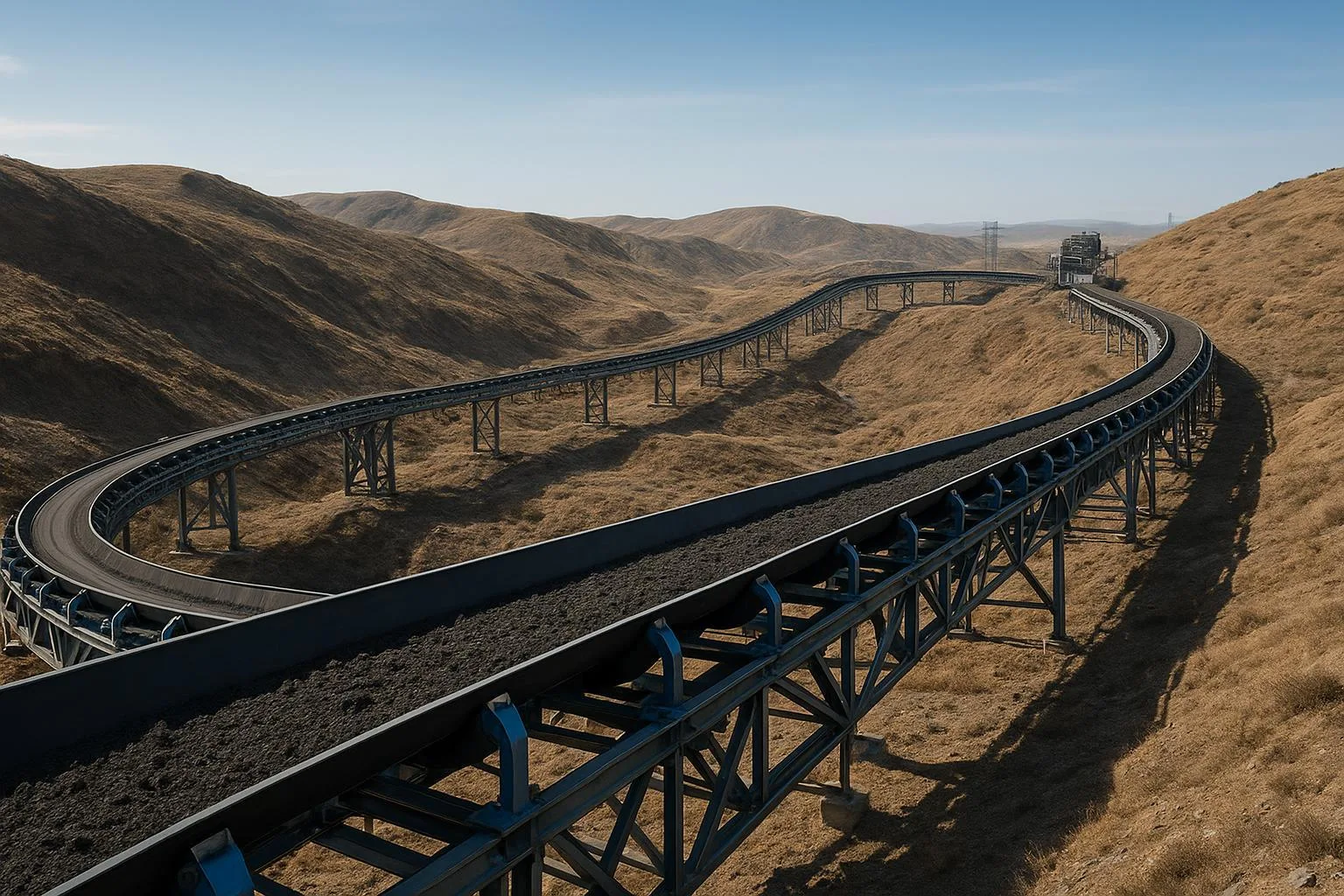
Horizontal and vertical curves can eliminate transfer towers and shorten route length, but they require dedicated curve analysis (curve radii, idler banking, side forces) and influence structure and idler selection. Treat curved overland conveyors as a distinct design problem—don’t size them as if they are straight flights and add curves later. Modern analysis tools implement curve methods consistent with CEMA-derived practice; see the Sidewinder features page for curve analysis capabilities and the Channar overland paper for long-route design context.
-
Use curves to remove transfers where justified, but validate tensions and belt edge stresses across load cases.
-
Terrain dictates civils: bridges, culverts, deep footings, and access roads can rival equipment cost.
Belt construction and covers (steel cord vs EP/NN; LRR covers)
Steel-cord belts dominate long overland systems because of high strength and low elongation. Cover compounds—particularly low-rolling-resistance (LRR) bottom covers—reduce indentation rolling resistance, often the largest energy component on long, relatively flat conveyors. Engineering literature and case notes attribute double-digit percentage energy reductions to LRR compounds under certain conditions. Treat vendor claims as examples and validate with your duty cycle and temperature profile. Context sources include the engineering study on troughed belt energy efficiency (paper link) and the Curragh overland case (CEMA-hosted case note).
-
Select tensile class from power/tension outputs with safety factors per your chosen standard (DIN 22101 safety factors were updated in 2011—see OCC notes linked above).
-
Evaluate LRR bottom covers as an OPEX lever; check compound data sheets and, where available, standardized test results (vendor examples such as Fenner’s Powersaver note can illustrate options—treat as examples, not universal values).
Idlers and spacing
Idler rotational resistance and sealing quality influence both energy use and reliability. Wider idler spacing can reduce the number of indentation zones per length (lowering indentation losses) but increases belt/material flexure and trough sag. Overland designs commonly land in the 3–5 m carry-idler spacing range for wide belts, subject to stiffness, load, and climate. Validate spacing with resistance modeling and check transitional impacts around curves and transfers. See discussion in the Practical Maintenance handbook (PDF).
-
Specify sealing quality and rotational resistance testing; low-quality bearings and seals increase drag and failure rates.
-
Track temperature and vibration during burn-in to catch outliers early.
Drives, controls, and take-up design
Drive selection (VFDs, distributed drives), take-up sizing, and control of start/stop transients impact belt tensions, motor rating, and component fatigue. Better control profiles reduce peak stresses, aiding splice life and pulley fatigue performance. ABB’s article in World Coal discusses how control strategy can reduce stress and energy (ABB paper), and Conveyor Dynamics provides overland design context (CDI).
-
Validate brake control on declines; coordinate drive control for load sharing.
-
Consider distributed drives for long routes to manage tensions and reduce belt class.
Transfer points and dust/spillage control
Every transfer adds structural steel, chute work, dust control, and housekeeping. Minimizing transfers reduces both CAPEX and OPEX but depends on route and material behavior. Curved overland conveyors sometimes replace intermediate towers when alignment permits. For system-level trade-offs, see BEUMER’s knowledge materials and the whitepaper comparing conveying vs trucking (BEUMER 2021).
Standards and methods: CEMA, ISO 5048, DIN 22101
Different standards yield different calculated powers and tensions for the same conveyor because their resistance factors and safety philosophies differ. Always state which method you’re using and your key assumptions.
| Standard | Scope and focus | Practical implications |
|---|---|---|
| CEMA (Belt Conveyors for Bulk Materials) | Effective tension approach that itemizes resistances (rolling/indentation, flexure, skirt/cleaner drag, pulleys, acceleration) plus gravity for lift; includes guidance for curves | Widely used in the Americas; practical for component selection; HP = Te × V / 33,000 convention; good alignment with many vendor datasheets |
| ISO 5048:1989 | Method for calculating operating power at the driving pulley and tensile forces; P = Fu · v framing with componentized resistances | International context; similar structure to CEMA but with its own symbols/definitions; ensures comparability across vendors using ISO framing |
| DIN 22101 (2011) | Design basis covering resistance, required power, belt tensions and safety factors, pulley groups, and cross-sectional area | 2011 update revised friction/safety-factor treatment; software like OCC’s Belt Analyst documents the implementation; often used in Europe and by global OEMs |
For public overviews and implementation notes, see the CEMA change pages, the ISO 5048 catalogue entry, and Overland Conveyor Company’s Belt Analyst page and release notes.
From calculation to cost — a practical screening workflow
Early-stage screening should be transparent and repeatable. Here’s a concise workflow you can adapt to your site:
- Define inputs
- Length and vertical lift; capacity (TPH), bulk density, surcharge angle; preliminary belt width and speed; ambient temperature range; expected idler spacing; number of transfers you aim to avoid with curves.
- Choose a method and compute power/tensions
- Select CEMA, DIN 22101, or ISO 5048. Compute effective tension and power across load cases (empty, partial, full; cold vs hot). For a quick imperial check under CEMA, HP ≈ Te × V / 33,000.
- Translate outputs into equipment sizes
- Belt tensile rating and safety factor; pulley diameters and lagging; motor(s) and VFD ratings; take-up mass and stroke; brake requirements (declines); control philosophy.
- Map to cost buckets
- CAPEX: belt class and width, idler quantity/quality, number of structures/trestles, transfer towers/chutes, drive stations and MCCs, civil works. OPEX: kWh/t from rolling resistance and lift, idler life/sealing, cleaner and chute wear, housekeeping.
- Sensitivity test the big levers
- Compare LRR vs standard bottom covers; adjust idler spacing within acceptable sag; evaluate 1–2 alternative alignments with different civil burdens; test distributed drives vs single head drive.
Illustrative example (for concept only, 2026 assumptions)
-
Inputs: 8 km length, +120 m lift, 3,000 TPH, 1,600 mm belt candidate at 5.0 m/s, ambient 5–35°C, carry idler spacing 4 m, one unavoidable transfer.
-
Method: DIN 22101 (2011) framing, conservative friction at cold start.
-
Result sketch: Effective tension leads to total drive power on the order of several megawatts for full load and cold start. Selecting an LRR bottom cover and optimizing idler sealing/spacing reduces steady-state energy draw by a meaningful percentage compared with standard compounds under warm conditions (directionally consistent with published engineering studies). Use software (e.g., Belt Analyst or Sidewinder) to quantify with your material and geometry. Numbers here are illustrative; actual results are site-specific.
Selection and implementation guidelines (procurement/spec checklist)
Use this condensed checklist to de-risk both cost and reliability during procurement:
-
Belts
- Specify construction (steel cord vs EP/NN), tensile class, splice type, cover grades (top/bottom), abrasion index, adhesion tests, elongation at reference load. If calling for LRR, request test references for the compound and expected temperature dependence.
-
Idlers
- Define compliance (CEMA/ISO dimensions), shell thickness and TIR limits, bearing class and sealing system, rotational resistance test criteria, corrosion protection, and QA sampling plans. Include noise/vibration criteria where applicable.
-
Pulleys
- Call out rim thickness and fatigue design basis, NDE of welds, balance class, lagging type/hardness, and minimum diameters per the selected standard (note DIN pulley group guidance).
-
Drives and controls
- State VFD control philosophy (start/stop ramps), load sharing for multiple drives, braking strategy (especially on declines), instrumentation for temperature and vibration.
-
Civils and structures
- Establish design loads for trestles/gantries, foundation types, drainage, access ways, and corrosion protection class.
-
QA/commissioning
- Require factory test plans, dimensional inspections, certificates of conformity, belt storage and splice QA, take-up pre-tension verification, alignment checks, no-load and loaded ramp tests, and E-stop/brake function tests.
These checklist themes reflect common specification elements found in industry handbooks and owner standards and align with the categories used by CEMA and DIN for component selection and sizing.
Common problems and troubleshooting patterns
Hot bearings or elevated idler temperatures
- Likely causes: sealing failure, contamination, misalignment increasing drag. Quick checks: IR temperature scan during operation; listen for tonal changes; replace on condition.
Persistent carryback and spillage at transfers
- Causes: worn cleaners, poor chute geometry, inadequate skirt sealing. Actions: refresh blades, tune belt speed vs loading, review chute design and liner wear.
Chronic tracking to one side
- Causes: troughing set misalignment, pulley not square, uneven loading, uneven tension distribution. Actions: verify structure and pulley alignment, inspect transition zones, adjust training devices sparingly.
Start/stop events trigger alarms or splice damage
- Causes: aggressive ramps, poor load sharing, insufficient take-up travel. Actions: refine VFD profiles, check take-up mass/stroke, validate brake timing and control logic.
References for these patterns include the Practical Maintenance handbook and ABB’s discussion of drive control profiles and their impact on stresses and reliability (links above).
Best practices for reliability and OPEX control
-
Treat alignment as a discipline: survey trestles and troughing sets periodically; track belt edge position data.
-
Optimize energy continuously: monitor kWh/t, idler temperature, and vibration; evaluate LRR covers at next belt change if not already specified.
-
Minimize transfers thoughtfully: use curves where justified and supported by analysis to reduce towers and housekeeping.
-
Document and trend data: log starts/stops, alarms, splice inspections, idler replacements, and energy consumption to guide maintenance planning.
-
Plan spares by failure mode: bearings/seals for idlers, cleaner blades, critical pulleys/lagging, and splicing kits.
Industry context on energy and controls can be found in ABB’s World Coal paper and engineering case notes such as the Channar and Curragh overland references.
Conclusion — what to do next
Overland Conveyor System Cost is not a single number; it’s the sum of design choices that shape both CAPEX and OPEX for decades. State your assumptions, choose a standard, model resistances and tensions, and then trace every kilowatt and component size back to a lifecycle cost impact. Focus your effort where it pays back: route alignment and transfers, belt construction and LRR covers, idler quality and spacing, and drive control.
Actionable takeaways: Use a standards-based workflow (CEMA, ISO 5048, or DIN 22101) to calculate power/tensions before talking budget line items; treat LRR bottom covers and idler sealing/spacing as primary OPEX levers—validate with your duty and temperature; reduce transfers with curves where analysis supports it; make QA and commissioning a scope item to avoid early-life failures.
If you’re specifying belts, idlers, or pulleys for an upcoming project and want component data to support the cost-and-reliability trade-offs above, a supplier like BisonConvey can be used as a reference point for engineering-grade components and documentation. Engage your shortlisted vendors early with your chosen standard, load cases, and route constraints so proposals are directly comparable.
References (selection for verification)
-
CEMA Belt Book change pages (public excerpts): effective tension categories and power calculation framing: CEMA change pages.
-
ISO 5048:1989 catalogue scope: operating power and tensile force calculation for belt conveyors: ISO 5048.
-
Overland Conveyor Company Belt Analyst (multi-standard support) and DIN 22101:2011 notes: Belt Analyst; release notes.
-
Curve analysis and method context: Sidewinder features.
-
Conveying vs trucking lifecycle comparison (assumption-bound example): BEUMER whitepaper 2021.
-
Energy and spacing/maintenance context: Practical Maintenance handbook; ABB World Coal article.
-
Case references: Channar overland paper; Curragh overland case note.