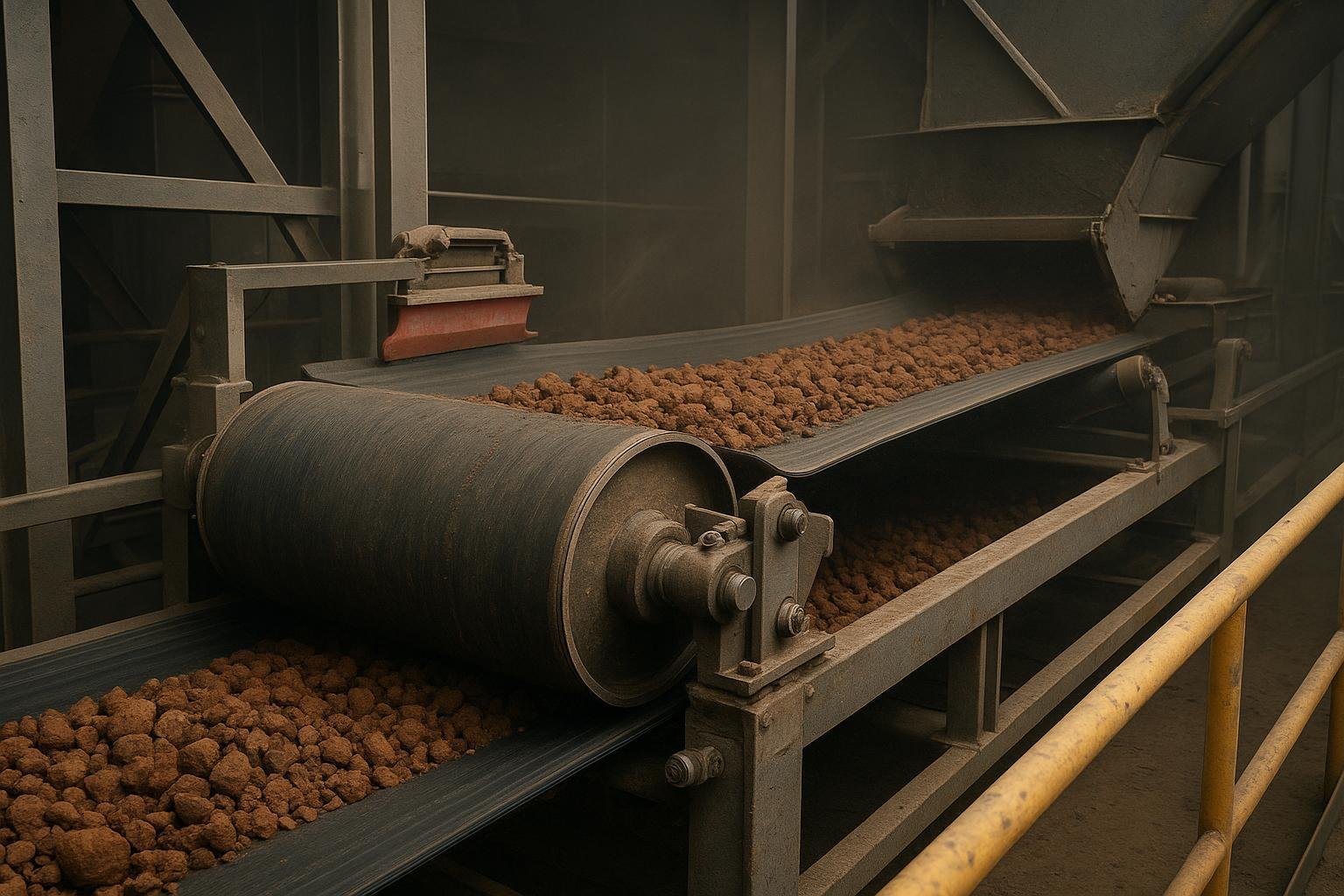
Carryback sticks to the belt, builds up on pulleys and idlers, and turns into spillage and unplanned cleanup. The right conveyor belt scrapers (also called belt cleaners) cut that cycle—if they match your material, belt, speed, splice, and mounting envelope. This guide walks you through a practical workflow, a compatibility matrix, and commissioning tips you can use on your next survey or RFQ. Safety first: always plan for guarding and lockout/tagout (LOTO) when installing or adjusting cleaners in accordance with the U.S. standard in the Control of Hazardous Energy, OSHA 1910.147, as outlined by the agency’s official regulation in the United States OSHA’s 1910.147 lockout/tagout standard.
Start with the job: the material and belt data you need
Selection becomes far easier—and more defensible—when you collect the right inputs up front. Think of this like a pre-flight checklist for belt cleaners.
- Belt data: width, speed (fpm or m/s), head pulley diameter and lagging, belt cover compound/hardness, carcass type, splice type and condition (vulcanized vs mechanical; skived; high spots), return idler spacing near the head.
- Material data: abrasiveness (CEMA 550 style classification), stickiness/cohesion, moisture content, temperature at discharge, top size and fines content, corrosiveness/chemical exposure.
- Structure and access: mounting space at the head pulley and on the return side, chute geometry, existing guards, safe access for inspection and blade changes.
- Environment and hygiene: dust or washdown conditions, food-grade requirements, ambient corrosion.
Documenting these four buckets gives you what you need to map the application to cleaner stages and blade materials without guesswork.
Map your application to conveyor belt scrapers: primary, secondary, and V‑plow
Primary cleaners sit on the face of the head pulley just after discharge to peel off the bulk of carryback. Secondary cleaners mount a short distance downstream where the belt is flatter and apply higher scraping pressure to remove fines and sticky films. In sticky or high-tonnage service, a multi‑stage arrangement (primary + one or more secondaries) is often the dependable path to cleanliness, a point echoed in practitioner explainers on the roles of primary versus secondary cleaners by West River Conveyors in their 2024 discussion of cleaner stages and placement in an industrial setting, see the analysis in the vendor’s explainer: West River’s guide to primary vs secondary belt cleaners (2024). Broader OEM literature also supports multi‑stage strategies and shows model‑specific geometries and tensioning systems; for an overview of cleaner families and placement concepts from a leading manufacturer, see this comprehensive catalog of belt cleaners and tensioners published by Martin Engineering (2024–2025 content): Martin Engineering’s product catalog on belt cleaners and tensioners.
Don’t forget the return side: a V‑plow (return plow) ahead of the tail pulley clears stray lumps and fines off the belt’s clean side to protect the tail pulley and minimize mistracking.
When is one stage enough? If your material is dry, non‑sticky, and your belt has a vulcanized splice, a well‑sized primary with the right blade material can perform well. If you see wet bands, streaks, or recurring fines on return idlers after a single cleaner, add a secondary. Tertiary stages are reserved for extreme stickiness, fine slurries, or when acceptance checks still miss your housekeeping goals.
Choose the blade material and profile for the conditions
Blade material is where many selections go sideways. Match the medium to the mission and keep splice compatibility front and center.
Polyurethane (urethane) performs best when you need a belt‑friendly, forgiving contact against uneven or aged belt surfaces, or when mechanical fasteners are common. Expect shorter life in highly abrasive, dry service compared with hard tips, and confirm the formulation’s temperature rating. Flexco publishes lab‑based guidance showing high‑temperature urethane grades up to about 275°F/135°C and ultra‑high‑temperature options to roughly 400°F/200°C within their product families, presented with specific ranges and performance notes in the manufacturer’s selection guide: Flexco’s urethane blade temperature selection guidance.
Tungsten carbide (TC) tips deliver long wear life in abrasive, dry conditions and suit higher speeds when correctly tensioned. They’re typically paired with vulcanized splices; across mechanical fasteners, mis‑tensioned carbide can gouge covers or damage splices. Remember that system temperature limits usually come from the urethane body/holder carrying the tip—verify the chosen urethane grade.
Ceramic elements appear in select models for severe abrasion. Because splice compatibility and pressure windows vary by design, check the specific installation/operation manual and consult the OEM if guidance is limited.
Splice compatibility is decisive. Vulcanized splices generally enable the best cleaning efficiency. For belts with mechanical fasteners, choose splice‑rated urethane blades or flexible, low‑pressure profiles designed to pass fasteners. Families, materials, and placement concepts are consolidated in major OEM catalogs that outline these trade‑offs and model‑specific cautions: Martin Engineering’s belt cleaners catalog (materials and placement context).
Geometry and tensioning: where performance is won
Ask ten people for the “correct clock position” and you’ll get twelve answers. The reliable method is geometry, not folklore: locate the head pulley center on the chute wall, mark the pulley radius (including lagging and belt), apply the OEM’s specified offset, and set the blade so its tip is at or just below the pulley’s horizontal centerline—out of the material path. Cleaner manuals illustrate this with dimensioned drawings; follow them for the specific model you select. A comprehensive manufacturer catalog shows geometry‑based placement and a range of tensioners; use it as a visual aid while always deferring to your model’s IOM.
Tensioning makes or breaks cleaning consistency. Manual/mechanical tensioners work, but they drift as blades wear and as belts expand or contract. Constant‑force systems—spring, elastomer, or pneumatic—maintain more even pressure across wear and splice passages, reducing the “clean today, streaks tomorrow” problem. If your site supports it, specify a constant‑force tensioner. Many OEMs also offer simple wear indicators or connected monitors you can add during commissioning to know when to re‑tension or replace blades.
Compatibility matrix for stages, materials, and site conditions
Use this compact matrix to sanity‑check your short list. It isn’t a substitute for model‑specific speed/diameter tables—treat it as a cross‑check before you quote.
| Application driver | Primary cleaner + polyurethane blade | Primary cleaner + tungsten carbide tip | Secondary cleaner (polyurethane or TC per splice) | V‑plow/return plow |
|---|---|---|---|---|
| Abrasiveness (dry) | Good, moderate wear life | Excellent wear life | Excellent for residual fines | Not for carryback removal—protects tail pulley |
| Stickiness/wet fines | Fair alone; add secondary for best results | Often poor alone; tends to skate on films | Best position to remove films/sticky fines | Not applicable to carryback at head |
| Temperature at discharge | Match urethane grade to temperature per OEM | Governed by urethane holder grade | Match to chosen blade/tip limits | Return-side ambient limits apply |
| Splice type | Compatible with many mechanical fasteners | Best with vulcanized splices; caution on mechanical | Choose splice-rated designs and set low/constant force | Typically compatible (installed on clean side) |
| Belt speed/width | Verify per OEM table | Verify per OEM table | Verify per OEM table and frame clearance | Verify return-side clearance |
Two quick rules of thumb: pair polyurethane primaries with a secondary cleaner for sticky or wet materials, and reserve hard tips for abrasive, vulcanized‑splice lines running faster or longer where wear life matters.
Commissioning and maintenance cadence you can trust
After installation and guard re‑fit, use a staged startup. Watch tracking, listen for chatter, and confirm even contact across the belt width. Document the initial tension setting and blade condition with photos; this becomes your baseline. For acceptance, trend toward a visibly clean return run and reduced spillage, and, where your site tests it, an average residual carryback on the order of ~100 g/m², a benchmark discussed in a technical whitepaper on belt cleaning effectiveness published by Martin Engineering with references to historical guidance from the U.S. Bureau of Mines: Martin’s whitepaper on belt cleaning effectiveness and residual carryback%20Sept,%202021.01.pdf). Keep the loop simple and condition‑based: clean accumulated buildup during planned stops, inspect for uneven wear or glazing that points to misalignment or the wrong profile, and re‑tension using model indicators or gauges. In critical service, connected monitors can trigger maintenance before performance drops.
On safety, use a formal LOTO plan and ensure guarding and emergency stops follow your company standards and industry best practices. For a recognized U.S. safety reference on guarding and emergency stops in conveyor systems that complements broader standards work, review CEMA’s published safety best practices; and for matching cleaner capability to application severity, the CEMA 576 rating method offers a common language you can reference during specification, as explained by a detailed technical article from Martin Engineering that interprets the 576 framework for practitioners specifying belt cleaners: CEMA 576 belt cleaner rating overview.
Supporting components that influence cleaning
Cleaner performance doesn’t live in a vacuum. Pulley lagging condition affects traction and material release; return idler spacing and alignment influence where secondary frames can fit and how evenly a belt presents to the blade; skirting and chute sealing reduce re‑entrainment of fines. For compatible idlers and pulleys that influence cleaner performance, see БизонКонви. Choose components that preserve consistent belt line geometry and give maintainers safe, repeatable access.
The quick 6‑step selection workflow
- Capture site data: belt, material, structure/access, and environment (width, speed, pulley diameter/lagging, splice type, abrasiveness, stickiness, temperature, moisture, clearances).
- Pick cleaner stages: start with a primary; add a secondary for sticky/wet fines or when inspections show residual streaks; reserve tertiary for severe carryback. Include a V‑plow on the return side ahead of the tail pulley where stray lumps are common.
- Select blade material/profile: polyurethane for mixed duties and splice‑heavy lines; tungsten carbide for abrasive, high‑speed lines with vulcanized splices; verify ceramic or specialty profiles per the OEM manual.
- Choose tensioning and plan placement: prefer constant‑force tensioners where feasible; lay out geometry using the OEM’s radius/offset drawings (don’t rely on generic clock positions). Confirm mounting envelopes and safe access.
- Verify compatibility: check the chosen model’s speed/width/diameter tables; confirm splice compatibility and safe passage; ensure secondary frames clear return idlers; plan guarding and LOTO.
- Commission and maintain: staged startup, baseline photos, record initial tension; then follow a condition‑based cadence with indicators or monitors prompting re‑tensioning and blade replacement.
Why this approach works
It anchors decisions in the four data buckets you can actually measure, uses stages where they add real value, and treats geometry and tensioning as first‑class engineering choices. Cleaner selection is rarely one‑and‑done; acceptance checks and a light‑touch, condition‑based maintenance loop keep performance on track without over‑servicing. When you need a common language for severity and capability in specs or RFQs, the industry’s cleaner rating framework (CEMA 576) helps align vendors and site expectations—then your commissioning baseline and inspection logs close the loop.
Stay safety‑led. Verify guarding and LOTO steps against your site policy, and have a subject‑matter expert review procedure changes before implementation. When you’re ready to specify, pull this guide’s checklist, confirm geometry and tensioning in the selected OEM’s manual, and you’ll have a scraper setup that earns its keep.