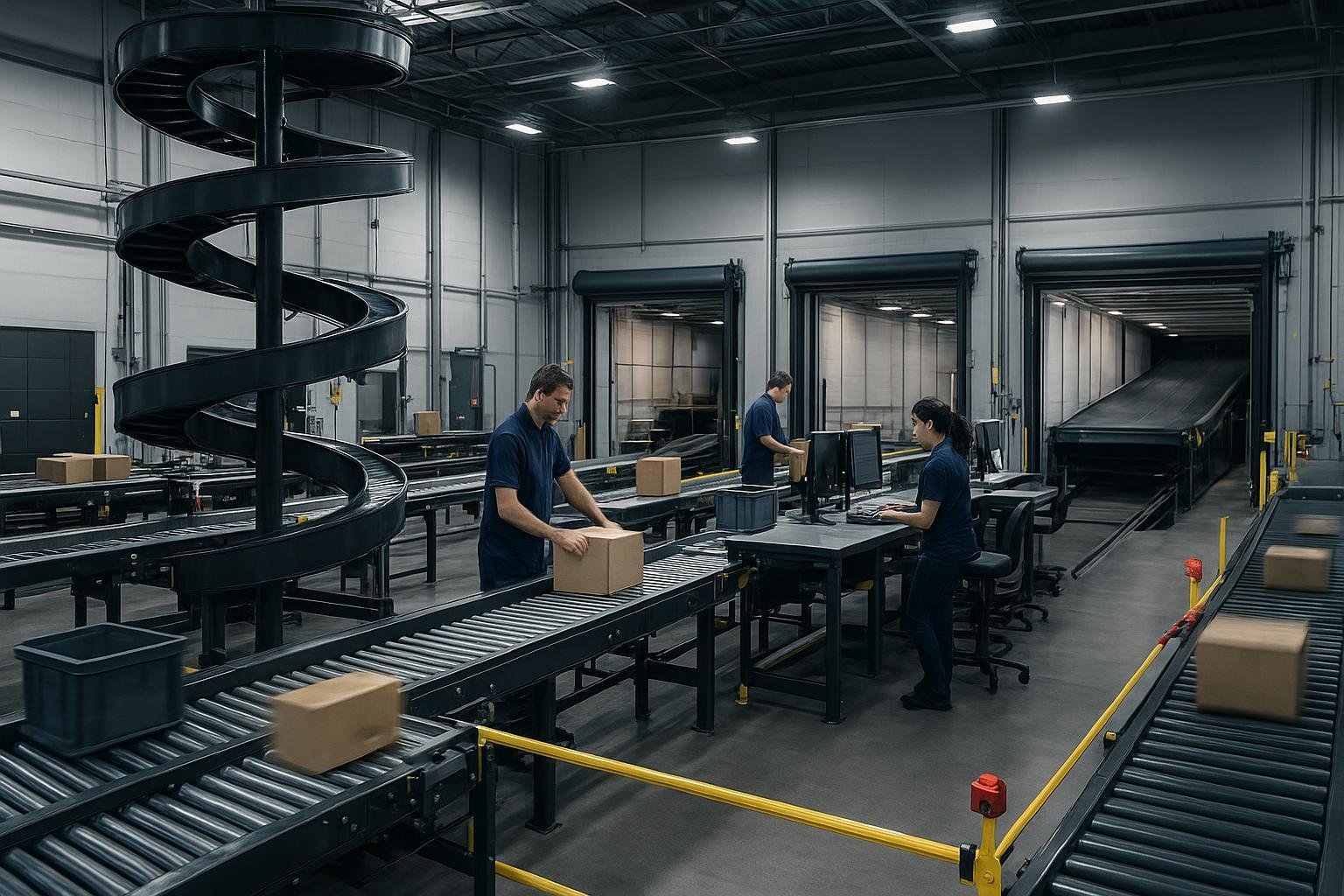
A busy DC doesn’t fall behind because people aren’t working hard—it falls behind when flow stops. Conveyors fix flow. When you replace long manual carries and congested handoffs with engineered, predictable movement, you get faster turns, fewer touches, safer workstations, and capacity that scales without adding headcount. This guide distills what actually works when logistics teams put conveyors to work.
Where Conveyors Move the Needle in Logistics
Conveyors improve performance where motion is repetitive and distance is the enemy.
- Throughput and cycle time: Continuous transport cuts dwell time between steps, reducing pick-to-pack and pack-to-ship intervals. Accumulation and controlled merges keep lanes moving instead of stop‑start surges.
- Labor hours: Every foot of travel you eliminate frees minutes per order. Zone-controlled MDR reduces babysitting of totes and cartons, so operators spend time on value tasks.
- Accuracy: Integrated scanning and print‑and‑apply on conveyor lines protect parcel identity, reducing mis‑sorts and relabels.
- Safety: Ergonomic infeed/outfeed heights, guarded nip points, and accessible e‑stops reduce strains and struck‑by risks when aligned to OSHA and ASME conveyor practices. See OSHA’s consolidated guidance in the Conveyor Safety eTool (ongoing) and the advisory ASME B20.1‑2024 overview.
- Space: Spirals, VRCs, and efficient accumulation reclaim floor space by moving vertically and shrinking buffer zones.
Choosing the Right Conveyor for the Job
Different flows call for different mechanisms. Think of it this way: what are you moving, how fast must it move, and what exceptions will it see?
- Belt conveyors: Best for steady transport, inclines/declines, and gentle handling of mixed cartons and totes.
- Motor‑driven roller (MDR): Ideal for zero‑pressure accumulation, merges/diverts, and zone control in e‑commerce and parcel.
- Sorters (cross‑belt, sliding‑shoe, tilt‑tray): High‑speed destination assignment when you have many lanes and high order lines.
- Spirals/VRCs: Elevation changes with minimal footprint; choose by required continuity and throughput.
- Telescopic belts: Fast, ergonomic trailer loading/unloading at docks.
- Flexible/expandable: Peak‑season adaptability where fixed lines aren’t justified.
Conveyor selection should follow proven unit‑handling design practices. The industry’s reference is CEMA’s Application Guide for Unit Handling Conveyors (2nd ed., 2016), which covers layouts, components, and application limits.
| Application need | Best-fit technology | Why it fits | Watch‑outs |
|---|---|---|---|
| Steady carton/tote transport, inclines | Belt conveyor | Continuous surface, handles small items and slopes | Tracking and tensioning must be maintained |
| Accumulation before pack/sort, merges/diverts | MDR roller | Zone control, zero‑pressure, energy efficient | Small/irregular items may need trays or belts |
| Many destinations at high speed | Sliding‑shoe or cross‑belt sorter | High throughput with precise induction | Cost/complexity; requires robust controls |
| Vertical movement in tight footprint | Spiral conveyor | Continuous flow with small footprint | Diameter limits and product stability |
| Intermittent pallet/case elevation | VRC | Safe, reliable vertical transfers | Lower throughput; queue management needed |
| Dock loading/unloading | Telescopic belt | Shorter walk paths, faster turns | Trailer condition variability; operator training |
Design and Integration That Actually Delivers
Start with process, not hardware. Map inbound, putaway, replenishment, picking, packing, and shipping. Where are the long walks, congested handoffs, and rework loops? Those are your conveyor candidates.
- Layout and flow: Size accumulation to cover upstream bursts. Balance merges with enough metering. Provide bypasses so you can keep flow during a fault. Set ergonomic heights and clear walkways.
- Controls and software: Conveyors shine when software orchestrates them. Use a layered architecture—WMS for inventory and orders, WES for task orchestration and wave/waveless optimization, WCS for device‑level execution and routing. For a clear primer, see Bastian Solutions’ explainer on how WES and WCS orchestrate operations (overview).
- Device integration: Standardize scanner, printer/applicator, scale, and dimensioner interfaces. Define response times and exception paths for no‑reads and jams. Instrument zones for live telemetry.
- Safety and compliance by design: Guard nip points and rotating parts; make emergency stop cords visible and within reach; apply lockout/tagout before service. OSHA’s 29 CFR 1910 machine guarding and LOTO requirements are summarized in the Conveyor Safety eTool (federal guidance). Align build and procedures with the advisory ASME B20.1‑2024 conveyor safety standard.
A quick sanity check: can you explain in one sentence what each zone does and how it fails safely? If not, keep simplifying.
Keep It Running: Maintenance Routines That Protect Uptime
Uptime depends on disciplined, boring routines.
- Daily/weekly: Clear debris, confirm belt tracking, listen for noisy rollers and bearings, verify guards and e‑stops, and test photo‑eyes.
- Monthly/quarterly: Lubricate per OEM guidance, check belt tension and alignment, inspect pulleys/lagging, test sensors and zone controls.
- Annual: Full mechanical/electrical inspection, structural review, drive health, and a safety labeling audit.
- Predictive: Track MTBF/MTTR, monitor motor temperature/vibration, add belt alignment sensors, and trend downtime causes.
For step‑by‑step points and intervals, see practical maintenance guides such as MHS/LAC/Lafayette and inspection checklists from Martin Engineering; a good starting reference is LAC’s conveyor system maintenance guide (industry guidance).
Measure What Matters: KPIs and a Simple Startup Plan
If you can’t measure it, you can’t improve it. Baseline before you switch on the first motor. Track throughput (cartons per hour by lane and sorter), productivity (labor hours per 1,000 cartons; lines picked per labor hour), accuracy (scan/read rate; mis‑sort rate; order accuracy), cycle times (dock‑to‑stock; pick‑to‑ship; pack‑to‑manifest), reliability (OEE; MTBF/MTTR; weekly unplanned downtime), and safety (recordables, near‑misses, LOTO audit results). To benchmark and set targets, logistics leaders often use WERC’s annual studies; see the WERC DC Measures benchmarking program (high‑level overview) for commonly tracked warehouse metrics. For broader context on technology adoption and orchestration trends shaping investment, consult the 2025 MHI/Deloitte summary released via Business Wire in March 2025: MHI Annual Industry Report focus on orchestration.
A simple startup plan
-
Week 0–2: Process map and data baseline. Time studies on travel, queue, and touch time. Identify two high‑impact conveyor candidates.
-
Week 3–8: Design and pilot. Lay out accumulation and merges, specify devices (scanners, print/apply), define WMS↔WES↔WCS handoffs, and validate safety in design reviews. Run a pilot line through a real shift.
-
Week 9–16: Implement and train. Phase go‑lives by area, adjust zone logic and work instructions, and lock in preventive maintenance.
-
Week 17+: Optimize. Tune accumulation lengths, tweak divert logic, and review KPIs weekly. Fold lessons into the next deployment.
Brief workflow example (neutral product mention)
At a mid‑size e‑commerce DC, a short MDR conveyor run now buffers picked totes before pack. A scanner gate validates tote identity; print‑and‑apply applies carrier labels; a small belt incline feeds a spiral to a mezzanine sorter. Selecting durable belts and compatible idlers reduced stoppages at the incline. Disclosure: BisonConvey is our product. For an overview of belt and idler categories used in heavy‑duty environments, see БизонКонви (brand site).
Closing: Put Flow First
Conveyors pay off when they eliminate wasted motion and standardize handoffs. Start with the process map, pick the right mechanism for each job, engineer safety and maintainability in from day one, and wire the system into your WMS/WES/WCS so exceptions don’t derail flow. Measure relentlessly, then make small, frequent adjustments. Ready to turn walking time into throughput? Start with one line, learn fast, and scale what works.