When uptime is non‑negotiable, a long-term supplier relationship isn’t built on platitudes—it’s built on a disciplined operating system. In heavy industry, one missed delivery or a quality slip can cascade into lost throughput, safety risks, and expensive workarounds. This guide lays out a pragmatic workflow, the scorecard math that keeps both sides honest, the contract mechanisms that align incentives, and the governance rhythms that make partnerships stick.
Start with Segmentation and Governance
Not every supplier warrants the same attention. Segment first, then set your engagement model accordingly.
- Strategic/critical: High impact on uptime, specialized specs, long lead times. Treat as partners. Monthly operational reviews plus executive‑level quarterly business reviews (QBRs). Annual strategy refresh.
- Bottleneck: Limited alternatives or volatile capacity; keep a close risk watch. Monthly health checks; QBRs as needed.
- Leverage: Many sources; focus on cost/TCO and service reliability. Quarterly reviews; no QBR unless performance slips.
- Routine: Low risk/spend; automate and review twice a year.
Governance cadence
- Monthly ops reviews (60–90 minutes): practitioner‑level, action‑oriented. Review last month’s data and close actions.
- QBRs (90–120 minutes): cross‑functional, trend‑focused. Discuss risks, roadmap, and contract/volume implications.
- Annual strategy: rebalance volume allocations, refresh long‑term agreements (LTAs), and reset targets with new demand and commodity outlooks.
Think of segmentation as your traffic control. It directs scarce attention to where it changes outcomes.
Measure What Matters: Supplier Scorecards
Scorecards translate expectations into numbers and make trade‑offs explicit. Use a balanced, weighted model with Delivery and Quality leading for uptime‑critical categories.
Data sources
- ERP/MRP for orders, confirmations, receipts, and price variance
- WMS/ASN feeds for receipt timestamps and fill rates (ANSI X12 856 for ASNs where used)
- QA/NCR systems for defects, 8D/A3 logs, and Right‑First‑Time (RFT)
- SRM/CLM for SLAs, contract terms, and action logs
Key KPIs and formulas (with typical target notes and sources)
| KPI | Formula | Target notes (contextual) | Primary data source |
|---|---|---|---|
| OTIF (On‑Time In‑Full) | (Orders delivered on time and in full ÷ Total orders) × 100 | Common aspiration band for critical items is ~95–98%; set by item criticality and volatility. See ISM/Ivalua practices. | ERP + WMS/ASN |
| On‑Time Delivery (OTD) | (On‑time deliveries ÷ Total deliveries) × 100 | Use contract delivery window; track alongside OTIF. | ERP/ASN |
| Lead‑time variance | Std. dev. of historical lead times (σL) | Lower is better; use in safety‑stock calc. | ERP |
| PPM (defects per million) | (Defective units ÷ Total units) × 1,000,000 | Targets vary by process; require YoY reduction with CAPA discipline. ISM uses PPM on scorecards. | QA/NCR |
| RFT (Right‑First‑Time) | (Lots conforming at first pass ÷ Total lots) × 100 | Pair with PPM to avoid blind spots. | QA |
| NCR rate | (Nonconformance reports ÷ Receipts) × 100 | Track trend and severity. | QA/ERP |
| CAPA closure SLA | Timeliness vs. severity classes | Example practice: contain 24–48h; root cause 5–10 biz days; full CAPA ≤30 days (contract‑defined). | QA/SRM |
| Cost/TCO | Price variance vs. should‑cost; expedite cost %; verified savings | Weight less than uptime KPIs for critical parts. | ERP/Finance |
| Service/Risk | Responsiveness, disruption incidents, quote cycle time, risk heatmap score | Calibrate by supplier tier. | SRM |
| Innovation/ESG | Co‑dev projects progressed; ESG milestones met | Track outcomes, not ideas. | SRM |
- Definitions and usage align with guidance from the Institute for Supply Management and leading SPM platforms. For context and definitions, see the ISM pages on supplier KPIs and scorecards as summarized in the ISM supplier performance measurement KPIs and Ivalua’s overview of supplier performance management.
Weighting guidance
- Uptime‑critical direct materials: Delivery 40%, Quality 40%, Cost/TCO 10%, Service/Risk 10%. Adjust Innovation/ESG as a bonus category.
- Leverage/routine: Delivery 25–35%, Quality 25–35%, Cost/TCO 20–30%, Service/Risk 10–20%.
Scorecard hygiene
- Use one system of record and lock definitions. No hallway metrics.
- Trend it. Quarter‑over‑quarter is more instructive than a single red/green.
- Tie misses to actions with owners and due dates.
Contracts That Enable Partnership (LTAs, Indexation, SLAs)
Contracts should stabilize economics and clarify expectations while leaving room for improvement.
Long‑Term Agreements (LTAs)
- Term and scope: parts list/SKUs, sites covered, forecast ranges, and change‑control.
- Price indexation: Reference published indices (e.g., steel via LME‑linked references; rubber via World Bank commodity series). Define base period, adjustment formula, frequency (quarterly is common), and caps/floors. For transparency on index mechanics, see Deloitte’s guidance on indexation concepts and use commodity series such as the World Bank Commodity Outlook (2025) for reference series.
- SLAs/OLAs: Quantified KPIs (OTIF, PPM, CAPA SLA), reporting cadence, and data‑sharing. In multi‑provider setups, define OLAs to clarify interdependencies; governance concepts are described in KPMG’s SIAM overview.
- Warranties: Scope and duration (e.g., 12 months for new parts is common in industrial settings); list exclusions and proof requirements. See industrial warranty constructs like ABB’s published examples for structure and terminology.
- Remedies and earnbacks: Service credits or earnbacks tied to missed SLAs with cure periods and escalation steps. For framing experience‑aligned measures, see WorldCC’s discussion of experience‑level agreements (XLA).
Clause hygiene
- Keep calculation examples in an annex to avoid disputes.
- Define audit rights, confidentiality, IP for co‑engineering, and data‑exchange formats (EDI/portal).
Collaboration That Sticks: QBRs, Joint Improvement, and Digital Integration
QBRs: a working session, not a performance theater. Use a single dashboard in the room.
Time‑boxed 90–120 minute QBR agenda
- Confirm objectives, scope, and target thresholds (5–10 min)
- Scorecard review with quarterly trends (20–30 min)
- Deep‑dive on misses; review 8D/A3 artifacts (15–20 min)
- Risk and resilience update; demand/supply outlook alignment (10–15 min)
- Joint improvement roadmap; owners, dates, expected impact (15–20 min)
- Contract/volume implications; next steps and schedule (10–15 min)
Continuous improvement
- Standardize 8D/A3 for quality and delivery deviations.
- Convert improvement ideas into measurable pilots with before/after KPIs.
Digital integration
- Automate the data trail with EDI/portals: 850 (PO), 856 (ASN), 810 (Invoice), 820 (Remittance). See the ANSI X12 portfolio and Oracle/SAP documentation for transaction definitions and ASN compliance details that feed OTD/OTIF dashboards.
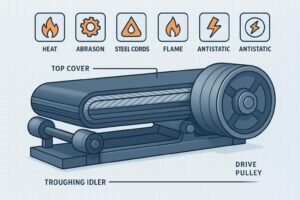
Qualification & Compliance for Conveyor Belts and Components
For conveyor belts and bulk‑handling components, qualification isn’t a checkbox—it’s your safety net.
Core standards and what to request
- ISO 14890: Requirements for textile‑ply conveyor belts for general use; ensure cover grade and construction match the application. Index at the ISO ICS 53.040.20 topic hub.
- DIN 22102: Textile‑ply belts; specify abrasion/cut/impact expectations with common grades (Y, W, X). See reputable explainers of how these relate conceptually to EN ISO categories.
- ISO 4649 (DIN 53516): Abrasion resistance via rotating drum; require certified volume loss (mm³) reports with test conditions.
- ISO 340: Flame resistance; obtain certificates and parameters for fire‑risk environments.
- CEMA references: Use as supplementary design norms for idlers/pulleys.
Verification artifacts to file
- Material datasheets (cover grade, thickness, tensile rating), ply construction, adhesion strength tests
- ISO 4649 abrasion report (mm³), ISO 340 flame certificate, dimensional tolerances
- Incoming‑inspection plan aligning to risk: sampling levels, critical dimensions, and visual standards
Micro‑example (neutral)
- For heavy‑duty conveyors, a partner like БизонКонви can be used to co‑define belt specs aligned to DIN 22102/ISO 14890 and set incoming‑quality KPIs (PPM, RFT) with quarterly scorecard reviews. This keeps qualification artifacts and ongoing performance governance on the same page.
For background on abrasion grades and tests, see manufacturer explainers such as Dunlop’s overview of abrasion standards and test methods and independent summaries of DIN abrasion ratings; always treat the standard text as authoritative.
Assure Continuity and Resilience
Resilience is a design choice. Bake it into the relationship early.
- Dual‑sourcing: Where feasible, qualify a secondary source for critical SKUs. Tie volume allocation to scorecard performance and risk.
- VMI/consignment: For steady‑demand MRO and wear parts, vendor‑managed inventory or consignment can reduce working capital and improve service. Mechanics and governance are documented in SAP/Oracle guidance—use special stock types and clear settlement cycles for consignment; define visibility and reorder logic for VMI.
- Safety stock and buffers: Use lead‑time variance and demand volatility in your safety‑stock math; revisit after major process changes.
- Change control: Any spec/material/process change triggers re‑qualification level proportional to risk and an update of certificates/tests.
Troubleshooting: When the Relationship Wobbles
Things will go off the rails occasionally. The point is to detect fast, contain safely, and fix systematically.
Late deliveries
- Contain: Expedite or pull from buffer; if pattern emerges, re‑plan safety stock or transport mode.
- Diagnose: Compare PO confirmation vs. ASN vs. receipt timestamps; check production capacity and transport hand‑offs.
- Correct: Add delivery reliability actions to the QBR log; monitor ASN accuracy to prevent blind spots.
Quality deviations
- Contain: Quarantine, sort, and protect production.
- Diagnose: Launch 8D/A3; verify process capability and measurement systems.
- Correct: Contractual CAPA timelines (e.g., contain within 24–48h; root cause within 5–10 biz days; full CAPA ≤30 days) and proof of effectiveness at next audit.
Specification drift
- Contain: Freeze changes; revert to last qualified spec if possible.
- Diagnose: Re‑validate drawings/materials; check supplier change‑control and PPAP‑like documentation if used.
- Correct: Re‑qualification tests (ISO 4649, ISO 340 where applicable); raise incoming inspection levels for N subsequent lots until stability proven.
Tip: Keep a living escalation matrix with names, phones, and 24/7 paths for critical SKUs. When the alarm rings, you won’t be hunting for org charts.
Put It All Together for a True Long-Term Supplier Relationship
A durable long-term supplier relationship is the result of consistent habits: segment smartly, agree on the math up front, meet on a rhythm, fix what breaks with discipline, and share the gains through clear contracts. Start with a minimal scorecard, one QBR, and a clean set of qualification artifacts; expand only when the data and risk say you should. Ready to tailor this system to your plant and category mix? What will your first QBR agenda and scorecard weights look like next quarter?