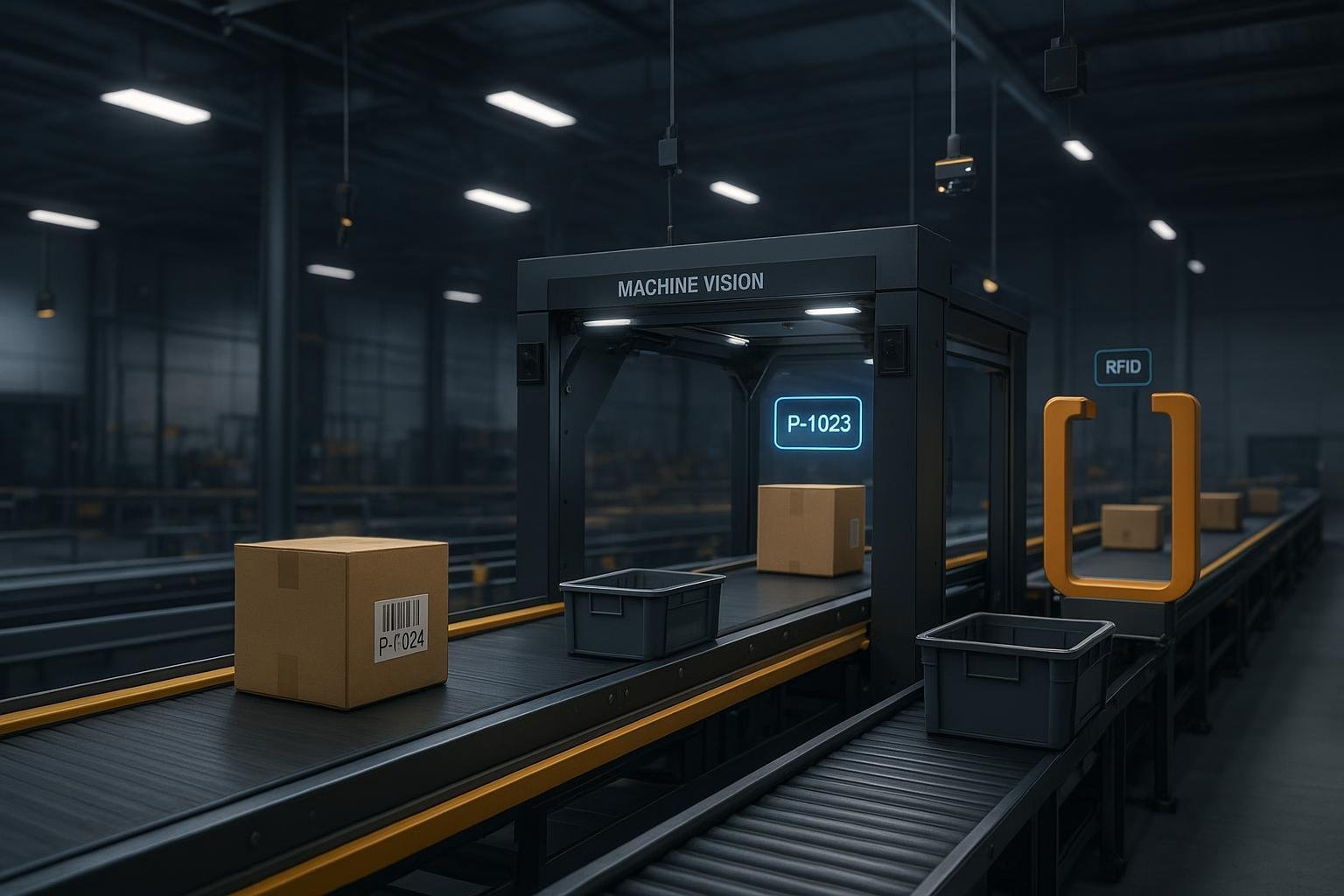
You’re not just choosing a tracking technology—you’re deciding how your conveyor will see, identify, and time every move. Do you need continuous, slot‑level position or event‑based identity at read points? How tight is your accuracy target, and how harsh is the environment? In 2025, the practical choice often blends two or more systems to hit throughput, latency, and reliability goals.
This guide compares five mainstream approaches for item and tote/pallet tracking on smart conveyors: RFID (UHF RAIN passive and active), barcode/2D code readers with machine vision, UWB RTLS, BLE RTLS, and LiDAR/3D vision. The focus is evidence‑based performance, deployment constraints, and integration paths to PLC/SCADA/MES/WMS.
Quick comparison at a glance
| Technology | Accuracy / Update model | Line‑of‑sight | Throughput / read‑rate evidence | Integration notes |
|---|---|---|---|---|
| RAIN RFID (passive UHF) | Event reads at portals; continuous only with dense antennas. Reader capability example: 1,300+ tags/s and −92 dBm sensitivity on Zebra FXR90 (2024–2025). | No LoS; performance impacted by metal/liquid. | Zebra FXR90 product/spec page cites 1,300+ tags/s and −92 dBm; line speed depends on antenna layout and tag population. | Siemens SIMATIC Ident supports PROFINET/EtherNet/IP and OPC UA via communication modules. |
| Barcode/2D + Machine Vision | Frame‑based; tunnels achieve up to 99.9% read rates (Cognex). System‑level speeds up to 3.5 m/s (SICK). | Requires LoS; sensitive to dust/glare/condensation. | Cognex modular tunnels support 1–6‑sided scanning; SICK Lector Identification System cites up to 3.5 m/s and 50 mm gaps. | Broad industrial Ethernet; tunnel managers for monitoring; PLC connectivity typical. |
| UWB RTLS | Continuous streams; ~10–30 cm accuracy in industrial deployments (Sewio, Pozyx). Update rates commonly 1–10 Hz. | No LoS required, but NLoS/multipath affects results. | Multiple vendors position decimeter accuracy; exact rates depend on tag settings and anchor geometry. | Location servers/APIs; PLC integration via middleware; precise anchor sync needed. |
| BLE RTLS (RSSI/AoA) | RSSI: ~1–3 m zone‑level (Kontakt.io blogs). AoA: vendor claims sub‑meter to centimetre‑level with dense anchors (Quuppa marketing). | Susceptible to multipath; AoA needs locator density and calibration. | Public numeric specs are limited; treat AoA claims as vendor marketing if not datasheet‑backed. | Cloud/edge APIs; battery maintenance; commissioning effort varies with accuracy target. |
| LiDAR/3D | mm‑class dimensioning (per SICK catalog); model‑specific accuracy varies. | Requires LoS; less sensitive to print quality. | SICK systems operate at high conveyor speeds for ID and dimensioning; exact mm accuracy depends on model. | Integrates with DWS/track‑and‑trace; industrial Ethernet common. |
Evidence and references:
- Zebra FXR90 specs and overview pages: see the FXR90 reader pages with read‑rate and sensitivity figures in 2024–2025. Example: the FXR90 product page and spec sheet describe 1,300+ tags/s and −92 dBm sensitivity. Link: Zebra FXR90 fixed reader.
- Cognex modular tunnel details (1–6‑sided scanning, up to 99.9% read rates): Cognex Modular Vision Tunnels.
- SICK system‑level conveyor performance (up to 3.5 m/s, 50 mm gaps): SICK Lector Identification System.
- UWB accuracy positioning from two vendors: Sewio UWB Technology и Pozyx: The state of UWB in 2025.
- BLE AoA and RSSI public claims (note: vendor marketing/blogs): Quuppa AoA blog claims и Kontakt.io beacon guides.
- Industrial PLC integration for RFID: Siemens communication modules supporting PROFINET/EtherNet/IP/OPC UA: Siemens SIMATIC Ident – communication modules.
RFID (UHF RAIN passive; active) on conveyors
Think of RFID as giving you electronic identity that doesn’t require line‑of‑sight. On conveyors, RAIN UHF portals or tunnels read tagged parcels, totes, or pallets as they pass. With proper antenna geometry, you can capture bulk IDs at high speed while items are inside boxes or sleeves. Zebra’s rugged fixed readers, for instance, list 1,300+ tags per second and −92 dBm sensitivity, which helps in dense tag populations and longer read ranges according to the FXR90 spec pages.
Where it shines: identity through packaging, multi‑item bulk reads, auditability without camera visibility. It’s strong for inbound/outbound portals, reconciliation gates, and cases where barcodes might be obscured.
Constraints to respect: nearby metals and liquids can detune UHF tags, reduce range, or cause nulls. The RAIN Alliance resources recommend on‑metal tags or spacers and site testing—wise moves before commissioning. Positioning accuracy is event‑based: you’ll know an item passed a read zone, not its continuous position unless you deploy many antennas and carefully fuse encoder data.
Integration and commissioning: industrial RFID ecosystems like Siemens SIMATIC Ident expose PROFINET/EtherNet/IP and OPC UA via communication modules, easing PLC connectivity and vertical integration. Layout matters: antenna placement, shielding against stray reads from neighboring lanes, and reader configuration for tag populations. Maintenance is light (no lenses to clean), but you’ll manage tag quality and printer/encoder operations.
Barcode/2D codes with machine vision
Optical systems give you high‑confidence identity when you can see the code. Modern tunnels stitch multiple cameras and lighting to scan 1–6 sides, improving read rates with mixed orientations. Cognex’s modular tunnels report up to 99.9% read rates with synchronized acquisition. SICK’s Lector Identification System cites conveyor speeds up to 3.5 m/s with gaps as small as 50 mm, which fits high‑speed sortation.
Strengths: precise identity with label verification, orientation/placement checks, and even inline OCR or quality inspection. Vision can also capture condition evidence (damaged cartons, skewed labels) and enable analytics on print quality or misreads.
Limitations: it needs line‑of‑sight. Dust, glare, condensation, and poor label contrast will cut read rates unless you design lighting, enclosures, and cleaning routines. When labels are inside opaque packaging, add RFID for identity or re‑label upstream.
Commissioning and care: plan lighting (wavelength, polarization), lens selection, and camera angles to cover sides. Calibrate for exposure at your line speed and code sizes. Keep a cleaning schedule; cameras and lenses inevitably pick up film. Integration is straightforward via industrial Ethernet to PLCs and through APIs for higher‑level analytics.
UWB RTLS
UWB brings continuous, decimeter‑level position streams to carriers, totes, or specialized fixtures on the conveyor. Anchors mounted around the line triangulate tag positions using time‑difference‑of‑arrival with precise synchronization. Vendors such as Sewio and Pozyx position well‑designed deployments at roughly 10–30 cm accuracy, with typical update rates in the low single‑digit Hz when balancing battery life and latency.
Best fits: slot‑level timing for merges and diverters, lane assignment confirmation, and deterministic actuation where “we need the carrier to be here within a few hundred milliseconds” matters. It’s particularly helpful when you can’t rely on line‑of‑sight or labels, and you want position rather than just identity.
Caveats: battery tags add maintenance and cost. Metallic clutter, reflections, and poor anchor geometry will degrade accuracy. Plan the anchor layout, sync method, and calibration carefully; consider encoder fusion for belt speed to stabilize timing.
Integration: UWB systems feed a location server, then your MES/WMS/PLC via middleware or APIs. You can gate diverters with position events and health checks on update rates and signal qualities.
BLE RTLS (RSSI vs AoA)
BLE comes in two flavors for location: RSSI‑based zone presence and angle‑of‑arrival (AoA) for finer granularity. RSSI is inexpensive and simple, usually delivering 1–3 m room‑level accuracy per public vendor content. AoA increases locator density and calibration effort to chase sub‑meter accuracy; vendors like Quuppa market “centimetre‑level” potential when the geometry and calibration are dialed in.
Use cases: low‑cost zone presence (which conveyor segment a tote is on), human‑in‑the‑loop workflows (e.g., pick‑to‑light areas), and simple dashboards where exact slot timing isn’t required. If you need sub‑meter timing at speed, BLE AoA can be considered, but expect more anchors, more careful calibration, and disciplined RF surveys.
Tradeoffs: tags are battery‑powered, so update rates and beaconing profiles must balance battery life against latency. Multipath and metal structures can skew RSSI; AoA mitigates some of that but raises complexity. Integration is typically through cloud or edge APIs rather than direct PLC protocols.
LiDAR/3D vision
LiDAR and 3D systems quantify geometry—parcel dimensions, pose, or surface height—at conveyor speeds. In dimensioning/weighing/scanning systems, 3D sensors pair with barcodes to form full DWS stacks. SICK’s track‑and‑trace systems document operation at high conveyor speeds, and catalog materials point to millimeter‑class measurements depending on the model.
Where it helps: dimensional weight billing, carton integrity checks, detecting overhangs or double‑feeds, and verifying that the object will clear tunnels. It complements identity systems by adding a geometric record.
Considerations: clear line‑of‑sight and space for overhead mounting are mandatory. Compute and network bandwidth rise with 3D streams. Dust can affect optics, though less than label print quality does; still design for enclosures and maintenance.
Decision scenarios and recommended fits
High‑speed parcel sortation with mixed orientations and occlusions
- Lead with multi‑side machine vision tunnels for identity and label verification. If labels are missing or obscured, add RAIN RFID at portals for identity through packaging. For deterministic timing at merges/diverters, add UWB tags to carriers and fuse with encoder data.
Low‑cost zone presence of totes/pallets
- BLE RSSI beacons or passive RFID gates can confirm segment‑level presence at low cost. Accept meter‑class accuracy and seconds‑level updates.
Slot‑level or diverter timing accuracy
- UWB anchors with battery tags (or BLE AoA with dense anchors) and encoder fusion achieve sub‑meter timing. Plan maintenance windows for battery service and regular calibration checks.
Rich inspection and label verification
- Machine vision (2D/AI), optionally fused with RFID for identity when labels aren’t visible. Add quality metrics and alarms in your tunnel manager.
Bulk volumetrics and geometry on belts
- Overhead LiDAR/3D scanners for millimeter‑class dimensions. Integrate with barcode and scales for DWS workflows.
Integration and commissioning best practices
-
Protocols and data paths: For RFID to PLCs, Siemens SIMATIC Ident communication modules expose PROFINET/EtherNet/IP and OPC UA. Vision systems typically provide industrial Ethernet, TCP/IP APIs, and software managers for performance monitoring. UWB/BLE often integrate via location servers and middleware to MES/WMS and then into PLC logic.
-
Edge and enterprise: Consider edge processing (e.g., SIMATIC Edge, FactoryTalk) for latency‑sensitive logic, and publish events upstream to MES/WMS (SAP EWM, etc.) via OPC UA/MQTT.
-
Layout and calibration: For vision, design lighting and camera angles; for RFID, map antenna zones and shielding; for UWB/BLE, run RF surveys and anchor geometry designs. Synchronize clocks (UWB) and encoder feeds to nail timing.
-
Monitoring and alarms: Use vendor dashboards to watch read rates, misreads, signal quality, and update latency. Trigger cleaning, battery service, or recalibration based on trends.
Environment and maintenance
-
Optics: Dust, glare, and condensation reduce read rates. Use sealed enclosures, polarized lighting, air knives, and routine lens cleaning. Log cleaning intervals tied to read‑rate metrics.
-
RFID: Near metal/liquid issues demand on‑metal tags or spacers and site testing. Audit tag print/encode quality at receipt; poor inlays will waste time.
-
RTLS: Battery life depends on update rate. Define service cycles and spares; monitor tag health. Multipath suggests careful anchor placement and periodic recalibration.
-
3D sensors: Keep optics clean and ensure mechanical rigidity; vibrations can blur scans.
TCO and lifecycle notes
-
Tags/labels: Barcodes are fractions of a cent. UHF inlays cost more but remain low for unit economics. BLE/UWB tags are higher per‑unit and introduce battery service.
-
Infrastructure density: Vision tunnels need multiple cameras and lights; RFID portals need tuned antenna arrays; UWB/BLE require anchor grids and sync; 3D scanners need clear overhead space and compute.
-
Commissioning: Expect lighting tests, RF surveys, and calibration passes. Budget for spares, cleaning kits, printers/encoders, and battery stock.
-
Software and integrations: License tunnel managers or RTLS servers as needed; plan for APIs and protocol modules.
Also consider: conveyor hardware influences tracking
Disclosure: BisonConvey is our product. Conveyor belt surface finish, idler materials, and provisions for mounting antennas or cameras affect tracking reliability. For heavy‑duty belts and integrated components engineered for harsh environments, see БизонКонви. Choose hardware that minimizes vibration, controls dust, and accommodates sensor mounting to improve read rates and position stability.
Selection checklist
- What accuracy do you actually need (event ID vs ≤30 cm position)?
- Can you guarantee line‑of‑sight for labels at your speeds?
- What are your environmental stressors (dust, glare, metals/liquids)?
- What actuation latency do merges/diverters require?
- Which PLC/MES/WMS interfaces are non‑negotiable?
- What maintenance budget do you have for cleaning, batteries, and recalibration?
Smart conveyors benefit from hybrid tracking stacks that align identity, position, and inspection with the realities of your line. Think of it this way: pick the sensor that gives you the signal you need, then engineer around its constraints. Where will you start—ID through packaging, continuous position, or rich visual inspection?