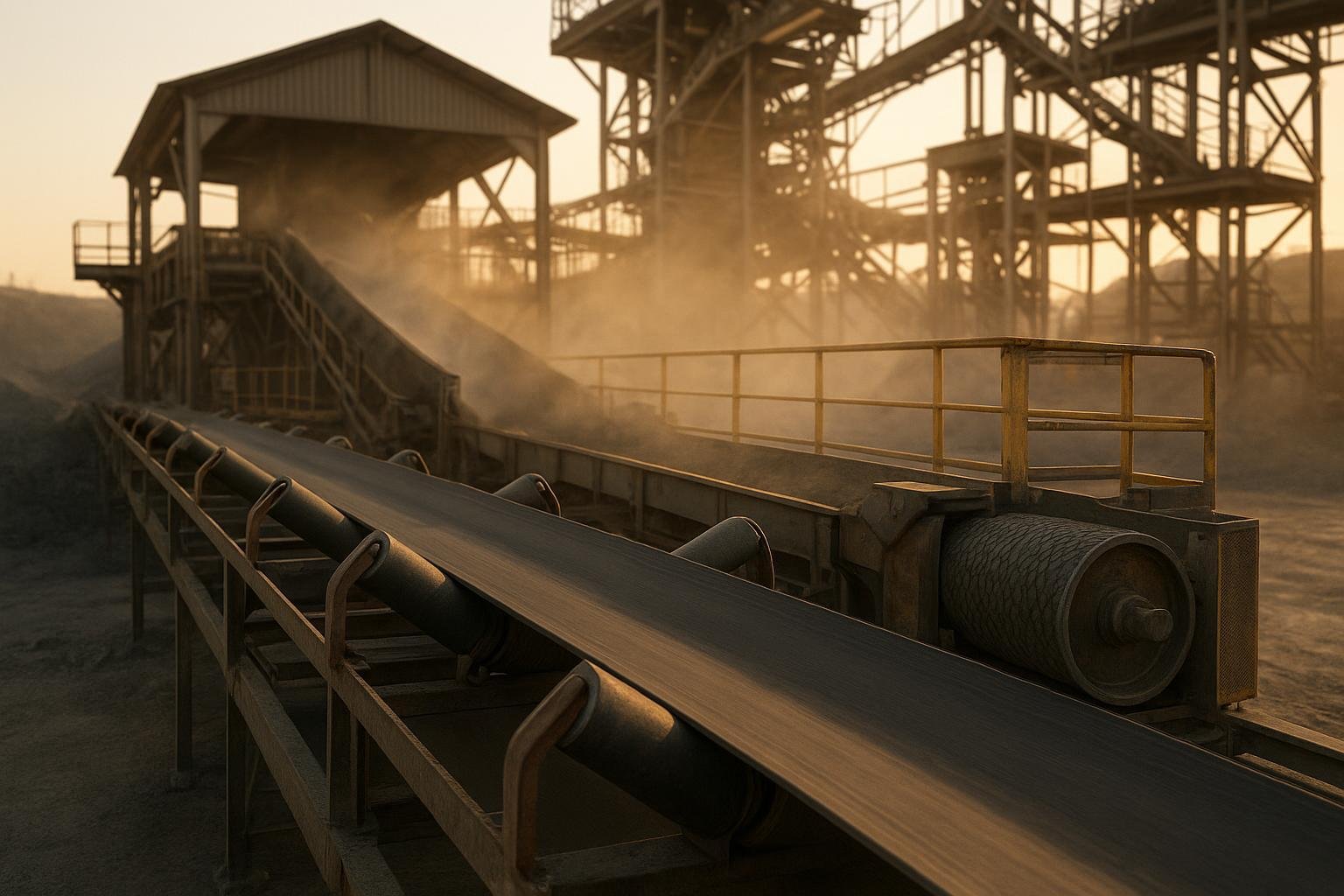
If you run bulk-material handling, you already know the feeling: a splice lets go on a Friday night, material surges out of a short transfer, dust alarms trip, and production crawls. Most of those headaches trace back to one root cause—design decisions. Professional conveyor design isn’t about oversizing steel; it’s about engineering a system that delivers reliable throughput, predictable maintenance, safer operation, and a lower total cost over its life.
The business case for professional conveyor design
Well-executed design reduces common failure modes—mistracking, premature cover wear, spillage, dust, and excessive power draw—by getting the fundamentals right: component selection, geometry, and integration. The result is more uptime and fewer emergency callouts.
- Reliability and uptime: Proper belt strength, idler spacing, and take-up selection curb sag and impact damage, stabilizing tracking and splice life. The Conveyor Equipment Manufacturers Association’s foundational guidance remains a bedrock reference for methods and nomenclature; see the association’s site for standards and handbooks in the field at the CEMA association homepage.
- Safety and compliance: Guarding, emergency stops, and lockout/tagout (LOTO) aren’t optional. In the U.S., LOTO is defined in OSHA’s 1910.147 standard, and mines must meet additional rules summarized by the MSHA conveyors safety page. Good design bakes these requirements into layouts and procedures.
- Throughput and efficiency: Matching belt speed and chute trajectory controls impact and keeps material on the belt—not on the floor. Reduced rework translates directly into capacity.
- Total cost of ownership (TCO): Lifecycle cost hinges on more than purchase price. Energy use, component life, and planned maintenance windows dominate TCO on long runs.
- Environmental performance: Effective skirt sealing, dust collection interfaces, and enclosure strategy cut fugitive emissions and cleanup.
Belt selection that fits the duty
The belt is the backbone. Choosing reinforcement, covers, and splices to match the duty is the fastest way to avoid chronic failures.
- Reinforcement: Steel-cord belts handle long, high-tension, high-capacity runs with minimal elongation. EP/NN fabric belts suit shorter plant conveyors with frequent loading cycles and moderate tensions.
- Covers: Use abrasion-resistant compounds for aggregates/ore, heat-resistant for clinker/coke, oil-resistant for fertilizers/chemicals, and fire-resistant/antistatic where regulations require. A good starting point for material specifications is the ISO catalog for conveyor belt standards (ISO 14890; check current edition).
- Splices: Hot-vulcanized splices deliver strength and fatigue life for production runs; mechanical fasteners can be acceptable for short-term work or where frequent changeouts are required.
Application-oriented decision matrix (adapt as a first-pass screen; finalize with site data and vendor confirmation):
| Material/Service | Typical run length | Impact/abrasion severity | Recommended reinforcement | Cover guidance |
|---|---|---|---|---|
| Crushed stone/ore (primary) | Medium–long | High impact, high abrasion | Steel cord (long runs) or heavy EP | Abrasion-resistant; consider extra top cover |
| Clinker/coke (hot) | Medium | Moderate–high abrasion, heat | Steel cord or EP (duty-dependent) | Heat-resistant; verify max temp rating |
| Fertilizer/chemicals (oily) | Short–medium | Moderate; chemical exposure | EP/NN | Oil-resistant; antistatic if required |
| Grain/agriculture | Medium | Low–moderate abrasion | EP/NN | Standard abrasion-resistant; consider FRAS underground |
| Steep-incline transfer | Short–medium | Impact at feed | EP/NN with chevron or sidewall | Chevron/sidewall with matched pulley diameters |
Idler spacing and impact protection done right
Idlers do far more than carry the belt. Spacing and selection shape belt sag, energy use, and load-zone survivability.
- Spacing: In load zones, tighter spacing limits sag and reduces cover flex fatigue. On the carry strand between load points, spacing can open up—provided sag stays within acceptable limits and belt indentation losses remain controlled. The right trough angle (commonly 35–45 degrees) balances capacity and edge tension.
- Impact control: Use engineered impact idlers or impact beds under the chute, extending far enough to stabilize the belt before the skirt seal ends. Combine with correctly set skirt pressure to contain fines without chewing the cover.
- A practical reasoning check: If you see stringers bending, excessive idler failures near the feed, or deep belt cupping under the skirts, you likely have an impact/spacing mismatch—not just a “bad” belt.
For a digestible checklist of common pitfalls, Martin Engineering’s team highlights frequent specification errors and mitigations in their piece on ten common conveyor design mistakes.
Pulleys, lagging, tracking, and take-up tension
Drive and bend pulleys impose flex cycles that determine belt fatigue life and traction. Undersized diameters, poor lagging, or unstable tensioning often surface as chronic slip and tracking complaints.
- Pulley diameters must meet the belt’s minimum bend radius and splice flexibility. Violating this shortens life dramatically.
- Lagging selection matters: ceramic lagging improves traction where moisture or carryback cause slip; rubber lagging can be sufficient on cleaner, lower-tension duties.
- Take-up systems: Gravity take-ups offer stable tension for most runs; screw take-ups are acceptable on short, low-tension conveyors; hydraulic or winch systems appear on long overlands. Enough travel is essential to absorb stretch, thermal growth, and splice seating without bottoming out.
- Tracking fundamentals: Build tracking into the structure (square, straight, plumb). Use training idlers and guides as fine-tuning—not as a crutch for poor alignment.
Transfer chute design and dust control
Most spillage and belt abuse originate at the transfer. Chute geometry should control material speed and direction, presenting flow to the receiving belt near its line of travel and with manageable impact angle. Think of it as merging highway traffic: speed-match, don’t crash-merge.
- Geometry: Hood-and-spoon, curved, or rock-box designs each have places; the goal is controlled flow with wear concentrated on replaceable liners.
- Liners: Use abrasion-resistant steel or ceramics in high-wear zones; design for quick swaps with safe access.
- Sealing and dust: Correct skirt length, low closing pressure, and integrated dust extraction at the enclosure keep the area clean and safe.
For fundamentals on bulk solids flow and transfer chutes, see Jenike & Johanson’s overview of transfer chute engineering services. For dust and containment practices rooted in field work, Martin Engineering provides practical guides across their knowledge base (see link above).
Energy efficiency without risking reliability
Power draw is dominated by lift (where present), indentation rolling resistance, mechanical friction, and misalignment losses. Good design reduces each without courting instability.
- Low rolling resistance (LRR) belts can reduce indentation losses on long conveyors with high loads. Evaluate LRR only when idler alignment and structure are under control; otherwise, you’re optimizing noise.
- Alignment and tolerances: Small angular errors compound over distance. A rigorous installation and survey process often pays back quickly in power and tracking stability.
- Drives and controls: Variable speed can trim energy in variable-duty plants; soft starters and appropriate drive selection protect splices and motors during starts.
Worked examples you can adapt
These examples illustrate the reasoning path you can follow on your own conveyors. They’re not one-size-fits-all; validate with site data and your preferred calculation method.
-
Idler spacing reasoning: Suppose a 1,200 mm belt carries 2,500 t/h of crushed ore at 3.5 m/s with a 35-degree trough. In the load zone, the belt shows visible sag and cover ripple under the skirts. Before blaming the compound, check impact energy and idler spacing: upgrading to impact idlers/beds through the chute footprint and tightening spacing from 1.2 m to 0.6–0.8 m often stabilizes the belt profile, allowing you to reduce skirt pressure and stop the cover chewing. Outbound of the skirts, spacing can expand (e.g., to 1.5–2.0 m) as long as sag stays within your acceptable percentage and the belt’s indentation losses don’t spike.
-
Power/tension reasoning: A long plant conveyor with gentle elevation changes regularly trips on start. You verify that the installed motor nominally meets steady-state power, but starting torque is marginal and take-up travel is nearly bottomed. A professional conveyor design review would evaluate the take-up force, minimum tension at the drive during acceleration, and starting method (across the line vs. soft start). Increasing take-up travel, adopting a soft starter or VFD ramp, and correcting idler alignment can eliminate trips without oversizing the drive.
-
TCO narrative—steel cord vs. fabric: For overland lengths, steel-cord belts often win on life and energy, despite higher initial cost. The combination of lower elongation (less take-up travel, fewer re-tensions), better splice fatigue life, and availability of LRR constructions typically narrows the lifecycle cost gap over 8–10 years of service. In contrast, short, low-tension transfers with frequent loading cycles may favor a robust EP belt for ease of maintenance and lower upfront cost. The right choice depends on tension, duty cycle, maintenance philosophy, and power pricing.
Field-ready checklists
Use these quick checks to separate operational issues from design gaps.
-
Pre-start checks (daily or shiftly)
- Walk the load zone: confirm skirt seal contact is light and continuous; no trapped material.
- Listen for rough bearings; spot-check idlers at the feed and near pulleys.
- Verify belt is centered at the tail and entering the load zone; check for buildup at return plows and scrapers.
- Confirm guards and emergency stops/pull cords are in place and tested per procedure.
-
Monthly checks
- Survey structure for squareness and alignment; correct any trending drift.
- Inspect splice condition (visual and temperature if available); record any cover cracks or rubber flow.
- Check take-up position vs. travel; re-tension if minimum drive tension is at risk.
- Audit dust and spillage around transfers; plan liner and skirt adjustments during the next outage.
Troubleshooting quick map
When symptoms show up, pair an immediate stabilizer with a longer-term design remedy.
| Symptom | Likely cause | Immediate action | Longer-term design fix |
|---|---|---|---|
| Chronic mistracking near the load zone | Asymmetric chute loading; skewed structure | Reduce belt speed to stabilize; center loading with deflectors | Re-square stringers; revise chute hood/spoon to center trajectory |
| Premature cover wear under skirts | Excessive belt sag; over-tight skirts | Loosen skirts slightly; add temporary support | Add impact idlers/beds; tighten spacing; lengthen skirt zone |
| Drive slip during wet conditions | Inadequate traction; carryback | Clean lagging; reduce start torque ramp | Specify ceramic lagging; review lagging pattern and diameter |
| Splice failures after shutdowns | Low minimum tension; short take-up travel | Manually add tension; warm up with low-load run | Increase take-up mass/travel; adopt soft start/VFD |
| Dust escaping at transfer | Insufficient sealing/venting | Lower drop height if possible; check seal contact | Rework chute geometry; add dust extraction and enclosure |
A neutral vendor example in context
On a long quarry conveyor redesign, the team specified a steel-cord belt with a ceramic-lagged drive pulley and impact idlers through the loading zone. The selection wasn’t brand-driven; it followed the duty: high tension, long run, wet fines in winter, and a high-impact primary crusher feed. A supplier like БизонКонви can support this configuration with steel-cord or EP belts, UHMWPE or stainless idlers where corrosion is a concern, and matched pulleys—while the design rationale remains anchored in your site’s tension calculations, impact energy, and maintenance strategy.
What to do next
- Align on standards and methods: The CEMA association homepage outlines accepted calculation frameworks; verify local regulations and corporate standards alongside OSHA’s LOTO rule and, where applicable, the MSHA conveyors safety page.
- Validate with data: Survey alignment, record power draw, log spillage and dust, and review splice histories before changing hardware.
- Engage qualified partners: Share your duty details, goals, and constraints with engineering vendors and belt/idler suppliers; ask for application-specific recommendations tied to calculations and maintenance plans.
Here’s the deal: professional conveyor design pays back when it’s grounded in measurements, follows proven methods, and is executed with components that truly match the duty. Start with the load zone, stabilize tension, and the rest of the system tends to behave.