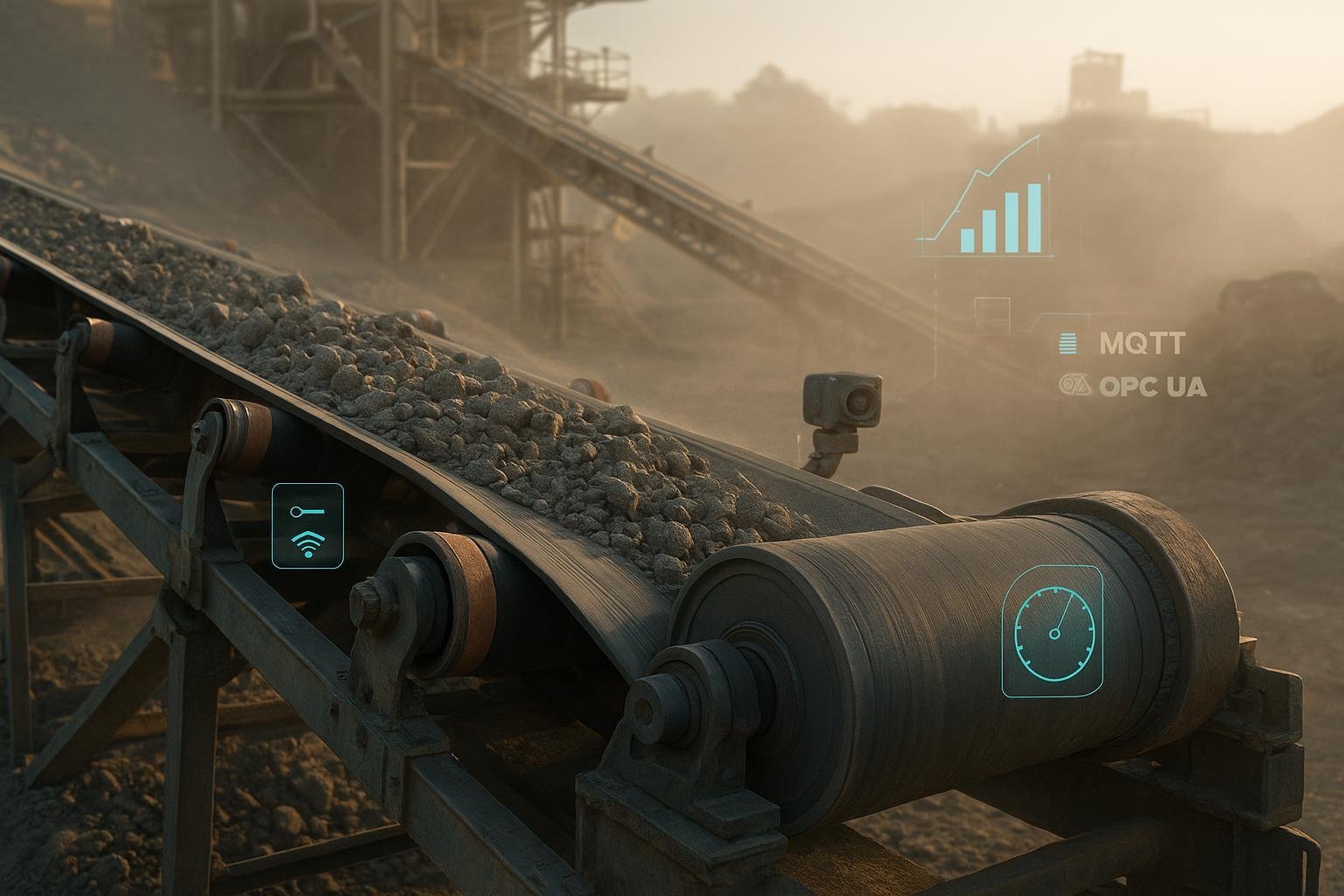
Unexpected belt failures don’t just stop tonnage—they scramble crews, inflate overtime, and chew through idlers, pulleys, and spares. Predictive Failure Analysis (PFA) gives you an earlier, clearer view of what’s changing on your conveyors so you can intervene before a tear, splice separation, or seized bearing cascades into hours of downtime. In this field guide, we translate PFA from slideware into a hands-on program you can pilot on one critical line and scale plant-wide.
You’ll get practical guidance on sensors and placement, data plumbing that works with PLC/SCADA, modeling approaches that keep false alarms in check, a 90‑day pilot and triage workflow, and a ROI framing you can defend with operations and finance. For searchers evaluating Predictive Failure Analysis conveyor belts initiatives, this guide focuses on implementable steps, not abstract promises.
Safety and standards that anchor the program
A predictive program must sit on top of prescriptive safeguards—never replace them. ISO 17359 frames how to stand up condition monitoring across assets, from scoping to data collection and diagnostics. Public materials confirm its continued relevance for building reliability programs in 2026; see ISO’s overview in the official index for context in applying program steps in industry environments, referenced in 2018 and still active in recent work lists according to ISO and national standards bodies. For scope limits when interpreting vibration measurements, the ISO 20816 family matters. ISO 20816‑3:2022 covers vibration evaluation for industrial machines above 15 kW under steady conditions; it’s useful background, but its severity zones don’t directly map to small idlers or pulleys. Build site baselines for those components and use bearing‑oriented analytics rather than copy‑pasting generic thresholds. See the official entry for ISO 20816‑3 for scope and exclusions.
- According to Google’s index for standards and updates, ISO keeps 20816 current and positions 17359 as the programmatic umbrella; see the official documents: the listing for ISO 17359 in ISO’s Online Browsing Platform and the standard page for ISO 20816‑3:2022.
- On safety, U.S. mining guidance continues to emphasize guarding, emergency stops, and slip/misalignment switches. MSHA’s 2025 Stand‑Down sheet on conveyor systems reiterates that interlocks and LOTO are first‑line controls; your PFA should ingest those signals as high‑severity events and route to immediate, guarded inspections.
References you can share internally:
- ISO — “Condition monitoring and diagnostics of machines (ISO 17359 framework)” (2018; still current in 2025 listings) — see the entry in the ISO OBP index: https://www.iso.org/obp/ui/en/
- ISO — “Mechanical vibration — ISO 20816‑3:2022” (scope for >15 kW machines): https://www.iso.org/standard/78311.html
- MSHA — 2025 safety focus for conveyors (guarding, LOTO, interlocks): https://www.msha.gov/sites/default/files/stand_down/Conveyor-Entanglement.pdf
Predictive Failure Analysis for Conveyor Belts: Sensor suite and placement
You’ll cover more failure modes, with fewer false alarms, by pairing mechanical fundamentals with a right‑sized sensor set. Think of your conveyor like a patient: vitals (speed, load, temperature), targeted auscultation (vibration, acoustic emission), and imaging (vision, magnetic/inductive scanning) paint a fuller picture.
Common failure modes and fit‑for‑purpose sensors:
- Idler and pulley bearing degradation: triaxial accelerometers (IEPE or MEMS) on brackets near bearing housings; thermistors/RTDs or IR for bearing temperature rise.
- Mis‑tracking and slippage: belt edge cameras/line lasers for drift; speed encoders/tachometers on head/tail pulleys; slip switches as hard interlocks.
- Splice defects and steel‑cord damage: magnetic or inductive scanning heads for steel‑cord belts; acoustic emission sensors near splices or impact zones to catch micro‑events.
- Cover wear, edge fray, and foreign objects: high‑resolution cameras and appropriate illumination; optional structured light for depth cues.
- Tension/load anomalies: load cells at take‑up or dedicated tension transducers; motor current data for indirect load trends.
Placement principles that reduce noise and missed detections:
- Mount accelerometers on rigid brackets with short fasteners; avoid thin guards or vibrating platework.
- Place temperature sensors on the bearing housing flat; for IR, ensure stable emissivity and line of sight.
- Put tachometers where slippage data is actionable (head pulley) and sync their timestamps to your historian.
- Position cameras at transfer points and return strands with stable lighting; shield from dust and water ingress.
- Install magnetic/inductive heads on a straight, stable belt segment with consistent lift‑off; ingest encoder pulses for defect localization.
Sensor placement checklist (use it during your walkdown):
- Verify a rigid mount and cable protection for each sensor; avoid moving guards.
- Confirm lighting and lens cleaning access for cameras; test glare at shift change.
- Validate that encoder/tach pulses align with historian timestamps.
- Ensure interlocks (slip/misalignment) are wired, tested, and logged in SCADA.
- Document tag names, units, and sampling expectations before commissioning.
Data architecture that actually works on site
Your PFA pipeline should align with what your automation stack already does well: structured asset models (OPC UA) and efficient telemetry (MQTT). A pragmatic pattern looks like this:
- Edge device (industrial PC or controller) collects vibration, temperature, current, speed. It computes basic features (RMS, kurtosis, temperature deltas) and publishes:
- OPC UA nodes for typed, browsable assets (Conveyor A > Idler Zone 12 > Bearing 2 > RMS).
- MQTT topics for lightweight, low‑latency alerts and time series (site/area/convA/zone12/bearing2/rms).
- SCADA/historian subscribes and stores; the analytics layer trains models and writes back health indicators and alerts.
- CMMS ingests alerts as work orders with asset tags and due dates.
Industry examples show this pattern is mainstream:
- IFM documents IO‑Link sensors streaming into moneo with northbound MQTT/OPC UA for SCADA/cloud connectivity; see IFM’s condition monitoring overview for motors and conveyors: https://www.ifm.com/de/en/shared/successstories/usecases/moneo/condition-monitoring-motor
- ABB controller families expose diagnostic data via an IoT Gateway supporting OPC UA and MQTT to external systems; see ABB’s OmniCore C line product sheet: https://library.e.abb.com/public/b1d56b58c1154ab8a01b8d89e1f46bf8/3HAC065034%20PS%20OmniCore%20C%20line-en.pdf
- Siemens and Rockwell show comparable northbound patterns for mixed intralogistics and process lines, including conveyor‑linked cells; see Siemens BRAUMAT V8.0 SP2 note on line monitoring: https://assets.new.siemens.com/siemens/assets/api/uuid:904b7836-f445-46dc-b683-2bc9105d28d6/BRAUMAT-V8-0SP2_original.pdf and Rockwell’s Innovation Center example on MQTT in FactoryTalk Optix: https://www.rockwellautomation.com/en-pr/support/product/product-downloads/innovation-center.html
Decision table: start small but targeted
| Criticality level | Environment | Minimal sensor package | Notes |
|---|---|---|---|
| High (single‑point failure, >$50k/hr downtime) | Abrasive/dusty | Accelerometers at high‑impact idlers, bearing temperature, tach/encoder, camera at transfer, rip/splice detection (steel‑cord: magnetic/inductive head) | Prioritize edge compute + historian; wire interlocks into alerting. |
| Medium | Wet/corrosive | Temp on bearings, tach, periodic handheld vibration routes; optional camera | Consider stainless/UHMWPE idler areas for corrosion risk. |
| Low (redundant path) | Clean/indoor | Tach + SCADA counters; operator inspections | Use PFA trends only if nuisance alarms are controlled. |
Modeling playbook: rules, trends, and ML that won’t drown you in false alarms
A hybrid approach balances safety, interpretability, and sensitivity:
- Rules for safety‑critical signals: interlocks (slip, misalignment, E‑stops) map to immediate actions. Treat these as hard alerts aligned with MSHA guidance on guarding and LOTO.
- Statistical trends for wear and load: use rolling medians and deltas on temperature, RMS vibration, and motor current. Trend rates tell you about degradation speed.
- Unsupervised ML for multivariate anomalies: isolation forest or autoencoder models detect subtle, correlated shifts across sensors (e.g., a modest RMS rise plus small speed jitter and a temperature creep).
- Supervised classification for known failure modes: where you have labeled events (e.g., seized idler), a gradient‑boosted tree or linear model can separate precursors from normal variation. Start simple to avoid overfitting.
Steel‑cord integrity logic: For steel‑cord belts, inductive/magnetic scanning provides defect maps and splice signatures as belts pass the sensing head. A recent peer‑reviewed study documents this methodology and how tachometer data localizes defects along the belt, supporting predictive refurbishment decisions. See the peer‑reviewed 2025 open‑access article “Sensor‑Based Diagnostics for Conveyor Belt Condition Monitoring and Predictive Refurbishment” on the U.S. National Library of Medicine archive: https://pmc.ncbi.nlm.nih.gov/articles/PMC12158312/
Feature extraction and a lightweight isolation forest recipe
# Inputs: multivariate time series (RMS_vib, Kurtosis, Temp, MotorCurrent, SpeedJitter)
# Step 1: Resample to uniform cadence (e.g., 1–5 s) and align by timestamp
X <- resample_align(sensors)

# Step 2: Windowing and features
def features(win):
  return [
    mean(win.RMS_vib), std(win.RMS_vib), kurtosis(win.RMS_vib),
    slope(win.Temp), delta(win.MotorCurrent), std(win.SpeedJitter)
  ]
Z <- sliding_window(X, size=300s, step=60s).map(features)

# Step 3: Train isolation forest on baseline weeks
model <- IsolationForest(contamination=0.01, n_estimators=200, random_state=42)
model.fit(Z_baseline)

# Step 4: Score and threshold by false‑positive budget
scores <- -model.score_samples(Z)
threshold <- percentile(scores_baseline, 99.5)  # tune to ops tolerance
alerts <- Z[scores > threshold]
Tuning tips that save time:
- Balance the false‑positive budget with your crew capacity. It’s better to catch 80% of actionable anomalies with 1–2 daily alerts than 95% with 20 daily alerts you’ll ignore.
- Keep a simple feedback loop: every alert gets a disposition code (true issue, nuisance, configuration). Retrain monthly with labels.
- Use explainable features (rates, deltas) so mechanics can see why an anomaly tripped.
Pilot workflow, alert triage, and RCA (90‑day plan)
Start with one high‑impact conveyor and a constrained scope. The goal is to prove signal quality, workable alerts, and maintenance impact—fast.
90‑day pilot plan
- Week 0–2: Instrument priority points, finalize tag list, verify timestamps and units in the historian. Configure rules for interlocks and temperature deltas.
- Week 3–6: Collect baseline, tune trend thresholds, and run an isolation forest in shadow mode (alerts reviewed, no auto WOs yet).
- Week 7–10: Turn on work‑order creation for high‑confidence alerts. Start capturing dispositions and MTTR.
- Week 11–13: Review KPIs (alert precision, avoided downtime hours), decide scale‑up or iterate.
Alert triage playbook (use consistently):
- Level 1 (Safety/Interlock): Immediate stop per procedure; LOTO and guarded inspection; document cause.
- Level 2 (Degradation/Trend): Visual check within 24–72 hours; schedule swap or lubrication; confirm on next cycle.
- Level 3 (Watch/Model): Monitor trend; no immediate action; re‑evaluate thresholds during weekly review.
Root‑cause analysis essentials:
- Attach historian trends and photos to the WO closure.
- Log contributing factors (contamination, misalignment, overload) and preventive actions (seal upgrade, idler spec change).
- Feed confirmed cases back into model retraining.
ROI you can explain to finance
When you quantify value, keep it simple and transparent.
KPIs to track:
- MTBF uplift (weeks between comparable failures before/after PFA)
- MTTR reduction (hours per event)
- Downtime hours avoided (based on alerts that led to planned interventions)
- Spare‑part turns and expedited freight avoided
- Maintenance cost per ton conveyed
Example payback framing
- Suppose your critical conveyor costs $40,000 per hour of downtime. In a quarter, you prevent two 2‑hour unplanned stops by catching a splice issue and a hot idler early. That’s 4 hours × $40,000 = $160,000 avoided. Your pilot (sensors + edge + labor) costs $85,000 in year one. Payback ≈ 6–7 months, not counting reduced safety exposure and smoother production.
Inputs for your ROI calculator:
- Hourly downtime cost per line (include labor and lost margin)
- Number and duration of avoided events (validated by WO notes)
- System and integration costs (capex + opex)
- Changes in MTTR and spares logistics (rush fees)
- Utilization gains (tons/hour × hours recovered)
For deeper implementation context on reliability programs around conveyors, see the internal guide on predictive maintenance: BisonConvey — Predictive maintenance for conveyor belts.
Practical example: transfer‑point monitoring with a SmartBelt‑style package
At a high‑load transfer point, you mount triaxial accelerometers on impact idlers, add bearing temperature probes on the same frame, place a compact camera with stable LED lighting to watch the belt edge, and install a tachometer on the head pulley. The edge device computes RMS/kurtosis and temperature deltas locally and streams anomalies via MQTT to SCADA while exposing an OPC UA node set for browsing in the asset tree. You treat misalignment and slip switches as hard interlocks; model‑based alerts only create WOs when they clear a precision threshold proven during the 6‑week baseline.
In this setup, a neutral, productized sensor family keeps mounting and ingress protection consistent across frames. If you’re evaluating catalog options, see the product‑level overview: BisonConvey — Belt condition sensors. For a systems view, including gateways and dashboards, see BisonConvey — Conveyor monitoring systems. Use these as references when drafting your spec sheet; the program remains vendor‑agnostic and must map to your PLC/SCADA and CMMS environment.
Further reading and standards
- ISO’s programmatic guide to condition monitoring offers the blueprint many plants follow for standing up reliability programs: ISO OBP index for condition monitoring and diagnostics (ISO 17359 framework)
- For vibration scope on larger machines and how practitioners adapt it for conveyor components, see ISO 20816‑3:2022 standard page
- Safety remains non‑negotiable. MSHA’s current materials summarize guarding and interlock expectations: MSHA — Conveyor Systems 2025 Stand‑Down sheet
- For OPC UA/MQTT integration exemplars used in condition monitoring pipelines, review IFM’s condition monitoring with moneo (MQTT/OPC UA) и Rockwell’s FactoryTalk Optix MQTT example
- For steel‑cord belts and predictive refurbishment logic, see the peer‑reviewed mapping approach: U.S. National Library of Medicine — DiagBelt+ conveyor diagnostics (2025 open‑access article)
Additional internal resources you can circulate with your team:
- BisonConvey — Conveyor belt monitoring overview
- BisonConvey — Condition monitoring for conveyors
Ready to get moving? Start with a single critical conveyor, confirm signal quality and timestamp alignment, run your hybrid model in shadow mode, and tune your false‑positive budget to real crew capacity. Then scale deliberately—one transfer point at a time—so Predictive Failure Analysis for Conveyor Belts becomes part of how you plan work, not another blinking dashboard.