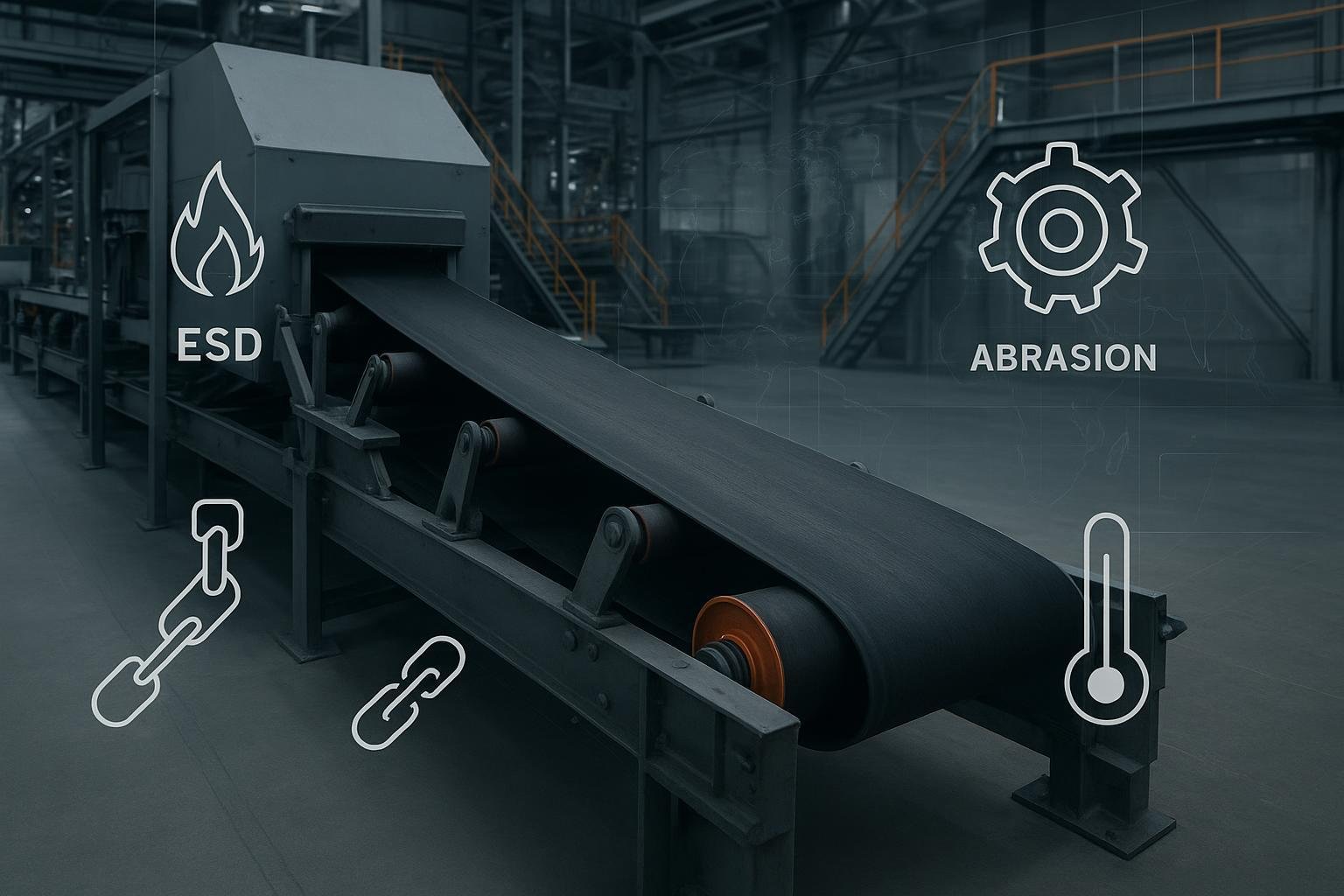
Conveyor belt failures don’t just stop production—they can create fire and explosion hazards, contaminate product, and trigger costly regulatory findings. The fastest way to reduce risk and make apples-to-apples purchases is to anchor specs to recognized conveyor belt testing standards.
This 2026 guide distills the most widely cited, regulator- and tender-relevant conveyor belt testing standards. You’ll see what each standard measures, where it applies (underground vs. surface; textile vs. steel cord), and how to verify compliance with official sources.
If you need example lab reports or a buyer checklist for audits, many manufacturers—including those focused on heavy-duty belts—can share sample documentation upon request in a neutral, standards-first format.
How we chose these conveyor belt testing standards
We prioritized standards that meet at least four of these criteria:
- Global adoption or regulatory relevance (commonly referenced in tenders or by authorities)
- Safety criticality (fire/ESD for underground mining and dusty/flammable environments)
- Coverage breadth of test methods (tensile, adhesion, abrasion, flame, anti-static, heat/oil)
- Recency and active maintenance by the standards body
- Clear, measurable acceptance criteria or category schemes
- Cross-standard harmonization (e.g., EN adoptions of ISO) to ease multi-region compliance
- Accessibility via official publishers and accredited labs for verification pathways
Note: Many standards are paywalled. We link to official publishers and regulator portals for discovery and verification. Always confirm the latest edition before purchasing or quoting in contracts.
Safety and ESD standards (start here for risk control)
These are the high-stakes standards most often required in hazardous locations. This section uses our primary keyword once more to help searchers land on the right content: choosing the right conveyor belt testing standards for safety-first applications.
1) MSHA 30 CFR Part 14 — Flame‑resistant conveyor belts; approval and test methods (U.S.)
- Purpose & scope: U.S. federal regulation specifying approval and flame test methods for belts used in mining, especially underground.
- Body/region: MSHA (United States)
- Key tests: Flame propagation/afterflame behavior; approval-specific test panels and procedures.
- Belt types: Textile and steel cord (as constructed for approval testing)
- Industries/use cases: U.S. underground mining; some surface mines per operator policy
- Acceptance/grades: Formal approval is required; belts carry an approval number when listed.
- Latest revision year: Check the current eCFR for updates
- Official link: See the federal codified text at the eCFR under the title for Part 14 via the official portal on the U.S. government site for the electronic Code of Federal Regulations: MSHA 30 CFR Part 14, flame‑resistant conveyor belts
2) EN 14973 — Conveyor belts for underground use — Safety requirements
- Purpose & scope: European safety requirements tailored to underground environments, with categories that include flame/ESD provisions.
- Body/region: CEN (European Union; published through national standards bodies)
- Key tests: Flame resistance, electrical properties, and category-based acceptance schemes
- Belt types: Textile and steel cord
- Industries/use cases: Underground mining and other underground conveyors in EU jurisdictions
- Acceptance/grades: Category scheme defined in the standard
- Latest revision year: Confirm on your national publisher’s catalog
- Official link: Start at the CEN/CENELEC public site, then purchase via your national body: CEN and CENELEC standards catalogue
3) EN 12882 — Conveyor belts for general surface use — Safety requirements
- Purpose & scope: Safety requirements and categories for belts in non‑underground (surface) applications.
- Body/region: CEN (EU; national adoptions for purchase)
- Key tests: Flame resistance, antistatic behavior, and category-based acceptance
- Belt types: Textile and steel cord
- Industries/use cases: Surface conveyors in cement, ports, steel, power, and more within EU jurisdictions
- Acceptance/grades: Category scheme defined in the standard
- Latest revision year: Confirm on national publisher catalog before purchase
- Official link: Use your national body (e.g., BSI, DIN/Beuth) via the CEN index: CEN and CENELEC standards catalogue
4) ISO 340 — Conveyor belts — Laboratory flammability tests
- Purpose & scope: Laboratory method to assess flammability behavior of conveyor belt materials under specified conditions.
- Body/region: ISO (global)
- Key tests: Small‑scale flammability/afterflame measurements
- Belt types: Textile and steel cord
- Industries/use cases: Baseline flame performance method often referenced globally (method only; not a regulatory approval)
- Acceptance/grades: Method provides results; acceptance thresholds are typically set by other standards/specs
- Latest revision year: Verify on the ISO catalogue
- Official link: Browse and purchase via the ISO Webstore catalogue: ISO catalogue – conveyor belt standards
—
Soft note: If you manage high‑risk operations (underground, grain dust, or combustible materials) and need example test records to compare against your site’s requirements, you can request neutral, standards‑referenced samples from a manufacturer’s engineering team to speed up vendor due diligence.
—
5) ISO 284 — Conveyor belts — Electrical conductivity/antistatic
- Purpose & scope: Specifies requirements/test method for electrical conductivity of belts to mitigate electrostatic hazards.
- Body/region: ISO (global)
- Key tests: Surface and/or volume resistance under defined conditions
- Belt types: Textile and steel cord
- Industries/use cases: Dusty or flammable atmospheres (e.g., grain handling, chemical plants)
- Acceptance/grades: Method results compared against policy or category thresholds in other standards
- Latest revision year: Verify on the ISO Webstore
- Official link: ISO’s standards catalogue for purchase and edition status: ISO catalogue – conveyor belt standards
Mechanical performance standards (selection and durability)
6) ISO 283 — Textile conveyor belts — Full‑thickness tensile properties
- Purpose & scope: Determines full‑thickness tensile strength and elongation at break/reference load for textile belts.
- Body/region: ISO (global)
- Key tests: Full‑thickness tensile; elongation at break/reference load
- Belt types: Textile (EP/NN)
- Industries/use cases: General industry, mining, ports — core spec in most tenders
- Acceptance/grades: Results compared to buyer specs (e.g., EP rating)
- Latest revision year: Check ISO catalogue
- Official link: Purchase via ISO Webstore: ISO catalogue – conveyor belt standards
7) ISO 252 — Conveyor belts — Adhesion between elements
- Purpose & scope: Test methods for adhesion between plies and between cover and carcass.
- Body/region: ISO (global)
- Key tests: Peel/adhesion strength under defined configurations
- Belt types: Textile (EP/NN)
- Industries/use cases: Durability-critical applications; complements ISO 283
- Acceptance/grades: Buyer- or category-defined thresholds
- Latest revision year: Check ISO catalogue
- Official link: ISO Webstore catalogue: ISO catalogue – conveyor belt standards
8) ISO 4649 — Rubber — Abrasion resistance (rotating drum)
- Purpose & scope: Rotating drum method (DIN wheel) to quantify abrasion volume loss of rubber compounds.
- Body/region: ISO (global)
- Key tests: Abrasion volume loss under defined load/surface
- Belt types: Cover compounds across textile and steel cord belts
- Industries/use cases: High‑wear environments (quarrying, primary crushing, ports)
- Acceptance/grades: Results often mapped to internal thresholds; cross‑referenced with DIN cover grades
- Latest revision year: Check ISO catalogue
- Official link: ISO catalogue for rubber test standards: ISO catalogue – rubber testing standards
9) DIN 22102 — Textile conveyor belts — General purpose and cover grades
- Purpose & scope: Requirements for textile belts including cover grades (commonly referenced W/X/Y/Z).
- Body/region: DIN (Germany; purchased via Beuth or national bodies)
- Key tests: Cover abrasion expectations; other mechanical particulars in the series
- Belt types: Textile (EP/NN)
- Industries/use cases: International tenders referencing DIN cover grades; aggregates and cement common
- Acceptance/grades: Cover grade scheme (e.g., abrasion classes); verify details in official text
- Latest revision year: Confirm on Beuth/DIN catalogue
- Official link: Start at the DIN/Beuth portal to locate/purchase: Beuth – DIN standards catalogue
Environmental and thermal standards (chemicals, heat, and ignition risks)
10) ISO 505 — Conveyor belts — Drum friction and related tests
- Purpose & scope: Methods for frictional behavior/heat build‑up between belts and drum surfaces (ignition risk mitigation).
- Body/region: ISO (global)
- Key tests: Drum friction; potential heat build‑up measures
- Belt types: All constructions
- Industries/use cases: Where frictional heating could be a hazard (e.g., stalled conveyors)
- Acceptance/grades: Method provides measurable outputs; acceptance set by policy or safety standards
- Latest revision year: Verify in ISO catalogue
- Official link: ISO Webstore: ISO catalogue – conveyor belt standards
11) ISO 1817 — Rubber — Determination of the effect of liquids
- Purpose & scope: Immersion protocols to evaluate property changes due to liquid exposure (e.g., oils, fuels).
- Body/region: ISO (global)
- Key tests: Volume change, tensile change, hardness change after immersion
- Belt types: Cover compounds across belt types
- Industries/use cases: Oil‑resistant, chemical, fertilizer, recycling
- Acceptance/grades: Method provides data; acceptance tied to application targets
- Latest revision year: Confirm on ISO catalogue
- Official link: ISO rubber materials testing catalogue: ISO catalogue – rubber testing standards
12) ISO 4195 — Rubber — Heat resistance/heat ageing relevant to belt covers
- Purpose & scope: Assesses thermal aging/resistance of rubber compounds used in heat‑resistant belts.
- Body/region: ISO (global)
- Key tests: Property change after high‑temperature exposure over time
- Belt types: Cover compounds for heat‑resistant belts
- Industries/use cases: Hot clinker, sinter, foundries, coke plants
- Acceptance/grades: Method provides deltas; acceptance limits set in specs
- Latest revision year: Confirm on ISO catalogue
- Official link: ISO Webstore: ISO catalogue – rubber testing standards
Construction‑specific standards (steel cord and system fit)
13) ISO 15236‑1 (and related parts) — Steel cord conveyor belts
- Purpose & scope: Requirements and test methods for steel cord belts (tensile, adhesion, construction).
- Body/region: ISO (global)
- Key tests: Cord tensile; adhesion between cords and rubber; construction performance metrics
- Belt types: Steel cord
- Industries/use cases: Long‑distance, high‑capacity conveying in mining, steel, ports
- Acceptance/grades: Part‑structured acceptance; verify in each part’s text
- Latest revision year: Confirm in ISO catalogue for each part
- Official link: ISO Webstore catalogue: ISO catalogue – steel cord belt standards
14) DIN 22131‑1 (and related parts) — Steel cord conveyor belts
- Purpose & scope: German standard set detailing requirements and test methods for steel cord belts.
- Body/region: DIN (Germany; distributed by Beuth/national bodies)
- Key tests: Cord tensile/adhesion; construction particulars by part
- Belt types: Steel cord
- Industries/use cases: EU‑centric projects; commonly cross‑referenced with ISO 15236
- Acceptance/grades: Defined by part; confirm in official text
- Latest revision year: Verify on Beuth/DIN catalogue
- Official link: DIN/Beuth catalogue: Beuth – DIN standards catalogue
Comparison table: standards vs. what they test
| Code | Body/Region | Category | Key tests | Belt types | Latest rev. year | Link |
|---|---|---|---|---|---|---|
| 30 CFR Part 14 | MSHA (US) | Safety (flame approval) | Approval flame tests | Textile/steel cord | See eCFR | eCFR Part 14 homepage |
| EN 14973 | CEN (EU) | Safety (underground) | Flame/ESD categories | Textile/steel cord | Check national body | CEN/CENELEC catalogue |
| EN 12882 | CEN (EU) | Safety (surface) | Flame/ESD categories | Textile/steel cord | Check national body | CEN/CENELEC catalogue |
| ISO 340 | ISO | Safety (flame test) | Lab flammability | Textile/steel cord | Verify at purchase | ISO standards catalogue |
| ISO 284 | ISO | Safety (ESD) | Electrical conductivity | Textile/steel cord | Verify at purchase | ISO standards catalogue |
| ISO 283 | ISO | Mechanical | Full‑thickness tensile/elongation | Textile | Verify at purchase | ISO standards catalogue |
| ISO 252 | ISO | Mechanical | Adhesion between elements | Textile | Verify at purchase | ISO standards catalogue |
| ISO 4649 | ISO | Mechanical (materials) | Abrasion loss (rotating drum) | Covers (all) | Verify at purchase | ISO rubber testing |
| DIN 22102 | DIN (DE) | Mechanical/spec | Cover grades (e.g., W/X/Y/Z) | Textile | Check Beuth | Beuth DIN catalogue |
| ISO 505 | ISO | Safety/mechanical | Drum friction/heat build‑up | All | Verify at purchase | ISO standards catalogue |
| ISO 1817 | ISO | Environmental/chemical | Effect of liquids/oils | Covers (all) | Verify at purchase | ISO rubber testing |
| ISO 4195 | ISO | Environmental/thermal | Heat ageing/heat resistance | Covers (all) | Verify at purchase | ISO rubber testing |
| ISO 15236‑1 | ISO | Construction (steel cord) | Steel‑cord tensile/adhesion | Steel cord | Verify per part | ISO steel cord standards |
| DIN 22131‑1 | DIN (DE) | Construction (steel cord) | Requirements/tests | Steel cord | Check Beuth | Beuth DIN catalogue |
Regional applicability and regulatory notes
- United States: Underground mining belts generally must be approved under MSHA Part 14. Verification requires an approval number and appearance in MSHA’s official listings. Surface mines may apply internal policies that reference flame/ESD performance.
- European Union: EN 14973 (underground) and EN 12882 (surface) define category schemes for safety. National adoptions/availability are handled by bodies such as BSI (UK), DIN (Germany), AFNOR (France), etc.
- Global ISO usage: ISO 340 (flame) and ISO 284 (ESD) are commonly referenced as test methods worldwide but may not, by themselves, satisfy local legal approvals.
- Other regions: Australia/New Zealand (AS/NZS) and South Africa (SANS) publish regional FRAS and belt specifications that many tenders cite. When operating multi‑region fleets, confirm equivalence or dual‑qualification.
Pricing and access to standards
- ISO standards: Purchased through the ISO Webstore. Prices vary by document and format; confirm the latest edition before checkout: ISO standards catalogue.
- EN standards: Discover via CEN/CENELEC, then purchase from your national body (e.g., BSI, DIN/Beuth, AENOR). Pricing and licensing differ by country: CEN and CENELEC standards catalogue.
- DIN standards: Typically available via Beuth in English/German editions with licensing options: Beuth – DIN standards catalogue.
- MSHA regulations: Free public access to the codified text (eCFR). Approval listings are provided by MSHA on official U.S. government domains: MSHA 30 CFR Part 14 on eCFR.
Quick selection map: choose tests by risk profile
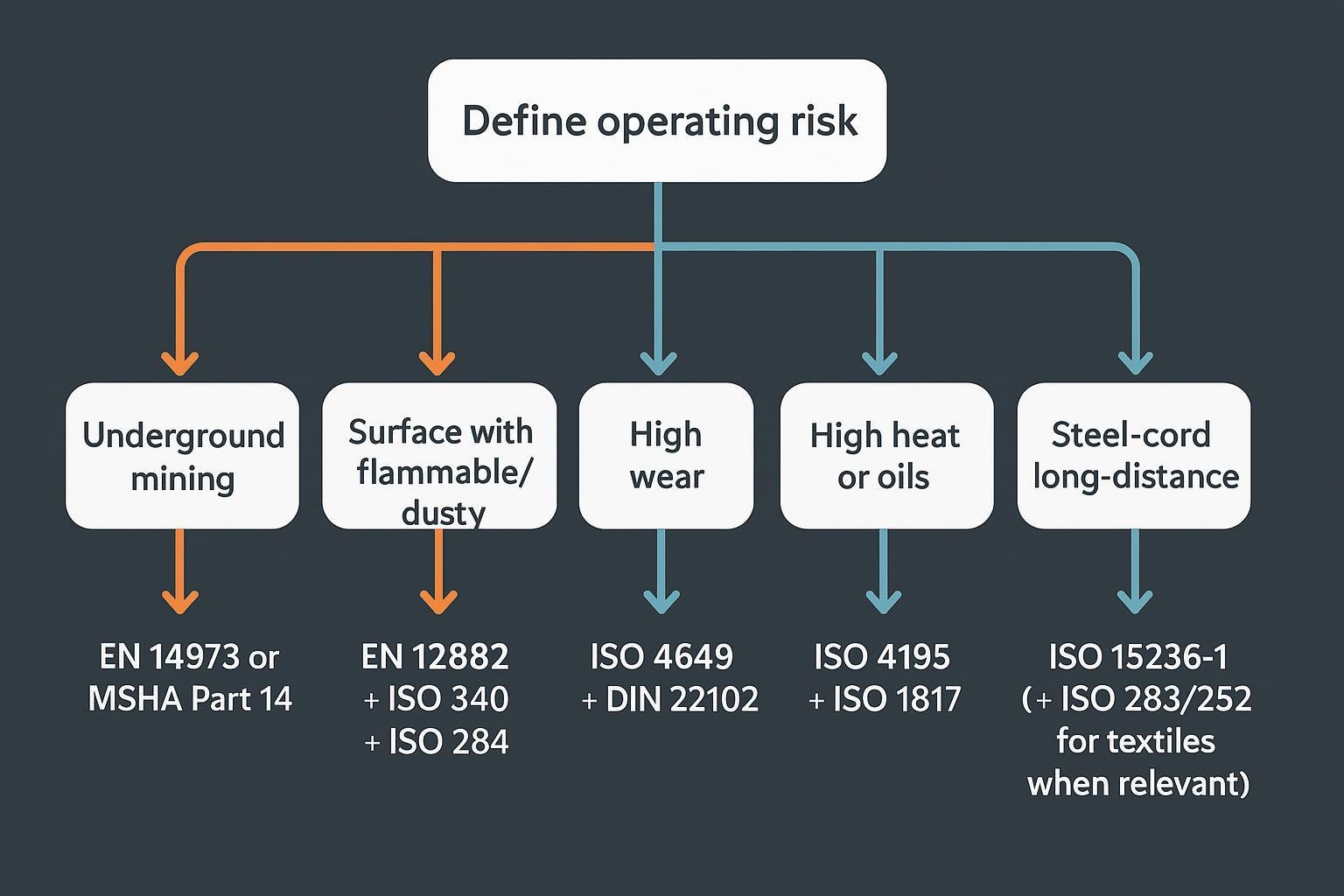
Think of this as a starting point, not a substitute for your site’s process hazard analysis:
- Underground mining: MSHA Part 14 (U.S.) or EN 14973 (EU)
- Surface with flammable/dusty atmospheres: EN 12882 + ISO 340 + ISO 284
- High wear: ISO 4649 plus a DIN 22102 cover grade target
- High heat or oils: ISO 4195 (heat) and ISO 1817 (liquids/oils)
- Steel‑cord, long‑distance: ISO 15236 family (and apply ISO 340/284 if safety demands it)
FAQ: choosing and interpreting conveyor belt tests
-
What are the core mechanical tests for textile belts?
- Most tenders ask for full‑thickness tensile/elongation (ISO 283), adhesion between elements (ISO 252), and cover abrasion (ISO 4649). Results should be traceable to sample IDs and test dates from an ISO/IEC 17025‑accredited lab.
-
Which flame and antistatic tests apply underground vs. surface?
- Underground: MSHA Part 14 in the U.S. and EN 14973 in the EU. Surface: EN 12882 categories. ISO 340 (flame) and ISO 284 (ESD) are test methods often referenced across both contexts.
-
How do DIN abrasion cover grades relate to ISO 4649 results?
- ISO 4649 yields abrasion volume loss values under a rotating drum method; DIN 22102 defines cover grades (often referenced as W/X/Y/Z). Buyers typically set target ranges that map lab results to a DIN cover grade in tenders.
-
How should I read a lab report for belt compliance?
- Check the standard code and edition, lab accreditation (ISO/IEC 17025), sample identification, environmental conditions (where relevant), and measured values versus your acceptance thresholds or category requirement. Ensure dates and signatures are present.
-
Can one standard “cover everything” for compliance?
- No. Safety, mechanical, and environmental properties are governed by different standards. Build a matrix that reflects your hazards (fire/ESD), duty cycle (tensile/adhesion), and media (abrasion, heat, oil/chemicals).
Next steps
If you’d like a neutral, standards‑first procurement checklist or a sample lab‑report template to accelerate vendor reviews, contact an engineering team that can share compliance‑oriented documentation for these standards. Teams focused on heavy‑duty belts often maintain testing records and can help map them to your site hazards and tender language.