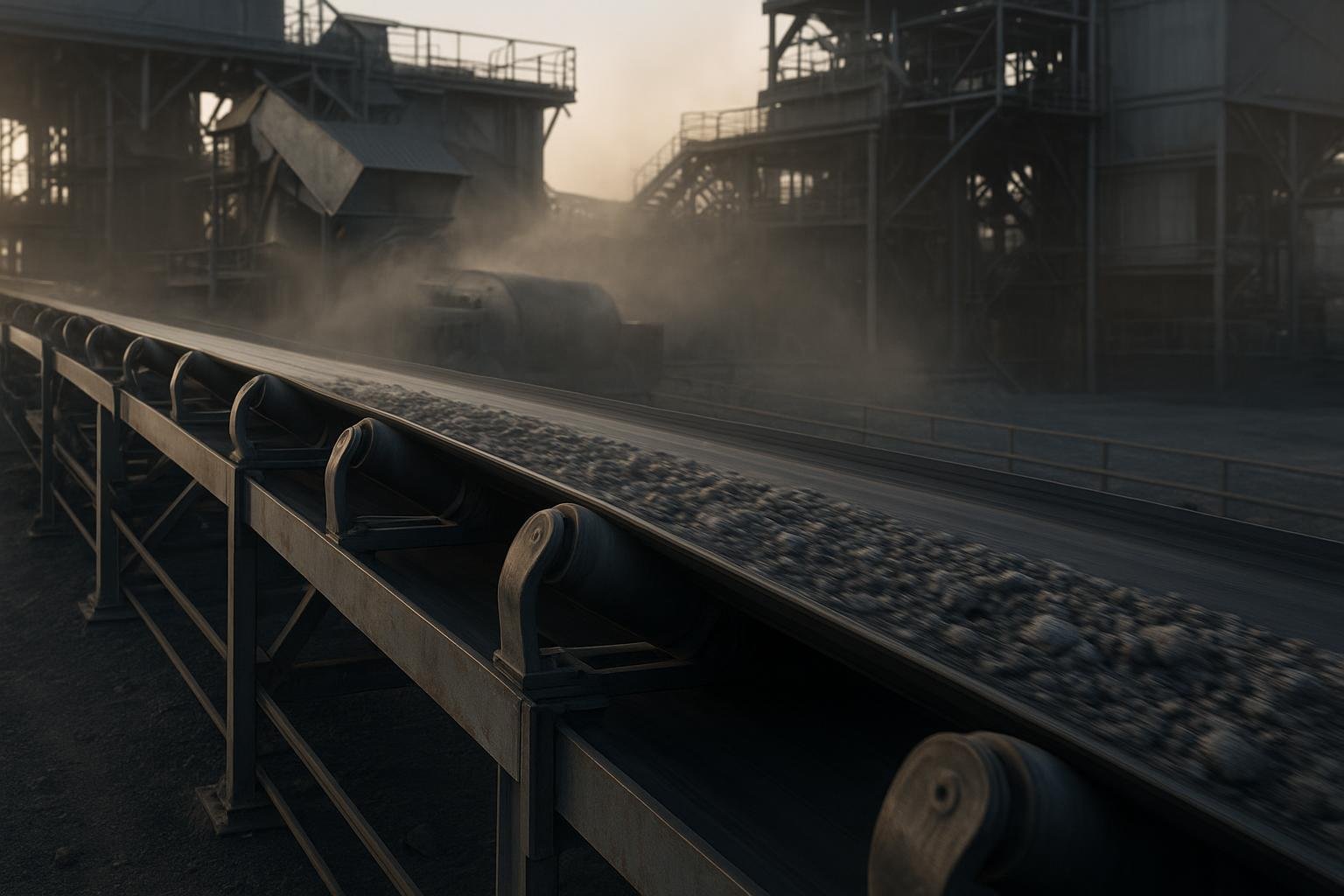
If you could turn one dial to move more tons per hour, it would be belt speed. But here’s the deal: speed also alters how your conveyor loads, how much energy it drinks, and how fast components wear. Get it right and you lift throughput with fewer side effects. Get it wrong and you buy yourself spillage, dust, and unplanned downtime.
What “belt speed” actually means—and why it scales capacity
Belt speed is the linear velocity of the belt surface along its path, typically expressed in meters per second (m/s) or feet per minute (FPM). Think of it as “miles per hour for material.” In practice, plants infer speed from a drive or idler roller’s RPM and diameter, or measure it directly with vision/encoders when slip matters.
For a fixed cross-sectional loading of material on the belt, volumetric capacity scales linearly with speed:
- Q (m³/s) = A × v
- TPH (t/h) = A × v × ρ × 3.6
Where A is the loaded cross-sectional area and ρ is bulk density (t/m³). That means, with A and ρ held constant, a 10% speed increase yields roughly 10% more throughput. High-speed conveyor literature treats this linearity as a first principle; see Lodewijks’ Beltcon paper, which also frames when “high-speed” design starts to change what else you must engineer for. According to the conference reprint of The Design of High Speed Belt Conveyors (Beltcon, 2024), speeds above roughly 10 m/s enter a different design regime with stricter transfer and dynamics requirements.
Quick numeric cue: If A = 0.08 m³/m and ρ = 1.6 t/m³ (1,600 kg/m³), raising v from 2.5 to 3.0 m/s increases TPH by 20% (linear with v).
- Baseline: TPH = 0.08 × 2.5 × 1.6 × 3.6 ≈ 1.15 × 10² t/h ≈ 115 t/h
- After increase: TPH = 0.08 × 3.0 × 1.6 × 3.6 ≈ 138 t/h
For context on methodology and power/tension modeling, Helix documents the ISO/DIN lineage (DIN 22101/ISO 5048) and the CEMA method clearly, noting that required power is total resistance multiplied by belt speed. See Helix Delta‑T’s calculation method overview and help pages that summarize each standard.
Efficiency isn’t just TPH: what changes as speed climbs
Throughput might rise linearly with speed, but other effects don’t always behave so nicely.
-
Transfer behavior (spillage, dust, loading stability) Faster belts discharge material with higher exit velocity and greater air entrainment. Result: overshoot, bounce, and more dust, especially with fine/dry materials. Good chute geometry that aligns the material’s velocity with belt motion, minimized drop height, and robust skirting can tame this. Practical guidance on spillage reduction and transfer control is summarized by FEECO’s engineering notes on minimizing spillage with troughed belts.
-
Energy and power Both DIN/ISO and CEMA frameworks compute power as the product of total resistance and belt speed, so power demand tends to rise with speed. Rolling resistance components (indentation, idler rolling) depend on load, belt rubber viscoelasticity, idler design, and speed. The net efficiency can vary: at higher speed, load per unit length can drop for the same tph, but idler rotational losses and dynamics may increase. For background, see the CEMA horsepower equation history discussed in a Bulk‑Online technical article and the ISO/DIN overviews in Helix documentation.
-
Dynamics, vibration, and wear Increasing speed can elevate transverse vibration amplitudes and the likelihood of resonance and belt flap, particularly near critical sections. That can accelerate wear on covers, idlers, and skirts if tension, idler spacing, and structure aren’t tuned. A 2023 open‑access study by Bortnowski and colleagues models how speed, stiffness, and geometry govern vibration and stability in operation.
Typical speed bands and the “high‑speed” conversation
There’s no single “right” number—the choice depends on material, width, trough angle, duty, and transfer design. These bands are indicative, not prescriptive.
| Application/material | Typical working belt speed |
|---|---|
| Mining – ore/coal (troughed) | ~2–6 m/s |
| Ports & bulk terminals | ~3–6 m/s |
| Cement/fine powders | ~0.5–3 m/s |
| Grain/friable fines | ≤1 m/s (gentle handling) |
| Belt feeders (dosing/control) | 0.15–0.5 m/s (30–100 FPM) |
Speeds above ~10 m/s are widely referred to as “high‑speed,” and with specialized design and control, systems near ~20 m/s are feasible, as described by Lodewijks (Beltcon, 2024). That regime demands careful attention to idler bearing RPM limits, belt dynamics, transfer‑point control, and dust containment.
Match speed to flow: control strategies that save energy
Running at nameplate speed during low‑load periods wastes energy and accelerates wear. Variable frequency drives (VFDs) let you match belt speed to actual flow and process state. Peer‑reviewed studies (e.g., Ji et al., 2021) quantify energy savings when belt speed tracks throughput, with reductions above 5% reported in practical scenarios. VFDs also enable smoother starts/stops and better control on challenging geometries (e.g., long overland or downhill), reducing dynamic tensions.
A pragmatic playbook:
- Establish a speed‑throughput curve (from design or calibrated measurements) and control to a target fill ratio.
- Set minimum speeds to maintain stable loading and avoid dusting at transfers.
- Coordinate with feeders so the belt isn’t forced to run fast while the feed is starved.
Before you increase speed: a field‑ready checklist
Use this short list to avoid moving a bottleneck from the drive to the cleanup crew.
- Safety and guarding: Confirm lockout/tagout and guarding are in place before adjustments; higher speeds amplify risk.
- Idler RPM and life: Check bearing limits vs. the new speed for your roller diameters and spacing; verify grease life assumptions.
- Chute and skirting: Validate that chute geometry and sealing can contain the higher discharge velocity; inspect skirt wear and dust hoods.
- Belt tensions and take‑up: Re‑run tensions (DIN/ISO or CEMA method) at the proposed speed; ensure take‑up travel and braking are sufficient.
- Material behavior: For friable or dusty material, test at incremental speed steps and monitor degradation and dust levels.
- Covers and cleaners: Confirm cover compound and thickness for higher wear; check cleaner compatibility at the new belt velocity.
Practical example: translating speed into selection (Disclosure)
Раскрытие информации: BisonConvey - это наш продукт.
Scenario: A 1,000‑mm wide troughed belt carries crushed limestone (ρ ≈ 1.6 t/m³). Current speed is 2.5 m/s, and loading achieves A ≈ 0.08 m³/m. Operations wants ~20% more throughput without adding a new line.
- Throughput impact: Increasing speed to 3.0 m/s adds ~20% TPH (linear with v, holding A constant).
- Component implications: At 3.0 m/s, idler RPM rises proportionally; verify bearing class and spacing. Skirt seal wear will increase—plan inspection intervals.
- Selection guardrails: For an upgrade, you may specify a low‑rolling‑resistance cover to temper indentation losses and review impact idler spacing under the chute. If transfer dusting appears, tweak chute angle or add a hood.
How BisonConvey components can be used in such a project:
- Belts: EP/NN fabric belts for plant conveyors or steel‑cord belting for long, high‑tension runs; cover compounds available for abrasion and heat service.
- Idlers: Impact idlers under loading, UHMWPE or stainless steel for corrosion‑prone or sticky environments.
- Pulleys and rollers: Engineered to match the revised tensions and speeds for compatible system behavior.
This mapping doesn’t change the physics—it simply shows how speed decisions flow down into belt construction, idler class/spacing, and pulley specs.
Wrap‑up and next steps
Belt speed is a powerful lever: it scales capacity linearly, but it also nudges every part of the system—transfers, energy, vibrations, and wear. Treat it as a controlled variable, not a fixed number. Use VFDs where variability is high, validate tensions with your chosen standard, and audit the transfer points before chasing more TPH.
If you’d like a design check or a selection conversation for belts, idlers, and pulleys that support your target speeds and duty, our engineering team can help at BisonConvey. For deeper reading, see:
- Lodewijks’ Beltcon paper on high‑speed conveyors (2024), which frames speed thresholds and feasibility.
- Helix Delta‑T documentation summarizing DIN 22101/ISO 5048 and CEMA power/tension methods.
- FEECO guidance on minimizing spillage and improving transfer control.
- Ji et al. (2021) on energy savings using belt‑speed control.
- Bortnowski et al. (2023) on vibration and stability.
References cited in text
- Lodewijks, G. The Design of High Speed Belt Conveyors. Beltcon (2024). The paper outlines high‑speed thresholds and requirements. Beltcon 2024 Lodewijks PDF
- Helix Delta‑T6 Calculation Methods and Help (DIN 22101/ISO 5048; CEMA; VISCO). Method summaries and examples. Helix CalcMethods и Helix Help
- FEECO International. Practical notes on spillage control with troughed belts. Minimizing Spillage
- Ji, J., et al. Energy‑saving belt speed control strategies. 2021, open access. PMC article
- Bortnowski, P., et al. Modelling of transverse vibration of conveyor belts. 2023, open access. PMC article
- Bulk‑Online. CEMA horsepower equation development overview. Technical article