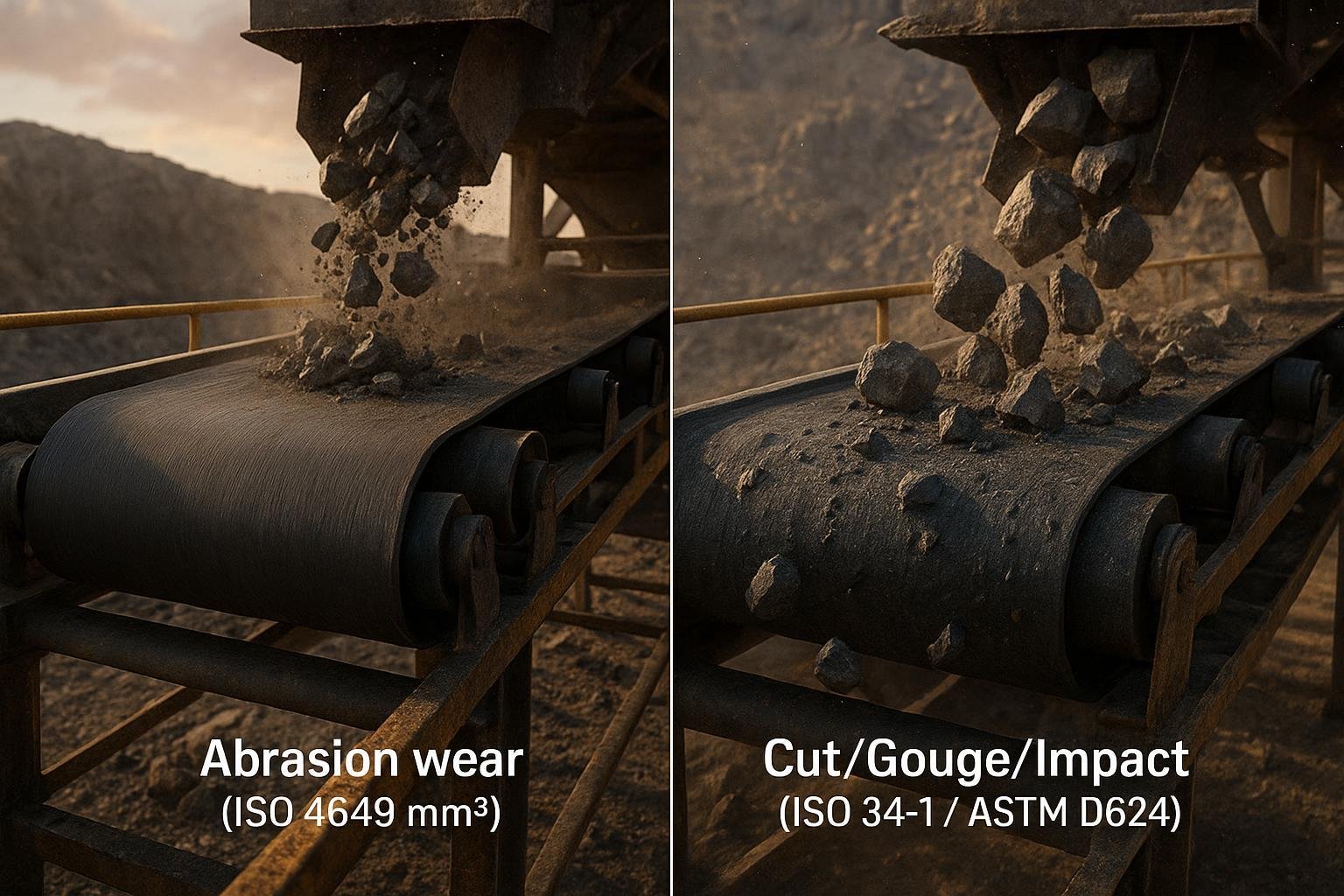
If your belt is wearing fast on fines but chunking at transfer points, you’re dealing with two different failure modes. Here’s the TL;DR: choose abrasion-optimized covers (low ISO 4649/DIN 53516 mm³) when grinding wear from fine to medium material dominates at moderate drop heights and speeds; choose cut/gouge-optimized covers (strong tear/impact behavior per ISO 34-1/ASTM D624, often aligned to DIN X or ARPM Grade I) when you run large, sharp, angular lumps or high-energy drops. If heat, oil, or FRAS rules apply, pick those compound families first, then optimize for abrasion or cut.
Standards in one minute (and what the numbers mean)
- ISO 14890 cover classes (H, D, L) are commonly mapped to DIN 22102 grades X, W, Y respectively. Lower abrasion volume loss indicates better resistance; the two systems are often used together in practice, though you should confirm the supplier’s exact mapping. See the overview in Dry Cargo’s discussion of belt standards and testing in the industry in 2019: Quality standards and testing in the conveyor belt industry.
- ISO 4649 (also cited as DIN 53516) measures rubber cover abrasion as volume loss in mm³; lower numbers = slower grinding wear. Dunlop explains the method and why Method A vs B matters in Abrasion standards and test methods (2024).
- Widely referenced DIN bands: Y ≤150 mm³ (general purpose), X ≤120 mm³ (abrasion plus some cut/impact), W ≤90 mm³ (high abrasion resistance). Cross-checked by multiple industry notes such as Conveyors247’s DIN abrasion ratings and Pooley’s technical papers; always verify on the supplier’s datasheet.
- North American ARPM (RMA) context: Grade I is positioned for higher impact/cut/gouge risk and often limits abrasion to around 125 mm³; Grade II is general purpose with higher abrasion allowances. See ASGCO’s Heavy-Duty Belting brochure (2024) for representative thresholds.
Think of it this way: ISO 4649 mm³ predicts how fast your cover “sands down” under fines; ISO 34-1/ASTM D624 tear and real-world impact behavior predict whether sharp lumps will rip or gouge the cover and expose the carcass.
Side-by-side: abrasion-resistant vs cut-resistant conveyor belt covers
Quick pick: fine, non-angular abrasive material → abrasion-optimized low mm³; large, sharp lumps/high drop → cut/gouge-optimized + thicker top cover.
| Dimension | Abrasion-optimized covers | Cut/gouge-optimized covers |
|---|---|---|
| Typical grade alignment | ISO 14890 D/L; DIN W/Y; ARPM Grade II | ISO 14890 H; DIN X; ARPM Grade I |
| Abrasion loss (ISO 4649/DIN 53516) | Typically ≤90–120 mm³ depending on grade; lower is better; verify Method A/B | Often 110–150 mm³ bands are acceptable trade-offs; verify actual mm³ on datasheet |
| Tear/cut propagation (ISO 34-1 / ASTM D624) | Adequate for general duty; not tuned for repeated sharp-lump tears; verify supplier test data | Elevated tear strength and better resistance to cut initiation/propagation; e.g., dedicated UCG/XCG compounds; verify supplier test data |
| Impact/gouge behavior | Moderate; prone to chunking under high drop/angular material if too thin | Strong; designed to resist chunking and carcass puncture under high-energy drops |
| Top-cover thickness guidance | Fines/light: ~3–6 mm; Mixed/medium: ~5–8 mm | Angular/heavy impact: ~8–12+ mm; very heavy: 12–15+ mm |
| Carcass pairing | EP/NN multiply suits most; steel cord for long, high-tension runs with fines | EP/NN with rip-stop breakers; steel cord with rip protection for severe impact/rip risk |
| Environment compatibility | Choose heat/oil/ozone-rated abrasion compounds as needed | Same: environment-first (heat/oil/FRAS), then cut/impact tuning |
| Rolling resistance/energy | Low-hysteresis LRR compounds favored on long, fines-dominant conveyors | Thicker, higher-hysteresis covers can raise power; balance gouge safety vs energy |
| Best for | Sand, clinker fines, iron ore sinter fines, cement raw meal | ROM ore, large slag, quarry shot rock, demolition/recycling with tramp metal |
| Availability/lead time (indicative) | Broad availability; verify width/strength/compound lead times | Often made-to-order at heavier gauges; confirm lead time at RFQ stage |
| TCO signal | Long wear life on fines; beware energy if covers get too thick | Prevents catastrophic damage/downtime at transfer; higher initial cover gauge cost |
Evidence notes to explore with suppliers: Sempertrans quantified a −66% cut depth vs DIN-X with its Transdura UCG compound in 2023 (CDi method) as shown in Transdura UCG brochure. Dunlop reports representative tear strength values for cut/impact-focused covers in Rip & Impact cover grades. Use these as examples and request your supplier’s test data.
How to choose for your duty profile
Here’s a practical decision flow you can apply on any plant:
- What are you moving? If it’s mostly fine to medium, non-angular abrasive material (sand, clinker fines), lean abrasion-optimized; if it’s large, sharp, angular lumps or slag, lean cut/gouge-optimized.
- What’s the drop height and impact energy? Higher drop heights and poor chute control push you toward thicker top covers and cut/gouge compounds; add impact idlers and proper lagging.
- How fast and how far? Long, high-speed conveyors running fines benefit from low-hysteresis abrasion compounds to curb power and heat (DIN 22123 IRR considerations).
- Any heat, oil, or chemicals? Choose the right compound family first (T125/T200 heat, MOR/SOR oil, ozone/UV) because incompatibility will fail the cover regardless of mm³.
- Carcass and rip risk? For severe impact or frequent tramp, specify EP/NN with rip-stop breakers or steel cord with rip protection; confirm pulley diameters and splice capability.
- What thickness? Start near 3–6 mm for fines/light, 5–8 mm for mixed/medium, 8–12+ mm for sharp, heavy impact. Keep top:bottom ≤3:1 and verify delivered gauges.
Scenario picks (quick reads)
- Fine abrasive sand at moderate speed: Abrasion-optimized cover targeting ≤120 mm³ (Method A/B disclosed), top ~5–6 mm on EP/NN; consider LRR compound for energy. DIN W/D equivalents fit if available.
- Large angular ore with high drop height: Cut/gouge-optimized (DIN X/ARPM Grade I or specialized UCG/XCG), top 10–12+ mm, impact idlers, and possibly steel cord with breakers.
- Clinker at elevated temperature: Heat-rated compound (T-class per supplier) first; within that family, pick abrasion-optimized for fines or cut-optimized if large nodules; thickness 6–10 mm depending on drop.
- Recycling/shredder with tramp metal: Cut/gouge-optimized with very robust tear behavior; EP with breakers or steel cord with rip protection; top 10–15 mm; prioritize chute control and magnets.
- Long overland conveyor with fines: Abrasion-optimized low-hysteresis LRR compound to reduce indentation rolling resistance; thickness only as needed (5–8 mm typical); monitor belt temperature and power.
- Ports/ship loaders (salt + large lumps): Ensure ozone/UV and corrosion considerations; choose cut/gouge-optimized when lump size is large, abrasion-optimized if mostly fines; manage lead times for wider widths.
Pricing, lead times, and what to confirm in 2026
Market conditions vary. Rubber, energy, and freight costs move quickly, and compound availability affects both price and lead time. Treat any online price lists as indicative only and obtain quotes. At RFQ/PO stage, confirm:
- Cover grade and tests: ISO 4649/DIN 53516 abrasion value with Method A/B; any tear/impact test data (ISO 34-1/ASTM D624) relevant to your duty.
- Compound compatibility: Heat class (e.g., T125/T200), oil resistance designation, ozone/UV specs, FRAS/antistatic needs (EN 12882 categories; EN ISO 284 antistatic). For compliance overview, see EN 12882 categories explainer (Fenner Dunlop EMEA).
- Carcass and reinforcements: EP/NN rating (e.g., EP400/3) or steel cord (e.g., ST2000), breaker layers, pulley diameter requirements, and splice method.
- Top/bottom cover gauges: Specify nominal and tolerance; keep top:bottom ≤3:1; verify delivered thickness upon receipt.
- Energy considerations: For long conveyors with fines, request low-rolling-resistance data (DIN 22123 or supplier equivalent) and estimate power savings; ConveyorBeltGuide’s energy-saving overview summarizes IRR basics.
- Lead time and logistics: Confirm manufacturing slot, width/strength availability, and shipping schedule; plan spares accordingly.
FAQs engineers ask
- What does the mm³ number mean for belt life? It’s the measured volume loss of the rubber under standardized abrasion (ISO 4649). Lower mm³ generally means slower cover wear on fines. Always compare like-for-like (Method A vs B) and verify on the same compound family.
- Can one belt handle both abrasion and cut/gouge? Some DIN X/ARPM Grade I compounds strike a middle ground, but severe sharp-lump duty still favors cut/gouge-optimized covers, while fines-dominant duty favors the lowest feasible mm³. There’s no universal winner.
- How thick should the top cover be for heavy impact? Start around 8–12 mm and go thicker (12–15+ mm) as drop energy and lump size increase. Pair with impact idlers and chute improvements to protect the cover and splice.
- When should I choose steel cord over EP/NN? Select steel cord for very high tension, long distance, or extreme impact/rip scenarios—especially when stretch must be minimal. Ensure your pulleys and splice practices fit the design.
Also consider: vendor support for selection
Disclosure: BisonConvey is our product. For plants that want application-driven selection guidance across both abrasion-optimized and cut/gouge-optimized cover families—and compatible idlers and pulleys—BisonConvey offers conveyor belts aligned with common ISO/DIN/ARPM testing practices. Learn more at БизонКонви.
Sources & standards referenced
- Standards equivalence and usage context: Quality standards and testing in the conveyor belt industry (Dry Cargo, 2019).
- Abrasion testing and thresholds: Abrasion standards and test methods (Dunlop, 2024); DIN abrasion ratings overview (Conveyors247, 2024).
- Cut/gouge examples: Transdura UCG brochure (Sempertrans, 2023); Rip & Impact cover grades (Dunlop EMEA).
- Energy/IRR basics: Energy-saving belts overview (ConveyorBeltGuide).
- Compliance (FRAS/antistatic): EN 12882 categories explainer (Fenner Dunlop EMEA).
Note: Standards and pricing guidance are current as of 2026 and subject to change. Always verify supplier datasheets and certificates before ordering.