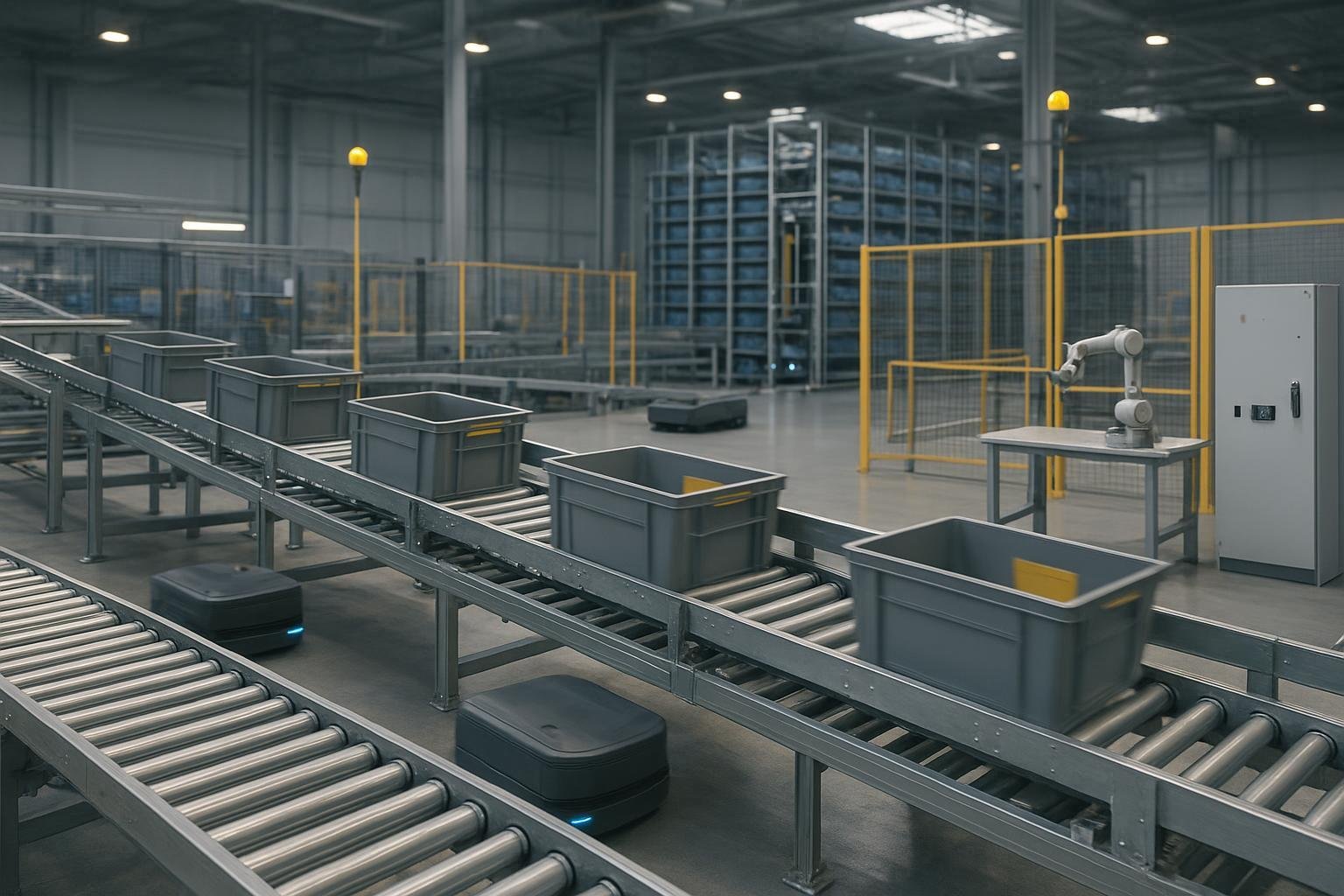
If your facility is planning upgrades for 2026 peak season, the biggest wins in 2025 aren’t shiny single-point technologies—they’re the handshakes between them. Adoption and spending are up, but the value materializes only when conveyors, AMRs/AGVs, AS/RS, and robots move in sync under one orchestration layer.
According to the 2025 benchmark work by Modern Materials Handling and Peerless Research Group, mobile robots and automated storage are advancing while organizations keep investing in orchestration software and material flow improvements. The 2025 Automation Survey reports measurable traction—AGVs in use at 31% of sites and shuttle/mobile robotic storage at 41%—with 59% planning upgrades or new deployments, and conveyance “fully automated” at 9% of respondents, reflecting a sober reassessment of what to automate and how it’s coordinated. See the survey summary in MMH’s 2025 analysis for full context in year and methodology details: the “2025 Automation Survey: Diving deep into warehouse automation trends”.
Trend snapshot: orchestration, mixed fleets, and pragmatic ROI
The broad direction is clear: orchestration-first design. WMS/WES platforms are coordinating missions across conveyors, AS/RS, AMRs/AGVs, and robot cells to reduce idle time, smooth merges, and shorten exception recovery. Why is this happening now? Because point solutions hit ceilings—merge starvation, congested accumulation, and manual resets—unless a higher layer manages shared capacity and priorities.
Facilities are also paring back “automate everything” visions in favor of hybrid flows. AS/RS shuttles feed decoupled conveyor accumulation, AMRs shuttle between islands, and robot arms handle induction, depal, or pack tasks at defined workstations. When the orchestration layer can throttle releases and reroute around faults, throughput variability drops and labor becomes more predictable.
Orchestration and controls: making handoffs boring (on purpose)
In practice, stable integrations rely on a few consistent patterns:
- Handoff signals and states: At each interface, standardize Ready, Occupied, and Fault states between conveyor PLCs and AMR/robot controllers. Document timeouts (often 30–60 seconds for load exchange) to prevent deadlocks. Pair each state with unambiguous machine action.
- Queueing and buffering: Use accumulation zones with FIFO or priority logic upstream of merges and robotic cells. AMR missions should be dynamically reassigned when a target node goes unavailable; WES should auto-divert or retry on exceptions.
- Latency budgets: Photoeyes, diverters, and AMR perception all introduce delays. Define and test budgets in a digital twin before commissioning; verify worst-case response at line rate.
- Fail-safe behavior: On loss of “ready,” stop or slow zones to hold loads in safe positions. Escalate to manual intervention only after automatic retry attempts.
Vendors rarely publish bit-level tag maps publicly, but these behaviors are the common denominators of resilient handoffs observed across modern deployments.
Safety by design: standards that govern the interfaces
Conveyors, AMRs/AGVs, and robots can safely share space only when safety functions are designed and validated as a system. Several standards frame those obligations in 2025. OSHA enforcement guidance has long emphasized guarding and accessible controls for conveyors and cites ASME B20.1 as a relevant consensus standard in regional emphasis programs, as seen in the agency’s amputations REP documentation: OSHA directive noting ASME B20.1 relevance (2019, active guidance). For mobile robots, the 2023 revision of ISO 3691-4 requires at least Performance Level d (PLd) for key detection and braking functions; a concise public overview is available from ANSI: “ISO 3691-4: Driverless industrial trucks” (ANSI blog, 2023/2024 updates). For industrial and collaborative robots near conveyors, the updated ISO 10218 framework and ISO/TS 15066 guidance apply; see a 2025-centric FAQ at Automate.org: “Updated ISO 10218 FAQ” (Automate.org, 2025).
| Standard / guidance | Scope at the interface | Practical implications |
|---|---|---|
| ASME B20.1 (Conveyors and Related Equipment) | Conveyor design/operation safety (U.S. consensus) | E-stops with manual reset at device; audible/visual pre-start warnings where personnel may be present; guarding of nip points; clear access to start/stop controls. Align conveyor logic with adjacent robot/AMR zones for consistent stops/resets. |
| OSHA machine guarding guidance | U.S. enforcement framing | Ensure labeling, accessibility, and guarding meet expectations; document risk assessments and training. |
| ISO 3691-4 (AMRs/AGVs) | Safety functions for driverless trucks | Personnel detection meeting PLd; speed/zone control; braking on detection/fault; validated to ISO 13849-1 or IEC 62061. Coordinate with conveyor cell interlocks. |
| ISO 10218-1/2 and ISO/TS 15066 | Industrial/collaborative robots | Choose mode (e.g., speed-and-separation monitoring, power/force limiting); validate protective distances and limits; coordinate monitored standstill with conveyor stops. |
| ISO 13849-1 / IEC 62061 | Functional safety validation | Validate the combined system’s safety-related parts; keep change control and periodic re-verification after modifications. |
A practical tip: treat the conveyor, AMR, and robot cell as one machine for risk assessment. If any interface can move a load unexpectedly, include it in the same hazard analysis and validation plan.
Throughput and buffering: decouple, then tune
The easiest way to stabilize throughput is to decouple upstream and downstream operations. Accumulation zones upstream of merges and robot cells absorb minor disruptions; dynamic mission reassignment ensures AMRs keep feeding available nodes rather than queuing at a blocked inducer. Instrument the usual choke points—merge points, scanner read zones, and sorter in-feeds—and tie KPIs to the WES dashboard so exceptions trigger automated escapes.
Real-world case data supports the impact of well-engineered interfaces. Exotec’s published deployments show how shuttle-based AS/RS (Skypod) paired with conveyor modules (Skypath) can accelerate fulfillment when the handoffs are clean. In the E.Leclerc Seclin grocery project, the operator reported roughly 70% faster order fulfillment and the ability to handle 50% more orders than before—both enabled by coordinated storage, conveyor transport, and workstations. See details in Exotec’s case write-up: “E.Leclerc Seclin: revolutionising drive‑through grocery with robotics” (case study). Your mileage will vary, but the pattern—decouple, buffer, and orchestrate—is consistently behind the numbers.
Energy efficiency in practice: ZPA/MDR, VFDs, and run‑on‑demand
Energy is no longer a side bonus; it’s a design input. Facilities are standardizing on run‑on‑demand controls and efficient hardware to cut kWh without sacrificing flow.
- Zero-pressure accumulation (ZPA) with motorized rollers: Decentralized 24V DC motorized roller zones power only when totes are present. In a 2025 integrator case, a modular MDR conveyor reportedly reduced energy use by about 60% versus a 480 VAC conveyor baseline in a robot-cell induction application—scope-limited but instructive. Review the narrative and constraints in the integrator’s summary: Facility Functions case study (2025).
- VFDs on constant‑torque drives: Drives on belt or chain conveyors allow speed matching to demand and soft starts that reduce peak currents. Savings depend on duty cycle; present ranges (often double‑digit percentages) only with real operating data.
- Low-rolling-resistance components and high‑efficiency motors: Hardware selection matters. Lower drag in idlers and precise tracking reduce required torque; premium-efficiency motors cut losses in continuous-duty zones.
- Monitoring and peak shifting: Attach energy monitoring to WES/WMS reporting and consider peak shifting where utility tariffs warrant it.
Here’s the deal: publish your assumptions. Energy payback depends on utilization, stop/start frequency, load distribution, and zone lengths. When you model those factors upfront—and keep measuring—you avoid “one-number” promises that don’t hold on your floor.
Practical component choices (neutral, integration-first)
When teams define interfaces, they sometimes under-spec the mechanicals that make control logic effective. A few reminders from recent retrofits and greenfields:
- Belting: Choose belt type for application (e.g., standard flat belt for carton flow; sidewall belt for steep in-feed moves). Trackability and coefficient of friction affect photoeye placement and zone lengths.
- Idlers and frames: Low-rolling-resistance idlers reduce drive torque, which pairs well with run-on-demand controls. Impact idlers at inductions protect belts and structures.
- Pulleys and lagging: Correct lagging (ceramic or rubber) maintains traction at starts/stops, reducing slip and unexpected restarts.
- Motorized rollers and drives: Size zones to the load spectrum; avoid overly long zones that negate ZPA benefits.
If you’re sourcing components, a specialized conveyor manufacturer can support energy and uptime targets with appropriate selections. For example, BisonConvey provides belts, idlers (including UHMWPE and impact), pulleys/lagging, and motorized roller options that align with the run‑on‑demand and low‑rolling‑resistance practices discussed above. Disclosure: BisonConvey is our product.
Implementation checklist
- Define orchestration responsibilities: What does WES control vs. PLCs vs. robot/AMR fleet manager?
- Normalize handoff signals and timeouts at every interface; test in a digital twin with worst‑case latencies.
- Apply safety standards as a system: ASME B20.1 for conveyors; ISO 3691‑4 for AMRs/AGVs; ISO 10218 and ISO/TS 15066 for robots; validate via ISO 13849‑1 or IEC 62061.
- Decouple flows with accumulation and clear exception paths (diverts, retries, manual bypass).
- Engineer for energy from day one: ZPA/MDR where suitable, VFDs on constant‑torque drives, efficient motors, and low‑resistance idlers; add metering and targets.
- Instrument merges, scanners, and sorter in-feeds; bind KPIs (throughput, idle time, kWh) to WES dashboards.
- Plan change control: after any modification, re‑verify functional safety and update documentation.
Mini change‑log (for evolving figures and references)
- Updated on 2025-12-22: Incorporated MMH/PRG 2025 survey references; added Facility Functions 2025 MDR energy case; aligned robot safety references to Automate.org ISO 10218 FAQ (2025).