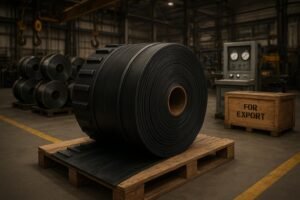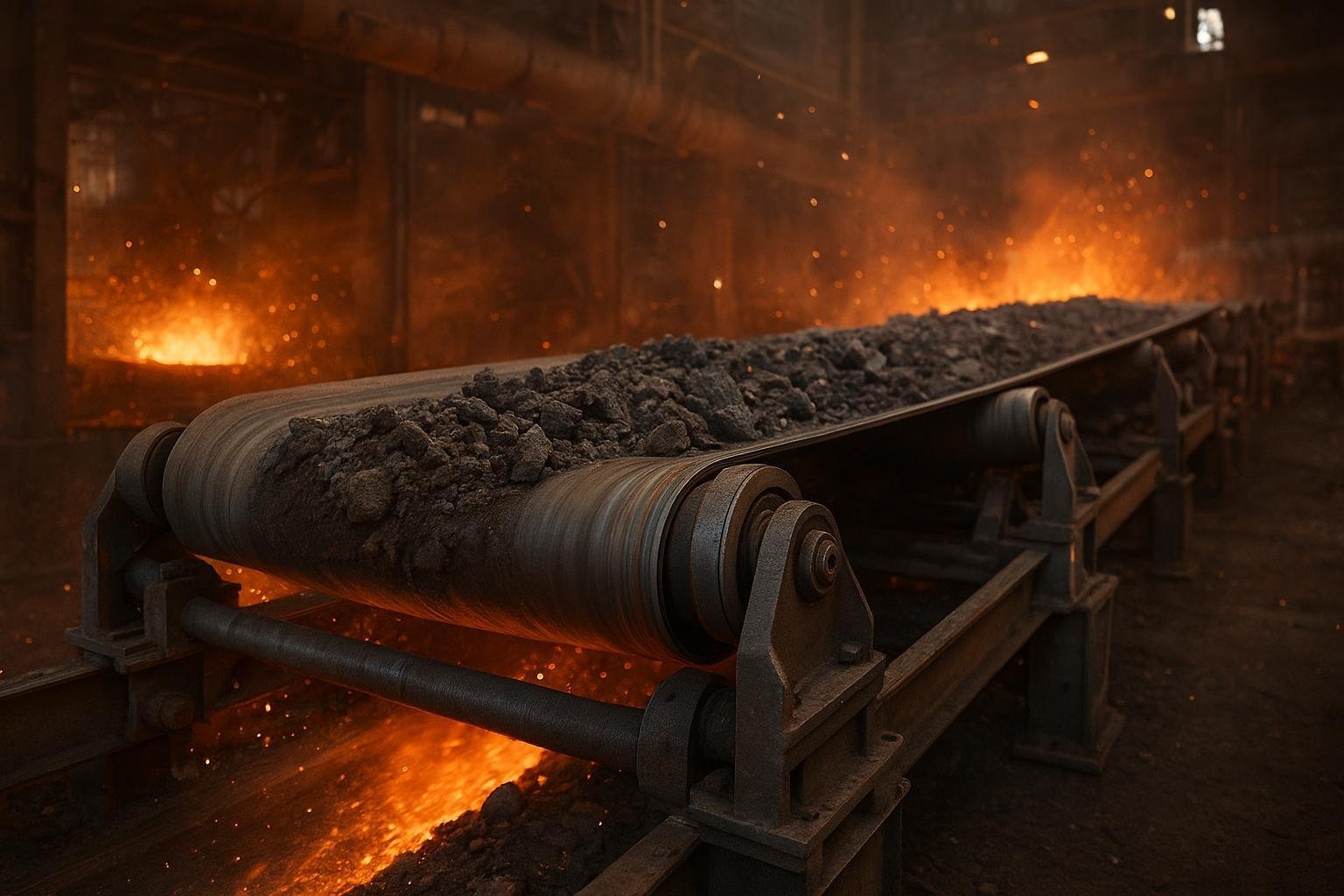
Steel plants move mountains—ore, coke, scrap, slag, hot and cold product—on belt conveyors that run hour after hour. In this guide, “heavy-duty rollers” means the conveyor idlers/rollers that support and guide those belts. It does not mean the powered work rolls that shape steel in rolling stands. That distinction matters for safety, specifications, and maintenance; for context on the shaping machinery, see the encyclopedia overview of tandem mills in the references below.
What “heavy-duty” rollers mean in a steel mill
Heavy-duty conveyor rollers (idler rollers) are unpowered, low-friction cylinders mounted in frames to carry and train a belt. They appear as troughing sets in the carry strand, returns under the belt, and self-aligners to correct tracking. In North American practice they’re commonly specified to CEMA classes (B through F), which step up roll diameter, bearing size, and load capacity. A practical overview aligned to CEMA practice is summarized in the ASGCO CEMA-rated idlers brief in the CL-101 document.
By contrast, the work rolls in a tandem mill are motor-driven tools that compress and shape strip under precise control—an entirely different function and design. For a concise background on those rolling stands, see the tandem rolling mill explanation.
The stressors in steel plants that punish standard idlers
Steel mills are hard on conveyors. Here are the main conditions that push plants toward heavy-duty idlers:
-
Heat: Radiant heat near hot product or coke causes lubricants to thin and components to expand. Bearing internal clearance must account for temperature so the bearing doesn’t run tight and fail early. Guidance from major bearing makers explains when to use greater-than-normal internal clearance (C3/C4) to tolerate thermal growth.
-
Abrasion and scale: Coke, ore fines, and mill scale act like grinding media. Shells, seals, and even frames wear faster. Carryback on return rolls increases drag and accelerates wear if housekeeping lags.
-
Impact at transfer points: Load zones see big lumps and occasional tramp metal. Shock loads can dent shells, loosen bearings, and gouge belts.
-
Moisture and corrosion: Wet slag, cooling water, and humid bays promote corrosion and contamination ingress. Seals must keep water and fines out without adding excessive drag.
-
Continuous duty: Many mill conveyors run non-stop. Small inefficiencies or contamination issues compound quickly into heat, noise, and failures.
Authoritative planning basics from conveyor component suppliers and maintenance notes from idler and belt-cleaning specialists reinforce these stressors and how they shorten service life if not addressed.
How heavy-duty design solves these problems (steel mill conveyor rollers in focus)
-
Shell diameter and thickness: Moving up in diameter (for example, into 5–7 in/127–178 mm ranges typical of higher CEMA classes) and using thicker shells increases stiffness, resists denting from impact and scale, and spreads bearing loads. OEM catalogs based on CEMA practice show how shell size rises with duty class.
-
Bearings and internal clearances: Deep-groove ball bearings with greater-than-normal internal clearance (C3/C4) are commonly used where heat and load are significant so that running clearance remains after thermal growth. Major bearing producers also pair these with high-temperature greases in steel applications.
-
Sealing systems: Multi-stage labyrinth geometries combined with a contact element are widely used to exclude water, dust, and scale while keeping drag low. Thermoplastic or stainless elements are chosen where corrosion risk is high.
-
Materials and finishes: Stainless or galvanized steel tubes/shafts are favored in persistently wet or chemically aggressive zones. Polymer rollers (HDPE/UHMW) can eliminate corrosion and reduce noise where loads and temperatures allow—verify limits for steel-mill duty.
-
Impact protection: At load points, use rubber-disc impact idlers and/or impact beds/cradles rated for the expected energy (lb‑ft). Correct installation height (slightly below adjacent idlers) protects the belt and minimizes shock transmitted to bearings.
-
Frames, spacing, and tracking: Heavier frames and appropriate idler spacing reduce deflection and vibration. Self-aligning idlers help correct drift in long runs or sticky service.
For evidence and planning detail, see the inline sources in the references section below.
Quick selection checklist for steel mill conveyor rollers
Use this fast filter before you open a calculator. If you answer “yes,” move up the specification accordingly.
- Hot zone near coke or hot product? Select heat-tolerant bearings with C3/C4 clearance and high-temperature grease; consider shielding (addresses idler bearing overheat risk).
- Frequent impact at loading? Specify rubber-disc impact idlers and/or an impact bed rated for the load; use thicker shells; this is where “impact idlers steel mill” queries usually arise.
- Persistent moisture or corrosives? Choose stainless or galvanized tubes/shafts, or polymer rollers if loads/temps permit; require multi-stage labyrinth seals.
- Severe abrasion/carryback? Favor thicker shells, robust sealing, and plan for belt cleaning to keep return rolls clear.
- Long runs or tracking issues? Add self-aligning idlers at intervals recommended by your OEM.
- High tonnage and wide belts? Step up CEMA class (D/E/F) with larger diameters and heavier frames.
- Limited maintenance windows? Favor sealed-for-life rollers in contaminated zones and standardize grease types elsewhere.
Spec cues by application zone
Below is an at-a-glance mapping. Always confirm with load calculations, belt maker guidance, and CEMA/OEM tables.
| Steel-mill zone | Typical stressors | Heavy-duty idler considerations | Notes |
|---|---|---|---|
| Ore yard / primary feed | Abrasion, large lumps, moisture | CEMA D/E troughing; 5–6 in rolls; thicker shells (approx. 7 ga–1/4 in); robust labyrinth seals | Use heavier frames and appropriate spacing; check lump size vs. shell denting risk |
| Coke transfer / loading | Heat, impact, fines | Rubber-disc impact idlers and/or impact beds; C3/C4 bearings; high-temp grease; sealed designs | Set beds slightly below adjacent idlers; verify impact energy rating |
| Slag handling (incl. granulated) | Abrasion, moisture/corrosion | Stainless/galvanized or polymer rollers; multi-stage seals; self-aligners | Plan frequent cleaning to reduce carryback |
| Scrap return | Impact, tramp risk | Thicker shells; heavier frames; impact protection; frequent inspection | Watch for noise/heat indicating bearing damage |
| Hot plate/coil bays (belt conveyors) | Radiant heat, scale | Heat-tolerant bearings/grease; shielding; sealed rollers; temp checks | Monitor with IR spot checks where practical |
Maintenance that extends life and prevents surprises
-
Inspection cadence: Adopt regular rounds—visual every 2–4 weeks and hands-on checks every 6–8 weeks are a pragmatic starting point. Listen for noise, feel for vibration, and look for wobble or buildup. Lockout/tagout before touching equipment. Practical notes on what affects conveyor roller life and the role of contamination and cleaning are summarized by Flexco in its guidance on roller life and product handbooks; see the linked reference below.
-
Temperature and noise monitoring: In hot bays, add infrared spot checks or sensors. Rising temperature or pitch often precedes failure. Bearing literature emphasizes that incorrect internal clearance and degraded grease drive early failures under heat; a concise primer is available from SKF on internal clearance and related application handbooks (linked below).
-
Cleaning and carryback control: Sticky coke and scale increase drag and mis-tracking. Keep scrapers maintained so return rolls stay clean; it pays back in energy and idler life.
-
Grease and sealing policy: Standardize grease types plant-wide and document where sealed-for-life rollers are used. In wet/hot zones, select high-temperature, water-resistant greases recommended by your bearing supplier.
-
Safety: Seized or overheating idlers can damage belts and, in rare circumstances, create ignition risks in hot-material service. Treat abnormal heat and smoke as urgent.
Practical example: a coke-transfer loading zone
At a brownfield coke-transfer point, the goal was to reduce shell denting and bearing failures without reworking the whole structure. The selected package used CEMA E impact idlers with rubber discs, 6-inch rolls with thicker shells, deep-groove bearings with C3 clearance and high-temperature grease, multi-stage labyrinth sealing, and a modular impact bed set 1/2–1 inch below adjacent idlers. A supplier such as BisonConvey can furnish this configuration and match it to the belt width and trough angle while keeping to neutral, standards-aligned specifications.
Advanced options and what to watch
-
Condition monitoring: Compact sensors for temperature, vibration, or sound can flag early bearing defects and help schedule changeouts before a failure cascades. An overview of remote monitoring options is available from major bearing manufacturers; see the SKF literature in the references.
-
Hybrid/ceramic bearings: In severe contamination or electrical environments, hybrid bearings reduce friction and can offer insulation. Validate cost/benefit carefully using bearing makers’ notes.
-
Polymer rollers: For persistent corrosion and noise reduction, HDPE/UHMW rollers are attractive, but verify load and temperature limits for the specific zone per OEM planning basics.
References and inline sources
-
CEMA practice and classes (dimensions/load context) summarized in an OEM overview derived from CEMA: see the ASGCO CEMA-rated idlers overview in CL-101, “CEMA Rated Idlers” (2019): https://www.asgco.com/wp-content/uploads/2019/06/CL-101CEMA-Rated-Idlers.pdf
-
Bearing internal clearance guidance explaining use of C3/C4 for thermal expansion and load: see SKF’s Internal Clearance knowledge base (2019): https://www.skf.com/uk/products/rolling-bearings/principles-of-rolling-bearing-selection/general-bearing-knowledge/bearing-basics/internal-clearance and SKF application handbook references (2025): https://www.skf.com/binaries/pub12/Images/0901d1968065f1f4-Bearing-preload_tcm_12-299896.pdf
-
Planning basics for roller materials and sealing options in bulk handling: Interroll Technical Information & Planning Basics for rollers (2026): https://www.interroll.com/fileadmin/user_upload/Downloads__PDF_/Rollers/Technische_Grundlagen_Foerderrollen_EN.PDF
-
Load-zone impact protection (impact idlers and beds/cradles): ASGCO Load Zone brochure (2020): https://www.asgco.com/wp-content/uploads/2020/05/ASGCO-Load-Zone-Brochure_ENG_web.pdf
-
What affects conveyor roller life, and how contamination/carryback matter: Flexco technical brief (2026): https://documentlibrary.flexco.com/X6173_enCL_2525_INSCCTlife_030620.pdf
-
Rolling-mill context for contrast with idlers (not the subject of this guide): Wikipedia on Tandem rolling mill (2025): https://en.wikipedia.org/wiki/Tandem_rolling_mill