When a belt fails early, you don’t just lose rubber—you lose production hours, damage idlers and pulleys, and risk safety incidents. This how-to guide gives procurement, QA/QC, and reliability teams a clear, practical playbook to evaluate conveyor belt manufacturing quality from factory floor to site acceptance, with references to the governing standards and buyer-ready templates you can adapt.
Preparation and scope alignment
Start by defining what you’re buying and how you’ll verify it. Identify whether your application calls for EP or NN fabric belts, steel cord belts for long runs and high tensions, or formed options like chevron belts and sidewall belts for steep angles. Tie every check you plan to an applicable standard and your service conditions.
- Define belt construction and special properties: EP fabric belts or NN fabric belts for plant use, steel cord belts for long-distance and high capacity, chevron belts and sidewall belts for incline service, plus any flame resistance, antistatic behavior, heat or oil resistance.
- Ask for documents in advance: Certificates of Analysis per lot, batch traceability for rubber, fabric, and cords, cure records, in‑process inspection logs, calibration certificates, ISO 9001 scope, and any declarations for flame or antistatic compliance.
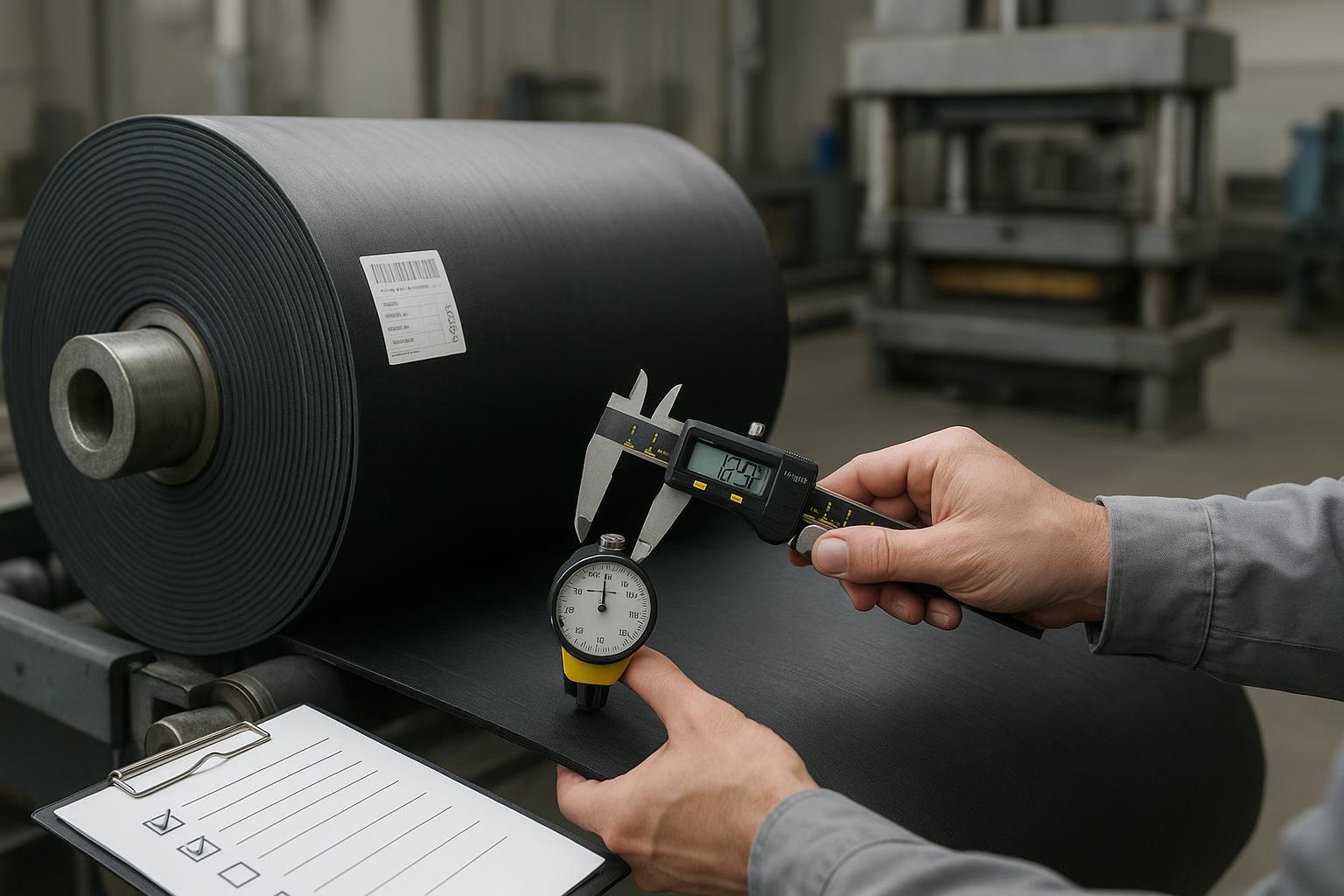
- Prepare tools and forms: Tape or steel rule, calibrated thickness gauge, Shore A durometer, sampling tools for adhesion testing, IR thermometer or pyrometer if reviewing presses, camera, and inspection forms aligned to your sampling plan.
- Set a sampling approach: For lot acceptance, many buyers adopt AQL sampling principles. Align your plan to your standard of record and risk profile, and specify when to escalate sample counts on first non‑conformance.
Why these steps matter: they lock scope, make factory visits efficient, and ensure you can defend accept or reject decisions.
Factory inspection steps to prove conveyor belt manufacturing quality
Begin with in‑process controls, then move to finished roll checks. You’re validating both how the belt was made and what arrived in front of you.
In‑process controls to review
Calender gauge control is foundational: the plant should demonstrate statistical process control on cover and skim gauges with up‑to‑date calibration. For textile constructions, look for consistent ply alignment and step length, correct carcass symmetry, and clean, well‑prepared skives. For steel cord belts, confirm cord spacing and tension uniformity, gum skim integrity without contamination, and tidy layup with proper cord alignment. Vulcanization records should show time, temperature, and pressure profiles with uniform press performance and managed cooling to avoid internal stresses and adhesion loss. Housekeeping tells a story too—foreign material in rubber or reinforcements is a preventable defect.
Finished belt checks
Match identity and markings to your purchase order and lot certificates. Markings should follow the applicable standard for traceability. Measure width, overall thickness, and individual top and bottom cover gauges at multiple locations; compare to tolerance bands in your governing document. Check length tolerance, roll diameter, and weight against expectations; confirm edge straightness and squareness so tracking issues don’t show up on day one. Inspect visual surfaces for blisters, voids, porosity, and cover defects. For steel cord, evaluate cord print‑through and ensure it’s within normal appearance limits. Review factory splices for uniform steps, clean adhesion interfaces, and absence of entrapped air.
These steps directly influence conveyor belt manufacturing quality because they reveal process discipline and the physical results you’ll live with in service.
Lab and validation tests buyers should specify
Use laboratory and spot tests to confirm mechanical integrity, adhesion quality, and special properties. Reference the relevant standard by name and edition in your RFQ or inspection plan, and have reports cite the exact method and acceptance basis.
Mechanical and adhesion integrity
- Fabric belts: For textile constructions, align product specification and test methods with the scope of ISO 14890. Typical programs include adhesion between plies and between covers and carcass, and tensile or elongation properties for rubber components using methods such as ISO 37. See the ISO catalogue entry for the scope of ISO 14890 textile conveyor belts specification and test methods.
- Steel cord belts: Reference the ISO 15236 series for steel cord belts for cord adhesion or pull‑out tests, spacing and tension uniformity checks, and marking.
Rubber cover and skim properties
- Abrasion resistance: Specify testing per ISO 4649 abrasion resistance of rubber and compare results to your grade requirements or regional norms.
- Hardness: Use ISO 7619‑1 Shore A hardness with calibrated durometers and conditioning.
- Tear and reinforcement behavior: Where rip or tear resistance matters, use ISO 34‑1 rubber tear strength and align acceptance to your service risk.
Special properties when required
- Flame behavior: For many above‑ground uses, call out small‑flame testing per ISO 340 laboratory flammability characteristics. For underground mining in Europe, match the appropriate category under EN 14973 underground conveyor belts fire safety. In the United States, belts used underground must comply with MSHA 30 CFR Part 14 flame‑resistant belts.
- Antistatic performance: Require electrical resistance per ISO 284 electrical conductivity specification and method when static control is part of the spec.
Selecting tests and frequencies
Not every project demands a full lab program. For critical conveyors or new suppliers, include witness testing during FAT and retain samples. For repeat orders with stable performance, spot checks and periodic lab verification can suffice. Always tie frequency to risk, lot size, and historical performance, using AQL sampling logic stated up front.
RFQ and inspection language you can copy
Use precise, copy‑ready language in your sourcing documents so suppliers know exactly how you’ll assess conveyor belt manufacturing quality.
Standards and conformance
The belt shall conform to [ISO 14890:YYYY] for textile belts or [ISO 15236‑X:YYYY] for steel cord belts, including marking, dimensional tolerances, and required properties. Where sectoral regulations apply (e.g., EN 14973 or MSHA 30 CFR Part 14), the supplier shall provide valid conformity or approval documentation.

Test methods and reports
All testing shall be performed using calibrated equipment traceable to national standards and shall cite the exact method (e.g., ISO 4649, ISO 7619‑1, ISO 37, ISO 34‑1, ISO 340, ISO 284) with specimen preparation, conditioning, and acceptance criteria as defined by this specification.

Sampling and acceptance
Lot acceptance shall follow the stated AQL sampling plan. On first non‑conformance, increase sample size per escalation policy and hold shipment pending resolution. Critical properties may be witnessed at FAT with retained samples per lot.

Packaging and storage
Packaging and storage shall comply with ISO 5285 and this RFQ, including core specification, protective wrapping, labeling, and transport restraints.
Clause themes and intent
| Theme | What you’re controlling | Why it matters |
|---|---|---|
| Standards naming | Locks the test set and tolerances | Prevents disputes over acceptance |
| Method citation | Aligns fixtures, rates, and prep | Ensures comparable results |
| Sampling plan | Defines lot‑level risk and workload | Avoids argument at shipment time |
| Packaging and storage | Preserves belt integrity to SAT | Stops avoidable damage in transit |
Troubleshooting cues from inspection findings
Use this table to move quickly from observation to corrective action during FAT or incoming inspection.
| Symptom | Likely cause | What to do next |
|---|---|---|
| Poor cover to carcass adhesion | Inadequate cure time or temperature, contamination, incorrect skim thickness or compound | Review vulcanization logs, re‑run adhesion tests to method, inspect skive prep and cleanliness, check calender SPC records |
| Excessive cord print‑through on steel cord belt | Insufficient skim thickness, over‑cure or pressure, cord spacing anomalies | Measure cover gauges, review cord spacing and tension logs, verify press uniformity |
| Off‑gauge covers | Calender drift, calibration or setup error | Audit SPC charts, recalibrate thickness gauges, re‑measure across the roll before release |
| Blisters or internal voids | Entrapped air, contamination, poor venting or pressure | Section a sample for cross‑section, check press pressure profile, strengthen cleanliness controls |
| Fails flame or antistatic check | Wrong compound, surface moisture or contamination, test setup error | Verify compound property targets, repeat per method, request reformulation evidence and new certificate |
Packaging and SAT tie‑in on arrival
Quality control doesn’t stop when the truck doors open. Confirm transport packaging preserved belt integrity and that paperwork still matches reality. On the floor, recheck identification and traceability against certificates, perform a few quick dimensional checks, and verify handling instructions are available and practical for your site. For storage and handling, follow the guidance summarized in ISO 5285 storage and handling of conveyor belts to prevent UV, moisture, or temperature damage before installation.
Practical supplier vetting
As you evaluate partners, look for a complete product line, transparent QA documentation, and readiness to support testing and traceability. For example, BisonConvey offers a broad portfolio of EP and NN fabric belts, steel cord belts, chevron and sidewall options alongside idlers and pulleys, and can supply documentation that aligns with the inspection approach described here.
Próximas etapas
Adapt the preparation checklist to your plant conditions, choose a sampling plan that matches risk and lot size, and decide which tests to witness during FAT. For projects with high consequence of failure, expand lab verification and retain samples. For repeat orders with stable performance, keep the cadence but stay disciplined on markings, dimensions, and critical properties like adhesion, abrasion, flame behavior, and antistatic resistance. Here’s the deal: the more clearly you define and enforce your acceptance language up front, the smoother your receiving dock and startup will run—and the better your conveyor belt manufacturing quality will be over the long term.