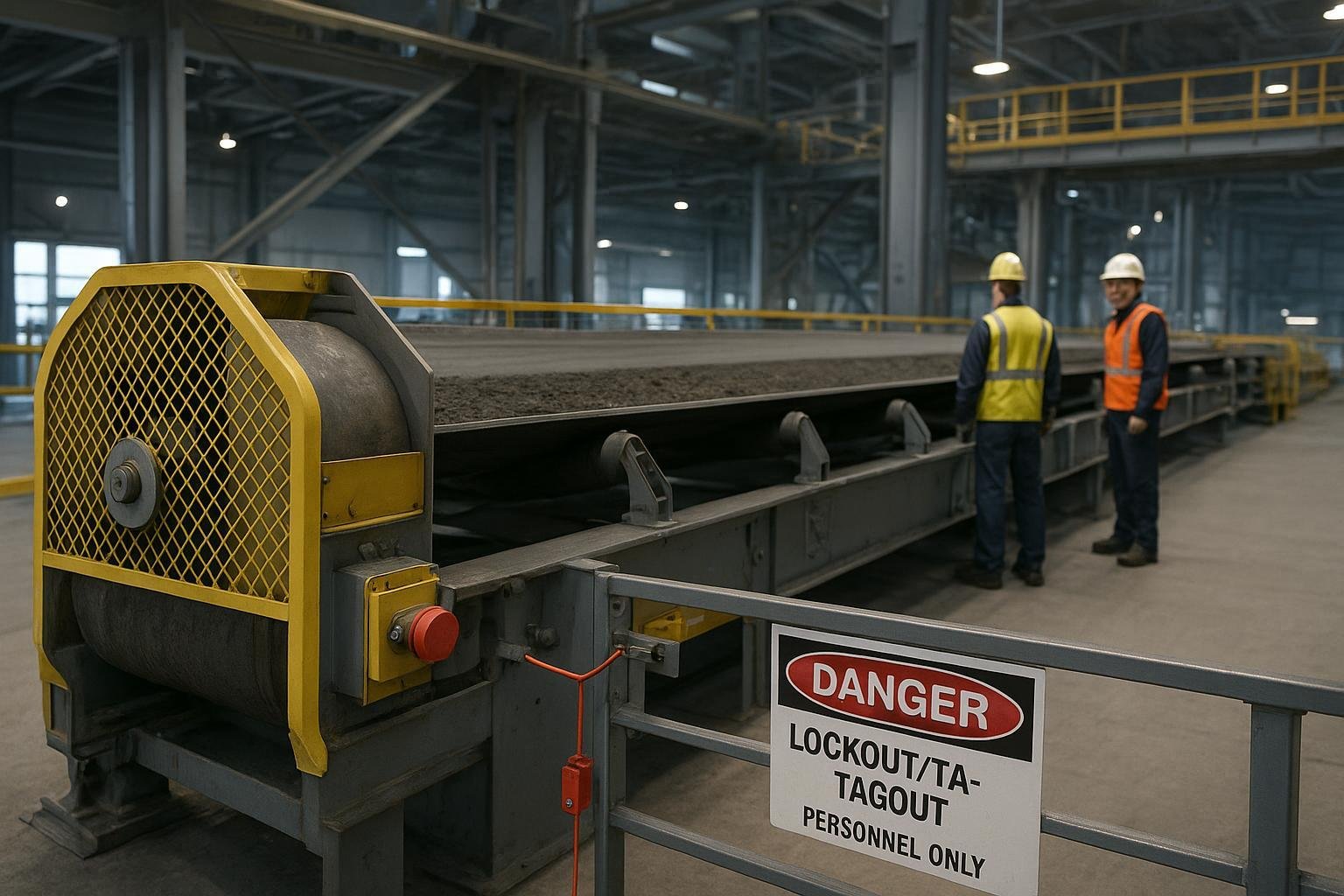
Conveyors move your throughput, but they can also move your risk. If you’ve had a near miss at a head pulley or a frantic scramble for an emergency stop, you know how quickly a normal shift can turn into an incident investigation. This guide lays out a practical, auditable workflow that aligns with OSHA requirements and current ASME B20.1-2024 updates—so your team can run safely, pass inspections, and avoid costly downtime.
What OSHA expects of conveyor operations—today
In general industry, three OSHA frameworks dominate conveyor safety: lockout/tagout (LOTO), machine guarding, and walking-working/access provisions. Construction projects rely on a specific conveyors rule as well.
-
LOTO (29 CFR 1910.147) requires a formal energy control program: documented, machine-specific procedures; role-based training; and periodic inspections. For conveyors, procedures must address electrical, hydraulic/pneumatic energy, gravity, and stored mechanical energy from belt tension—including blocks/restraints and verification of zero energy before work. See OSHA’s program overview and eTool guidance in the official pages for the energy control program and required procedure content: according to the OSHA energy control program overview and the eTool’s required energy control procedure content.
-
Mechanical power-transmission apparatus guarding (29 CFR 1910.219, with 1910.212 context) mandates guarding of belts, pulleys, shafts, couplings, and in‑running nip points. Guards must be substantial and prevent reach-under/over/through exposure. OSHA’s machine guarding portal clarifies expectations and interpretations for conveyors and other equipment; see the OSHA machine guarding standards portal and an OSHA interpretation referencing 1910.219 and 1910.212 from May 8, 2023: OSHA Standard Interpretation (2023-05-08).
-
Construction work (29 CFR 1926.555) specifies general conveyor requirements and incorporates ANSI B20.1-1957 by reference. Many facilities also adopt modern ASME B20.1 guidance for current best practice. The codified rule is available in the eCFR 1926.555 Conveyors section.
Practically, that means common tasks—jam clearing, belt tracking, splicing, housekeeping under return runs—fall under LOTO; nip points at head/tail pulleys and take-up units must be guarded; and elevated runs need safe access and protection from falling material.
ASME B20.1-2024: updates worth adopting
ASME B20.1 is a consensus safety standard widely used to design, install, maintain, and operate conveyors. The 2024 edition introduces updates that improve risk control and audit clarity:
- Emergency stop devices: When E-stops are located away from the conveyor, the controlled equipment must be identified—clarifying what a remote E-stop actually affects.
- Maintenance and lubrication clarifications: Sections 5.2 and 5.3 strengthen expectations for safe maintenance.
- Dust hazards: A new section addresses dust-related risks, supporting combustible dust mitigation where conveyors move fine materials.
These highlights are summarized by authoritative sources: see the ANSI Blog’s overview of ASME B20.1-2024 (Dec 2024) and Workplace Publishing’s 2025 article on the standard’s updates. Adopting these practices can sharpen your procedures and make inspections smoother—especially around E-stop identification and dust hazard controls.
Build a compliant workflow for conveyors
Think of compliance as an operating model, not a binder on a shelf. The following workflow has proven reliable across mining, logistics, and manufacturing lines.
-
Guarding program: Install fixed or interlocked guards on head/tail pulleys, take‑ups, drives, and hazardous return idlers. Guard projecting keys/setscrews and couplings. Where conveyors pass over aisles or work areas, use overhead guarding to prevent falling material. Align with OSHA guarding rules and the machine guarding standards portal.
-
Emergency stops and startup warnings: Provide accessible pull cords or buttons along the line. If a remote E‑stop controls the conveyor, label which equipment it affects per ASME B20.1-2024. Establish documented function tests at a frequency commensurate with hazard and use; CEMA’s E‑stop guidance supports a risk-based test cadence; see CEMA SBP‑002 E‑Stop Application Guide.
-
LOTO procedures that address stored belt energy: Create machine-specific procedures covering all energy sources. For belt tension, relieve energy via take‑up mechanisms, block pulleys, secure moving elements, and verify isolation before work. OSHA’s eTool pages detail program elements and inspections; consult the OSHA energy control program overview.
-
Access and fall protection: Provide safe platforms and crossovers; install guardrails and toe boards as needed; restrict access under energized conveyors, and maintain housekeeping to prevent slip/trip hazards.
-
Training and documentation: Train authorized, affected, and other employees according to role; run E‑stop drills; keep inspection records for guards, E‑stops, and annual LOTO procedure audits. Documentation is often the difference between “compliant” and “deficient.”
Inspection and audit cadence
Set expectations and prove them. A practical cadence that aligns with OSHA expectations and industry practice might look like this:
- Daily: Visual checks of guards, pull-cords/buttons, signage, and housekeeping around conveyors; note defects and correct promptly.
- Weekly: Function-test E‑stops on risk-based intervals; inspect take‑up areas and returns for reach‑in hazards; verify that any temporary removals of guarding are documented under LOTO.
- Annually: Audit each LOTO procedure (per 1910.147) and certify the inspection; refresh role‑based training; review incident/near‑miss data to adjust guarding or testing frequency. Reference OSHA’s program and eTool guidance for periodic inspections and certification; see OSHA’s LOTO program page and NIOSH’s overview of periodic inspection concepts in NIOSH Workplace Solutions (2022).
Warehousing NEP: what inspectors are looking for
OSHA’s National Emphasis Program on Warehousing and Distribution Centers (effective July 13, 2023) directs comprehensive inspections that often include conveyors. Expect attention to machine guarding, LOTO, walking‑working surfaces, egress, heat, and ergonomics—plus documentation quality. The directive is public; see OSHA’s NEP directive CPL 03‑00‑026 and the news release announcing the program. If you operate in logistics, ask yourself: could you hand an inspector your E‑stop test log, LOTO audits, and guard inspection records on the spot?
Practical example: executing a planned belt change
Disclosure: BisonConvey is our product.
During a scheduled belt change on a primary transfer conveyor, the team applies group LOTO, isolates electrical and hydraulic power, and relieves belt tension using the take‑up. Pulley blocks and restraint devices are installed, and zero energy is verified. Guards at the head/tail and take‑up are removed under the procedure and tagged; temporary barriers and signage restrict access. E‑stops are function‑tested post‑installation, and remote devices are labeled to identify controlled equipment per ASME B20.1‑2024.
Where operations require robust guarding or components that simplify housekeeping around returns, facilities may select heavy‑duty idlers or guarded pulleys that meet the dimensional and clearance needs of their system. In practice, we’ve seen teams use stainless or UHMWPE idlers in corrosive environments and ceramic‑lagged pulleys at impact zones to reduce slippage and wear—choices that support safer, steadier operation without changing the compliance fundamentals.
Penalties and the cost of getting it wrong
OSHA’s maximum civil penalties were adjusted in January 2025: $16,550 per violation for serious/other‑than‑serious/posting, and $165,514 per violation for willful or repeated. Failure‑to‑abate penalties may accrue per day. See OSHA’s memo on 2025 penalty adjustments and the Jan 15, 2025 news release. Combine that with the reality that LOTO and machine guarding rank among the most frequently cited standards each year, according to NSC Safety+Health’s FY2024 Top 10 summary, and the business case for prevention becomes obvious.
Actionable next steps
- Map tasks to hazards: list jam clearing, tracking, splicing, cleanup, and inspection routes; identify nip points, reach‑in spots, and dust risks.
- Update procedures: bring LOTO content up to 1910.147 expectations; add stored belt energy steps; label remote E‑stops per ASME B20.1‑2024.
- Set a test cadence: adopt a risk‑based schedule for E‑stop function tests, and keep records current.
- Prove compliance: keep annual LOTO audits and inspector‑ready logs for guards and E‑stops; run drills quarterly.
- Use authoritative references to validate your program: OSHA’s LOTO pages, machine guarding standards, the eCFR 1926.555 rule for construction sites, and the ASME B20.1‑2024 summaries cited above.
Run conveyors like you expect a visitor on the floor at any moment. It’s good safety—and it’s good business.