If you run bulk conveyors in mining, ports, steel, cement, power, chemicals, or agriculture, you’ve probably noticed the idler conversations have changed. The focus is moving from “what fits the stringer” to “what cuts energy, survives the environment, and reduces risk.” Four forces dominate the 2024–2025 shift: materials, energy efficiency, smart monitoring, and safety compliance. Here’s how they come together—and what to do about it.
1) Materials: from all‑steel to stainless and UHMWPE/composites
Idler construction is diversifying. The choice is no longer only between light- and heavy-duty steel. Stainless and polymers (often UHMWPE) are now credible in defined zones, while sealing systems get more attention than ever.
Why the shift? Corrosion, noise, handling safety (lighter rolls), and moisture are pushing plants to mix materials by location. OEM guidance stresses matching material and sealing to duty and environment rather than applying a one-material policy across a site. For a clear overview of selection variables by duty class and sealing, see Rulmeca’s practitioner notes in the 2024–2025 period: rollers, bearings, and labyrinth seals should be chosen as a system to suit impact, dust, and moisture conditions, not in isolation, as outlined in the company’s guidelines on the right roller choice and series families. See the descriptive discussion in the manufacturer’s guide: “Rollers for conveyor: guidelines for the right choice” (Rulmeca).
Two themes stand out in heavy industry: duty still rules—high-impact loading, abrasive fines, and heat exposure keep heavy-duty steel dominant in primary loading and transfer areas. Environment matters—stainless and UHMWPE/composite options are increasingly used in corrosive, wet, or noise-sensitive zones, and on returns, where impacts are lower.
Below is a quick table to align environment/duty with a starting material and sealing focus. Treat it as a screening aid, not a specification.
| Environment & Duty cue | Steel | Stainless steel | UHMWPE/composite | Sealing priority |
|---|---|---|---|---|
| Mining/quarry primary load, abrasive fines | Heavy-duty steel shell, thick wall | Only where corrosives justify cost | Not recommended in direct impact zones | Multi-labyrinth, dust scrapers, heat-tolerant grease |
| Ports/marine salt spray, moderate duty | Coated steel common | Good for corrosion, carry side | Good for return/idler frames to cut corrosion and weight | Labyrinth + water ingress barriers, corrosion-resistant housings |
| Steel/cement high dust/heat | Heavy-duty steel with heat-rated bearings | Use selectively near corrosives | Limited; verify temperature limits | Heat-tolerant grease, debris barriers |
| Power/coal (including underground) | Heavy-duty steel; fire risk management focus | Niche, depending on environment | Case by case; check anti-static and temperature ratings | Sealing to keep fines out; monitoring for hot idlers |
| Chemicals/fertilizers (corrosives) | Coated steel in low-corrosive spots | Strong option on carry where corrosion is severe | Attractive on returns for low weight and corrosion resistance | Chemical-compatible seals; static control |
| Agriculture/grain (noise/dust) | Steel where impacts occur | Limited need | Strong on return and light-duty carry for noise and weight | Dust-focused labyrinth, low-drag seal designs |
Remember: polymer rollers have temperature and impact limits; stainless adds cost and weight; coated steel can be a solid middle path. Match the roller’s seal system (labyrinth geometry, v-rings, shields) to the environment as diligently as you pick shell material.
2) Energy efficiency you can actually model in 2025
Power draw is quantifiable—if you use the right frameworks. Designers commonly calculate main resistances and total power using the DIN 22101 approach (equivalent friction factor, belt mass, load, length, velocity), which allows you to see how idler drag and spacing influence the friction term and thus horsepower. A clear engineering treatment of these relationships is presented in Lodewijks’ work on conveyor power prediction: “Belt Conveying – Developments in the CEMA Horsepower Equations and New Conveyor Power Prediction” (Beltcon, 2024 paper link).
The other half of the story is indentation rolling resistance (IRR) in the belt’s bottom cover. IRR is measured under controlled conditions by DIN 22123 and reported per unit width—values you can plug into models. Lower-hysteresis bottom covers reduce IRR, and temperature shifts can raise it. For a practitioner-level explainer of IRR measurement and compound choices, see the 2020s analysis: “Evaluating the indentation rolling resistance performance of conveyor belt covers” (Australian Bulk Handling Review).
How do idlers fit in? Their contribution is twofold: mechanical resistance (bearing and seal drag) and the number of rotating elements (driven by spacing). Optimizing spacing can reduce the count of rotating idlers but must respect belt sag, tracking, and impact rules. Dimensional classes and selection guidance are organized in CEMA #502, which remains the mainstream reference for troughing and return idlers across classes B–G; see the 2022 edition’s scope and selection notes on the standard page: “CEMA Standard #502-2022: Troughing/Return Idlers” (CEMA Store).
A sensible modeling path for plants:
- Establish a baseline. Use your current belt’s IRR (tested per DIN 22123 if available), actual idler types and spacing, and load profiles in a DIN 22101-calculable model. Note power at typical operating temperatures.
- Test scenarios. Compare one change at a time: lower-drag idler seals/bearings; revised idler spacing; low-rolling-resistance (LRR) bottom cover. Keep belt support and tracking constraints in view.
- Validate on the line. After a change, verify amperage trends and belt temperature. If you can, instrument a short section to measure idler temperatures and vibration before/after.
You’ll notice this approach avoids “magic” percentages. That’s on purpose—credible savings come from inputs you can audit.
3) Smart monitoring: useful, but still emerging
Updated on 2025-12-27
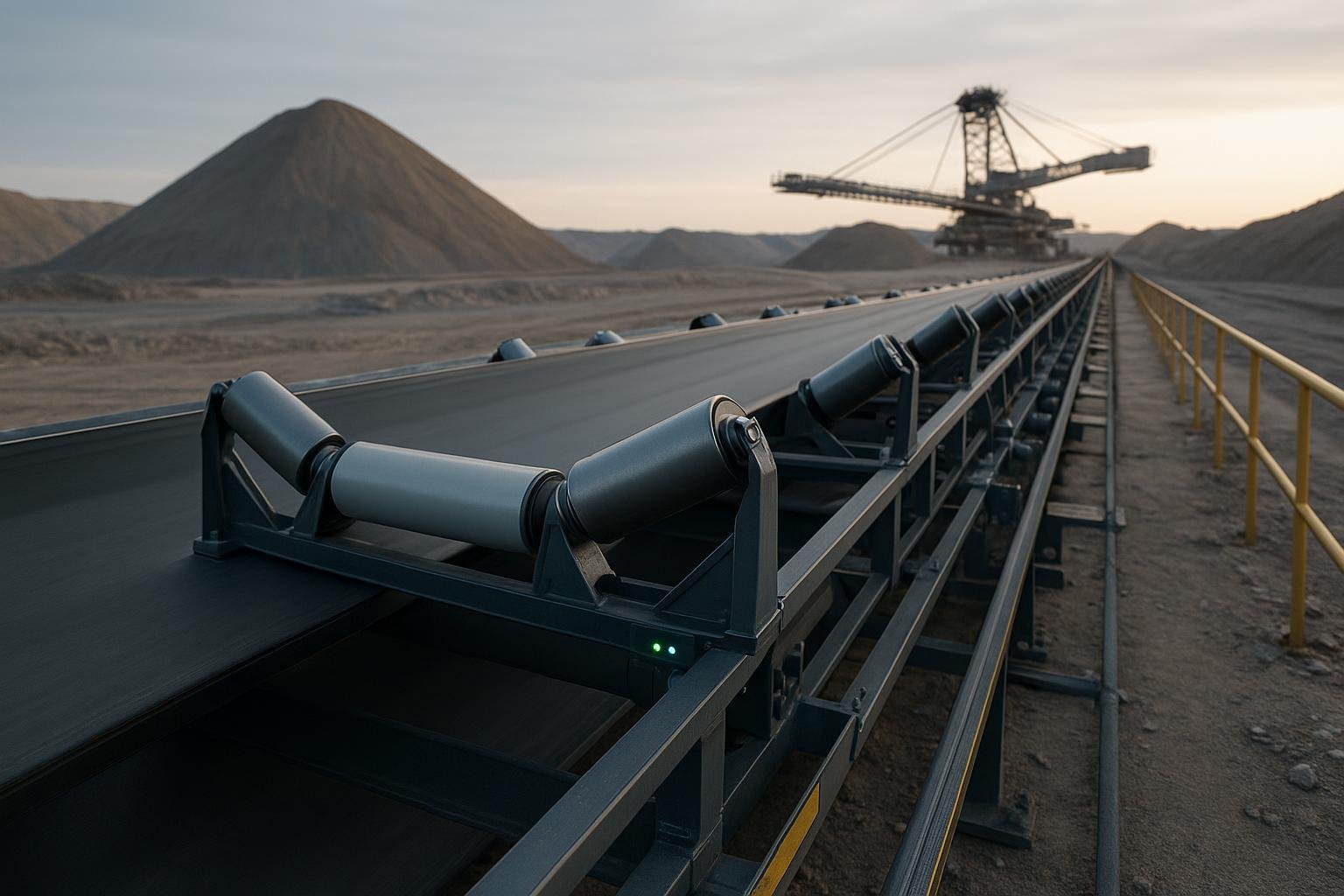
“Smart idlers” promise earlier detection of failing bearings (and the heat that follows), plus alerts for belt tracking anomalies. In 2025, the functions are clearer than the field evidence. Embedded sensors typically report temperature and vibration, sometimes aided by acoustic signatures, and push events into dashboards or a CMMS.
Public, named deployments with outcomes are still thin. What we do have are signals of maturation and active R&D: a corporate integration, for instance, where Kadant’s 2025 announcement of its completed integration of Vayeron (Smart-Idler®) indicates continued investment in embedded roller sensing and analytics, though the note is not a case study—see Kadant’s integration news (Sept 2025). On the research side, laboratory work continues on acoustic/vibration-based detection and localization; a 2025 study proposes transformer-based models for idler anomaly localization in controlled conditions—promising, but not field-proven.
Pilot it, don’t boil the ocean. Select one conveyor with a known failure history and instrument a limited number of impact and return locations. Track three KPIs: detection lead time (hours/days before failure), false-positive rate, and maintenance action effectiveness. Integrate events with your CMMS so alerts translate into work orders, not just red dots on a screen. If the pilot shows useful lead time with manageable noise, expand. If not, shore up inspection routines and hot-idler detection methods first.
4) Safety and compliance are non‑negotiable
Two safety themes dominate idler risk: guarding nip/pinch points and preventing roller fires from seized components.
Guarding obligations are explicit in many jurisdictions. Ontario’s guidance for mines, for example, requires guarding pinch points at head/tail/drive/tension pulleys and at carry/return idlers where belt lift is restricted, with specified clearances; it also mandates guarding under conveyors over work areas. Read the government page for the exact wording and enforcement context: “Conveyor guarding in mines” (Ontario, Canada). In Australia and New Zealand, regulators reference the AS/NZS 4024.3610/3611 standards for conveyors (nip points, emergency e-stops, safety distances). Full texts are paywalled, but regulator summaries consistently point to these parts when auditing plants.
Fire risk is the other recurring issue. The Australia Mining Safety Journal underscores how failed idlers can overheat and ignite belt or dust, and it stresses competent online inspections (while running), hot-idler detection aids, and access to non-walkside areas. See: “Conveyor roller fire prevention” (AMSJ).
An inspection routine that works in practice combines running inspections, non-contact temperature checks on suspect rolls, and frequent guard verification around return idlers with restricted lift. Walk both sides where safe and permitted, listen for rough bearings, feel for abnormal vibration through the frame, and watch for belt wander contacting structure. Where anomalies appear, scan temperatures and escalate immediately. Then confirm guards cover nip points to the prescribed distances, especially over walkways and under conveyors crossing work areas.
When was the last time you audited return idlers over walkways or under conveyors crossing work areas? It’s surprising how often those zones drift out of compliance between projects.
5) Sector‑by‑sector playbook for 2025 decisions
Mining and quarrying. Primary loading and transfer points remain the realm of heavy-duty steel idlers with robust multi-labyrinth seals. Consider low-drag seal/bearing designs on long overlands to chip away at mechanical resistance. In power models, include LRR bottom covers and confirm IRR inputs at operating temperature. Fire-risk controls and regular online inspections are essential.
Ports and logistics. Salt and moisture drive materials. Stainless or coated steel on carry; UHMWPE/composites often make sense on returns to cut corrosion and weight, improving handling safety during changeouts. Prioritize seals with water ingress barriers. Noise considerations near communities also favor polymers on non-impact runs.
Steel and cement. Dust, abrasion, and heat argue for heavy-duty steel with heat-rated bearings and grease. Maintain strict guarding in cramped areas around hoppers and chutes. If you are aiming for energy gains, look first at belt compounds and then idler drag—both can be represented in DIN-style models.
Power and coal handling. Above all, control sources of heat. Maintain inspection cadence, add hot-idler detection in locations with restricted access, and ensure pull-cord e-stops are effective and visible. Material choices vary site by site; confirm anti-static and temperature ratings when polymers are considered.
Chemicals and fertilizers. Corrosive dusts and residues push plants toward stainless components on the carry side and UHMWPE composites for returns. Confirm chemical compatibility and static control. Monitoring pilots can be valuable here because corrosives often mask early bearing symptoms.
Agriculture and grain. Noise and dust are the main pressures. UHMWPE on return and light-duty carry positions reduces weight and sound levels, while good labyrinth seals keep fines out. Maintain frequent visual inspections because material build-up can still cause tracking events.
6) Example from the field (neutral, materials‑first)
A fertilizer terminal facing urea-induced corrosion replaced return-run steel rollers with UHMWPE units and moved select carry positions to stainless steel where corrosion was most severe. The change reduced corrosion-related changeouts and made handling during maintenance safer due to lower roll weight on returns. Temperature limits and impact constraints kept primary loading zones on heavy-duty steel.
Disclosure: BisonConvey is our product. In a case like this, a supplier such as BisonConvey can support the mixed-material specification (UHMWPE returns, stainless or coated steel carry in corrosive bays, heavy-duty steel at impact) and provide seal options suited to high-moisture, corrosive dust.
This is not a one-size recommendation; it’s an example of matching duty and environment. Always validate material compatibility and temperature ratings before switching.
What to do next
- Pull your last 12 months of power data and build a baseline model using DIN 22101 inputs. If available, source IRR values from DIN 22123 testing for your current and candidate belts.
- Review idler material mix by zone: keep heavy-duty steel in impact areas; evaluate stainless and UHMWPE/composites where corrosion, moisture, or noise dominates.
- Tighten inspection and guarding: verify nip-point coverage and add hot-idler detection where access is limited. Align with local regulator guidance and, where applicable, AS/NZS 4024 principles.
- Pilot monitoring pragmatically: define KPIs, integrate alerts with your CMMS, and scale only if lead time and false-positive rates meet your thresholds.
Change is real, but it’s manageable. Think of idlers as part of an integrated system—materials plus sealing, energy modeling, monitoring where it helps, and safety that holds up under scrutiny. That’s how you turn 2025’s trends into fewer stoppages, lower risk, and predictable costs.
References and standards mentioned in this article
- CEMA’s dimensional and selection basis for idlers: CEMA Standard #502-2022 — Troughing/Return Idlers
- Power and resistance modeling context: Belt conveying power prediction (Lodewijks, Beltcon paper, 2024)
- Indentation rolling resistance testing and belt cover selection: Evaluating IRR performance of belt covers (Australian Bulk Handling Review, 2020s)
- Practitioner selection notes for idlers and sealing: Rulmeca – guidelines for the right roller choice
- Guarding requirements example: Ontario – Conveyor guarding in mines
- Fire prevention guidance: AMSJ – Conveyor roller fire prevention
- Smart monitoring market signal: Kadant completes integration of Vayeron (Sept 2025)