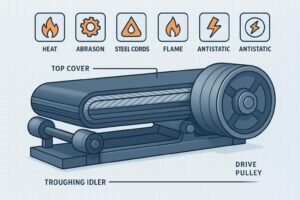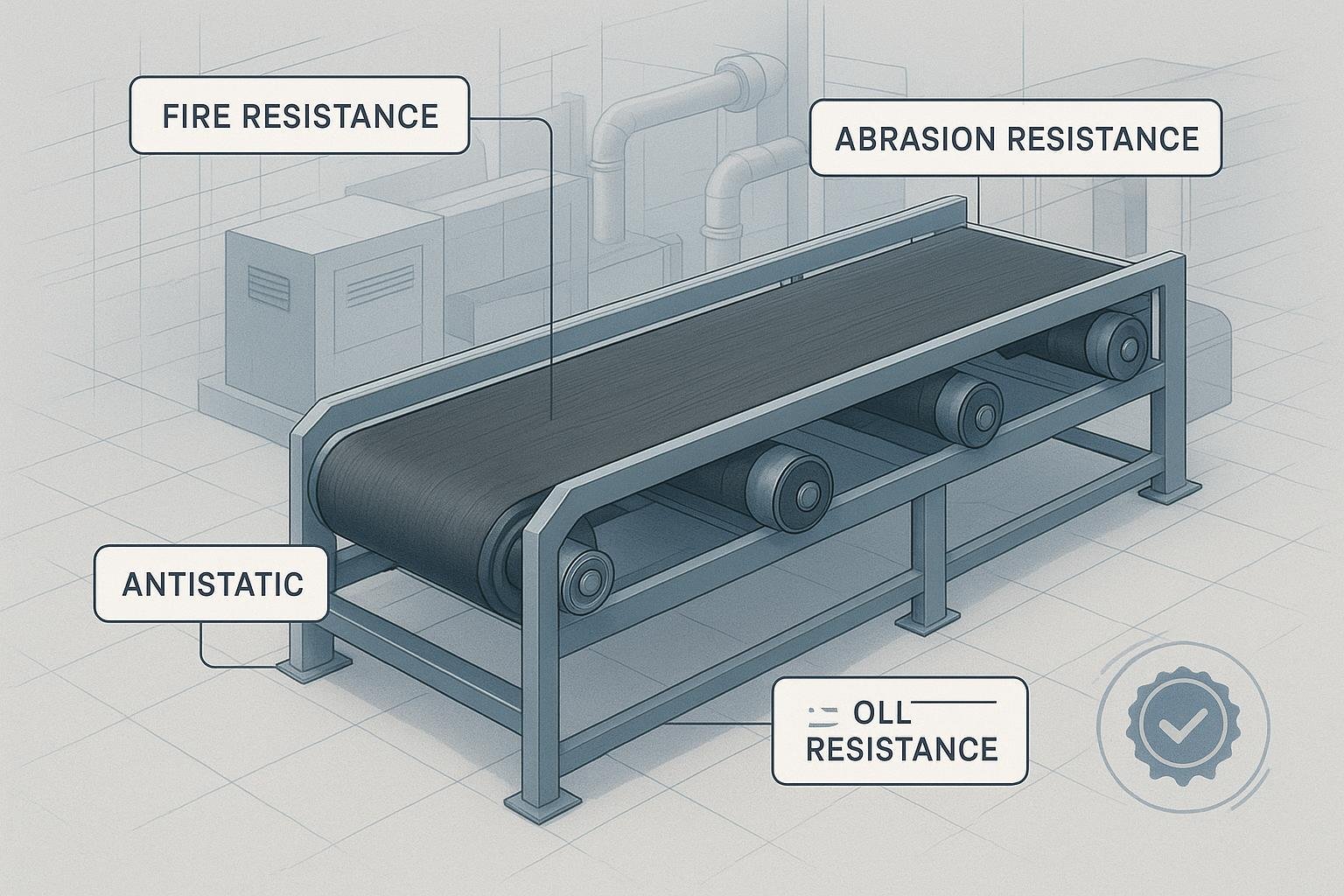
Conveyor belt quality certification is the documented proof that a specific belt construction meets defined performance and safety requirements, plus evidence that the manufacturer runs controlled, audited processes. In practice, it splits into two buckets: product-level compliance and approvals (test reports and, where applicable, regulator approvals for a specific belt design or batch) and manufacturer-level system certifications (ISO 9001/14001/45001) that attest to quality, environmental, and OH&S management but do not certify a belt’s fire, abrasion, or oil resistance on their own.
Core standards and approvals explained
EN ISO 340 — Small-scale flammability
EN ISO 340 is a lab test that exposes belt samples to a flame and records afterflame/afterglow and behavior under airflow. It’s useful as a screening method and is referenced by other standards, but it is not an underground safety approval. For scope and method context, see the descriptive entry in the EN ISO 340:2022 catalog.
EN 14973 — Underground categories
EN 14973 defines electrical and flammability safety requirements for conveyor belts in underground installations and classifies belts into categories suited to different hazard levels. It’s the go-to for underground belts in many European contexts. Selection is based on a documented hazard assessment. See the EN 14973:2015 catalog entry for scope and class structure.
MSHA 30 CFR Part 14 — U.S. underground approval
For U.S. underground coal mines, flame-resistant conveyor belts must be approved to 30 CFR Part 14 by MSHA. Approval involves a tunnel flame test series and quality assurance controls; approved products are listed by MSHA. A claim of “tested to ISO 340” does not substitute for MSHA approval in this jurisdiction. Program and test method summaries are outlined in MSHA’s QA and materials approvals documentation: see the MSHA approvals and QA overview.
ISO 284 — Antistatic (electrical conductivity)
ISO 284 sets the method and limits for the electrical resistance of conveyor belts to help control static discharge. Antistatic properties are important for dust handling and in ATEX-zoned areas. Catalog details appear in the ISO 284:2012 listing.
EN ISO 4649 (ISO 4649) — Abrasion resistance
This method measures volume loss (mm³) of a rubber test piece against a rotating drum (Method A or B). For belts, Method A is commonly specified. Lower volume loss means higher abrasion resistance; some product standards or purchase specs set maximum allowable loss. Method details are summarized in the ISO 4649 overview.
ASTM D471 — Oil resistance (rubber property—effect of liquids)
ASTM D471 immerses rubber specimens in reference oils, measuring changes in mass, volume, and dimensions to indicate oil resistance of cover compounds. Results are comparative; they help you judge compatibility for oily environments, ports, or recycling lines. Method information is outlined on the ASTM D471 standard page.
ISO 14890 and DIN 22102 — Product specifications and cover grades
ISO 14890 covers general requirements for textile-reinforced belts with rubber or plastic covers used on surface conveyors, including tensile, adhesion, and dimensional tolerances. DIN 22102 defines cover grades (Y, W, X) that are widely used shorthand for abrasion- and cut/impact-oriented performance expectations. For authoritative scope, consult ISO’s OBP abstract for 14890 and national publishers for DIN 22102; manufacturers often contextualize these families in practice—see, for example, Fenner Dunlop EMEA’s discussion in World Fertilizer.
How to verify conveyor belt quality certification
Getting a PDF isn’t the finish line. Here’s the workflow I use on incoming documents—because a tidy report doesn’t help if it’s not traceable to what you’re actually installing.
-
Match hazards to standards before you ask for paperwork
- Start with a short hazard statement in the RFQ. Do you need underground approval, fire/antistatic behavior, abrasion, oil resistance, or all the above? This keeps requests sharp and avoids fluff.
-
Request the right evidence, by name and method number
- Examples: EN ISO 340 flammability test report; EN 12882 categorization statement; EN 14973 class evidence; MSHA Part 14 approval listing; ISO 284 antistatic report; EN ISO 4649 Method A abrasion results; ASTM D471 immersion data. Suppliers should know these on sight.
-
Validate laboratory competence (ISO/IEC 17025) and scope
- Check that the testing laboratory is accredited for that exact method. Use the ILAC MRA signatory network to find national Accreditation Body directories and confirm the lab’s scope covers ISO 284, ISO 4649, etc. Guidance lives on the ILAC MRA and signatories page.
-
Inspect the report anatomy (traceability and decision rules)
- A solid test report includes: unique report ID/date, lab identity and accreditation mark where applicable, client and sample ID, referenced method and any deviations, environmental conditions, results with units, and the decision rule for conformity where used. These checkpoints align with ISO/IEC 17025 reporting clauses.
-
Cross-verify formal approvals in public listings
- For MSHA Part 14, look up the approval directly in the MSHA database or contact the approvals center. The MSHA QA and approvals overview describes the program and lists.
-
Confirm sample traceability and validity window
- The sample identifier on the report must link to the delivered belt (batch/lot, compound code). Ask for the re-test cadence if your project spans many months. If requirements change mid‑project, agree a requalification plan.
Example workflow (neutral, replicable)
- Suppose you’re vetting a heat‑resistant surface belt for a clinker conveyor with occasional oil contamination. You’d request EN ISO 340 and ISO 284 reports, EN ISO 4649 Method A abrasion results, and ASTM D471 oil‑immersion data. A manufacturer such as BisonConvey can typically supply redacted sample reports from accredited labs for the exact compound and construction you intend to purchase. You would then verify the lab’s ISO/IEC 17025 scope via the ILAC directories, check report IDs and signatures, and match the sample IDs to the production batch that will be shipped. No superlatives—just paperwork that ties to the belt you will install.
Hazard to standard mapping
Think of this section as a quick routing map: identify your primary hazard, then request evidence aligned to it.
| Typical hazard/use case | Primary requirement(s) | What to request |
|---|---|---|
| U.S. underground coal | Formal regulator approval | MSHA 30 CFR Part 14 approval (product listing/certificate); splice and QA per MSHA guidance; optional lab test reports for context |
| Underground installations (EU and others) | Underground safety categories | EN 14973 class evidence appropriate to your hazard assessment; supporting test reports referenced by the standard |
| Above-ground plants needing fire and antistatic safety | Fire reaction and electrical conductivity | EN 12882 categorization with supporting EN ISO 340 results and ISO 284 antistatic report; any EN 12881 tests if applicable |
| Explosive dust atmospheres (grain, wood) | ATEX-compliant system selection and antistatic belt | System-level ATEX technical file/Declaration of Conformity for the conveyor assembly; ISO 284 report for belt; zoning documentation |
| High-temperature process lines (clinker, steel) | Heat-resistant cover retention and abrasion | Product spec showing heat-resistant compound performance; EN ISO 4649 abrasion report; relevant heat-ageing data per purchase spec |
| Fertilizers and highly abrasive ores | Abrasion/cut resistance | EN ISO 4649 Method A results (volume loss/ARI); cover grade alignment (e.g., DIN 22102 classes); any cut/impact notes |
| Ports/logistics with oils/ozone/UV | Oil and environmental resistance | ASTM D471 immersion results for the selected oil(s); evidence of ozone/UV resistance where specified |
References for the categories above include EN 12882 and EN 14973 catalogs, the EN ISO 340 listing, and MSHA approvals materials cited in this article.
Purchasing checklist and pitfalls
What to request (keep this handy in RFQs and incoming inspections):
- Product‑level evidence
- EN ISO 340 flammability test report (where fire behavior matters)
- ISO 284 antistatic test report (especially for dust handling/ATEX)
- EN ISO 4649 Method A abrasion results (mm³ volume loss or ARI)
- ASTM D471 oil‑immersion results for the relevant oil(s)
- Formal approvals where required (e.g., MSHA Part 14 listing; EN 14973 class evidence)
- Manufacturer‑level evidence
- ISO 9001/14001/45001 certificates for the belt manufacturing site (current, with correct scope)
- Traceability and governance
- Sample/batch IDs and compound codes matching delivered belts; report dates; re‑test cadence; authorized signatories
Common pitfalls
- Equating an EN ISO 340 “pass” with underground suitability. It isn’t. Underground requires EN 14973 (EU) or MSHA Part 14 (U.S.).
- Treating ISO 9001/14001/45001 as proof of a belt’s fire or abrasion performance. They’re system certifications, not product approvals.
- Accepting in‑house lab printouts without checking ISO/IEC 17025 accreditation and scope for the stated methods.
- Forgetting to verify sample IDs against production batch details.
FAQ
What exactly counts as “conveyor belt quality certification”?
- It’s a combination of product‑level test evidence and, where applicable, formal approvals (e.g., MSHA Part 14) plus manufacturer system certifications (ISO 9001/14001/45001). Only the product‑level evidence and approvals prove a specific belt’s performance properties.
Do ISO 9001/14001/45001 certificates guarantee belt performance?
- No. They indicate the maker runs audited management systems. You still need product‑level test reports and, if relevant, regulator approvals.
How often should tests be updated?
- There’s no universal rule. As a buyer, request recent reports (e.g., within 12–24 months) for compounds subject to change, and confirm requalification triggers (formula, supplier, or process changes). For formal approvals like MSHA Part 14, rely on the regulator’s current listings and the manufacturer’s QA obligations.
What if requirements change mid‑project?
- Document the change, then update the mapping (hazard → standard) and request new evidence. If moving to an underground jurisdiction, re‑specify to EN 14973 or MSHA Part 14 as applicable.
Próximas etapas
If you’re scoping a project and need to confirm conveyor belt quality certification, assemble your hazard statement, then ask suppliers for named test reports and any required approvals. Use ILAC directories for lab checks, and verify traceability before sign‑off. When you’re ready, request sample documentation from your shortlisted manufacturers to compare like‑for‑like.