If you’re building or upgrading a packaging or bottling line, the fastest way to de-risk the project is to match belt type to task. This guide maps the best conveyor belts for packaging and bottling plants to specific jobs—transport, accumulation, tight transfers, vertical moves, indexing, diverting, wash/rinse tunnels, ESD areas, and inclines—using 2026-ready sources and real-world practices.
How we chose the best conveyor belts for packaging and bottling plants
Selection criteria and indicative weights:
- Capability match to bottling/packaging tasks (25%)
- Hygiene and compliance potential (20%)
- Throughput performance (speed, accumulation, minimum transfer radius) (20%)
- Flexibility (curves, format changeovers, modularity) (15%)
- Lifecycle cost (wear, maintenance, availability) (15%)
- Evidence quality (5%)
Links in each section point to manufacturer docs or respected integrator guides for verification.
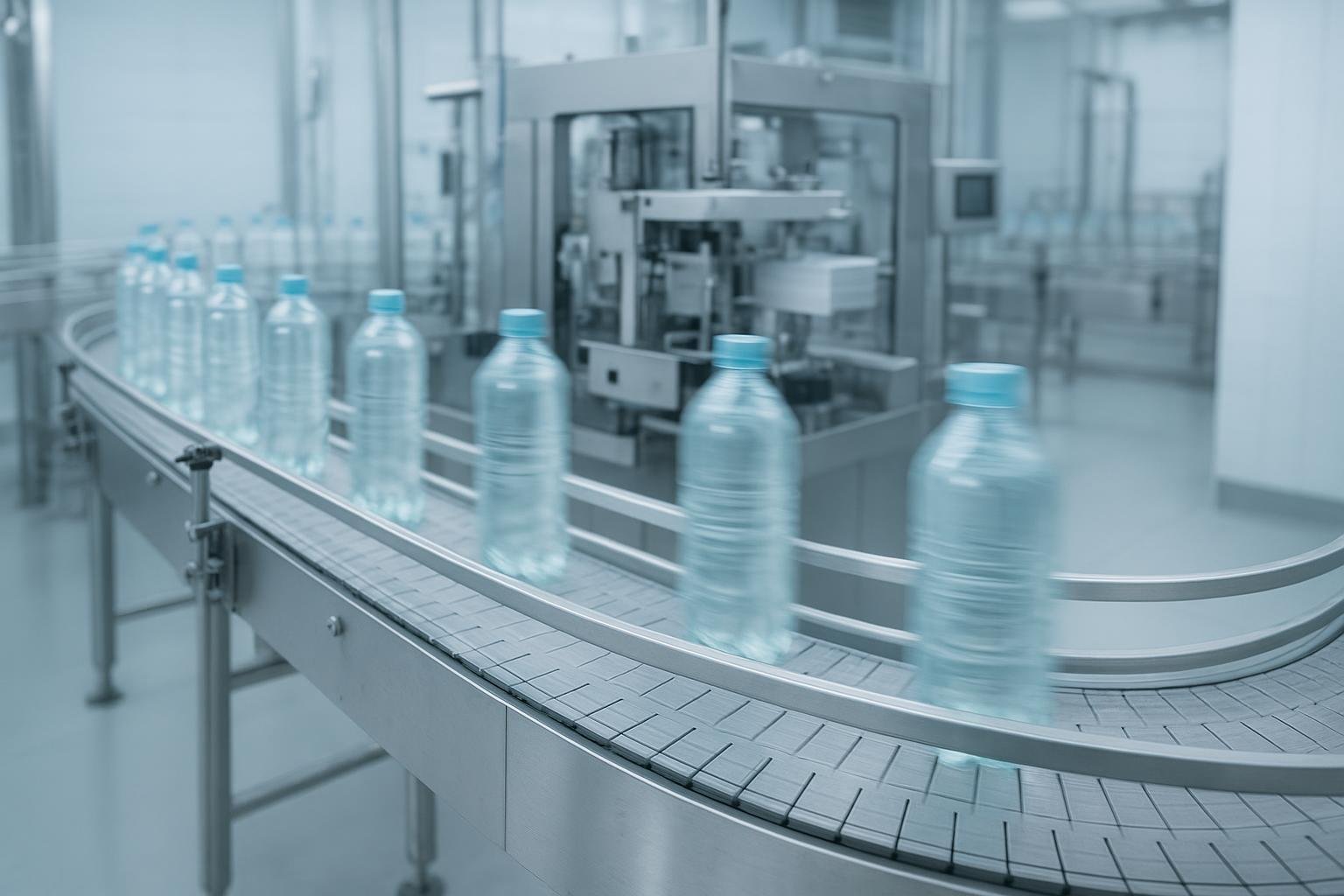
Tabletop/slat chain belts — Best for core bottle transport
Best for: Moving PET/HDPE/glass through filling, capping, labeling, and pack-out on straight sections and curves.
Key traits: Flat-top chain in acetal or stainless runs on UHMW wearstrips; ubiquitous 4.5-inch formats simplify layout and spare parts. ACASI notes that “the most common conveyor width in the bottling industry is the 4.5-inch tabletop, either straight or curved,” underscoring its role in line design according to the ACASI bottling conveyor overview. Integrator primers and OEM guides also document tabletop as a bottling mainstay, such as the Hanover Conveying belt-type guide and Dorner’s conveyor belt guide.
Pros: Mature ecosystem with chain varieties (low-friction, high-friction, LBP inserts); easy accumulation with dynamic backpressure control; wide curve options. Cons: Requires lubrication in many wet bottling environments; wearstrip management and sprocket alignment are ongoing maintenance items.
Fit notes: Especially good for high-speed bottle handling where consistent backline pressure is needed for starwheel feeds. Not ideal where ultra-small nosebar transfers are required for tiny vials.
Spec cues: Confirm chain series, minimum curve radius, and allowable speed from the manufacturer. For curve inspiration and small-radius layouts, see the compact-curve specs on Dorner’s C3 platform as a reference point.
Modular plastic belts (MatTop) — Best for curves, washdown, and format flexibility
Best for: Mixed product sizes, frequent changeovers, and hygienic washdown zones where quick repairs are valuable.
Key traits: Interlocking acetal/PP/PE modules with hinge rods; many surfaces (flat-top, open-grid, friction-top) and side-flex series for curves. You can tailor surface friction and open area to balance hold vs release. For series-level engineering data (materials, minimum radii, nosebar options), consult the Intralox Belt Finder.
Pros: Modular repairs reduce downtime; broad surface library; good cleanability and CIP-friendly designs. Cons: Heavier than single-ply PU; hinge lines can trap fines if sanitation design is weak; side-flex specs vary and must be verified.
Fit notes: Excellent for bottle and pack transport around multiple 90°/180° turns, and for wet, sugary environments. Not the first choice when you need ultra-tight transfers for tiny containers.
Spec cues: Validate minimum inside radius and nosebar diameters for your chosen series; confirm allowable speed and temperature range.
PU/PVC food-grade flat belts — Best for tight transfers and gentle handling
Best for: Lightweight primary packaging, pouches, trays, and delicate items requiring small nosebar transfers.
Key traits: One- or two-ply PU/PVC constructions with FDA/EU food-contact options. Ammeraal’s Food Safety Guideline summarizes compliance frameworks (EC 1935/2004; EU 10/2011 plastics; FDA where applicable) and hygienic design principles; see the Ammeraal Food Safety Guideline. Minimum pulley diameters can be very small on specific PU belts—Ammeraal’s Silam EM 8/2 data sheet lists a 6 mm flexing minimum—enabling crisp, low-gap transfers; see the Silam EM 8/2 datasheet. Comparable PVC and PU options with different bend radii are cataloged by Ammeraal and other suppliers such as Belting Edge’s food-grade range and the Lutze Group food & beverages lineup.
Pros: Ultra-small transfer diameters minimize product tipping; smooth, easy-to-clean surfaces; broad FG/AS options. Cons: More sensitive to tracking/tension; mechanical fasteners can create sanitation traps; not suited for heavy impact or sharp edges.
Fit notes: Ideal in feed-in/out of labelers, coders, and inspection where a small gap prevents snagging. Not ideal for abrasive environments or very heavy secondary packs.
Spec cues: Confirm flexing/backflexing pulley sizes, splice type (endless vs mechanical), and FG/antistatic declarations in the specific datasheet.
Low-back-pressure (LBP) accumulation — Best for buffering without damage
Best for: Line balancing between filler, capper, labeler, and case packer—keeping bottles moving without scuffing.
Key traits: Surfaces or inserts designed to reduce product-to-belt friction and backline pressure, allowing accumulation at speed. Concepts and options are explained in integrator resources such as Dorner’s accumulation overview. LBP can be achieved via roller-top modular belts, low-friction tabletop chain, or dedicated LBP chains with roller inserts.
Pros: Reduces jams and cosmetic damage; improves starwheel feeds; supports higher OEE during downstream slowdowns. Cons: Can complicate line control if friction is too low; added components (rollers) may increase maintenance.
Fit notes: Use where bottles routinely queue ahead of inspection, shrink tunnels, or packers. Not ideal when precise stopping/indexing is required—use timing belts there.
Spec cues: Verify the friction coefficient or roller geometry for your chosen belt/chain series and confirm accumulation length, speed, and control logic with the OEM.
Side-grip/gripper belts — Best for vertical bottle transfers in tight spaces
Best for: Elevating or lowering bottles between elevations without conveyors that consume floor space.
Key traits: Paired, opposing belts with compliant gripper covers hold bottles by the sidewall, enabling steep inclines/declines or “wedge” conveying. OEMs in canning/bottling reference side-grip/wedge solutions for compact vertical moves, as noted on Dorner’s canning & bottling page.
Pros: Minimal footprint; gentle handling when grip is tuned; continuous flow between levels. Cons: Requires careful setup to avoid label scuffing; limited bottle diameter range per setup; grip material wear is a consumable.
Fit notes: Great between rinser/filler mezzanines and floor-level pack-out. Not for unstable containers with very high center of gravity unless guided.
Spec cues: Confirm allowable bottle diameter range, grip material (e.g., silicone, NBR), belt speed window, and clearance to guards.
Timing/synchronous belts (PU/HNBR) — Best for indexing and pick-and-place feeds
Best for: Precise, repeatable motion into fillers, cartoners, case packers, and robotics cells.
Key traits: Positive-drive tooth profiles (e.g., GT, AT, T) available in weldable PU wide belts or rubber/HNBR. Gates documents GT4 synchronous belts with expanded temperature and chemical resistance—useful near washdown or caustics; see the Gates PowerGrip GT4 overview and sell sheet. For food-grade TPU and custom profiles, see the Gates TPU product catalog. Megadyne provides PU open-end and endless options, antistatic per ISO 9563, and packaging brochures; see the Megadyne urethane guide and packaging brochure.
Pros: Accurate indexing; low stretch; wide range of pitches and backings; profiles/cleats can be added for pockets. Cons: Requires correct tensioning and alignment; debris can affect tooth engagement; tooth wear if misaligned.
Fit notes: Choose PU for clean, weldable constructions and rubber/HNBR where heat or chemicals are harsher. Not for uncontrolled accumulation zones.
Spec cues: Match pitch to sprockets; verify allowable speed, temperature, and any FDA/FG declarations if in primary zones.
Roller-top and omni-directional modular belts — Best for diverting, merging, and low-pressure accumulation
Best for: Intraline merges, 90° transfers to case packers, and accumulation zones that protect labels.
Key traits: Integrated rollers in modular belts create very low surface friction; transverse versions allow side shifting for diverting. For example, Intralox Series 400 and 1400 Roller Top platforms detail roller diameters and configurations; see the Intralox S400 Roller Top and Intralox S1400 Roller Top. Transverse Roller Top variants support omni-directional handling; see Intralox S400 TRT and S4400 TRT.
Pros: Gentle product-on-belt contact; controlled diverts without pusher arms; scalable widths. Cons: Higher initial cost; requires well-designed controls; sanitation attention around roller bushings.
Fit notes: Ideal near labelers and case packers where directing flow matters. Not necessary on long, straight runs where standard flat-top suffices.
Spec cues: Confirm minimum transfer geometry (nosebars or inserts) if small containers are present; check allowable loads and speeds per series.
Wire mesh/stainless belts — Best for wash, rinse, and cooling tunnels
Best for: Rinse/cool zones where high open area and thermal compatibility are needed.
Key traits: Stainless wire mesh provides non-porous, easy-to-clean surfaces and airflow for cooling and washing. Wire Belt describes sanitation advantages and multiple mesh styles suitable for hygienic applications; see the Wire Belt sanitation article. Principles of open-grid and sanitation-friendly designs for cooling/freezing also appear in Ashworth’s plastic belt overview.
Pros: Excellent temperature resistance; high open area for spray/air; long service life with correct cleaning. Cons: Can imprint on soft packages; requires proper edge guarding; open area reduces support for small items.
Fit notes: Solid choice for bottle washing, rinsing, and cooling tunnels. Not ideal where tiny items could drop through the mesh.
Spec cues: Specify grade (304 vs 316), target open area, wire diameter, and sanitation method; validate compatibility with chemicals and temperatures.
Anti-static/ESD belts — Best for labelers, printers, and inspection zones
Best for: Reducing static that can skew print quality, attract dust, or interfere with sensors.
Key traits: Food-grade and antistatic belts are available with defined surface resistivity. Ammeraal publishes FG belts with AS/AM properties, and Volta documents ESD and AS material ranges (<10^8 Ω/sq for ESD; <10^10 Ω/sq for AS). See the Ammeraal Ropanyl EF 10/2 technical datasheet example and Volta ESD/AS catalog.
Pros: More stable labeling/printing; fewer nuisance shocks; better sensor reliability. Cons: Requires proper grounding; ESD characteristics can drift if belts are heavily worn or contaminated.
Fit notes: Use near CIJ/thermal printers, label applicators, and vision inspection. Not necessary in wet-only, non-sensitive areas.
Spec cues: Confirm resistivity range, grounding scheme, and any ATEX considerations; see Ammeraal’s ATEX guidance for explosive atmospheres.
Specialty friction-top or cleated modular belts — Best for inclines/declines of packs
Best for: Moving shrink-wrapped bundles or cartons up/down at controlled angles without slippage.
Key traits: High-grip surfaces (ribbed, nub, diamond) and optional tabs/cleats raise the maximum angle. Intralox documents ThermoDrive surfaces like Ribbed V-Top and Nub Top for moderate to steep inclines, and Series 1400 ProTrax with Tabs for up to roughly 30° performance depending on payload; see Intralox ThermoDrive surfaces and Series 1400 ProTrax with Tabs.
Pros: Reliable pack traction; predictable angles; modular maintenance. Cons: More friction means more motor power and wear; debris can wedge under tabs if housekeeping is weak.
Fit notes: Excellent after case packers and shrink bundlers. Not ideal for unsealed primary packages prone to snagging.
Spec cues: Confirm angle limits with your product’s COG and surface; validate sprocket/cleat compatibility and sanitation plan.
Decision matrix: matching belt types to typical bottling tasks
| Task | Tabletop | Modular plastic | PU/PVC flat | LBP accumulation | Side-grip | Timing | Roller-top | Wire mesh | ESD/AS | Friction/cleated |
|---|---|---|---|---|---|---|---|---|---|---|
| Filler to capper transport | Strong | Strong | Moderate | Strong | — | — | Moderate | — | — | — |
| Labeler infeed/outfeed | Strong | Strong | Strong | Moderate | — | — | Moderate | — | Strong | — |
| General accumulation | Strong | Strong | — | Strong | — | — | Strong | — | — | — |
| Tight transfers (small items) | — | Moderate | Strong | — | — | — | Moderate | — | — | — |
| Vertical elevation | — | — | — | — | Strong | — | — | — | — | — |
| Indexing/pick-and-place | — | — | — | — | — | Strong | — | — | — | — |
| Diverting/merging | — | Moderate | — | Moderate | — | — | Strong | — | — | — |
| Wash/rinse/cooling tunnels | — | Moderate | — | — | — | — | — | Strong | — | — |
| ESD-sensitive printing/inspection | — | — | Strong | — | — | — | — | — | Strong | — |
| Inclines/declines (secondary packs) | — | Strong | — | — | — | — | — | — | — | Strong |
Use this matrix as a starting point; verify final selection with vendor datasheets and trials.
Procurement checklist (quick scan)
- Define product form and stability: PET/HDPE/glass; filled vs empty; center of gravity; surface condition (dry, wet, sugary).
- Sanitation zone and compliance: Open plant vs CIP/washdown; FDA/EU food contact needs; HACCP/EHEDG expectations; documentation required.
- Transfer geometry: Minimum pulley/nosebar diameters; deadplate gaps; starwheel and guide rail interfaces.
- Throughput and control: Target speed, accumulation length, backline pressure strategy, indexing accuracy requirements.
- Materials and environment: Temperature, chemicals, abrasion; choose acetal/PP/PE, PU/PVC, stainless as needed.
- Power and structure: Drive sizing for friction surfaces; wearstrip materials (UHMW), frame drainage, and access for cleaning.
- Maintenance and spares: Tension/tracking plan, hinge rods/cleats/rollers, lead times, and tooling.
- Validation: Certificates for FG/ESD/ATEX; run-off test, sample belt, or on-site trial.
Two quick examples from the field
- Labeler jams reduced with tight transfers: A beverage plant swapping a small infeed belt to a PU model with a 6 mm minimum pulley reduced tip-over and label misapplies at the labeler infeed. The approach mirrors specifications found in Ammeraal’s PU datasheets, such as the Silam EM 8/2 example, where small pulley diameters enable near-gapless transfers.
- Gentler accumulation before case packing: Plants deploying roller-top modular belts report smoother queuing and fewer scuffs ahead of packers, consistent with the low-back-pressure behavior described on Intralox Series 400 Roller Top product pages.
FAQ
-
What is the best belt for bottling lines? There isn’t a single “best.” Match belt to task: tabletop for core bottle transport; modular plastic for curves and washdown; PU/PVC for tight transfers; LBP or roller-top for accumulation; timing belts for indexing; wire mesh for wash/rinse; ESD belts near printers.
-
Do I need FDA or EU food-contact belts for packaging? Only where the belt may contact food or the primary package interior. For guidance on frameworks like EC 1935/2004 and EU 10/2011, see the Ammeraal Food Safety Guideline and validate with your HACCP/EHEDG policies.
-
How small can my transfer be without tipping bottles? It depends on container diameter and belt design. PU belts can reach very small pulley diameters (e.g., 6–14 mm on certain models), while modular/tabletop typically require larger nosebars; verify with series datasheets and test.
-
Is lubrication still required on tabletop chains? Often yes in wet environments; dry lube systems are common. Confirm with your chain supplier and consider low-friction chain materials to manage backline pressure.
-
What about air conveyors for PET preforms or empty bottles? Air conveyors are common for empties, but they’re outside the scope here. This guide focuses on belt/chain conveying once bottles are on the line.
-
How do I size accumulation length? Start from downstream rate losses and target buffer time (e.g., 2–5 minutes of production). Then select LBP/roller-top solutions and control logic to keep backline pressure within acceptable limits.
Methodology notes and sources
In addition to hands-on integration experience, this article references recognized vendors and guides: ACASI on 4.5-inch tabletop norms in bottling via the ACASI conveyor overview; tabletop and bottling notes in the Hanover Conveying guide and Dorner’s conveyor belt guide; hygienic and compliance frameworks in the Ammeraal Food Safety Guideline; PU/PVC tight-transfer examples via Ammeraal’s Silam EM 8/2 datasheet; ESD/AS ranges from the Volta ESD/AS catalog; roller-top capabilities from Intralox Series 400/1400 references; and wash/cooling tunnel principles in Wire Belt’s sanitation explainer and Ashworth’s plastic belt overview. For a general primer, see BBM Packaging’s overview of bottling conveyors.
A practical next step
If you’re scoping non-food-contact legs—like case conveyors to palletizers—or need idlers and pulleys that minimize rolling resistance, a general industrial supplier can help you size components and optimize uptime. BisonConvey — Disclosure: BisonConvey is our product — focuses on heavy-duty belts and components for demanding environments; see the company overview at BisonConvey. For food-contact belts and specialty bottling surfaces, validate options with the manufacturers linked above and request application-specific datasheets and trials.