
If your belt fails early or your idlers seize, production doesn’t just slow—it bleeds money. The good news: you can avoid most of those headaches by qualifying vendors with the same rigor you use on critical rotating equipment. This guide shows exactly how to select conveyor manufacturers in Asia with standards-backed checks, audit-ready artifacts, and practical thresholds you can verify before you buy.
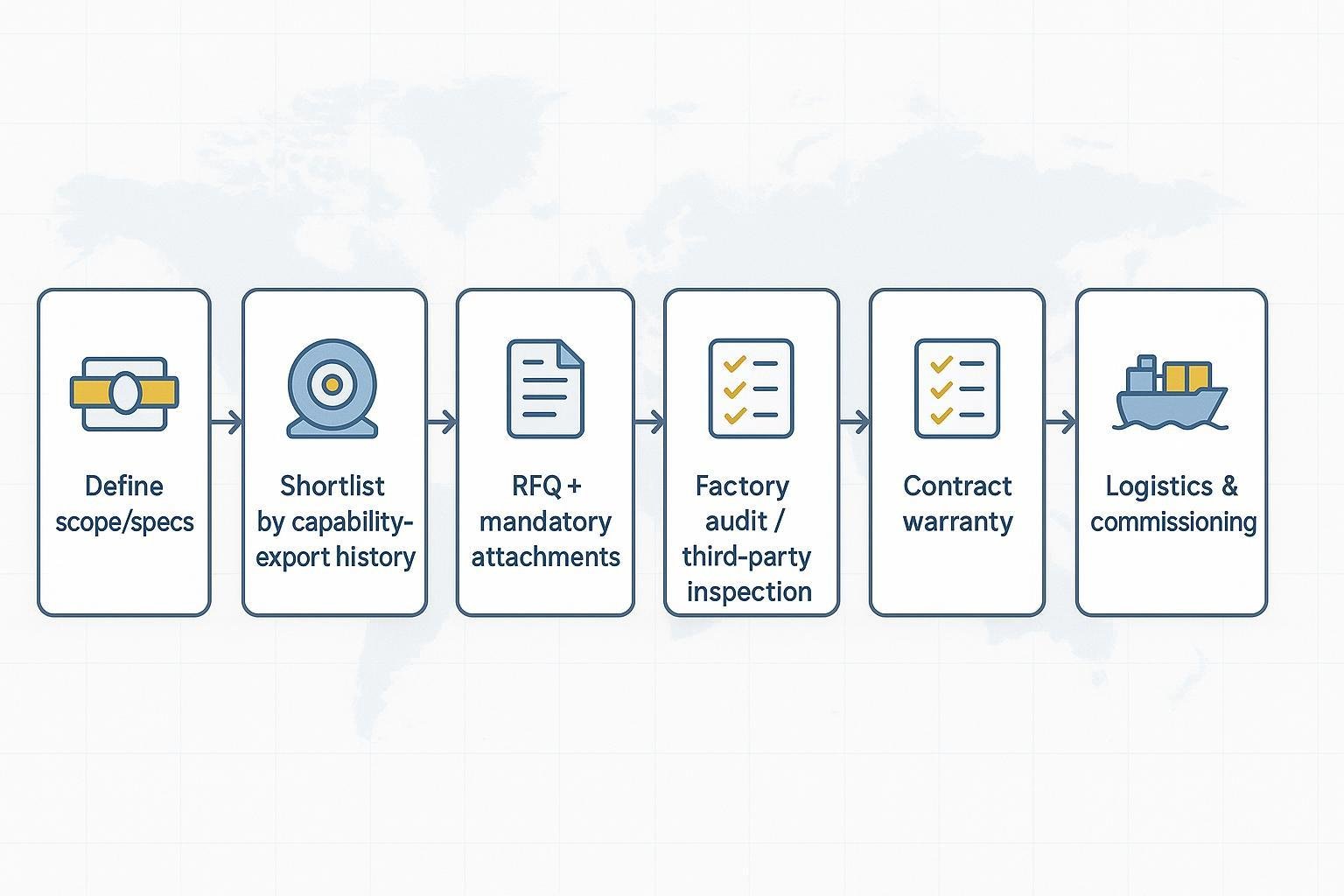
The 7-step workflow to select conveyor manufacturers in Asia
Choosing a supplier isn’t a mystery; it’s a repeatable process. Here’s the deal: run this workflow end to end and you will filter out noise fast while surfacing manufacturers who can meet spec and ship on time.
-
Define scope and critical specs. Decide whether you need a full system integrator or component specialists (belts, idlers, pulleys). Lock the duty, material, environment (abrasion, heat, flame, corrosion), belt type (EP/NN vs steel cord), idler class, and pulley requirements.
-
Shortlist by capability and export history. Look for factories with the product scope you need, evidence of shipments to your destination industry/country, and English (or target-language) documentation maturity. Request a basic data pack before RFQ: company profile, equipment lists (calenders, steel-cord lines, balancing rigs), and three recent export POs with Incoterms.
-
RFQ with mandatory attachments. Your RFQ must demand drawings with tolerances, a draft Inspection & Test Plan (ITP), and sample test reports for similar products. Specify the standards that will govern acceptance and the documents you expect at FAT/SAT.
-
Samples and test plan. For belts: lab strips for ISO tensile/adhesion/abrasion; for idlers: one roll per size for runout and rotational resistance checks; for pulleys: a sample balance/NDT report from a recent job. Decide which tests you’ll witness.
-
Factory audit or third-party inspection. Validate QMS implementation on the floor, inspect test labs and calibration, observe welding, machining, and balancing. Trace materials back to MTRs, and verify bearing authenticity.
-
Contract and warranty. Convert acceptance criteria into contract exhibits (ITP, drawings, test reports, QA records). Nail down warranty terms tied to duty, exclude misuse, include spare parts lead times and availability.
-
Logistics and commissioning. Choose the right Incoterm, confirm ISPM 15 wood packaging, validate HS codes, and plan buffers for today’s routing realities. Set up Site Acceptance Test (SAT) steps so commissioning isn’t a scramble.
Standards you can actually check (and what to ask for)
Standards don’t buy you certainty unless you translate them into documents and data you can read. Below are the must-haves and how to verify them.
Belts — textile and steel cord
Ask for a conformity statement that ties your product to ISO belt families and test methods. For textile belts, require ISO 14890 for specifications and ISO 283:2023 for full-thickness tensile and elongation, plus ISO 4649 abrasion and, if needed, ISO 340 flame testing. The ISO ICS index for conveyor belts lists these families clearly; use it to align your RFQ and acceptance plan, as summarized by the official ISO index for belt standards and tests in ICS 53.040.20. See the standards families overview in the ISO ICS index for belts and tests: the conveyor belt section shows ISO 14890, ISO 283:2023, and related methods under a single umbrella, making it easier to cite in RFQs (ISO ICS 53.040.20 index). For steel cord belts, reference the ISO 15236 series for longitudinal tensile and adhesion tests, which supersede older traction test methods linked to legacy ISO 7622 in standards histories (ISO 15236 series overview).
Buyer checks to record:
- Drawings show belt construction (EP/NN vs steel cord), cover grades and thicknesses, and minimum pulley diameters (you may cross-check approach using ISO 3684’s minimum pulley guidance via the ISO OBP index: request the vendor’s calculation method and values) (ISO OBP index for belt diameters).
- ISO 283/15236 reports list lab accreditation, method, sample size, date, and results (tensile, elongation, adhesion). Abrasion data reports mm³ loss per ISO 4649; flame tests cite ISO 340 if your industry requires it.
- Materials traceability: MTRs for steel cords and compound batch records; splice method and splice test data pre-approved.
Idlers — classes, runout, and rotational resistance
Specify ANSI/CEMA Standard No. 502 for troughing and return idlers and call out the intended class (B through F/G). CEMA’s published engineering conference and committee agenda sets confirm that 502 governs dimensional compatibility and that Total Indicated Runout (TIR) tables and impact/energy concepts are part of accepted practice; they also document proposed rotational resistance test setups and prerequisites like ≤0.015 in TIR at the support point for Type A tests at around 500 rpm. Use those public documents to anchor your RFQ language and request the supplier’s test procedures and data (CEMA committee agenda set, 2019; see also an earlier test-method note in the CEMA idler committee agenda set, 2012).
Buyer checks to record:
- Supplier declares ANSI/CEMA 502 class and provides dimensional drawings; TIR/runout results and rotational resistance data with method references and test conditions (diameter, speed, grease type).
- Bearings and seals: brand/class stated; labyrinth design shown; grease specification provided; optional water ingress test with method, pressure, duration, and raw data.
For Asia context on cross-standards interchangeability, some reputable manufacturers publish mappings showing how ISO/DIN/JIS/GB/CEMA frameworks coexist for idlers and rollers. That helps you assess dimensional compatibility in mixed-standard plants (Idler standards mapping example from a leading Asian OEM).
Pulleys — balancing, lagging, and weld quality
Demand balance reports that cite the applied part of ISO 21940 for rigid rotor balancing and the selected G grade (e.g., G16 for general conveyors, subject to speed/service). ISO’s overview pages help you reference the right document family in contracts (ISO 21940 overview). For welding/NDT, require QA plans and reports aligned to ISO 5817 for weld quality levels and appropriate methods such as magnetic particle (ISO 17638) and ultrasonic testing (ISO 17640). TWI’s technical notes provide helpful context on how these standards interrelate in fabrication quality and acceptance (TWI guidance on welding/NDT and ISO 5817). For lagging, ask for material (e.g., SBR ~60 Shore A), thickness, groove pattern, and bond QA; pulley OEM catalogs show the range of lagging options and document in-house QA including balancing and NDT so you can mirror expectations in your ITP (Pulley and lagging catalogs example).
Buyer checks to record:
- Balance grade and speed assumptions stated; report shows residual unbalance and correction method; serial traceability matches your PO.
- Weld QA shows WPS/PQR, welder qualifications, visual acceptance to ISO 5817 level B/C as specified, and NDT results per plan.
- Lagging spec and bond test records attached; hardness and groove pattern verified.
Factory audits and testing that de-risk your order
On-site you want to confirm that the promised quality system lives on the shop floor. Start with certificate validation: ISO 9001:2015 should be in scope for design/manufacture of your items and verifiable through accredited chains such as IAF CertSearch or national accreditation portals like UKAS CertCheck. ISO and IAF explain why accredited certification matters and how to validate a certificate’s scope, site coverage, issue/expiry dates, and accreditation trail (ISO certification guidance; see also UKAS CertCheck).
In fabrication areas, look for WPS/PQR binders and calibrated gauges. For pulleys, observe welding, then ask to see NDT stations and final dynamic balancing; tie each step back to serial numbers and reports. TWI’s overviews connect ISO 5817 acceptance with NDT methods you’ll see on the floor, so use that to align your acceptance plan with what the factory does in practice (TWI fabrication quality overview). For idlers, request a live runout and rotational resistance demonstration under the same conditions used in the supplier’s declared method. For belts, inspect sample preparation and lab records for ISO 283/15236 tests; confirm lab accreditation and sample sizes.
Red flags during audits include unverifiable ISO 9001 certificates, inconsistent test records, resistance to showing sub-supplier traceability (compounds, bearings), and balancing rigs without documented calibration. Any of these should pause qualification until corrected.
RFQ fields and acceptance documentation
Below is a compact field set you can paste into your RFQ and later use to check submissions. Include it as an attachment and make every row a contractual exhibit.
| Category | Key RFQ fields to specify | Documents you expect back for acceptance |
|---|---|---|
| Belts (textile) | EP/NN; tensile rating; cover grade and thickness; min pulley diameters; splice method; environment (abrasion/heat/flame) | ISO 14890 conformity; ISO 283:2023 tensile/elongation; ISO 4649 abrasion; ISO 340 flame (if needed); drawings; MTRs/compound batch records |
| Belts (steel cord) | Cord class; rated strength; cover grade; splice design; indentation rolling resistance need (energy modeling) | ISO 15236 tensile/adhesion; splice test data; MTRs for cords; optional ISO 23586 report; drawings with tolerances |
| Idlers | ANSI/CEMA 502 class; diameters/lengths; trough angle; bearing brand/class; sealing type; grease | TIR/runout data; rotational resistance report with method/conditions; drawings; bearing authenticity evidence; noise/balance checks |
| Pulleys | Shell/shaft material and thickness; lagging type/thickness/pattern; welding process; balance grade (ISO 21940) | Balance report with G grade and speed; WPS/PQR; welder quals; ISO 5817 acceptance; MT/UT reports; lagging hardness/bond QA; serial traceability |
| QMS & traceability | ISO 9001 scope; calibration list; ITP with hold/witness points; sub-supplier control | Validated ISO 9001 certificate; calibration records; ITP signed; PPAP/FAI (as needed); batch/lot traceability to MTRs |
| Export & packing | Incoterm; HS codes; WPM; marking; insurance; photos | Packing list; commercial invoice; ISPM 15 marks on crates; cargo photos; insurance cert (if CIF); country-specific docs |
Supplier scoring rubric (quality, evidence, traceability, logistics, TCO)
Score suppliers against the same yardstick every time. Weight most points toward evidence-backed quality and lifecycle support rather than headline price.
| Criterion | Weight | What full credit looks like |
|---|---|---|
| QMS and certificate validity | 15% | ISO 9001:2015 in-scope; verifiable via IAF/AB portal; multi-site coverage documented |
| Standards/test evidence | 25% | Complete ISO/CEMA/ISO 21940 reports with lab creds, methods, raw data; drawings with tolerances |
| Materials and traceability | 15% | MTRs for metals; compound batch IDs; bearing lot traceability; PPAP/FAI for new designs |
| Process capability | 15% | Documented equipment lists (calenders, cord lines, balancing rigs); capacity data aligned with lead times |
| Export & logistics readiness | 10% | Correct HS codes; Incoterm proficiency; ISPM 15 program; accurate docs on prior exports |
| Lifecycle support | 10% | Warranty clarity; spare parts policy/lead times; after-sales contacts in-region |
| Cost & TCO | 10% | Competitive price plus energy/wear/downtime discussion; not just unit cost |
Interpretation: Anything below 70% overall should remain in “develop” status with corrective actions. Above 85% with clean audits usually qualifies for trial orders.
Export, packing, and customs you shouldn’t skip
Incoterms 2020 define who arranges carriage, insurance, and where risk transfers. The ICC’s official pages are the most reliable reference. For containerized shipments from Asia, FCA typically avoids the FOB paperwork trap; FOB remains suited to non-container sea shipments; CIF includes seller-arranged sea freight plus minimum insurance; DAP covers delivery without import clearance (ICC Incoterms 2020 overview). ISPM 15 wood packaging rules require HT or MB treatment and IPPC marks on two opposing sides under NPPO oversight—use the IPPC explanatory document to brief your packing team and to audit supplier crates (IPPC ISPM 15 explanatory document).
Confirm HS codes early with your broker. Textile conveyor belts are often classified under 5910 per Trade.gov references; your exact code may vary by construction and destination—lock this before documents are cut (Trade.gov HS 5910 reference). Finally, plan time buffers. Ongoing Red Sea rerouting has added days to many sailings; forwarders advise booking early and building contingency into your critical paths (Flexport advisory on Red Sea impacts).
- Choose the Incoterm that matches your control/risk appetite and shipment mode.
- Require IPPC-marked, ISPM 15-compliant crates and photo evidence before shipment.
- Align HS codes and valuation with your broker to prevent holds.
- Add 2–3 weeks of buffer on ocean routes affected by diversions.
Red flags and smart negotiation levers
Supplier behavior during qualification tells you a lot. Watch for unverifiable certificates, reluctance to share raw test data, vague balancing notes without ISO 21940 references, idlers with no rotational resistance method, or bearings bought through gray channels. Each is a risk—and a lever.
- Tie milestone payments to the delivery of specific QA documents (e.g., balance report with G grade, ISO 283 results) instead of calendar dates.
- Set hold points in the ITP for weld NDT and roll runout checks; no sign-off, no shipment.
- Use third-party labs or inspectors to witness critical tests if internal labs lack accreditation.
- Consolidate shipments and standardize crate designs to lower damage risk and freight cost.
- Offer trial orders with price escalation only after passing FAT against your thresholds.
Example: what good looks like in practice
On mixed-standard plants, you’ll often buy belts, idlers, and pulleys from one qualified source for compatibility and accountability. Manufacturers such as BisonConvey produce belts (steel cord and EP/NN), idlers (including impact and UHMWPE types), and pulleys for heavy-duty service. When you shortlist similar Asian suppliers, ask upfront for ISO 9001 validation, ANSI/CEMA 502 dimensional/class data for idlers, ISO belt test reports (ISO 283/15236 families), pulley balance reports citing ISO 21940 with the selected G grade, and export documentation samples. That evidence—more than any brochure—predicts a steady, low-maintenance install.
Next steps and downloadable templates
Start this week: send an RFI that mirrors the RFQ table above, ask for a draft ITP and two anonymized test reports, and block time for a remote factory walk-through. Build your scorecard from the rubric here and enforce witness points for balancing, idler runout, and belt tensile/adhesion. If you keep everything tied to standards and serial numbers, your first shipment will arrive not as a gamble, but as a controlled, auditable investment.