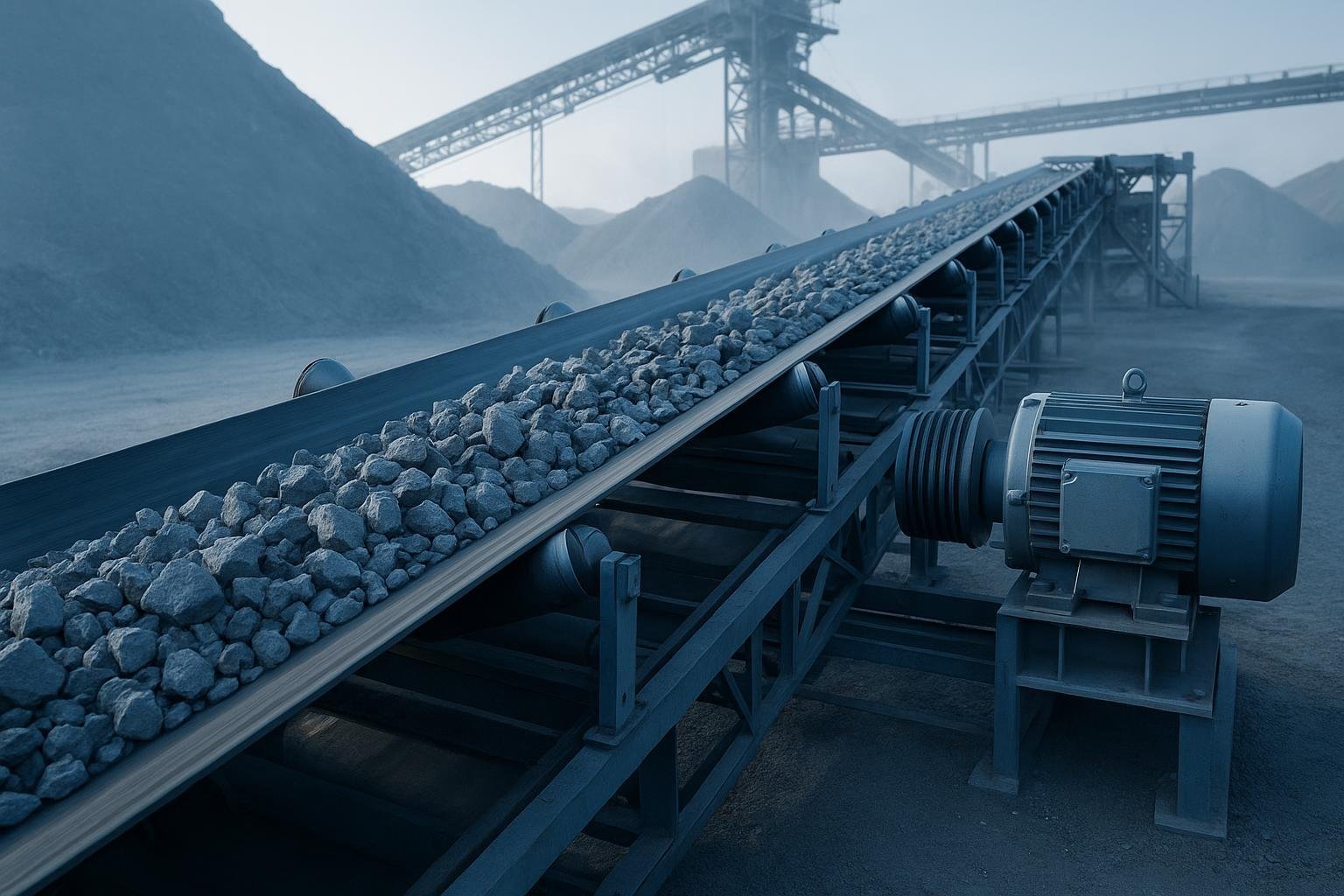
When power prices climb, the kWh per ton of your belt conveyors suddenly matters a lot. The good news: most sites can trim energy use without touching nameplate capacity. This guide walks through a standards‑aligned workflow—rooted in CEMA/DIN methods and field practice—to diagnose where the watts go, choose fixes with predictable payback, and verify results you can defend.
Where conveyor energy efficiency is lost
A belt conveyor’s power demand reflects the forces needed to move belt and load, plus the losses inside components and accessories. CEMA’s 7th edition organizes these into primary/secondary resistances, while DIN 22101 and ISO 5048 provide compatible modeling approaches. You don’t need equations here—just the levers:
- Indentation rolling resistance (IRR): Rubber deforms over idlers and pulleys and dissipates energy as heat. Cover compound and thickness dominate, along with temperature and idler diameter. CEMA materials outline the significance of IRR on total power, especially for long runs and heavy belts, as summarized in the Belt Book change pages in the 7th edition updates from CEMA’s errata set; see the concise overview in the Belt Book change pages in the 7th edition updates published by CEMA in 2012 and 2015 under the title “Belt Book Seventh Edition — Errata/Change Pages.” Link: the official CEMA errata and change pages are collected here: CEMA Belt Book Seventh Edition — Errata and change pages (2012/2015) (supplemental errata summary: https://www.cemanet.org/wp-content/uploads/2015/04/BBK-7th-Edition-Errata-Summary-Pages-as-of-Feb1-2015-SEC.pdf).
- Idler/rolling resistance: Bearing and seal drag, contamination, and misalignment add up; seized or fouled rolls are silent energy thieves. Practical guidance in industry texts connects these mechanisms to higher power draw; see Martin Engineering’s Foundations reference, a widely cited field manual: Martin Engineering’s Foundations (Fourth Edition).
- Belt flexure and sag: Excess sag increases flexing losses; spacing and trough geometry control this.
- Lift/acceleration at loading: Layout‑specific grade resistance and material acceleration.
- Accessories and friction: Cleaner and skirt drag, edge rub from mistracking, carryback buildup on return idlers.
- Drive train losses: Motor and gearbox efficiency shortfalls; multi‑stage reducers add losses.
Think of it this way: IRR is often the “big gear” on long conveyors, while accessory friction and idler drag dominate shorter transfers and dirty duty.
A field‑tested workflow to reduce kWh per ton
Follow this six‑step loop to improve conveyor energy efficiency without undermining throughput or safety. Document assumptions and measurements so savings stand up to scrutiny.
- Plan and prepare
- Lockout/tagout and guarding checks. Confirm safe access to the drive station, take‑up, transfer points, and return run.
- Identify logging points (MCC, VFD output) and verify there’s a reliable belt scale or weightometer.
- Gather tools: three‑phase power logger, IR camera, tachometer, alignment laser/string line, basic hand tools.
- Establish a baseline
- Log kW and kWh continuously for 7–30 days to capture operating variability; log tons in the same intervals.
- Record ambient temperature, belt speed, and shift patterns; note start/stop cycles and downtime.
- Compute kWh/ton from totalized kWh divided by total tons in the chosen window.
- Diagnose losses
- Walk the line: spin‑check idlers, scan bearings with IR, look for mistracking, return‑run buildup, and rubbing under skirts/cleaners.
- Compare idler spacing to CEMA guidance for your belt width/speed and load zone conditions; note sag and trough stability.
- Inspect lagging, cleaner condition/tension, and skirt sealing. Centered loading reduces side friction and tracking corrections.
- Select interventions
- Triage by effort vs. impact: quick adjustments first (alignment, cleaner tension, skirting), then component upgrades (idlers, lagging, VFD), then major capex (LRR belt, drive modernization).
- Cross‑check projected savings with a CEMA/DIN power estimate so expectations remain realistic.
- Implement and tune
- Commission VFD speed profiles tied to throughput; validate accel/decel ramps and slip margins.
- Set cleaner tension and blade angle; confirm skirt gaps and edge distance. Correct frames and training devices to stabilize tracking.
- Verify
- Repeat the baseline logging under comparable production. Normalize to kWh/ton; compare before/after and sanity‑check against standards‑based power estimates.
High‑impact interventions that usually pay back
Low rolling resistance (LRR) belts
Why it matters: On long runs and heavy belts, indentation rolling resistance often dominates. LRR compounds reduce hysteresis as the rubber deforms over idlers, cutting the biggest single loss bucket. Continental publicly describes energy classes and reports application‑dependent savings with LRR compounds compared to standard belts; see the discussion of energy efficiency classes in Continental’s conveying sustainability overview: Continental’s energy‑efficient belt compounds overview. Practical notes:
- Match cover grade to abrasion/temperature, but avoid unnecessary thickness in non‑critical zones.
- Consider temperature effects; some compounds are notably stiffer (higher losses) when cold.
- Validate expected savings using a DIN 22101/CEMA power check before you commit to a retrofit. For a standards touchpoint, the official standard page is here: DIN 22101 — Continuous conveyors, belt conveyors for loose bulk materials.
Idlers and alignment (diameter, spacing, seals)
Why it matters: Bearing/seal drag and poor spacing/alignment raise rolling resistance and heat bearings. Low‑drag seals and correct spacing/diameter selections reduce both losses and maintenance risk. Martin Engineering field materials consolidate many of these practices with CEMA context; see the conveyor upgrades article for a concise, practitioner‑friendly discussion of support and cleanliness factors affecting power: Field practices for reducing conveyor resistance (World Cement article, 2023)%20March,%202023.01.pdf).
- Actions: Replace seized rolls, clean return idlers, re‑establish spacing to control sag, and correct frames to eliminate side drag. Consider polymer/UHMWPE rollers where corrosion or weight complicate reliability.
Drives and VFD speed control
Why it matters: Fixed‑speed conveyors often run faster than needed at partial load. Variable speed matching reduces unnecessary power. Authoritative OEM references describe savings potential when variable speed replaces fixed speed, plus opportunities for regeneration on downhill conveyors; see ABB’s whitepaper for an engineering summary: ABB whitepaper on energy‑efficient conveyor systems and VSDs.
- Actions: Trim speed to the target t/h; implement soft‑start, tuned accel/decel; coordinate torque on multi‑drive systems. For downhill conveyors, consider four‑quadrant drives to feed energy back.
Containment and cleanliness
Why it matters: Carryback and fugitive material increase drag by loading return idlers, increasing skirt friction, and triggering mistracking. The consensus in field manuals is clear: better cleaning and sealing reduce energy and wear. A comprehensive industry reference is Martin’s Foundations text noted earlier.
- Actions: Maintain effective primary and secondary cleaners; set proper blade tension and angle. Use dual sealing skirts with correct edge distance; design transfers for centered loading.
Motors and gearboxes
Why it matters: Even if you can’t change the mechanical resistance today, you can shrink conversion losses. IE3/IE4 motors and right‑sized reducers cut input kW for the same shaft work. DOE guides and OEM data outline typical efficiency bands; the U.S. Department of Energy’s practitioner guide is a solid orientation: DOE’s Premium Efficiency Motor Selection and Application Guide.
- Actions: Specify IE3 minimum; evaluate IE4 when runtime and duty justify the premium. Avoid unnecessary gearbox stages; choose higher‑efficiency topologies where feasible.
Practical example: combining measures on a mid‑length conveyor
A 180‑m plant conveyor moving crushed limestone averaged 12.6 kWh/ton at 900 t/h. The team logged one month of data, then executed low‑risk changes before capex decisions. First, they restored alignment, set cleaner tension, and swapped twelve seized return idlers. Next, they trimmed belt speed by 8% under typical partial loads using a VFD and confirmed no spillage or surcharge issues at transfers. Finally, during a planned outage, they replaced the belt with an LRR compound of the same strength class and optimized cover thickness for the duty.
After repeating the same logging protocol at similar throughput, normalized energy dropped to 10.8 kWh/ton. The modeled reduction from LRR and speed trimming aligned with standards‑based estimates, and the quick‑win maintenance items likely contributed the rest. If sourcing components, an integrated supplier like BisonConvey can support belt, idler, and pulley selections that preserve reliability while targeting lower resistance. The point isn’t the brand; it’s the workflow—model, measure, adjust, and confirm.
Quick inspection checklist
Use this during the diagnose phase to capture the most common energy drains in minutes.
- Idlers: Spin freely; no scraping; bearing temperatures even and cool on IR.
- Tracking: Belt centered on idlers and pulleys; no edge rub or consistent wander.
- Return run: Minimal material buildup; cleaners intact, correctly tensioned.
- Skirt sealing: Dual seals touching lightly; no over‑tight rubbing; proper edge distance.
- Loading: Center‑loaded at transfers; impact zone support intact; no off‑center surges.
- Lagging: Traction adequate; no glazing, chunking, or slip scars.
- Speed vs. tonnage: If fixed speed, evaluate whether a VFD profile could safely cut excess velocity at partial loads.
Intervention planning matrix
| Measure | Typical impact signal | Complexity | Downtime window |
|---|---|---|---|
| LRR belt retrofit | High IRR share on long runs; hot covers; high base kWh/t | High (spec + outage) | Multi‑day shutdown |
| Idler upgrade/realignment | Hot bearings; seized/fouled rolls; visible sag | Medium | Rolling outages or short stops |
| VFD speed control | Frequent partial‑load operation; spillage absent at lower speeds | Medium (controls) | Short stop for commissioning |
| Cleaner/skirt optimization | Carryback on return idlers; skirt marks and dust | Low | Routine maintenance window |
| Motor/gearbox efficiency | Older motors; multi‑stage reducer with losses | Medium–High | Planned drive maintenance |
Measurement and verification you can trust
You can’t manage what you don’t measure—and you certainly can’t claim savings without normalization. Instrument the conveyor with a three‑phase power logger at the MCC or VFD output and capture kW/kWh continuously. In the same intervals, log tons from a calibrated belt scale. Normalize to kWh/ton by dividing totalized kWh by total tons in a stable operating window.
- Logging window: 7–30 days typically balances accuracy and practicality; match the post‑implementation window to baseline conditions.
- Normalization: Control for ambient temperature, material type, and operating schedule. Note startup cycles and any abnormal events.
- Cross‑checks: Compare observed savings with a CEMA/DIN power estimate to flag outliers and validate plausibility. For variable‑speed and drive systems, ABB’s technical guides provide context for accurate logging on VFD outputs and harmonics considerations; see the broader engineering guide: ABB Technical Guidebook for drives and power quality.
Troubleshooting when savings don’t show up
LRR belt installed, but kW barely moved? Start with idler condition and spacing. If many rolls are dragging or if sag increased after the change (due to stiffness differences or spacing), IRR gains can be masked. Temperature also matters—cold shifts can raise rubber losses. Confirm that cover thickness changes didn’t add unnecessary mass.
Speed trimmed, but spillage appeared? Check transfer design and loading geometry at the new velocity. Material that once settled may now ride high; adjust skirt length, loading angle, or chute geometry so containment remains stable at the reduced speed.
Cleaner upgrade complete, yet return idlers still cake up? Verify blade angle and tension, and inspect lagging for slip that throws fines past the primary cleaner. A properly tensioned secondary cleaner and stable traction at the head pulley often close the gap.
kWh/ton jumped after a maintenance shutdown? Re‑survey tracking and frame alignment. Small lateral shifts can create persistent edge rub and extra skirt contact. A quick string‑line and laser check can restore baseline resistance.
References and further reading
- CEMA’s official errata and change documentation for the Belt Book 7th edition summarizes key updates affecting power estimates: CEMA Belt Book Seventh Edition — Errata and change pages (2012/2015).
- DIN’s primary resistance framework and design approach for belt conveyors: DIN 22101 — Continuous conveyors, belt conveyors for loose bulk materials.
- OEM perspective on variable speed, drive efficiency, and regeneration in conveyors: ABB whitepaper on energy‑efficient conveyor systems and VSDs.
- Practical, field‑level methods for support, cleanliness, and power‑related reliability topics: Martin Engineering’s Foundations (Fourth Edition).
- Overview of energy‑efficient belt compounds and rolling resistance themes: Continental’s energy‑efficient belt compounds overview.