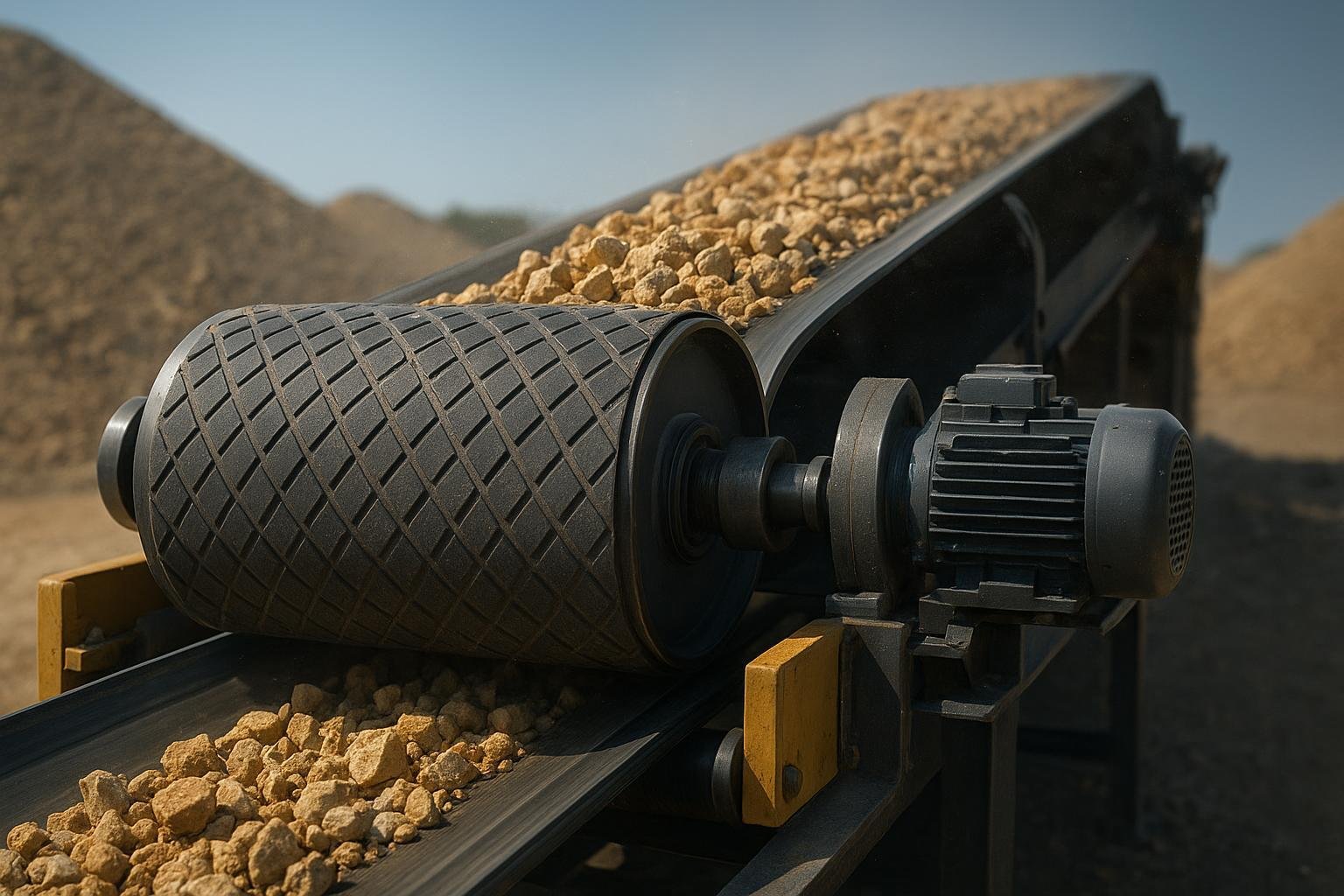
A conveyor drive pulley is the powered pulley that grips the belt and turns it, moving material down the line. In bulk handling, the drive pulley is typically mounted at the head (discharge) end and coupled to a motor and gearbox. Think of it like the driven wheel on a vehicle: torque comes from the motor, traction comes from the contact between the pulley face and the belt cover.
According to the manufacturer guidance in the PCI Conveyor Pulley Selection Guide (2023), the drive (head) pulley’s job is to transmit power to the belt. Practical overviews emphasize that traction—often aided by lagging and appropriate wrap angle—allows the pulley to move the belt and load without slip.
Definition and Where It Sits
- Drive pulley: A powered pulley that transmits torque to the belt through friction. Most systems place it at the head end.
- Head pulley: A location term—the pulley at the discharge end. When the drive is at the discharge, the head pulley is also the drive pulley.
The tail pulley (at the feed end) is usually non-powered, and snub or bend pulleys are non-powered redirection pulleys used to shape the belt path and, near the drive, to increase wrap.
| Pulley type | Powered? | Typical location | Primary role |
|---|---|---|---|
| Drive (often the head) | Yes | Head/discharge | Transmit torque to the belt via friction |
| Head | Sometimes | Discharge end | Redirect into return; if driven, it’s the drive pulley |
| Tail | No | Feed end | Redirect from return to carry; interfaces with take-up |
| Snub | No | Near the drive | Increase wrap angle over the drive for traction |
| Bend | No | Various (routing) | Change belt direction on carry/return runs |
How a Drive Pulley Moves the Belt
The belt moves because the drive pulley develops frictional grip with the belt cover. Two things control how much torque the pulley can transmit without slipping:
- The coefficient of friction between the belt cover and the pulley lagging.
- The belt’s wrap angle around the drive pulley.
Here’s the deal: the maximum tension ratio the pulley can support before slip is governed by the capstan (Euler–Eytelwein) relation, which in plain terms says “more wrap or more friction equals more traction.” Designers first calculate tight-side and slack-side tensions with methods in ISO/DIN/CEMA, then check whether the available traction is enough. See an overview of ISO/DIN power and tension methods in the CEMA technical paper referencing DIN 22101 friction factors (2019).
Because wrap angle matters, you’ll often see a snub pulley placed near the drive to increase wrap across the drive pulley, improving traction during start-up, steady running, and emergency stops.
Lagging and Tracking Essentials
Lagging is the cover applied to the drive pulley face—usually rubber or ceramic tiles—to raise friction, shed water, and resist abrasion. It’s central to reliable traction in wet or contaminated service.
- Rubber lagging: Common in dry service, available in patterns (e.g., diamond) to help water shedding. Effective friction can drop in wet conditions.
- Ceramic lagging: Inlaid or full tiles increase friction and maintain grip better when wet or muddy; they also resist abrasive wear.
Important caveat: there isn’t a single universal friction number (μ) that applies to all belts and laggings. The value depends on belt cover compound, lagging type and texture, contamination, temperature, and test method. Vendors advise using product-specific data and traction calculators. Flexco notes these variables and provides selection resources in its Flex-Lag technical guide (2021).
On tracking, crowning (a slightly domed pulley face) can help some fabric belt applications, but alignment and installation quality are usually the dominant factors. The Habasit Fabric Conveyor Belts Engineering Guide explains practical tracking rules and stresses alignment; crowning is used sparingly and is generally avoided for steel cord belts due to stiffness and potential edge wear—consult the belt supplier.
Key Specifications and Selection Factors
Selecting a drive pulley is engineering-driven. The following points align with CEMA practices summarized in PCI’s guide and CEMA commentaries:
-
Diameter: Heavy-duty bulk conveyors commonly use drive pulleys in the 12–60 in (≈300–1500 mm) range. Larger diameters can reduce belt flexing and stress at high power and increase the contact area. See diameter considerations in the PCI Pulley Selection Guide (2023).
-
Face width: Match belt width with adequate edge clearance; choose straight or crowned faces based on belt construction and tracking strategy. PCI discusses profiles and v-guide interactions.
-
Shaft and bearings: Live-shaft designs with external bearings are common in heavy applications. Sizing follows stress and deflection criteria referenced in CEMA B105.1 practices and errata; see stress/deflection notes in CEMA’s published errata for the 7th Edition.
-
Balance and runout: Excessive runout or imbalance can cause vibration and tracking issues. CEMA commentary explains how runout is measured (bare drum, mid-face) and when lower runout improves performance; see CEMA’s conveyor pulley runout commentary.
Wrap angle and lagging choice are part of the same selection picture: if traction calculations show shortfall, increase wrap (snub geometry permitting), select a lagging with higher effective friction, or adjust drive configuration.
Practical Example: Quarry Conveyor Drive Pulley Choice
Divulgación: BisonConvey es nuestro producto.
A mid-length quarry conveyor moves crushed stone with frequent spray and fines carryback. The drive is at the head end. Here’s a simple, replicable approach:
- Estimate tensions and power with ISO/DIN/CEMA methods for the belt and loading conditions. Use conservative friction factors for wet service.
- Check traction: compare the required tension ratio to what’s available from your current wrap angle and lagging. If it’s tight, add a snub pulley to achieve ≥180° wrap within the belt’s minimum bend radius, or upgrade lagging from rubber to ceramic.
- Select diameter: favor a larger drive pulley to reduce belt flexing at high power, staying within the belt manufacturer’s minimum pulley diameter guidance.
- Verify shaft stress and deflection against CEMA criteria; select bearings with appropriate load and sealing. Confirm balance/runout tolerances for your speed.
- Document alignment and tracking strategy; avoid crowning with steel cord belts unless specified by the belt supplier.
In wet quarry conditions, many teams adopt ceramic lagging on the drive pulley plus a strategically placed snub pulley to maintain traction margins during cold starts and emergency stops. The process is straightforward and rooted in standards-informed checks.
Maintenance and Safety Checklist
- Look for slippage indicators: polished lagging tiles, burnishing, or belt speed/bulk flow mismatches. Re-check tension and wrap if slippage is observed.
- Inspect lagging and cleaning systems: maintain belt cleaners to minimize carryback that can reduce traction; replace damaged lagging segments promptly.
- Monitor bearings and vibration: elevated bearing temperature or unusual vibration near the drive requires immediate shutdown and inspection.
- Guarding and LOTO: ensure guarding at pinch points and apply lockout/tagout with blockout and testout before maintenance; see Martin Engineering’s lockout/tagout procedures for a clear safety overview.
Advanced Option: Motorized (Drum) Pulleys
Motorized pulleys integrate the motor, gearbox, and bearings inside the drum, providing a sealed, compact drive. They’re well-suited to harsh environments where contamination, space, or maintenance access is constrained. Power availability and radial load capacity vary by model; see the heavy-duty range described by Rulmeca in its motorized pulley technical pages.
Wrap-Up
A drive pulley’s job is simple—deliver torque to the belt through reliable traction—but getting it right requires attention to wrap angle, lagging selection, diameter, shaft/bearing sizing, and balance/runout. Calculate tensions first, check traction margins, and choose components that fit your belt construction and environment. Document your operating conditions and consult belt and pulley suppliers when in doubt; small setup changes like snub placement or lagging upgrades can transform reliability.