Industrial robotics is having a real moment—and conveyors are right in the middle of it. The International Federation of Robotics reports 542,000 industrial robot installations in 2024 and projects 575,000 in 2025, marking the second-highest annual tally on record, with Asia leading deployment. Those figures, published in 2025, reinforce that automation is not a fad but an operating model shift, according to the IFR’s global robot demand update (2025). Meanwhile, warehouse and plant leaders are budgeting accordingly: Modern Materials Handling’s 2025 Industry Outlook shows automation/technology at the top of investment priorities, with an average $402,000 spend planned for material handling systems in the next year, per the MMH 2025 survey.
So what happens when mobile robots and vision-guided systems meet the humble conveyor? Some fundamentals of belt mechanics stay the same. But handoff precision, stop/start behavior, safety zones, and uptime strategies are evolving fast.
From fixed lines to flexible cells: AMR–conveyor handoffs
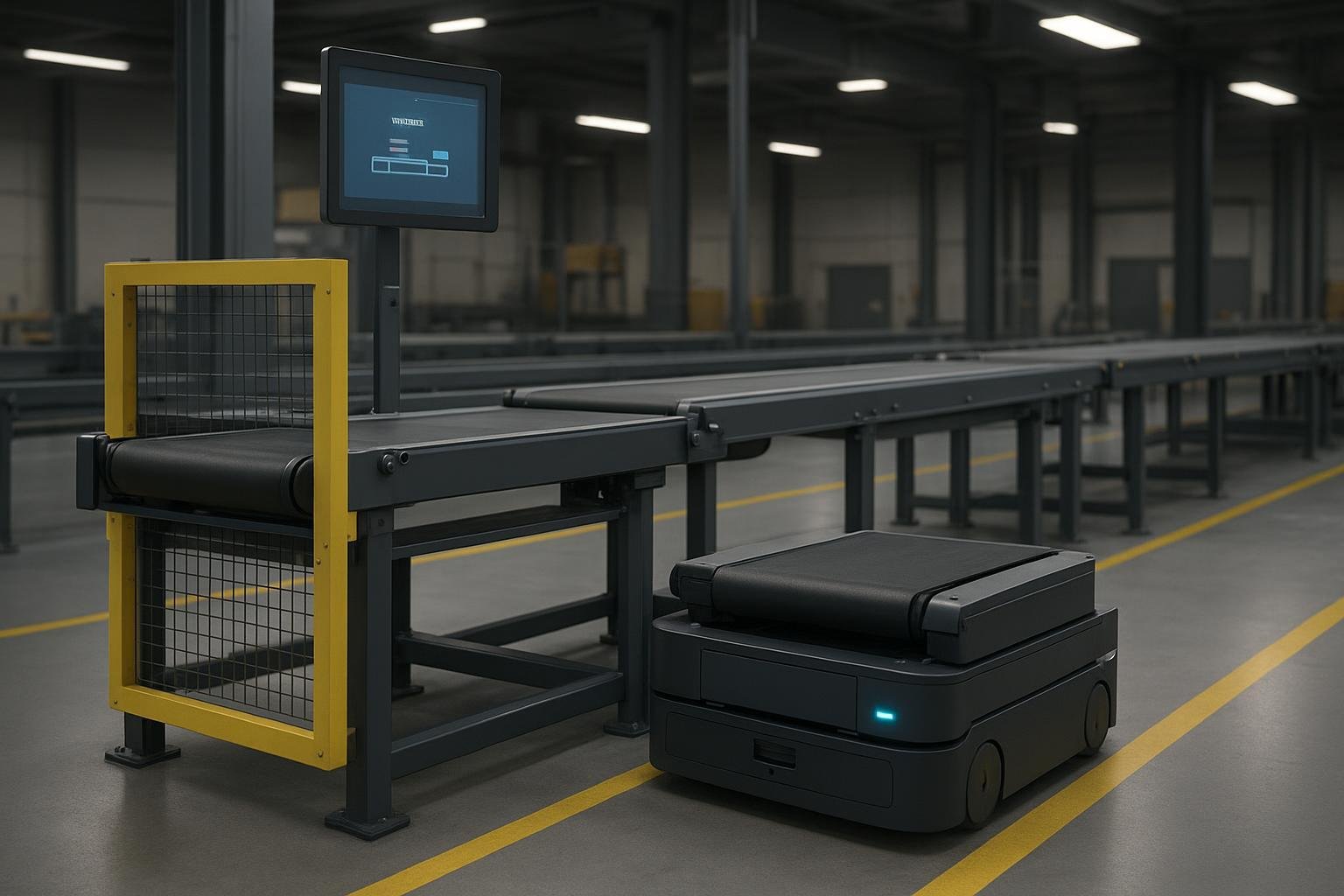
The biggest shift is architectural. Instead of long, monolithic lines, operations are reconfiguring into flexible “cells” that connect via autonomous mobile robots (AMRs). The critical moment is the handoff: a docked AMR must exchange loads with a stationary conveyor reliably, without nudges, retries, or jams.
Mechanically, you’ll see AMR “top modules” that mirror stationary conveyor surfaces. Chain-driven live roller (CDLR) toppers suit pallets and heavier units, while belt toppers provide full-surface support for cases and totes. Pop-up transfers and diverters handle lateral moves and gapping. Controls-wise, the handoff is a handshake between the AMR mission controller and the facility PLC: position reached, interlocks confirmed, conveyor run signal issued, speed synchronized, transfer complete, and safe stop. Sensors—photo-eyes for presence, inductive for docking features, and LiDAR or cameras for fine alignment—close the loop.
Vendors increasingly build the integration tissue. OTTO Motors, for example, describes centralized integrations that link AMR fleets to MES/WMS via open APIs and to PLCs via OPC UA, coordinating missions, intersections, and endpoints for safe, repeatable handoffs, as outlined in OTTO’s centralized integrations brief (2024). Vertical reciprocating conveyors (VRCs) also enter the picture to span floors: PFlow details load classes from light tote lifts to heavy-duty units, with gates, guarding, and WMS-coordinated in‑feed/discharge—a practical backbone for multi-level AMR–conveyor flows per PFlow’s VRC integration guidance (2024).
The throughline? Precision docking, clear I/O contracts between mobile and fixed assets, and a well-defined safe state if anything goes out of bounds.
Safety in mixed traffic
When mobile robots and conveyors share space, safety is a design parameter, not an afterthought. ISO 3691-4 (updated in 2023) is the core global standard for driverless industrial trucks like AMRs, covering risk assessment, protective stop functions, and person detection fields. Recognized summaries emphasize performance level requirements and operating modes; see this ISO 3691-4 update overview (2024) for scope and changes. In U.S. facilities, OSHA requirements still apply to conveyors—machine guarding for nip points and rotating parts under 29 CFR 1910.212 and lockout/tagout for service/maintenance under 1910.147.
What does that mean on the floor? Define guarded transfer zones where an AMR docks; interlock gates or light curtains with the conveyor run signal; enforce speed and approach limits for the AMR; and design HMIs that make status and alarms obvious. Run a documented risk assessment that covers human–robot interactions, maintenance access, and emergency stops. Then test with mixed traffic during commissioning to validate stop distances, sensor coverage, and fault recovery.
Belts, idlers, and pulleys tuned for robots
A robot-ready conveyor isn’t just about controls. Mechanics matter at the handoff.
-
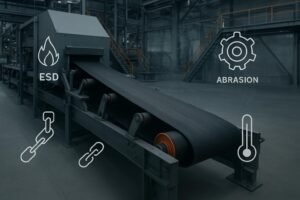
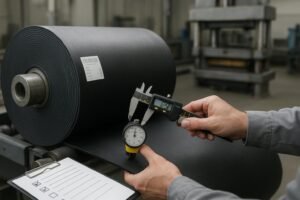
Belt carcass and cover: Choose carcasses (EP/NN fabrics for versatile plant use; steel cord for long runs and high loads) that maintain track under the start/stop cycles common in robot-served cells. Cover compounds and surface textures influence grip and release—smooth covers for low-friction transfers, patterned or chevron surfaces for inclines, and sidewalls for steep angles. In ESD-sensitive electronics or food, choose specialty covers.
-
Surface behavior: AMR-to-conveyor transfers benefit from predictable coefficients of friction. A belt that’s too slick can cause rejections; too grippy can snag. Calibrate by test-running typical payloads at the intended speeds and accelerations.
-
Idlers and alignment: Low-rolling-resistance idlers reduce energy and heat—important for frequent stop/starts—and self-aligning idlers help keep tracking stable, minimizing edge wear that can foil optical alignment systems.
-
Pulleys and lagging: Start/stop duty and VFD speed profiles place different demands on drive pulleys. Appropriate lagging (rubber or ceramic) sustains traction without over-tensioning. Ensure crown and wrap angles match your torque and duty cycle.
The goal is a belt path that stays stable across variable speeds and frequent transfers, so the robot “sees” a consistent, forgiving interface.
Reliability by design: predictive maintenance that actually works
Robots add flexibility, but they don’t remove the need for classic reliability engineering. In fact, higher orchestration makes unplanned conveyor stops even more disruptive. The answer is instrumenting your conveying assets and turning signals into action.
A practical sensor stack includes vibration and temperature on idler bearings and motors; acoustic monitoring for bearing faults; belt tracking sensors at transitions; and motor current draw to catch jams or drag. Wireless nodes and gateways make it feasible to cover dozens of points without rewiring. Analytics then trend baselines, detect anomalies, and prioritize interventions.
The results vary by site, so be wary of headline numbers without context. Instead, build your own before/after baseline: MTBF, MTTR, downtime hours by cause, and “handoff fails per 10,000 transfers.” Use those metrics to tune PM intervals, spares stocking, and alarm thresholds. If you’re piloting new sensor platforms, begin on the highest-risk zones—docks, merges, and curves near robot cells—so any early wins translate directly into smoother human–robot operations.
Energy efficiency for robotic facilities
Robotic-era lines run differently: more frequent stop/starts, variable speeds, and islanded cells that spool up on demand. That changes the energy math.
Mechanical levers can deliver reliable, measurable savings. Low-rolling-resistance cover compounds are designed to cut indentation rolling resistance; for example, Fenner Dunlop’s PowerSaver line describes applications where energy consumption drops versus standard covers, with savings dependent on duty and idler condition, as noted in Fenner Dunlop’s PowerSaver overview. Lightweight carcasses and precision-sealed idlers reduce drag further. On the controls side, variable-frequency drives (VFDs) match speed to load and enable demand-driven logic so idle sections don’t run. Tie it together by metering: log kWh by zone, correlate with throughput, and verify that control logic changes actually deliver off-peak reductions without hurting cycle time.
Think of it this way: every watt you don’t waste as heat in belt/roller friction is a watt your AMR fleet doesn’t have to wait on at the next handoff.
Practical micro‑example and a short checklist
Divulgación: BisonConvey es nuestro producto.
In a retrofit cell feeding palletizing, a facility replaces a legacy straight run with a short, VFD-driven belt conveyor section and a guarded AMR docking bay. The conveyor uses an EP fabric belt with a smooth cover for clean releases, low-rolling-resistance idlers to limit heat during frequent starts, and a ceramic-lagged drive pulley to maintain traction at reduced tension. The AMR’s topper mirrors a belt surface. The PLC and AMR controller exchange a simple I/O contract: “dock in position,” “guard closed,” “conveyor run,” “transfer complete,” and “clear.” Post-commissioning metrics show fewer transfer retries and a small but measurable kWh reduction during low-throughput windows. BisonConvey components—belts, idlers, and pulleys selected to the cell’s duty profile—fit within this pattern and are sized by width, strength rating, environment, and quantity, available via BisonConvey.
A quick, role-agnostic checklist to de‑risk AMR–conveyor integration:
- Define the handoff sequence and I/O (signals, timeouts, safe states) before hardware shows up.
- Select belt surfaces for predictable grip/release at your target speeds and accelerations.
- Specify low-rolling-resistance idlers and appropriate pulley lagging for start/stop duty.
- Guard docking zones; interlock access points; validate with a documented risk assessment.
- Instrument critical points (vibration, temperature, tracking) and baseline MTBF/MTTR/kWh.
- Pilot VFD logic for demand-driven starts; measure energy and throughput before and after.
References cited in text
- IFR (2025): Global robot demand update — see linked press release in the first section.
- MMH (2025): Industry Outlook Survey — see linked survey in the first section.
- OTTO Motors (2024): Centralized integrations brief — see link in AMR–conveyor handoffs.
- PFlow Industries (2024): VRC integration guidance — see link in AMR–conveyor handoffs.
- ISO 3691-4 (2023/2024 summaries): See link in Safety section.
- Fenner Dunlop PowerSaver cover compound: See link in Energy section.
Change‑log
- 2025-12-18: Initial publication with 2024–2025 adoption data (IFR) and integration examples (OTTO Motors, PFlow), safety references (ISO 3691-4), and energy measures (Fenner Dunlop). Next review by 2026-03-31.