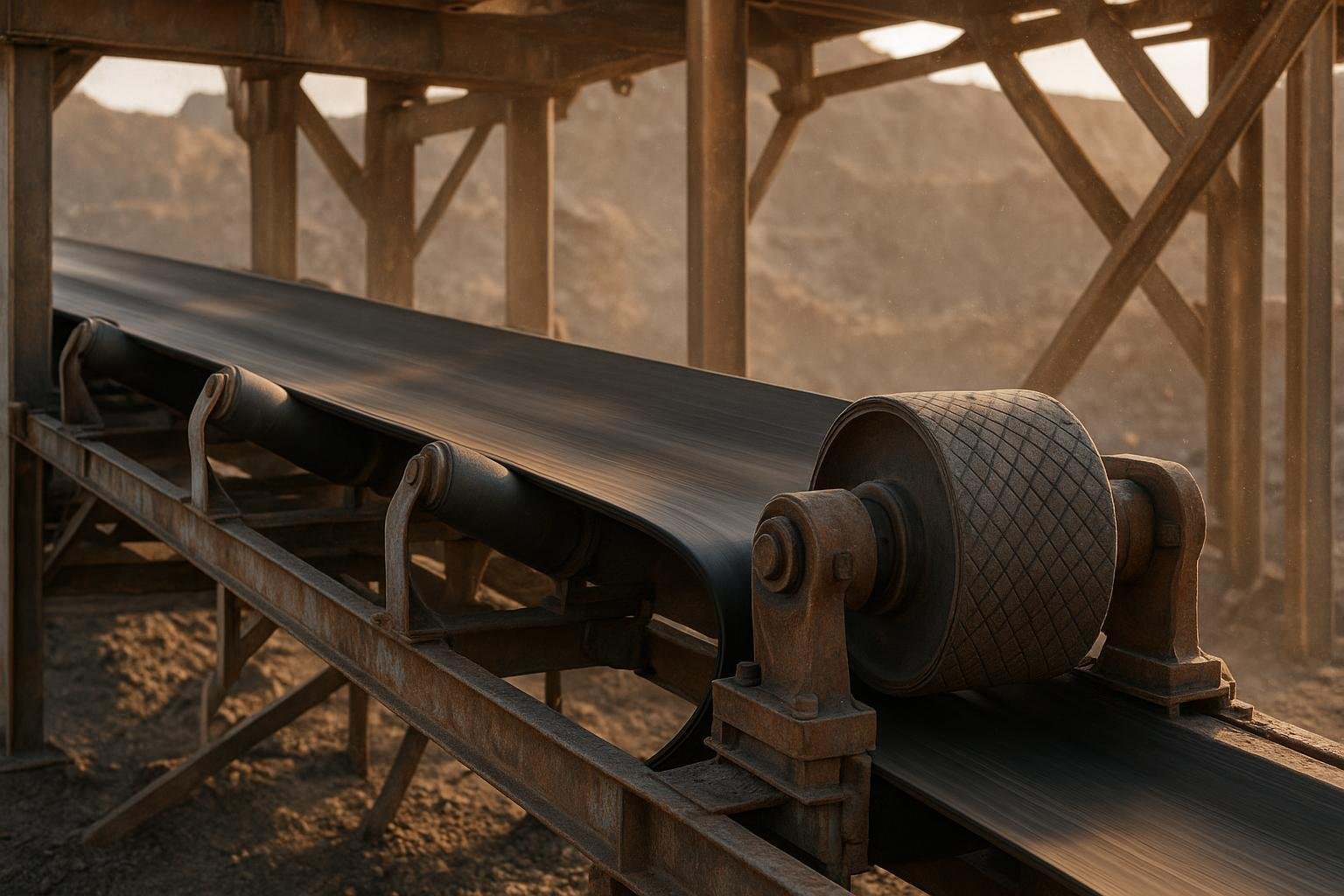
Keeping a conveyor belt centered isn’t just about neat lines—it’s the difference between smooth shifts and emergency shutdowns. When the belt wanders, edges fray, spillage increases, structures take a beating, and friction can even create dangerous heat at seized components. This guide explains how belt tracking systems work, what truly causes belts to drift, and how to fix and prevent it with a balanced mix of geometry, loading discipline, and well-placed devices—always within the context of recognized standards and safe work practices.
How Belt Tracking Systems Work
At its core, tracking is about keeping the belt running on its intended centerline. Think of the belt as a long, flexible beam under tension. If forces on the left and right sides aren’t balanced—because of misaligned idlers, uneven traction at the drive, or off-center loading—the belt will “steer” toward the side with more friction or shorter effective path. Trough geometry, idler squareness, and pulley alignment all shape these forces.
Here’s the simple analogy: picture steering a canoe. A slightly stronger paddle stroke on one side nudges the canoe to the other side. On a conveyor, a skewed idler or a crowned/lagged pulley with uneven contact acts like that extra paddle stroke, calling the shots on belt direction. Belt tracking systems—ranging from self-aligning/training idlers to dedicated belt trackers and crowned pulleys—apply controlled, corrective steering while you work to keep upstream geometry and loading disciplined.
Physics shows up in three ways operators can manage:
- Geometry: Squared idler frames, parallel pulleys, and true string-line/laser alignment reduce asymmetric drag.
- Loading: Centered, consistent loading minimizes lateral moments that push the belt sideways.
- Traction: Adequate, uniform grip at the drive (via lagging and proper tension) prevents one side from slipping and “pulling” the belt off-line.
Authoritative industry resources emphasize getting the basics right before leaning on devices. For a practical foundation on how adjustments propagate and why centered loading matters, Martin Engineering’s knowledge pages on training belts provide accessible explanations and field cues in 2024–2026 publications; see the discussion in the article on training the conveyor belt (2026 update).
Common Causes of Mistracking (and How to Confirm Them)
Belt drift is rarely a mystery when you walk the line methodically. Typical culprits include off-center loading, skewed or worn idlers, misaligned pulleys or structures, incorrect belt tension, sticky carryback that re-weights one side, splice defects, wind or thermal effects, and even subtle frame deformations. Industry overviews catalog these issues with practical checks; two concise starting points are Redline Systems’ cause-and-solution articles from 2023–2025 and Martin Engineering’s problem-solved notes from 2023 onward. For accessible primers, see Redline Systems on conveyor mistracking causes and solutions (2025 update) and the Martin case note on belt misalignment causing structural and belt damage (2023).
To confirm causes quickly, observe the belt entering and leaving each pulley and watch the loading zone under different feed rates. Sight along idler strings or use a laser to verify squareness, check return rollers for buildup or seized bearings, and inspect splices for bias or thickness steps. These simple field checks often pinpoint which side is generating extra friction and steering the belt.
Components of Belt Tracking Systems
Self-aligning/training idlers and belt trackers
Self-aligning or “training” idlers sense lateral position and generate a restoring steering force by pivoting the roll or frame. More robust belt trackers add guide rolls, sensing geometry, or heavy-duty pivots to correct drift rapidly, both on the return and carry side. Correct placement matters as much as the device itself: manufacturers aligned with CEMA principles advise placing return-run units well ahead of points where correction is needed and keeping them clear of pulleys and the loading zone. Martin Engineering’s tracker documentation summarizes practical placement logic and maintenance, emphasizing observation and avoiding overuse; see the product manual for the Martin Tracker series for installation spacing and service cues in this 2025 PDF manual, and an earlier heavy-duty variant in this 2024 resource.
Key reminders from field practice:
- Start with structure and loading. Trackers aren’t a substitute for a square, clean conveyor.
- Favor low-tension zones on the return run for the first line of correction; add carry-side devices beyond the loading zone only if needed.
- Space multiple devices judiciously; too many can “hunt” the belt and accelerate wear.
Crowned and lagged pulleys
Crowns introduce a slight diameter increase toward the centerline, encouraging the belt to center itself. Lagging (rubber or ceramic) improves traction, with ceramic adding grip and wear resistance in wet or abrasive conditions. Because current open sources seldom publish numeric crown rise guidance, avoid rules of thumb without an OEM or CEMA-backed specification. The role is qualitative: enhance traction and provide a centering tendency at stable, well-aligned drives and snubs. For a current overview of lagging choices and their traction roles in industrial service, refer to Kinder’s 2024 pulley and lagging overview, summarized in this conveyor pulleys article (2024).
Edge guides and limiters
Edge-contact devices can protect belt edges in the short term and help prevent catastrophic contact with structure, but they don’t cure root causes. Use them as safeguards while you correct geometry, loading, tension, and housekeeping. In practice, edge guides pair best with methodical alignment work and, where appropriate, a small number of well-placed trackers.
Manual Tracking and Troubleshooting — A Practical Workflow
Here’s a structured, technician-friendly approach you can apply across shifts. It assumes proper lockout/tagout and guarding in place for any work that exposes hazards.
- Stabilize the environment
- Clean return rollers, pulleys, and the loading zone. Remove carryback and buildup that drags one side.
- Verify belt cleaners are functioning and not applying lateral force.
- Verify geometry from the ground up
- String-line or laser the conveyor centerline. Square idler frames to the line; equalize troughing angles. Correct obvious skew before touching trackers.
- Confirm pulleys are parallel and in-plane. If you lack a laser, use a precision level and diagonal measurements to bracket alignment.
- Center the loading
- Observe the material stream at multiple feed rates. Adjust chute lips, skirts, and impact idlers so the burden lands on the centerline with even wing loading.
- Set proper tension and traction
- Check take-up travel and tensioning method. Underset tension or a slick drive side can create asymmetric slip. Rubber or ceramic lagging improves uniform traction when the drive is aligned and bearings are healthy. For quick refresher tips on tension checks, see Redline’s 2023 tension guide.
- Address local drift with trackers if needed
- Install a return-run self-aligning idler or tracker upstream of the drift zone, keeping it a safe distance from pulleys. Start with one device; add a second only after observing stability.
- For carry-side issues beyond the loading zone, consider a carry-side tracker, but revisit step 3 first.
- Inspect splices and stiffness transitions
- A biased or stepped splice can nudge the belt. Verify alignment, thickness uniformity, and adhesion; correct or rebuild if defects are found.
- Observe, document, and iterate
- After each change, run loaded and unloaded, at low and high flow. Note the belt path entering/exiting pulleys and the return line. Adjust gradually; small tweaks have outsized effects several idler spaces downstream.
Automation and Sensorized Trackers
Where loads vary, conditions change quickly, or the cost of a spill is high, automated trackers and sensorized correction systems can reduce constant manual intervention. These systems monitor belt position and apply rapid steering inputs, helping keep belts centered through transients. Trade coverage has highlighted increased responsiveness and labor savings when automation complements good mechanical discipline. For a recent overview, see the Canadian Mining Journal’s feature on a highly responsive tracker in this 2024 article.
In practice, automation pays off when:
- The conveyor sees frequent rate changes, wet/dry transitions, or variable burden profiles.
- The consequence of a spill (cleanup time, product loss, safety risk) outweighs the added device complexity.
- You can integrate status signals into PLC/SCADA to alarm on out-of-band drift and document interventions.
Still, automation isn’t magic. It works best on top of squared structure, centered loading, and clean, freely rotating rolls.
Maintenance and Inspection Cadence for Belt Tracking Systems
You don’t keep belts tracking by “set and forget.” Small degradations—dust rings on returns, a skewed idler knocked by a loader bucket, a tired take-up—accumulate until you’re chasing a chronic wander. A layered cadence helps you catch drift before it bites.
Suggested cadence (adjust by duty cycle and criticality):
- Per shift at critical zones: Observe belt path at loading, head, and tail; scan for buildup; listen/feel for rough idlers. Document any drift direction and magnitude cues.
- Weekly: Verify idler squareness on problem segments; check take-up travel; inspect cleaners and skirts; audit tracker operation (free pivoting, no binding).
- Monthly: Laser or string-line spot-checks on long runs; inspect splices for bias or thickness steps; assess lagging wear and traction under load.
For a compact reference on where problems tend to hide, Martin Engineering’s inspection article outlines nine critical points maintenance teams should revisit routinely; see the 2024 inspection points primer.
Two quick discipline tips:
- Housekeeping is not cosmetic. Carryback on one wing re-weights the belt and drags it sideways—then heats up idlers from friction.
- Change one thing at a time and log it. When the belt behaves, your notes become the site’s playbook.
A simple inspection planner (example)
| Interval | Focus areas | What “good” looks like |
|---|---|---|
| Per shift | Loading zone, head/tail approach, return run | Centered burden, no lateral rub, clean returns, steady belt edge relative to structure |
| Weekly | Idler squareness, take-up travel, cleaners/skirts, tracker freedom | Squared frames, adequate travel margin, even cleaner pressure, tracker pivots free |
| Monthly | Alignment spot-checks, splices, lagging, structure | Centerline within site tolerances, unbiased splices, lagging with uniform wear, no frame creep |
Standards and Safety Context You Should Know
Two standards families shape good tracking practice for belt tracking systems: installation/alignment guidance from CEMA and belt construction tolerances from ISO. While the definitive numbers live behind paywalls, you can still anchor your program to their principles and cite official sources in documentation.
- CEMA installation guidance: Appendix D of the 7th edition covers installation/alignment practices for pulleys and idlers and emphasizes getting geometry and centered loading right so training devices play a supporting role. See the official listing for Appendix D at CEMA’s store page (7th ed., Appendix D), and a public committee agenda packet referencing these tolerances at CEMA’s 2023 FEC materials.
- ISO dimensional standards: ISO 14890 (textile belts) and the ISO 15236 series (steel cord belts) specify belt dimensions and tolerances that support consistent tracking by controlling camber, width, and thickness variation. See ISO’s official catalog and OBP index via the ISO catalogue for conveyor belts y the ISO OBP index. A 2024 technical clip from Martin Engineering’s publications also references an ISO allowance for belt wander on correctly aligned, centered-load conveyors; consult this World Fertilizer 2024 excerpt%20Oct,%202024.01.pdf) for context and practitioner framing.
Safety framing (not legal advice): Any inspection or adjustment that exposes moving parts or de-guards equipment must follow your jurisdiction’s rules on guarding and hazardous energy control.
- OSHA context for general industry: 29 CFR 1910.212/219 address guarding rotating/nip points and power-transmission apparatus; 1910.147 sets lockout/tagout requirements during servicing. See OSHA’s 2023 interpretive reference in this letter of interpretation.
- MSHA context for mines: Guarding of pulleys/heads/tails is codified in 30 CFR 75.1722, and repeated safety alerts stress de-energizing, locking/tagging out, and blocking against motion before work on conveyors. Start with the eCFR guard requirement page and MSHA’s recent conveyor safety alert on LOTO and blocking (2024).
Practical Retrofit Example (Neutral)
A port conveyor handling variable-moisture bulk sees periodic drift on the return run during wet weather. The crew has already squared structure and centered loading, but transients still nudge the belt on acceleration. The team adds one return-run self-aligning idler upstream of the tail and replaces the drive pulley lagging with ceramic tiles to stabilize traction under wet conditions. The combination dampens transient drift and shortens recovery time when the load profile changes.
In deployments like this, a manufacturer such as BisonConvey can supply the self-aligning idler assembly and a ceramic‑lagged drive pulley sized to the existing shaft and face width. The example aligns with CEMA-style placement logic (favor return-run correction ahead of pulleys, avoid overuse) and respects the principle that devices support—rather than replace—good geometry and loading discipline. In short, belt tracking systems earn their keep when they complement sound alignment and housekeeping.
Prioritize Your Next Steps
If you’re inheriting a conveyor with a tracking history, here’s the order of operations that prevents firefighting. Geometry and housekeeping come first: square the idlers, align the pulleys, clean everything that turns, and verify centered loading at multiple rates. If this alone doesn’t calm the belt, add minimal, well-placed tracking devices—start with a return-run unit upstream of the problem area, observe under load, and add a second device only if the belt still wanders; consider carry-side units beyond the loading zone only after the chute is corrected. When variability rules the day, consider sensorized belt tracking systems integrated with PLC/SCADA to correct drift quickly and alarm on out-of-bounds movement. Document as you go; a concise log of what changed, where, and how the belt responded becomes the playbook that keeps nights and weekends quiet.
Closing Thoughts
Belt tracking isn’t a single adjustment; it’s a system behavior you shape with alignment discipline, centered loading, clean, free-rolling components, and just enough corrective hardware to keep things steady when the world gets messy. Start with the geometry you can prove, watch the belt at the critical transitions, and make small, deliberate moves. The result is fewer stops, fewer surprises, and a belt that runs where it should—shift after shift.